Posted On:
08 APR 2026 4:53PM by PIB Delhi
In a significant step towards advancing Aatmanirbhar Bharat and the vision of Viksit Bharat @2047, the Indian Council of Agricultural Research (ICAR) is spearheading transformative research in conservation agriculture and climate-resilient wheat and barley systems to strengthen national food security, fuel self-reliance, climate resilience and sustainable livelihoods.
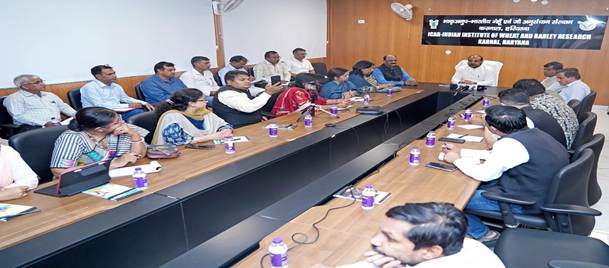
Dr. M. L. Jat, Secretary, Department of Agricultural Research and Education (DARE) and Director General, ICAR, today visited the ICAR–Indian Institute of Wheat and Barley Research (IIWBR) and ICAR–Central Soil Salinity Research Institute (CSSRI), Karnal, to review ongoing research and development initiatives. A media team from Delhi also accompanied the visit.
During the visit, Dr. Jat reviewed key research activities aimed at enhancing productivity, reducing input costs, and improving resilience to climate variability in the Indo-Gangetic Plains, while emphasizing the importance of advancing climate-resilient and resource-efficient agricultural practices.
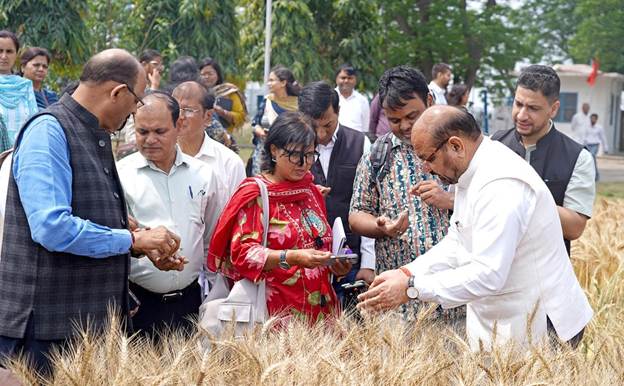
Highlighting India’s preparedness in wheat production, Dr. Jat stated that the country is well-prepared and expects higher output this year, ensuring both domestic food security and the ability to support other countries in the current global scenario. He further emphasized that ICAR’s focus remains on developing climate-resilient and nutrient-rich crop varieties to address climate challenges while improving farmers’ incomes and public health. He also underlined that innovations such as Biological Nitrification Inhibition (BNI) are enabling reduction in fertilizer use by up to 25 percent without compromising productivity, benefiting both farmers and the environment.
India’s agricultural sector, which transitioned from food insecurity to surplus production in the post-Green Revolution era, is now being reoriented to address emerging challenges such as groundwater depletion, crop residue burning, soil degradation, biodiversity loss, and climate-induced risks. Some of these projects are being implemented in collaboration with CIMMYT, BISA, and JIRCAS.
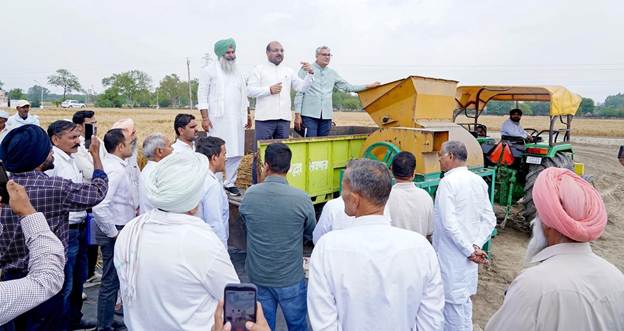
To address these priorities, ICAR, in collaboration with the International Maize and Wheat Improvement Center (CIMMYT), has been leading a long-term, systems-based research platform since 2009 at CSSRI, Karnal, focusing on locally tailored, climate-resilient and resource-efficient cropping systems, particularly the maize-wheat production system.
This conservation agriculture platform has generated significant outcomes, including up to 85 percent savings in irrigation water, 28 percent reduction in fertilizer use, 51 percent savings in fuel consumption, and up to 95 percent reduction in crop residue burning. It has also contributed to a 46 percent reduction in greenhouse gas emissions, up to 33 percent increase in system productivity, and nearly doubling of household incomes, thereby strengthening national food and nutrition security while reducing dependence on external inputs and volatile global markets.
The initiative has also demonstrated strong ecological benefits, with soil microbial populations and organic carbon levels doubling within 15 years, improving soil health, climate resilience and supporting national commitments towards carbon neutrality and One Health goals. The platform has emerged as a hub for international collaboration, with research published in over 50 high-impact journals including Nature and Science, and findings informing policies on crop diversification, water conservation, residue management and mechanization.
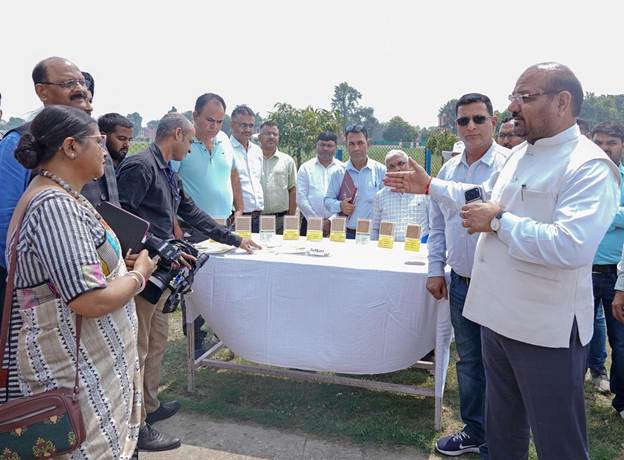
During the visit, Dr. Jat also reviewed the Indian Wheat Rust Research and Surveillance Programme, which plays a critical role in protecting wheat crops from stripe, leaf, and stem rust diseases through coordinated monitoring, rapid diagnostics, and timely advisories. Long-term surveillance has established predictable patterns of yellow rust occurrence in regions such as Ropar (Punjab) and Yamunanagar (Haryana), strengthening early warning systems. A nationwide network of over 30 institutions and Krishi Vigyan Kendras supports surveillance across nearly 10 million hectares, with more than 1,000 advanced wheat lines evaluated annually for resistance.
Progress in BNI-enabled wheat development was also reviewed, highlighting its role in improving nitrogen use efficiency by reducing losses due to leaching and emissions. Research integrating breeding, genomics, and multi-location evaluation is underway, with 19 promising wheat lines currently under evaluation at 70 percent of recommended nitrogen levels. It is estimated that adoption on 25 percent of cultivated area, along with a 30 percent reduction in nitrogen application, could result in annual savings of approximately ₹2,000 crore.
Dr. Jat further reviewed pre-breeding programmes utilizing wild relatives such as Aegilops, including Aegilops tauschii, to introduce traits for tolerance to drought, heat, salinity, and diseases. These efforts are crucial for developing climate-resilient wheat varieties capable of addressing future challenges and ensuring long-term food security.
In the area of nutritional security, ICAR has released 55 biofortified wheat varieties enriched with iron, zinc, and protein. Nearly 45 percent of the wheat cultivation area is now under biofortified varieties, reflecting increasing farmer adoption and a high varietal replacement rate.
Dr. Jat also reviewed conservation agriculture practices such as zero tillage, residue retention, and mechanized sowing technologies, which have demonstrated improvements in system productivity by 6–10 percent, along with significant gains in soil organic carbon and savings of up to 70–75 percent in fuel and time.
Barley research and development at IIWBR was also assessed, highlighting its importance as a climate-resilient and resource-efficient crop. With lower water and fertilizer requirements and increasing demand in food, feed, and industrial sectors, barley is emerging as a key component of sustainable agriculture, particularly due to its high dietary fibre content and role in health-focused food products.
By integrating scientific innovation with field-level implementation, ICAR continues to empower farmers, strengthen rural economies, and create sustainable livelihood opportunities for women and youth, reinforcing India’s commitment to resilient, self-reliant and sustainable agriculture.
****
RC/MS