PIB Backgrounder
AI and Climate Action in India
Innovations, and a Path to Sustainability
प्रविष्टि तिथि:
16 FEB 2026 3:09PM by PIB Delhi

Key Takeaways
- The India-AI Impact Summit 2026 is the first global AI summit being hosted in the Global South.
- It is anchored in three pillars People, Planet, and Progress with a focus on AI for inclusive, sustainable development.
- These pillars are put into practice through AI-driven climate and disaster resilience protecting lives, safeguarding ecosystems, and strengthening preparedness.
- At the grassroot level, AI-based weather forecasting now reaches nearly all villages, with Gram Panchayat-level coverage and the Bharat Forecasting System (May 2025) delivers high-resolution (6 km) predictions.
- AI is strengthening climate risk management by monitoring sea-level rise, and improving cyclone forecasts through Advanced Dvorak Technique.
Climate change is a pressing reality today, that affects practically every aspect of life and livelihood. As climate risks grow, proactive solutions are needed for adaptation and mitigation. India has made significant progress in this regard, increasing green cover, harnessing renewable energy, reducing emissions, addressing the challenge of extreme weather. In recent years Artificial Intelligence (AI) has emerged as a powerful tool that helps in this fight against climate change. Artificial Intelligence (AI) enables computers to learn from data and make decisions or predictions, much like humans do. Deep learning is a method within AI that helps computers learn better by analysing large amounts of information. When applied to climate studies, AI systems analyse climate related data and provide solutions for improved climate modeling, optimized renewable energy generation, solutions for sustainable agriculture, and enhanced disaster resilience.
Recognizing AI’s critical role in driving inclusive development, the India-AI Impact Summit 2026 is being held from February 16–20 at Bharat Mandapam, New Delhi. It is the first global AI summit hosted in the Global South. Built on three foundational pillars-People, Planet, and Progress- the summit focuses on AI's transformative potential across governance, innovation, and sustainable development.
AI-Enabled Early Warning and Disaster Risk Reduction
Advanced technology is reshaping how we predict weather patterns and prepare for natural disasters.
Forecasting System: Cyclone and Extreme Weather Modelling
India significantly enhanced its cyclone forecasting capacity through AI-assisted tools:
- Advanced Dvorak Technique is being used by the India Meteorological Department (IMD) and other government institutions to estimate cyclone intensity.
Cyclone Monitoring
IMD uses satellite-based AI tools to monitor tropical cyclones. The Advanced Dvorak Technique helps estimate intensity of cyclones. IMD also uses AI-based guidance from the European Centre for Medium-Range Weather Forecasting. These tools help predict when cyclones will form, where they will go, and how strong they will become.
- High-Power Computing Systems with 22 PetaFLOPS capacity have been installed by the Ministry of Earth Sciences. About 10% of this system uses special Graphics Processing Units for AI work. There are also separate GPUs dedicated only to AI and machine learning research in weather forecasting. These systems help develop better weather prediction models.
Under Research & Development
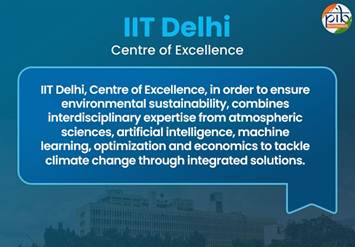
- Transformer-based neural networks developed by Indian researchers forecast monsoon behavior up to 18 days in advance.
- Comparative studies of global AI systems (including GraphCast, PanguWeather, Aurora, and FourCastNet) have demonstrated improved path prediction accuracy up to 96 hours ahead of cyclone landfall with 200-kilometer accuracy in seconds. These advancements are strengthening evacuation planning, and infrastructure protection.
- Spatially Aware Domain Adaptation Network (SpADANet)is developed by IIT Bombay. It is an AI model that improves cyclone and hurricane damage assessment from aerial images. The spatially aware model achieved over 5% better accuracy than existing methods in classifying damage levels using limited labeled data. It addresses key constraints faced by disaster agencies like NDMA-lack of labeled data, limited computing power etc. and enabling faster and reliable disaster response.
- Reliability Ensemble Averaging (REA) is used by IIT Madras to improve climate predictions for India. They combined 26 climate models and scored each based on accuracy in predicting current weather and future changes. Testing on four Indian cities (Coimbatore, Rajkot, Udaipur, and Siliguri) showed most models poorly predicted rainfall. However, REA provides much more reliable results, helping reduce uncertainty for climate planning in monsoon-prone regions.
- A Virtual Centre at Indian Institute of Tropical Meteorology (IITM) Pune develops AI-based application tools. IMD has created a special team to strengthen AI and machine learning research. IMD has signed agreements with IITs, NITs, ISRO, DRDO, and other institutions for AI research collaboration. Scientists receive training in AI through workshops and courses. IMD organizes a training course on AI and machine learning fundamentals every year in May.
Landslide, Flood and Glacial Monitoring
AI-driven early warning systems are also operational in vulnerable regions:
- An indigenous AI-based landslide early warning system provides alerts up to three hours before slope failures in Himalayan regions. The system uses low-cost sensors measuring soil moisture, rainfall, humidity, temperature, and ground displacement. Data feeds into a machine learning model with over 90% accuracy. Installed at more than 60 sites across Himachal Pradesh, it detects millimetre-level slope movements. Built with locally sourced components at a fraction of imported technology costs, the system strengthens disaster preparedness. It enables timely evacuations in India's landslide-prone areas.
- Indian Land Data Assimilation System (ILDAS), funded by ISRO (2021-24), estimates land surface states and floodplain inundation using coupled models and remote sensing data. Flood forecasting systems integrating physics-based modelling and AI techniques improve river basin management in the Ganga and Brahmaputra regions. BrahmaSATARK provides impact-based flood forecasts for the Brahmaputra Basin, while GBM-CLIMPACT is a climate-impact toolbox assessing water sector readiness in the Ganga, Brahmaputra, and Meghna basins.
Together, these AI-enabled systems enhance early warning lead times, strengthen evacuation planning, reduce infrastructure losses, and safeguard vulnerable communities across climate-sensitive regions
Last-Mile Climate Intelligence: Reaching Communities
- Gram Panchayat Level Weather Forecasting (GPLWF)was launched by IMD in collaboration with the Ministry of Panchayati Raj. This service covers nearly all gram panchayats across India. It uses multiple weather prediction models simultaneously. Farmers can access these forecasts through apps like e-Gramswaraj, Meri Panchayat, and Mausam gram. The forecasts include temperature, rainfall, humidity, wind, and cloud information. This helps farmers make better decisions about planting, harvesting, and irrigation.
- Bharat Forecasting System (BharatFS) was launched by the government on May 27, 2025.This is an Indian-built weather prediction model. It provides very detailed forecasts at the village level. BharatFS has 6km resolution, which is better than the previous 12km resolution. It can predict rainfall up to 10 days in advance. This helps farmers, disaster managers, and the public to prepare better.
Emerging AI tools for Climate and Weather
- MausamGPT (Generative Pre-trained Transformer), an AI chatbot, is being developed by the government to advise farmers and others about climate and weather. The government is conducting AI research in forecasting and predicting rainfall patterns. AI is being used to forecast fires, fog, lightning, and thunderstorms. Deep learning helps improve rain predictions in weather systems.
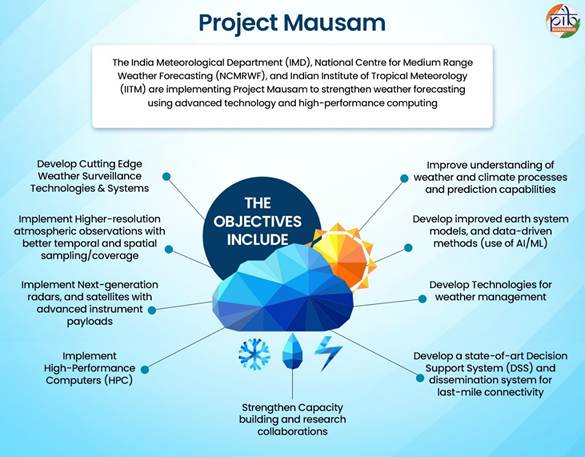
- Coastal and sea level monitoring using AI helps India to prepare for climate risks. Along India's coastlines, AI checks which areas might be affected by rising sea levels. This helps city planners design better cities that can handle these changes. Communities can then prepare and protect themselves from future risks.
By democratizing access to high-resolution climate information, India is embedding resilience at the community level.
AI-Powered Forest Surveillance and Conservation
- AI protects Indian forests through advanced surveillance and monitoring technologies using Machine Vision (MV) and Artificial Intelligence to analyse real-time footage from cameras deployed around forest areas.
- AI serves as a robust early warning system for forest fires and the human activities that cause them, helping prevent or contain fires before they spread, which is critical since humans are responsible for 75% of all global wildfires.
- AI and MV-enabled cameras deployed along forest boundaries detect animals straying beyond forest areas, helping prevent human-wildlife conflicts that threatens forest ecosystem health.
- AI monitoring technologies detect illegal encroachment and felling activities in protected forest areas.
Integrated satellite, drone, and ground-sensor networks are strengthening conservation governance and safeguarding natural carbon sinks.
AI Innovations in Air and Water Risk Management
- Real-time air quality monitoring:
AIRAWAT Research Foundation of IIT Kanpur has signed an MoU with IIT Delhi to advance AI-driven research and solutions for sustainable cities. This collaboration focuses on critical urban challenges including air quality, energy, mobility, infrastructure, waste management, and digital governance. Key initiatives include developing AI-enabled sensor systems for real-time air and bioaerosol monitoring, aiming to build smarter, healthier, and more resilient cities through technology-driven innovations. By integrating multi-source urban data, AI contributes to building climate-resilient and environmentally sustainable cities.
- Groundwater and Drinking Water Risk Mapping
IIT Kharagpur researchers developed an AI-based prediction model to detect arsenic pollution in India's drinking water, addressing a crisis affecting millions along the Ganga banks. Using AI algorithms on environmental, geological, and human usage data, the team predicted groundwater arsenic distribution and health risks. They identified high and low arsenic zones across the delta region. The model shows a strong association of ‘surficial aquitard thickness’ and ‘groundwater-fed irrigation’ to regional-scale as-hazard. This framework helps identify safe drinking water sources in arsenic-affected areas like West Bengal and supports the government's Jal Jeevan Mission by enabling smarter groundwater source selection.
AI is transforming India's approach to environmental protection, paving the way for sustainable development and healthier communities.
India is advancing as a global leader in AI-driven climate solutions. The country has made institutional innovations and strong multilateral partnerships. India now provides village-level weather forecasts. These forecasts reach nearly every panchayat. The indigenous Bharat Forecasting System offers 6km resolution predictions. This democratizes climate information access across the country.The country has invested substantially in AI infrastructure. This includes 22 PetaFLOPS computing capacity. These investments show India's commitment to innovation and international cooperation. India is working towards its net-zero emissions goal by 2070. AI-powered solutions help in many areas. These include renewable energy optimization, sustainable agriculture, and disaster prediction. These are not just technological achievements. They are essential tools for building climate resilience. India is proving that AI can be a powerful tool in fighting climate change. This is especially important for vulnerable communities in the Global South.
References:
India AI
https://indiaai.gov.in/article/ai-and-climate-action-in-india-a-strategic-perspective-in-2025
https://indiaai.gov.in/article/the-intersection-of-ai-and-climate-change-innovations-for-a-sustainable-future
https://indiaai.gov.in/case-study/ai-based-prediction-model-for-detecting-arsenic-in-india-s-drinking-water
https://indiaai.gov.in/article/iit-bhubaneswar-developed-an-ai-model-to-enhance-rain-forecast-accuracy
Press Information Bureau
https://www.pib.gov.in/PressReleasePage.aspx?PRID=2216805 &r
https://www.pib.gov.in/PressReleasePage.aspx?PRID=2158416®=3&lang=2
https://www.pib.gov.in/PressReleasePage.aspx?PRID=2158416®=3&lang=2#:~:text=On%2027%20May%202025%2C%20the,the%20short%20and%20medium%20range.
Indian Institute of Technology
https://acr.iitm.ac.in/iitm_in_news/researchers-at-iit-madras-come-up-with-climate-model-for-indian-regions/
https://iitk.ac.in/kss/index.php/mou/34-sign-mou-with-iit-delhi
https://www.iitb.ac.in/research-highlight/novel-spatially-aware-ai-model-makes-hurricane-damage-assessment-more-accurate
https://dcecm.iitd.ac.in/
https://home.iitd.ac.in/show.php?id=71&in_sections=Research#:~:text=New%20Delhi:%20Two%20recent%20studies,resource%20management%20across%20South%20Asia
https://hydrosense.iitd.ac.in/research/
Department of Science and Technology
https://dst.gov.in/satellite-based-real-time-monitoring-himalayan-glacial-catchments-can-strengthen-early-flood-warning
Ministry of Earth Sciences
https://www.moes.gov.in/schemes/mission-mausam
https://mausam.imd.gov.in/event/mission_mausam.pdf
Niti Aayog
https://frontiertech.niti.gov.in/story/low-cost-indigenous-sensors-ai-deliver-real-time-landslide-alerts-across-himalayan-slopes/
Other
https://www.investindia.gov.in/team-india-blogs/role-technology-protection-forests-climate-change-mitigation
https://www.digitalindia.gov.in/initiative/global-partnership-on-artificial-intelligence/
Click here to see pdf
****
PIB Research
(रिलीज़ आईडी: 2228662)
आगंतुक पटल : 5191