Ministry of Railways
Indian Railways’ Safety Measures Yield Results: 58% Drop in Signalling Failures Contribute to Sharp Decline in Accidents
Enhanced Safety Measures Result in 66% Decline in Railway Staff Deaths During Track Maintenance
Indian Railways Pays ₹30.75 Crore as Ex-Gratia and ₹23.53 Crore as Compensation to Next of Kin in Train Accidents from 2022–23 to 2024–25
Posted On:
06 FEB 2026 6:32PM by PIB Delhi
Modernization of Signalling System Infrastructure
Indian Railway is continuously modernizing current infrastructure of its signalling system as under :
1. To improve reliability, Electrical/Electronic Interlocking Systems with centralized operation points and signals in place of old mechanical signalling have been provided at 6660 stations as on 31.12.2025.
2. Interlocking of Level Crossing (LC) Gates has been provided at 10,097 Level Crossing Gates up to 31.12.2025 for enhancing safety at LC Gates.
3. Complete Track Circuiting of stations to enhance safety by verification of track occupancy by electrical means has been provided at 6,665 stations up to 31.12.2025.
4. Axle counters for automatic clearance of Block Section, BPAC (Block Proving Axle Counter) are provided to ensure complete arrival of train without manual intervention before granting line clear to receive next train and to reduce human element. These systems have been provided on 6142 Block Sections up to 31.12.2025.
5. Automatic Block Signalling (ABS) that enhances line capacity within existing track infrastructure has been provided at 6625 Route km upto 31.12.2025.
6. Other reliability enhancement measures by embedding redundancies into the various signalling systems are being incorporated viz
(i) provision of dual detection systems,
(ii) redundancy in power supplies and
(iii) redundancy in transmission media etc.
7. Provision of power operated lifting barriers at interlocked level crossing gates with sliding boom to enhance reliability for improvement in train operation.
8. Signalling assets maintenance are planned & under taken during Rolling Block introduced in Indian Railways (Open Lines) General Rules vide Gazette notification dated 30.11.2023, wherein work of integrated maintenance/repair/replacement of assets is planned up to 52 weeks in advance on rolling basis and executed.
9. Detailed instructions on issues related with safety of Signalling, e.g. mandatory correspondence check, alteration work protocol, preparation of completion drawing, etc. have been issued.
10. System of disconnection and reconnection for S&T equipment as per protocol has been re-emphasized.
11. Regular counseling and training of staff is undertaken.
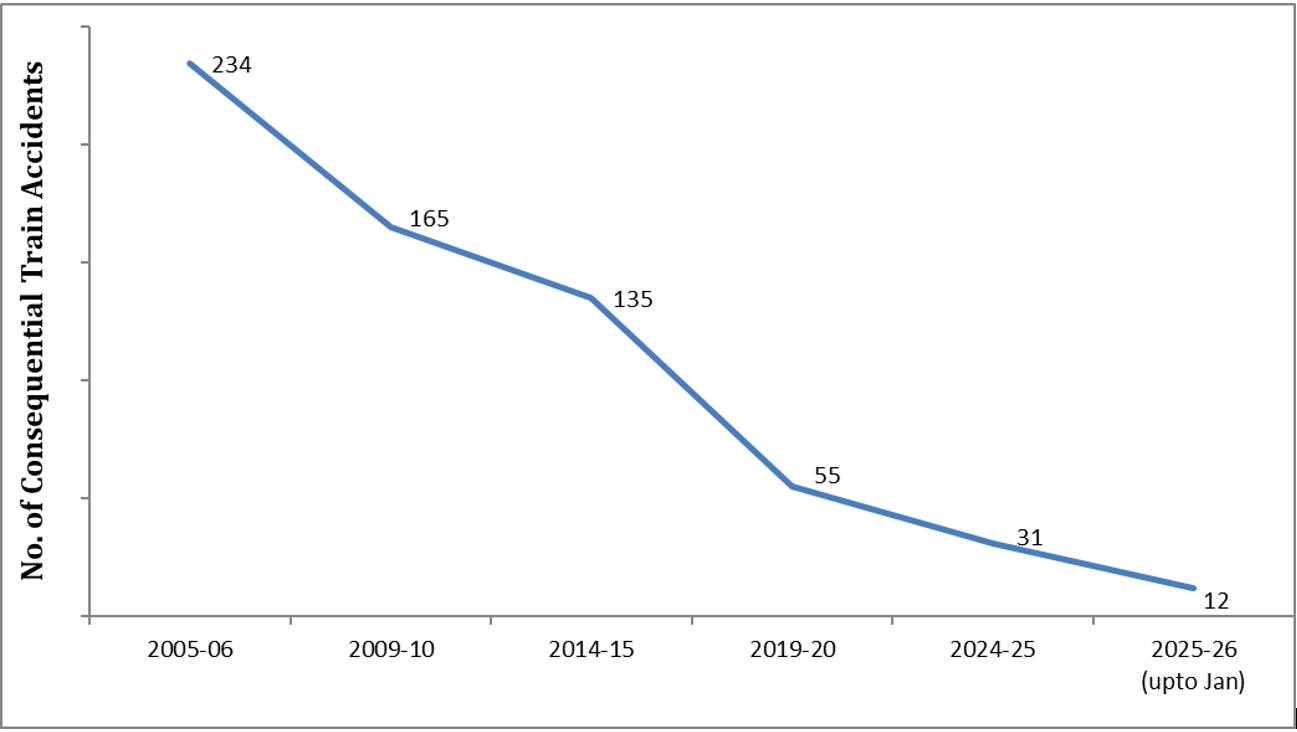
In view of the above measures, signalling failures has reduced by about 58% during last 11 years. Further, as a consequence of various safety measures taken over the years, there has been a steep decline in the number of accidents.
Number of Consequential Train Accidents has reduced as shown in the table below:-
|
Year
|
Consequential Accidents
|
|
2014-15
|
135
|
|
2025-26 (Till date)
|
12 (90% lesser)
|
Another important index showing improvement in safety in train operations is Consequential Accidents Index, the details of which are as under:-
Consequential Accident Index:-
|
Year
|
Accident Index
|
|
2014-15
|
0.11
|
|
2024-25
|
0.03 (73% lesser)
|
This index measures number of consequential accidents as a ratio of total running Kilometers of all trains.
Accident Index = No. of consequential accidents / No. of trains X million kilometers run
Safety and Welfare of Track Maintenance Employees
Following measures have been taken for the safety and welfare of track maintenance employees:
1. Track maintainers have been equipped with essential safety gears while working in hazardous environments. The major safety equipment like Retro Reflective Safety Jackets (Luminous Vests), Safety Shoes, Gloves, Safety Helmet with detachable miner's light, Tricolour Light Emitting Diode (LED) 3 cell torch, Rain Coat, Winter Jacket etc. have been provided to them.
2. In order to enhance efficiency and reduce physical strain of these employees, Light Weight Tools and equipment like Spanner, Hammer, Crowbar etc. have been provided. In addition, battery/ hydraulic operated machines and automated systems have been devised for light maintenance tasks like extracting/ inserting fittings, tightening bolts, lubrication of rails joints etc. to minimize physical fatigue and improve productivity.
3. Mechanized maintenance of tracks using various types of Track Machines have been introduced for all types of strenuous jobs such as tamping, ballast cleaning, lifting & aligning of track as well as grinding, cutting, drilling of rails etc. to reduce the manual efforts. Multi utility/ Rail borne vehicles have been provided for track maintenance to mobile gangs.
4. To reinforce safety practices, regular counselling and medical examinations are carried out. Regular training sessions are conducted to raise awareness about potential hazards. The "Personal Safety First" programme with proper safety protocols is conducted through seminars and workshops, where these employees are trained on ‘How to stay safe while working on or near the track’.
5. Regular training programs on track safety rules, use of machines/ tools, first-aid etc. are conducted through Zonal Training Centres (ZTC) with practical and visual training aids for better appreciation.
6. As regard to welfare measures to employees, they have been provided Gang Tools cum Rest Room, Gang Huts, Toilet's facilities at manned level crossing, Water bottle (2 litre, heat insulated), family accommodation to take care of education and health of dependents. Further, Risk and Hardship Allowances has been provided according to nature of duty of the track maintainers.
7. Flexibility in duty roaster as per climatic conditions and requirements are permitted. Recognition and awards for exemplary performance in safety and maintenance of tracks are done for encouragement of track maintainers.
8. VHF based Approaching Train Warning System gives an advance warning to staff through handheld VHF Receiver device on changing Advance Starter Signal to Green for coming train in block section. These devices are being provided to staff working on railway track of all routes for added safety in addition to normal protection precautions. This system is being introduced progressively across Indian Railways network. About 340 block sections have been covered so far with this system.
As a result of the above safety measures, there is 66% reduction in no. of deaths of railway staff during track maintenance work from 196 in 2013-14.
Railways follow a compensation mechanism under which an amount of Rs. 25 lakhs (w.e.f. 01.01.2016) as Ex-gratia lumpsum compensation is paid by the Railways to the family/ dependents of an employee who loses his/ her life due to accidents in the course of performance of duty.
Compensation for Death and Injury of Railway Passengers in Train Accidents
Accidents victims are paid ex-gratia relief soon after an accident or untoward incident. Total amount of ex-gratia paid by the Railways to the next of kin of deceased in train accidents during the last three years (2022-23 to 2024-25) is Rs. 30.75 Crores.
Compensation for death and injury of railway passengers in train accidents and untoward incidents, as defined under Section 124 and Section 124-A (read with Section 123) of the Railways Act, 1989, is decided by Railway Claims Tribunal (RCT) on the basis of a claim application filed by the victims/their dependents before RCT and it disposes of the cases after following the due judicial process. Railway Administration pays compensation when a decree is awarded by Hon’ble RCT in favour of the claimant and Railways decide to implement the decree. Compensation amount is over and above the ex-gratia amount.
The amount of compensation paid by the Railways to the next of kin of deceased in train accidents during the last three years (2022-23 to 2024-25) is Rs. 23.53 Crores.
It may be noted that the compensation paid in a year need not necessarily relate to the accidents/ casualities in that year alone. The amount paid in a year depends upon the number of cases finalized by Railway Claims Tribunals (RCTs) or other Courts of Law in a particular year irrespective of the year(s) in which the accidents have occurred.
Compensation is paid within 30 days after the receipt of judgment.
This information was provided by the Union Minister for Railways, Information & Broadcasting and Electronics & Information Technology, Shri Ashwini Vaishnaw, in a written reply to questions in Rajya Sabha today.
*****
Dharmendra Tewari/ Dr. Nayan Solanki
(Release ID: 2224591)
Visitor Counter : 1490