Posted On:
21 JAN 2026 6:04PM by PIB Delhi
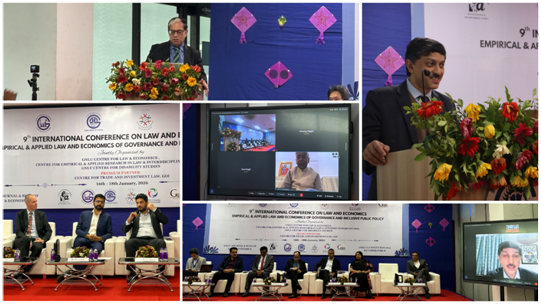
The Centre for Trade and Investment Law (CTIL), in collaboration with the Gujarat National Law University (GNLU), through its Centre for Law and Economics, Centre for Empirical & Applied Research in Law & Interdisciplinary Studies, and Centre for Disability Studies, successfully organised the 9th International Conference on Law and Economics (Empirical & Applied Law and Economics of Governance and Inclusive Public Policy) at GNLU, Gandhinagar.
The Conference examined key issues at the interface of law and economics, including trade policy challenges from the perspectives of policymakers, academicians, practitioners and industry stakeholders. It featured panel discussions, technical sessions and expert plenary talks. Over the three days, the Conference brought together leading figures from legal academia, the judiciary, legal practice, industry and policymaking to deliberate on contemporary legal and economic issues shaping trade policy, governance and inclusive public policy. CTIL led two panel discussions on “World Intellectual Property Organization (WIPO) Treaty on Intellectual Property, Genetic Resources, and Associated Traditional Knowledge (TKGR Treaty) and the Trade Related Aspects of Intellectual Property Rights (TRIPS) Agreement”, and “India’s Approach to Trade in Health Services: Emerging Challenges and Gaps.”
The inaugural session was attended by Former Judge, Supreme Court of India, Justice A.K. Sikri, and Attorney General of India, Shri R. Venkatramani, as special guests. In his keynote address, Justice A.K. Sikri emphasised that judges should not only apply the law but also consider the economic consequences of legal interpretations. The Attorney General of India, Shri R. Venkatramani, highlighted the need for new institutional arrangements and empirical models to address emerging challenges faced by policymakers.
The Conference witnessed participation from scholars and practitioners specialising in law and economics from national law schools across India, along with international scholars from leading universities and international organisations, including the University of Hamburg, Germany; Myongji University, South Korea; University of Pretoria, South Africa; Tomyongji Hoku University, Japan; and the United Nations Economic and Social Commission for Asia and the Pacific (UNESCAP). Industry leaders from the healthcare and biotechnology sectors also participated in the deliberations.
Head, Centre for Trade and Investment Law, Prof. (Dr.) James J. Nedumpara, in his expert plenary talk on “Services Trade and Professional Mobility”, discussed recent developments in the India–New Zealand Free Trade Agreement and the India–United Kingdom Comprehensive Economic Partnership Agreement, with specific reference to commitments on the temporary movement of natural persons. He also provided insights on cross-border modes of services delivery, visa-related regulatory barriers and the growing relevance of Mutual Recognition Arrangements (MRAs).
A CTIL-organised panel examined the interface between the WIPO TKGR Treaty and the WTO TRIPS Agreement. Chair of the session, Prof. (Dr.) Unnat Pandit, in his special address, emphasised the robustness of India’s patent regime and the facilitative role of biological diversity regulation in protecting and integrating traditional knowledge with modern scientific research. The panel highlighted the significance of the WIPO TKGR Treaty in addressing fraudulent disclosures and wrongful grant of patents based on traditional knowledge. The panel included Dr. Raghavender G.R., Department for Promotion of Industry and Internal Trade (DPIIT), Ms. Latika Dawara, Indian Patent Office, Mumbai, and practitioners Mr. Anand Shetty and Mr. S.K. Srihari, who outlined practical compliance-related challenges. Associate, CTIL, Mr. Pranav Narang, provided insights on the legal interplay between the TKGR Treaty and other international agreements.
CTIL also convened a panel on India’s approach towards trade in health services. President, Shalby Hospitals Limited, Mr. Shanay Shah, chaired the session and spoke on the growth of medical tourism in India and the need for improvements in insurance portability and visa facilitation. The discussion highlighted global shifts driven by digital health, artificial intelligence adoption and intermodal linkages, and emphasised the need for coordinated national strategies to balance commercial expansion with universal access. The panel also included Mr. Sreejith Narayanan Edamana, Apollo AyurVaid, Dr. Rupa Chanda, United Nations Economic and Social Commission for Asia and the Pacific (UNESCAP), and Assistant Professor, CTIL, Ms. Shiny Pradeep, who discussed India’s facilitative approach to traditional medicine. Professor, University of Pretoria, South Africa, Prof. (Dr.) Stephanus Phillipus van Zyl, highlighted fiscal mechanisms that can be leveraged to attract investment in the healthcare sector.
***
Abhishek Dayal/Abhijith Narayanan/Anushka Pandey