|
PIB Backgrounder
PRAGATI: A Decade of Cooperative, Outcome-Driven Governance
Posted On:
13 JAN 2026 7:08PM by PIB Delhi
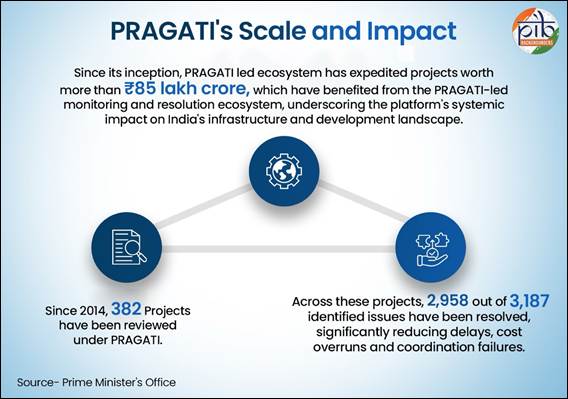
- PRAGATI has significantly accelerated India’s development by fast-tracking projects worth more than ₹85 lakh crore.
- Under PRAGATI, 382 major national projects have been systematically reviewed and closely monitored.
- Out of 3,187 identified issues, 2,958 have already been resolved, significantly reducing delays and cost overruns.
- The platform ensures real-time coordination between the Centre and States under direct Prime Ministerial supervision, strengthening accountability.
|
PRAGATI: A Model of Real-Time Governance
PRAGATI (Pro-Active Governance and Timely Implementation) is the Government of India’s flagship platform for fast-tracking projects, schemes, and grievance redressal through direct, real-time review by the Prime Minister, in partnership with States and Union Ministries. PRAGATI is a strong example of how digital governance can translate intent into real, visible progress. Launched in 2015 under Prime Minister Narendra Modi, PRAGATI has reshaped how India tracks and drives major infrastructure projects and key social programmes. More than a review forum, it reflects a push to break bureaucratic inertia, strengthen a Team India approach across the Centre and States, and build a culture where decisions are time-bound, follow-through is expected, and outcomes are measured. Several long-pending projects initiated by previous governments were also taken up under the PRAGATI platform and subsequently unlocked or completed. These include the Bogibeel rail-cum-road bridge (conceived in 1997), Navi Mumbai International Airport (conceptualised in 1997), Bhilai Steel Plant modernisation (approved in 2007) among various others.
PRAGATI: What It Is and Why It Was Needed
Large time and cost overruns had long been a persistent challenge in India’s public projects and schemes. To address this issue across all levels of government, the Prime Minister conceptualized PRAGATI as a comprehensive solution. PRAGATI is a distinctive, integrated, and interactive platform designed to both resolve grievances of and to monitor and review key programmes and projects of the Government of India, along with projects highlighted by State Governments. The PRAGATI platform uniquely brings together three modern technologies—digital data management, video conferencing, and geo-spatial technology. Through this system, the Prime Minister can directly engage with concerned Central and State officials, supported by complete information and up-to-date visual evidence from project sites. This initiative also represents an innovative step in e-governance and exemplifies the principles of good governance.
PRAGATI’s Origin and Evolution
PRAGATI draws its inspiration from SWAGAT (State Wide Attention on Grievances by Application of Technology). SWAGAT was then Chief Minister of Gujarat Shri Narendra Modi’s brainchild, launched in April 2003, and one of India’s early, technology-enabled platforms of its kind for grievance redressal. Aptly named—SWAGAT means “welcome” in many Indian languages—it was designed to make government more accessible and accountable. Citizens could submit complaints online, track their applications, view decisions, and even interact with officials through video conferencing. A structured screening process ensured that serious, high-priority petitions reached the Chief Minister’s desk, while monthly public hearings created a direct channel for citizens to place their concerns before the state leadership. Over time, SWAGAT came to be widely recognised for strengthening transparency, responsiveness, and accountability in public service delivery.
After taking office as Prime Minister in 2014, PM Modi sought to scale the underlying discipline of SWAGAT to the national level. With PRAGATI, the focus expanded from individual grievances to the larger, more complex challenge of driving delivery across major projects and key programmes - especially where issues were stuck due to multi-agency dependencies or Centre–State coordination. In that sense, PRAGATI was not merely a digital upgrade; it represented a shift in how governance is executed—more time-bound, more outcome-driven, and more collaborative, aligned with the broader principle of “Minimum Government, Maximum Governance.”
Structured Review and Follow-up Process
- PRAGATI is a technology-driven platform for monitoring projects, redressing citizen grievances, and reviewing scheme implementation through coordinated efforts of Central Ministries and State Governments. It also integrates platforms such as PM GatiShakti, PARIVESH, and the PM Ref Portal.
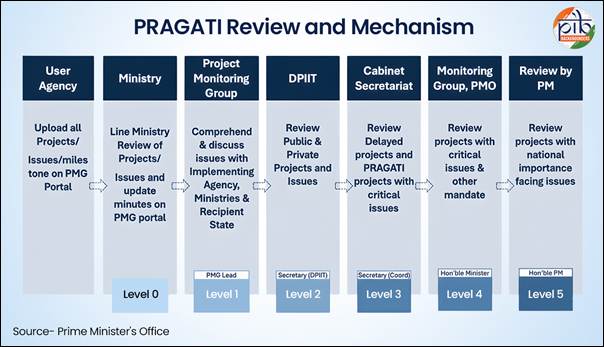
- At the apex level, the Prime Minister chairs PRAGATI review meetings with Chief Secretaries of States and Secretaries of Central Ministries/Departments to resolve issues related to identified projects and schemes.
- Following the meetings, a multi-tier follow-up mechanism ensures timely implementation of decisions. Projects are monitored by the Cabinet Secretariat, while schemes and grievances are reviewed at the Ministry level under continuous oversight of the Prime Minister’s Office (PMO).
Project & Issue Escalation Mechanism
Regular issues are resolved at the Ministry level, while complex and critical issues are escalated for review up to PRAGATI.
Strengthening Cooperative Federalism and Governance
PRAGATI institutionalises cooperative federalism in action. Chief Secretaries of States and Secretaries to the Government of India participate together, answerable in real time, enabling faster resolution of inter-state and Centre-State issues. The platform breaks silos by ensuring:
- Direct coordination between multiple ministries and State governments.
- Time-bound follow-up monitored by the Cabinet Secretariat.
- Shared ownership of outcomes rather than fragmented responsibility.
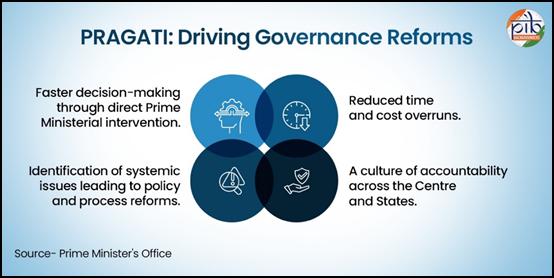
This model has substantially improved inter-ministerial coordination and reduced procedural bottlenecks that traditionally delayed large public projects.
PRAGATI’s Impact Across Key Infrastructure Sectors
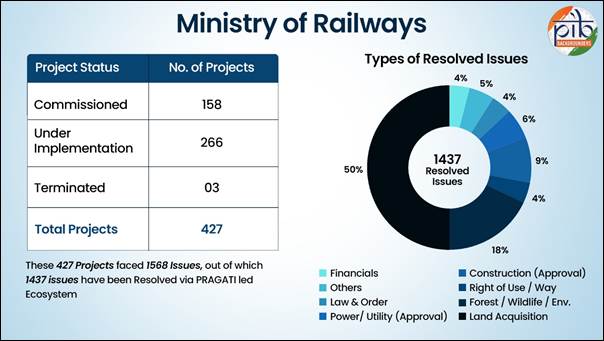
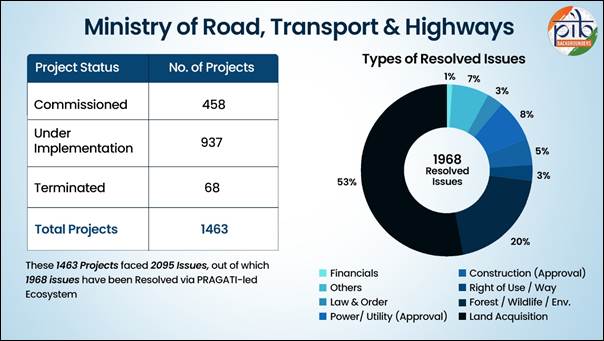
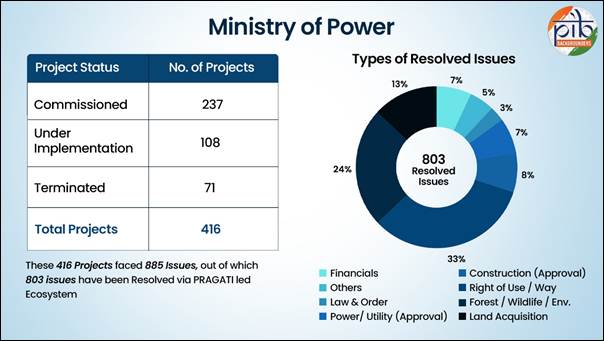
PRAGATI has played a pivotal role in accelerating implementation and resolving bottlenecks across major infrastructure sectors. Some key sectoral impacts are highlighted below.
Beyond Infrastructure: Social Sector & Citizen-Centric Governance
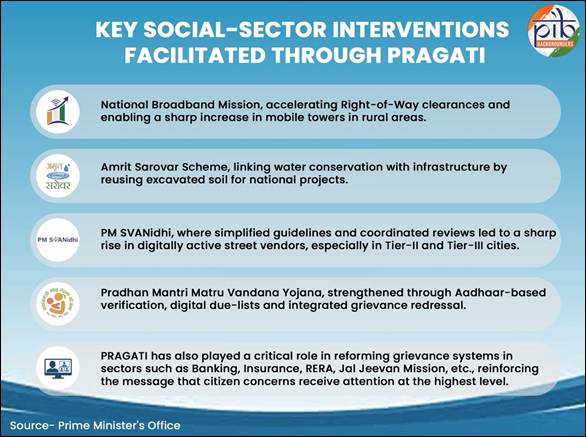
While PRAGATI initially focused on large infrastructure projects, its scope has expanded to social sector schemes and public grievances, making it a people-centric governance instrument.
Examples of Long-Pending Projects Unlocked Through PRAGATI
Several projects that had remained stalled for decades were completed or decisively unlocked after being taken up under the PRAGATI platform, demonstrating the impact of sustained high-level monitoring and inter-governmental coordination.
- The Bogibeel rail-cum-road bridge in Assam, first conceived in 1997, had remained pending for over two decades due to funding and coordination challenges. Following regular reviews under PRAGATI, inter-agency issues were resolved, and execution was closely monitored, leading to the project’s completion and inauguration in 2018, significantly improving connectivity and strategic mobility in the North-East.

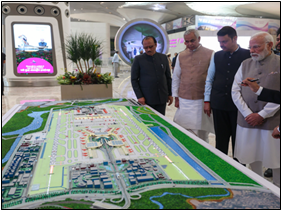
- The Navi Mumbai International Airport, conceptualised in 1997, remained delayed for around 25 years due to land acquisition, rehabilitation of project-affected families and the involvement of multiple agencies. Following PRAGATI intervention, these long-pending issues were addressed in a time-bound manner through Centre–State coordination, unlocking the project and significantly accelerating construction. Hon’ble Prime Minister inaugurated phase I of the project in October 2025.
- The modernisation and expansion of the Bhilai Steel Plant, approved in 2007, faced prolonged delays of nearly 15 years due to contractual disputes, execution challenges and cost overruns. High-level monitoring under PRAGATI helped resolve inter-ministerial and PSU-level bottlenecks, enabling completion of the modernisation programme and enhancement of the plant’s capacity and efficiency.
- The LARA Super Thermal Power Project (Stage-I) in Chhattisgarh, sanctioned in December 2012, experienced delays for more than 13 years due to land acquisition and contractor-related constraints. Continuous monitoring and issue resolution through PRAGATI helped unblock the project, resulting in the commissioning of the units and the addition to national power generation capacity.
- The Gadarwara Super Thermal Power Project in Madhya Pradesh, approved in 2008, had remained delayed for over a decade because of land, fuel linkage and execution-related issues. After being taken up under PRAGATI, outstanding clearances and coordination issues were fast-tracked, leading to the commissioning of the project and strengthening of regional power availability.
-
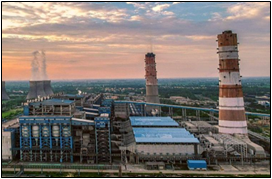 - Recognised as a critical anchor in India’s eastern power generation landscape, the North Karanpura Super Thermal Power Project (NKSTPP) is a flagship pit-head thermal power initiative aimed at strengthening base-load electricity availability and grid reliability in eastern India. The physical progress of the project stood at approximately 60% during FY 2019–20. Following focused reviews and coordinated interventions, including a PRAGATI review conducted in September 2021, project execution witnessed a marked acceleration, with physical progress increasing to around 87% by FY 2023–24.
- The Nabinagar Super Thermal Power Project (NSTPP) occupies a strategic position in India’s energy security architecture. Upon escalation under the PRAGATI mechanism, unresolved land and rehabilitation issues were addressed. This intervention enabled focused monitoring and accountability, leading to progressive resolution of land-related constraints and resumption of project execution.
- All India Institute of Medical Sciences (AIIMS), Bibinagar is being established at Bibinagar in Yadadri Bhuvanagiri District, Telangana, under the Pradhan Mantri Swasthya Suraksha Yojana (PMSSY). The project was reviewd under the PRAGATI mechanism on 28.06.2023, following which a clear progress in project execution was observed. As of 14.09.2023, the physical progress stood at 29%, which increased sharply to 57% by the end of FY 2023–24, reflecting the impact of focused monitoring and expedited decision-making under PRAGATI.
![]()
- Jammu & Kashmir has entered a new era of healthcare accessibility and excellence with the establishment of the All-India Institute of Medical Sciences (AIIMS), Jammu, at Samba. Given the national importance of AIIMS Jammu in strengthening healthcare access in the region, the project and its critical bottlenecks were taken up through the Project Monitoring Group (PMG) and subsequently escalated to the PRAGATI mechanism. The project was reviewed under PRAGATI on 28-06-2023. The PRAGATI intervention proved decisive in altering the project’s execution environment. With the issue elevated to the highest level of governance, accountability across departments was sharply reinforced.
- The All India Institute of Medical Sciences (AIIMS), Guwahati, was sanctioned on 24th May 2017 under the Pradhan Mantri Swasthya Suraksha Yojana (PMSSY). PRAGATI served as a critical intervention platform, with reviews in April 2018 and February 2023. PRAGATI’s oversight directly enabled resolution of key dependencies, including commissioning of electricity infrastructure, acceleration of stormwater management systems, alignment of water supply readiness, and overall synchronisation necessary for operationalisation.

- Mumbai Urja Marg Limited (MUML) is a Ministry of Power, Government of India–envisaged transmission strengthening project in Maharashtra, designed to reinforce the power transmission backbone for the Mumbai Metropolitan Region. The project faced multiple interlinked land, forest, Right of Way (RoW), and administrative bottlenecks. It was sanctioned in October 2024. PRAGATI-driven interventions converted fragmented approvals into synchronized action, enabling progressive achievement of milestones—80 per cent RoW clearance by 2023, 100 per cent foundation, erection, and stringing completion by August 2024, and successful charging of transmission lines in September 2024—thereby restoring execution momentum and ensuring timely commissioning of the MUML project.
- The 400 kV D/C Teesta III–Kishanganj Transmission Line (214 km) is an Inter-State Transmission System (ISTS) project designed to evacuate power from Sikkim’s commissioned hydro assets. It stands as evidence of how PRAGATI converts high-level directives into field-level delivery by resolving jurisdictional constraints and aligning multi-agency execution, rather than altering engineering design. It remains a reference case of coordinated Centre–State intervention enabling commissioning in challenging terrain with sustained operational performance.
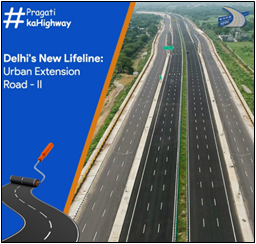
- The UER-II project along NH-344M was conceived as a transformative intervention to augment Delhi’s road infrastructure and restore traffic efficiency. Given its strategic importance for Delhi-NCR mobility, the project was taken up for close monitoring under the Project Monitoring Group (PMG) and subsequently reviewed at the national level through the PRAGATI mechanism. The PRAGATI intervention proved pivotal in breaking long-standing inter-departmental bottlenecks as each pending issue was digitally tracked with assigned responsibilities and timelines.
- The four-laning of the Sangareddy–Akola–Nanded section of NH-161 spans 426 km from Akola (NH-53) in Maharashtra to Sangareddy in Telangana, passing through Washim, Hingoli, Nanded and Degloor. Forming part of the Indore–Hyderabad Economic Corridor under the Bharatmala Pariyojana, this strategic highway provides seamless connectivity between major urban and economic centres across Central and Southern India. The project was escalated to the PRAGATI portal. The coordinated intervention brought all stakeholders—State authorities, district administration and the project proponent—onto a single implementation framework with clear timelines and accountability. The resolution of these long-standing issues within a short span of six months highlights the transformative role of the PRAGATI mechanism in unlocking complex infrastructure bottlenecks and driving time-bound delivery.
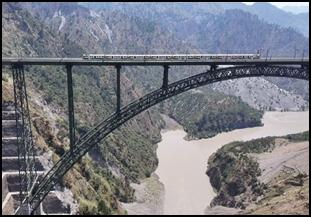
- Work on the Jammu–Udhampur–Srinagar–Baramulla rail link started in October 1994 while the date of sanction was 31st March 1994 but progress remained slow for nearly 25 years owing to difficult terrain, land acquisition constraints, forest clearances, and security-related challenges. After the project was reviewed under PRAGATI, critical clearances were expedited, and bottlenecks were addressed through coordinated action, resulting in the completion of the project and operational rail connectivity in the Kashmir Valley.
- The four-laning of the Khajuri–Wyndhamganj section of NH-75 (Sec-V) represents a strategically important highway upgradation initiative in Jharkhand, aimed at strengthening regional and inter-state road connectivity. The value of PRAGATI-led oversight is reflected in the project’s ability to maintain momentum through its more complex later stages. Physical progress had reached 44.4% prior to the PRAGATI review in August 2024, and subsequently advanced to 92.02%, demonstrating sustained execution and effective issue management. At a stage where large infrastructure projects often experience slippages due to land, clearance and coordination challenges, the continued progression underscores how high-level monitoring and coordinated action at the State and district levels helped prevent stagnation and ensured timely consolidation of works.
- The Mumbai Trans Harbour Link (MTHL), officially named Atal Bihari Vajpayee Sewri–Nhava Sheva Atal Setu, stands among India’s most transformative urban transport infrastructure initiatives. Implemented by the Mumbai Metropolitan Region Development Authority (MMRDA) with financial support from the Government of India, the Government of Maharashtra, and the Japan International Cooperation Agency (JICA), project represents India’s longest sea bridge, spanning 21.8 kilometres, and a landmark addition to the national transport network. Guided under the PRAGATI mechanism, the project progressed through a disciplined, time-bound governance framework that ensured early institutional alignment and sustained execution momentum.
-
 - The Jagdishpur–Haldia & Bokaro–Dhamra Natural Gas Pipeline (JHBDPL), implemented by GAIL (India) Limited is a cross-country pipeline project extending the National Gas Grid into eastern and north-eastern India. Post PRAGATI, commissioning proceeded wherever technically feasible, while unresolved segments were escalated to “high-priority status” through structured monitoring cycles at the Prime Minister’s Office, Cabinet Secretariat, and DPIIT, with State Governments instructed to resolve pendencies at the district level. This shift from sequential dependence to modular execution altered the execution trajectory and enabled the project to move from delayed readiness to near completion.
|
PRAGATI: A Global Case Study in Project Acceleration
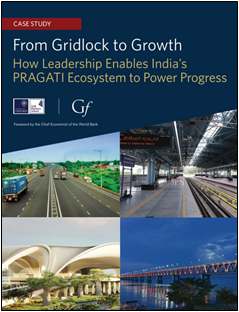
A landmark case study by Oxford’s Said Business School, titled “From Gridlock to Growth: How Leadership Enables India’s PRAGATI Ecosystem to Power Progress,” highlights PRAGATI as:
- Transformative digital governance platform that has strengthened senior-level accountability & fast-tracked long-pending infrastructure and social sector projects.
- Global benchmark and a “Single Source of Truth” for real-time project monitoring and inter-governmental coordination.
- Global best practice and replicable model for developing economies, that can drive infrastructure delivery, economic growth, and improved public trust.
- Institution in cooperative federalism, bringing States/UTs administration and central ministries onto one platform, ensuring apolitical, uniform attention to projects.
|
PRAGATI’s influence on infrastructure delivery is visible across four dimensions:
Economic: Delays don’t just raise project costs through price escalation and logistical churn—they also postpone the economic returns these assets generate through higher passenger movement and commercial activity. By accelerating issue-resolution and completion, PRAGATI helps bring these returns online sooner and improves the value of every rupee invested.
Social: Faster completion means communities benefit earlier. Better roads connect remote areas to schools, hospitals, and markets; rail links, bridges, and logistics upgrades support local enterprise and job creation. The cumulative effect is a more connected India—where access, opportunity, and quality of life improve in ways that citizens can feel.
Environmental: Modernisation cannot come at the cost of sustainability. PRAGATI supports responsible development by helping fast-track environment-related decision-making while keeping safeguards in view, reducing avoidable time overruns that can increase emissions and resource use. PM GatiShakti puts forests, wildlife and eco‑sensitive zones on the same GIS planning canvas, so environmental sensitivities are visible before a project is finalised. That early visibility enables alignment planning, site-suitability and compliance checks—so agencies can adopt alternative alignments and design mitigations upfront to avoid sensitive habitats and reduce ecological impact. And by relying on digital review and videoconferencing, it reduces the need for carbon-intensive travel.
Positive Governance: PRAGATI is not only about expediting projects—it strengthens the culture of delivery. It reinforces transparency, time-bound accountability, and inter-government coordination, and it has helped spread process improvements across departments. In doing so, it acts as a catalyst for wider modernisation and initiatives that aim to extend the benefits of growth more evenly across the country.
As PRAGATI achieved its 50th meeting milestone, it stands as a defining example of how technology-enabled leadership, cooperative federalism and continuous monitoring can translate intent into outcomes at a national scale. Five critical infrastructure projects have been reviewed during the meeting by the Prime Minister across sectors, including Road, Railways, Power, Water Resources, and Coal. These projects span 5 States, with a cumulative cost of more than ₹40,000 crore. This acts as symbol of the deep transformation India has witnessed in the culture of governance over the last decade.
Prime Minister’s Office
Click here to see in pdf
PIB Research
(Release ID: 2214258)
|