PIB Backgrounder
Digitalizing India’s Dairy Sector
Building a Smarter, Transparent, and Farmer-Centric Ecosystem
Posted On:
09 JAN 2026 10:32AM by PIB Delhi
Key Takeaways
- More than 35.68 crore animals have been issued “Pashu Aadhaar” under the National Digital Livestock Mission (NDLM), enabling traceable livestock management.
- Over 17.3 lakh milk producers across 54 milk unions benefit from the Automatic Milk Collection System (AMCS), ensuring transparent payments and efficient operations.
- Around 198 milk unions and 15 federations use the Internet-based Dairy Information System (i-DIS) for data-driven decision-making and performance benchmarking.
- Milk route optimisation using GIS technology has helped cooperatives in several states save significantly on transportation costs and improve delivery efficiency.
|
Introduction
India is the world’s largest producer of milk, accounting for 25% of global output. As the sector continues to expand, digital tools are playing an increasingly crucial role in improving productivity, transparency, and farmer welfare. The National Dairy Development Board (NDDB) has been at the forefront of this transformation, developing digital platforms that connect farmers, cooperatives, and stakeholders across the dairy value chain. These initiatives aim to modernize operations, reduce inefficiencies, and enhance traceability, ultimately strengthening the world’s largest dairy ecosystem.
National Digital Livestock Mission (NDLM)
The National Digital Livestock Mission (NDLM), implemented by NDDB in collaboration with the Department of Animal Husbandry and Dairying (DAHD), represents a major step toward a unified digital livestock ecosystem called “Bharat Pashudhan.”
To enhance data-driven livestock management, the Bharat Pashudhan database records field activities such as breeding, artificial insemination, health services, vaccination, and treatment, with over 84 crore transactions logged. Field personnel, including veterinarians and extension workers, assist farmers in accessing this system.
The NDLM uses digital tools such as unique animal identification, data integration, and mobile applications to empower farmers and improve productivity. It aims to ensure every animal in India has a digital identity, linking it to health records and productivity data. NDDB provides both technical and financial support to implement this mission across states.
In line with the international practices a unique 12-digit bar coded Tag ID in the form of ear tag is being issued to all livestock animals. This unique code has been named as “Pashu Aadhar”, and it acts as a primary key for registering all types of transactions done on the animals such as Vaccination, Breeding, Treatment, etc. All these transactions can be viewed at a single place against the Tag ID and shall be visible to the farmer as well as to the field veterinarians and workers for respective animals/area. Till November 2025, over 35.68 Crore Pashu Aadhaar has been generated.
Under the National Digital Livestock Mission, the 1962 App provides authenticated information on best practices and government schemes. Besides, the toll-free number 1962 is available to the farmers to get the veterinary services through Mobile Veterinary Units at their doorstep.
Automatic Milk Collection System
At the heart of India’s cooperative dairy model is the daily milk collection from millions of farmers. To make this process transparent, efficient, and farmer-friendly, the National Dairy Development Board (NDDB) has developed the Automatic Milk Collection System (AMCS), a robust, integrated software platform for managing every aspect of operations at Dairy Cooperative Societies (DCS).
AMCS automates milk collection by digitally recording each transaction, including quantity, quality, and fat content, and instantly transferring payments to farmers’ bank accounts. Using open-source technology, the system ensures traceability, eliminates manual errors, and promotes transparency at every level. Farmers receive real-time SMS updates on their daily sales and payments, while cooperatives gain access to data-driven insights for better procurement and production planning.
The system is integrated at Union, Federation, and National levels, connecting with financial institutions and providing mobile-based key informatics for all stakeholders. Currently operational in 12 states/UTs, AMCS covers over 26,000 Dairy Cooperative Societies and benefits over 17.3 lakh milk producers across 54 milk unions (as on October 22, 2025), reflecting NDDB’s commitment to building a digitally empowered and inclusive dairy ecosystem.
The integrated AMCS solution has the following major Applications / components.
- DCS Application: Common, multilingual AMCS Application at DCS Level which works on Windows / Linux and Android Platform.
- Portal Application: Common Centralized AMCS Portals at Union, Federation and National Level.
- Android Apps: Common, multilingual Mobile Applications one each for Society Secretary, Dairy Supervisor and Farmer.
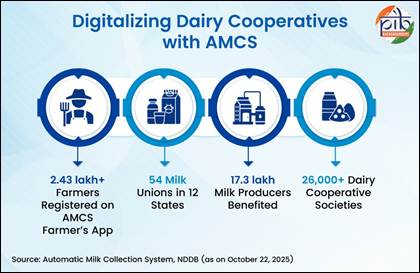
This Android-based application serves as a Digital Passbook for farmers and a real-time information and alert platform for Dairy Secretaries and Supervisors. So far, over 2.43 lakh farmers, 1,374 supervisors, and 13,644 secretaries have registered (as on October 22, 2025) on the AMCS mobile app.
NDDB Dairy ERP (NDERP)
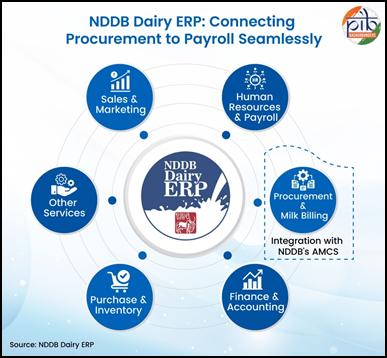
The NDDB Dairy ERP (NDERP) is a comprehensive, web-based enterprise resource planning system developed and customized specifically for the dairy and edible oil industries. Built on an open-source platform (Frappe ERPNext), it eliminates the need for any software installation and can be accessed seamlessly through a computer or mobile device. It is also available on Android and iOS (mNDERP) for distributors, offering a complete and cost-effective solution without proprietary or recurring licensing fees.
The iNDERP portal (https://inderp.nddb.coop) is an online platform for distributors integrated with NDERP. It enables them to manage orders, delivery challans, invoices, and payments efficiently. Distributors can track deliveries, view outstanding balances, and download invoices directly from the portal, ensuring smooth coordination with milk unions and federations.
The mNDERP mobile app, available on Android and iOS, offers the same functionalities as iNDERP for distributors on the go. It allows them to place orders, check deliveries, access invoices, and monitor payments easily through their smartphones, promoting transparency and convenience in dairy business operations.
NDERP includes all major functional modules such as Finance and Accounts, Purchase, Inventory, Sales and Marketing, Manufacturing, HR and Payroll, each integrated with advanced workflows and maker-checker features to ensure greater transparency and control. The system also features dashboards and analytical tools that support data-driven decision-making across management levels.
Crucially, NDERP is integrated with the Automatic Milk Collection System (AMCS) to create an end-to-end digital solution, from cow to consumer, covering milk collection, processing, and distribution. To enhance efficiency, the platform incorporates a mass-balancing technique in the production module, helping dairies minimize processing losses.
Semen Station Management System (SSMS)
The Semen Station Management System (SSMS) is a comprehensive digital platform designed to streamline the production of Frozen Semen Doses (FSD) and ensure adherence to the Minimum Standard Protocols (MSP) and Standard Operating Procedures (SOPs) set by the Government of India. The system covers all core operations of semen stations, including bull lifecycle management, semen production, quality control, biosecurity, farm and fodder management, and sales tracking. It integrates with laboratory equipment and RFID bull tags for accurate, efficient, and traceable operations, ensuring every stage, from production to distribution, is digitally monitored.
SSMS is connected to the Information Network for Semen Production and Resource Management (INSPRM), a national portal that enables real-time data sharing between semen stations and field-level systems like INAPH (Information Network for Animal Productivity and Health). This integration allows complete traceability of semen doses supplied across the country and supports coordinated monitoring through a central database. Developed under the National Dairy Plan I (NDP I), a World Bank-funded initiative implemented by NDDB, the system has modernized semen stations nationwide, strengthening India’s artificial insemination network and contributing to enhanced dairy productivity. Currently, 38 graded semen stations across India are using SSMS to ensure quality, transparency, and standardization in semen production.
INAPH
Information Network for Animal Productivity & Health (INAPH) is an application that facilitates capturing of real time reliable data on Breeding, Nutrition and Health Services delivered at Farmer’s Doorstep. It helps to assess and monitor progress of the projects.
Internet-based Dairy Information System
Efficient data management is central to evidence-based planning and informed decision-making in the dairy sector. The Internet-based Dairy Information System (i-DIS) developed by the National Dairy Development Board (NDDB) provides a unified digital platform for dairy cooperatives, milk unions, federations, and other allied units to systematically collect, share, and analyse data. The system enables participants to track performance indicators such as milk procurement and sales, product manufacturing and distribution, and the supply of technical inputs, while allowing each organisation to benchmark its performance against others.
Currently, around 198 milk unions, 29 marketing dairies, 54 cattle-feed plants, and 15 federations across the country are part of i-DIS, contributing to the creation of a reliable and comprehensive National Cooperative Dairy Industry Database. This data-driven ecosystem supports strategic decision-making and policy formulation within the dairy sector. NDDB also conducts regular refresher workshops for Management Information System (MIS) officials from participating unions to strengthen their ability to use i-DIS effectively and ensure its optimal utilisation for planning and operations.
Milk Route Optimisation
Efficient milk collection and distribution are vital for the success of India’s dairy supply chain. To make this process more cost-effective and systematic, the National Dairy Development Board (NDDB) has introduced milk route optimisation using GIS (Geographical Information System) technology. This digital approach replaces manual planning by mapping milk procurement and distribution routes on digitised maps, allowing easy visualisation of multiple route options and supporting data-driven decision-making.
Using GIS-based route planning helps reduce transportation distance, fuel costs, and time, improving overall efficiency in milk procurement and delivery. NDDB launched a milk route optimisation exercise in August 2022 under the Vidarbha Marathwada Dairy Development Project, where routes for four milk chilling centres were redesigned, leading to notable savings in transportation costs. Similar exercises in Varanasi Milk Union, West Assam Milk Union, Jharkhand Milk Federation, and Indore Milk Union have also produced encouraging results, showcasing the potential for significant cost reduction in dairy logistics.
To help cooperatives adopt this technology widely, NDDB has developed a web-based dynamic route planning software that enables fleet and route optimisation in a structured, scientific, and user-friendly manner. Available free of cost to dairy cooperatives, this tool allows real-time route planning and supports better operational control. By integrating technology with cooperative efficiency, NDDB’s route optimisation initiative is setting a benchmark for sustainable and cost-effective milk transport in India’s dairy sector.
Conclusion
India’s dairy sector, which contributes a quarter of the world’s milk output, is undergoing a remarkable digital transformation led by the National Dairy Development Board (NDDB). Through integrated platforms such as NDLM, AMCS, NDERP, SSMS, i-DIS, and route optimisation tools, the sector is moving toward greater efficiency, transparency, and inclusiveness. These systems are not just enhancing operational productivity but also ensuring that millions of small and marginal dairy farmers are directly linked to a modern, tech-driven ecosystem.
By combining cooperative strength with digital innovation, India is setting new standards in sustainable dairy development, one where every litre of milk and every animal is part of a connected, traceable, and efficient value chain. The ongoing efforts reflect NDDB’s vision of creating a digitally empowered dairy sector that serves both producers and consumers, driving India closer to its goal of being the global leader in safe, sustainable, and technology-driven milk production.
References:
- https://www.pib.gov.in/PressReleasePage.aspx?PRID=2114715
- https://www.pib.gov.in/PressReleseDetail.aspx?PRID=2115188
- https://amcs.nddb.coop/
- https://amcs.nddb.coop/Home/UnionDetails
- https://amcs.nddb.coop/Home/About
- https://nderp.nddb.coop/subpage?i-NDERP
- https://nderp.nddb.coop/subpage?m-NDERP
- https://nderp.nddb.coop/subpage?NDERP
Click here to see pdf
****
PIB Research
(Release ID: 2212724)
Visitor Counter : 4634