Posted On:
06 DEC 2025 10:02AM by PIB Delhi
Key Takeaways
- Government approves Export Promotion Mission (EPM) with ₹25,060 crore to boost exports, especially for MSMEs and labour-intensive sectors.
- Unified, digitally driven framework through DGFT replaces multiple export-support schemes for faster and transparent delivery.
- Niryat Protsahan and Niryat Disha provide integrated financial and market-readiness support to exporters.
- ₹20,000 crore credit guarantee and RBI’s relief measures strengthen liquidity and ease export credit pressures.
- Focus on tariff-impacted sectors and exports from non-traditional districts to ensure broad-based, inclusive export growth.
|
Introduction
India’s export performance has been central to the nation’s economic strategy, helping generate employment, drive growth in manufacturing and services, and integrate Indian firms into global value chains. To further strengthen export competitiveness, especially for MSMEs, first-time exporters and labour-intensive sectors, the government approved the Export Promotion Mission (EPM).
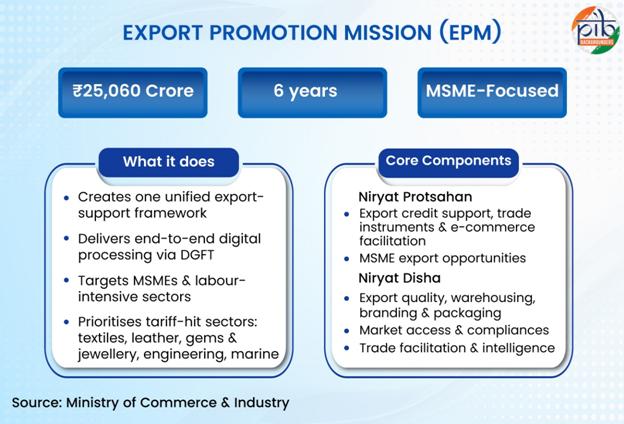
Announced in the Union Budget 2025–26, the Mission represents a major structural reform, merging multiple fragmented export-support initiatives into a single, outcome-based and digitally enabled framework. With a total outlay of ₹25,060 crore for FY 2025-26 to FY 2030-31, EPM aims to strengthen India’s export ecosystem, improve access to affordable trade finance and enhance global market readiness and competitiveness across sectors and regions.
Why a Mission? Policy Rationale
India’s export ecosystem has been supported by a range of targeted interventions in recent years, including interest equalisation, market access initiatives and export-incentive schemes and infrastructure support. The mission builds on these efforts by addressing key factors identified for strengthening export competitiveness, such as enhancing access to affordable trade finance, supporting compliance with international export standards, improving coordinated export branding and market-access facilitation, and reducing logistics disadvantages for exporters in interior and low-export-intensity regions.
Recent export trends underscore the importance of a more coordinated and digitally enabled support framework that can strengthen competitiveness and market-readiness across both merchandise and services sectors.
By consolidating multiple schemes into a single, digitally managed and outcome-linked architecture, the Export Promotion Mission aims to deliver more streamlined and effective support to India’s exporters, ensuring a unified, flexible and responsive framework that aligns with evolving global trade conditions.
Structure, Governance and Financing
EPM will span six years with a total outlay of ₹25,060 crore covering FY 2025-26 to FY 2030-31. The Mission is anchored in an institutional framework comprising the Department of Commerce, Ministry of MSME, Ministry of Finance, Export Promotion Councils, Commodity Boards, financial institutions, industry associations and state governments.
The Directorate General of Foreign Trade (DGFT) will act as the implementing agency, operating a dedicated digital platform for end-to-end processes, from application to approval to disbursal, aligned with trade and customs systems. The Mission emphasizes inter-ministerial coordination, state partnership and data-driven monitoring.
Two Integrated Sub-Schemes: Niryat Protsahan & Niryat Disha
EPM operates through two integrated sub-schemes that together address finance and non-financial enablers:
Niryat Protsahan (Financial Enablers) — This sub-scheme focuses on improving access to affordable trade finance for MSME exporters through instruments such as interest subvention on pre- and post-shipment credit, export-factoring and deep-tier financing, credit cards for e-commerce exporters, collateral support for export credit and credit-enhancement for new or high-risk markets.
Niryat Disha (Non-Financial Enablers) — This sub-scheme aims to raise market readiness and competitiveness through support for export quality and compliance (testing, certification, audits), international branding and packaging assistance, participation in trade fairs and buyer-seller meets, export warehousing and logistics, inland transport reimbursements for remote-district exporters, and capacity-building at clusters, associations and district-level facilitation cells.
Digital Implementation and Monitoring
A key design feature of EPM is its dedicated digital platform, through which DGFT will manage all processes, from application to approval to disbursal, in an integrated, paperless manner. The platform will be aligned with existing trade systems, enabling faster processing and transparent delivery of Mission interventions.
The Mission is an outcome-based, adaptive mechanism capable of responding to global trade developments. The digital architecture supports coordinated implementation, outcome-linked delivery and timely oversight, underpinning the Mission’s emphasis on efficiency, inclusiveness and export-readiness.
Sectoral and Regional Focus
EPM places priority on sectors most impacted by global tariff escalations, notably textiles, leather, gems & jewellery, engineering goods and marine products , while retaining flexibility to support other emerging export sectors. The Mission explicitly targets MSMEs, first-time exporters and labour-intensive value chains, ensuring inclusive outreach.
Under the Niryat Disha component, interventions are directed towards interior and low-export-intensity districts, with measures such as inland transport reimbursement, warehousing and logistics support, participation in trade fairs, branding & packaging assistance, and district-level capacity building. These efforts aim to broaden the geographic spread of India’s exports and enable inclusive participation in global markets.
Credit Guarantee Scheme for Exporters
In tandem with the Mission, the government approved an expansion of the Credit Guarantee Scheme for Exporters (CGSE), providing up to ₹20,000 crore in additional credit support for eligible exporters, including MSMEs. The scheme is implemented by the Department of Financial Services (DFS) through the National Credit Guarantee Trustee Company Limited (NCGTC), which will provide a 100% credit guarantee coverage to Member Lending Institutions (MLIs) for extending additional credit facilities.
The scheme strengthens liquidity by 100% Government of India guarantee through NCGCTC, by enabling collateral-free credit access and an additional working capital of upto 20% of the sanctioned export working capital limits. Valid upto 31st March 2026, the government’s decision is expected to support exploration of new export markets and boost global competitiveness of Indian exporters.
Regulatory and Central Bank Support (RBI Measures)
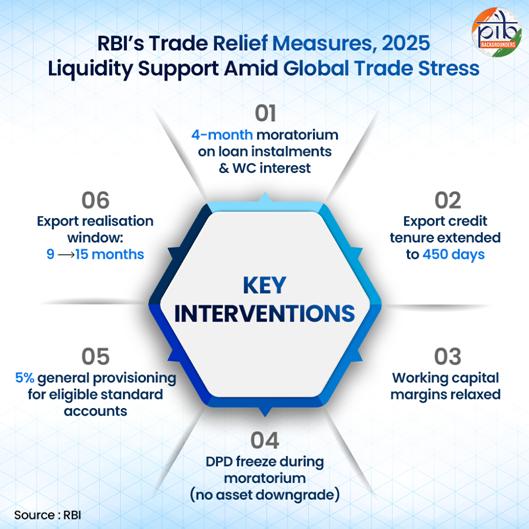
The Mission’s effectiveness is further reinforced by complementary steps announced by the Reserve Bank of India (RBI) to ease liquidity pressures in the export sector amid global trade disruptions. In November 2025, the RBI issued the Reserve Bank of India (Trade Relief Measures) Directions, 2025, aimed at mitigating debt-servicing stress and promoting the continuity of viable export-oriented businesses.
Key Measures Announced by RBI
1. Moratorium on Repayments — Regulated entities (REs) may offer a moratorium on term-loan instalments and defer interest on working-capital (WC) facilities falling due between 1 September and 31 December 2025. Interest will accrue on a simple-interest basis, without compounding, and may be converted into a Funded Interest Term Loan (FITL) repayable between 31 March and 30 September 2026.
2. Extension of Export Credit Tenure — The permissible credit period for pre-shipment and post-shipment export credit has been extended to 450 days for credit disbursed up to March 31, 2026.
For packing credit facilities already availed by exporters before August 31, 2025, where dispatch could not take place, REs may allow liquidation from any legitimate alternate source, including domestic sale proceeds or substitution of export contracts.
3. Flexibility in Working-Capital Management — To maintain liquidity during the effective period, REs may recalculate drawing power by reducing margins or reassessing working-capital limits.
4. Regulatory Forbearance on Asset Classification — The moratorium/deferment period will be excluded from days-past-due (DPD) calculations under IRACP norms; granting relief will not be treated as restructuring; credit bureaus (CICs) are directed to ensure borrowers’ credit histories are unaffected.
5. Provisioning Requirement — Regulated entities must make a general provision of not less than 5 per cent on eligible borrower accounts that were standard as on 31 August 2025 and for which relief has been extended.
6. FEMA Relaxations for Export Realisation — Under the Foreign Exchange Management (Export of Goods and Services) (Second Amendment) Regulations, 2025, the period for realisation and repatriation of export proceeds has been extended from nine months to 15 months, and the shipment period against advance payments has been increased from one year to three years.
Together, these regulatory and fiscal measures provide an integrated framework of support to exporters — maintaining liquidity, protecting credit discipline and aligning with the Mission’s goal of an enhanced export-ecosystem.
Expected Outcomes and Macroeconomic Linkages
To enable a more competitive and resilient export ecosystem, the Mission is designed to deliver measurable outcomes across financing, quality standards, market access and institutional capacity. By providing a coordinated, technology-driven and industry-responsive framework, EPM strengthens support in areas such as trade finance, compliance readiness and district-level participation.
EPM is expected to:
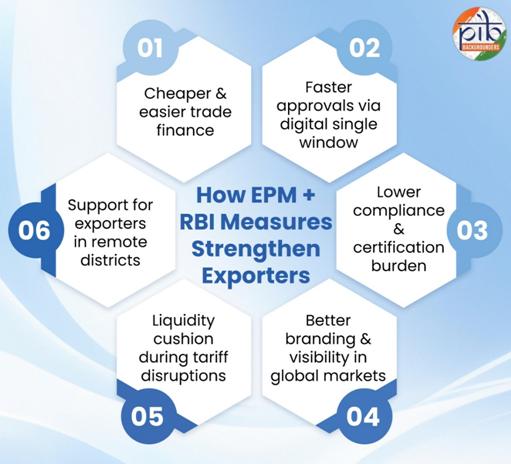
- Improve access to affordable trade finance for MSMEs
- Raise export-readiness through compliance and certification support
- Enhance market access, branding and visibility of Indian products
- Boost exports from non-traditional districts and sectors
- Generate employment across manufacturing, logistics and allied services
These outcomes align with national objectives, strengthening export-led growth, promoting Atmanirbhar Bharat and contributing to the long-term vision of Viksit Bharat @ 2047. By consolidating and modernising export support, the Mission aims to make India a resilient, trusted and competitive partner in global trade.
Conclusion
The Export Promotion Mission marks a decisive step toward a coherent, technology-driven and inclusive export ecosystem. By merging fiscal incentives, financial facilitation, digital governance and regulatory flexibility into a single mission-mode framework, the government has created a powerful platform to enhance India’s global trade competitiveness. As the Mission unfolds alongside the RBI’s relief measures and the expanded Credit Guarantee Scheme, it underscores a whole-of-government approach to export-led growth, empowering MSMEs, diversifying markets and positioning India as a resilient, reliable partner in global commerce.
References
Ministry of Commerce & Industry
https://www.pib.gov.in/PressReleasePage.aspx?PRID=2189383
https://www.pib.gov.in/PressReleasePage.aspx?PRID=2190829
Cabinethttps://www.pib.gov.in/PressReleasePage.aspx?PRID=2189389&s=09
RBI
https://www.rbi.org.in/Scripts/NotificationUser.aspx?Id=12921&Mode=0
https://rbidocs.rbi.org.in/rdocs/content/pdfs/FEMA23(R)(7)13112025.pdf
See in PDF
***
M