Ministry of Jal Shakti
Union Jal Shakti Minister Shri C. R. Paatil Addresses First Regional Conference on JJM 2.0 at Tiruchirappalli
Seven Southern States and Union Territories deliberate on accelerating implementation and ensuring long-term functionality of rural drinking water supply schemes
Inter-ministerial convergence, source sustainability, institutional strengthening and Gram Panchayat-led water governance emerge as key priorities
प्रविष्टि तिथि:
12 NOV 2026 7:53PM by PIB Delhi
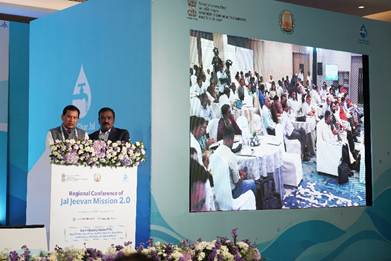
Shri C. R. Paatil, Hon’ble Union Minister of Jal Shakti, addressed the first Regional Conference on Jal Jeevan Mission (JJM) 2.0, organised by the Department of Drinking Water and Sanitation (DDWS), Ministry of Jal Shakti, in collaboration with the Government of Tamil Nadu. The two-day conference, being held on 12–13 November 2026, brings together senior officials and representatives from seven southern States and Union Territories namely, Tamil Nadu, Karnataka, Keralam, Andhra Pradesh, Telangana, Puducherry and Lakshadweep to review progress, address challenges and strengthen sustainable rural drinking water services. implementation
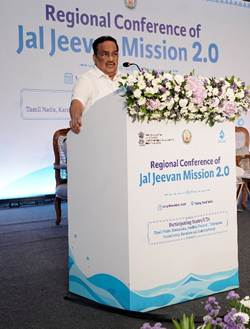
Chairing the Ministerial Session at the Conference, Hon’ble Union Minister of Jal Shakti, recalled the transformative vision of the Hon’ble Prime Minister behind the launch of Jal Jeevan Mission in 2019, aimed at ensuring access to tap water for every rural household. He highlighted the remarkable progress achieved under the Mission, with household tap water connections reaching approximately 16 crore rural households, significantly improving the lives of rural communities, particularly women.
The Union Minister noted that the Regional Conference was being organised as a follow-up to the Departmental Summit on Water held on 1–2 September 2026, to translate the deliberations and decisions of the Summit into concrete action at the State, district and village levels. He emphasised that the remaining works must be completed within the approved Mission timeline of December 2028 and appealed to States to make concerted efforts towards completing them by December 2027, wherever feasible.
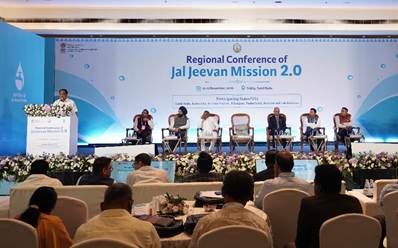
Hon’ble Minister underscored that JJM 2.0 represents a transition from infrastructure creation to assured and sustainable drinking water service delivery. He stressed the need for States to operationalise the prescribed structural reforms, particularly those relating to operation and maintenance (O&M), institutional accountability and long-term functionality of rural water supply systems. He reiterated the Government of India's commitment to providing financial support for eligible works, subject to fulfilment of the prescribed reform conditions, and urged States to accelerate implementation and effective utilisation of available resources.
Emphasising the importance of water security, the Union Minister called for greater attention to groundwater recharge, rainwater harvesting and community-led water conservation. Referring to Jal Sanchay Jan Bhagidari, he highlighted the potential of decentralised water conservation structures and urged States to strengthen convergence among departments and actively involve communities in source sustainability measures. He also encouraged participating States to exchange successful practices and adopt practical solutions to overcome implementation challenges.
Shri Thiru N. Anand, Hon’ble Minister, Rural Development and Panchayati Raj, and Water Resources in the Government of Tamil Nadu, highlighted the State's progress in expanding rural household tap water connections and strengthening drinking water infrastructure through combined water supply schemes and improvement of existing systems. He outlined initiatives relating to O&M, periodic cleaning of overhead tanks, community-based water quality testing, collection of water service charges and district-level monitoring of drinking water services. He reaffirmed Tamil Nadu's commitment to JJM 2.0 and emphasised continued Centre–State cooperation for completing the remaining works and sustaining drinking water services.
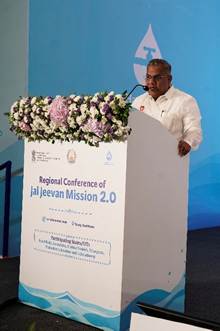
Shri Ashok K. K. Meena, Secretary, DDWS, stated that the Tiruchirappalli conference was the first in a series of five regional conferences aimed at translating the outcomes of the Department al Summit on Water held in September 2026 into actionable measures. He emphasised source sustainability, effective O&M arrangements, financial sustainability, skilled local workforce and strengthened Gram Panchayat-led governance as key priorities. He also highlighted the importance of digital platforms, including Sujalam Bharat, and inter-ministerial convergence to support sustainable service delivery.
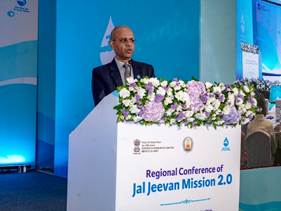
Shri Kamal Kishore Soan, Additional Secretary and Mission Director, NJJM, during his interactions across various presentations, emphasised the need to translate reforms into effective field-level implementation and strengthen interdepartmental coordination among Rural Development, Panchayati Raj and Rural Water Supply Departments.
He highlighted the need for regular assessment of drinking water sources, effective utilisation of Finance Commission grants, strengthening Gram Panchayat own-source revenue and ensuring sustainable financing for operation and maintenance.
During the Ministerial Session, Shri D. Senthil Pandiyan, Joint Secretary, DDWS, apprised the Hon’ble Union Minister on the objectives and key deliberations of the Regional Conference. He highlighted the importance of regional conferences as platforms for mutual learning, sharing of best practices and strengthening coordination among States/UTs. Referring to the historical significance of the Kallanai Dam and the Cauvery water management system, he emphasised community ownership, effective operation and maintenance, and interdepartmental convergence for ensuring sustainable rural drinking water services under Jal Jeevan Mission 2.0.
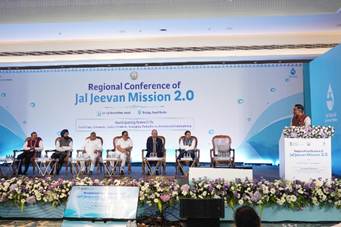
The conference commenced with a welcome address by Shri Dinesh Ponraj Oliver, Mission Director, JJM, Tamil Nadu. Senior officials of the Government of Tamil Nadu and representatives of participating States and Union Territories also attended the deliberations.
Shri Hari Narayan Murugun, Director, DDWS, presented the vision and key structural reforms under JJM 2.0 and reviewed the progress of participating States and Union Territories on various reform parameters. The presentation highlighted institutional strengthening, service utility arrangements, source sustainability, water quality governance, digital monitoring, capacity building and skilled human resources.
The Ministry of Skill Development and Entrepreneurship, represented by Dr. M Jayaprakashan, Regional Director, RDSDE, highlighted the importance of developing a skilled local workforce for the operation and maintenance of rural drinking water systems, including training and certification of village-level functionaries.
Shri Y. K. Singh, Director, DDWS, highlighted convergence opportunities with major tribal development initiatives, including PM-JANMAN and Dharti Aaba Janjatiya Gram Utkarsh Abhiyan (DA-JGUA), to address drinking water requirements in tribal and particularly vulnerable tribal group habitations.
The Ministry of Rural Development, represented by Ms. Deeksha Supyaal Bisht, Assistant Commissioner, VB-G RAM G and Shri Gauri Shankar, Project Officer, MoRD, presented opportunities for convergence under VB-G RAM G for water conservation, groundwater recharge, source sustainability and eligible maintenance-related interventions.
Shri Vipul Ujwal, Director, Ministry of Panchayati Raj, highlighted the central role of Gram Panchayats in sustaining rural drinking water services, with particular emphasis on O&M financing, integration of drinking water requirements into Gram Panchayat Development Plans (GPDPs) and utilisation of Finance Commission grants. The discussions also emphasised convergence of capacity-building modules developed under JJM 2.0 with the training framework of Rashtriya Gram Swaraj Abhiyan (RGSA).
Phani Kumar, Project Director, National Institute of Ocean Technology, highlighted its indigenous Low Temperature Thermal Desalination (LTTD) technology, with eight plants established in Lakshadweep to provide safe drinking water with minimal environmental impact. It also showcased an innovative Ocean Thermal Energy Conversion (OTEC) project integrating renewable energy generation with desalination to strengthen island water security.
Representatives from seven States/UTs—Karnataka, Tamil Nadu, Kerala, Andhra Pradesh, Telangana, Puducherry and Lakshadweep presented their achievements, key challenges, best practices and progress on reforms under Jal Jeevan Mission 2.0. The presentations covered physical and financial completion of schemes, Sujalam Bharat digital initiatives, geo-tagging of water supply assets, Jal Arpan and Har Ghar Jal certification, drinking water service delivery assessment, capacity building and skilling, community participation, and institutional, financial and source sustainability measures. States/UTs also shared innovative approaches, implementation challenges and time-bound action plans for accelerating reforms and ensuring sustainable rural drinking water services.
The conference provides an important platform for strengthening Centre–State coordination, promoting inter-departmental convergence and accelerating the implementation of JJM 2.0 reforms towards sustainable drinking water services for every rural household.
****
PS
(रिलीज़ आईडी: 2335598)
आगंतुक पटल : 154