PIB Backgrounder
Additive Manufacturing in India
Building India's Future with Next Generation Digital Manufacturing
प्रविष्टि तिथि:
07 OCT 2026 12:05PM by PIB Delhi
|
India is emerging as a competitive player in digital revolution through Additive Manufacturing (AM), a 3D printing technology in which digital file controls the process of manufacturing. The National Strategy for Additive Manufacturing (NSAM) is a strategy introduced in 2022 to build India's AM ecosystem. It has made steady progress so far, training over 1,54,000 individuals and supporting 56 AM start-ups. The strategy is now moving into its NSAM 2.0 phase, planning even bigger market than NSAM 1.0 - positioning AM as a building block of Atmanirbhar Bharat and Viksit Bharat.
|
India's Technology Story is Changing Gears
Over the last decade, India has moved from being only a user of technology to becoming a builder of it. Digital public infrastructure has already shown the world how India can build digital systems at population scale. That same confidence is now spreading from the digital world into the physical one - into how India designs, builds and manufactures things. This is where Additive Manufacturing (AM) enters the picture. It is the emerging technology and innovation that is quietly turning digital designs into real, physical objects.
Additive Manufacturing is becoming one of the newest engineering frontiers of India's manufacturing journey. The global AM machines market is projected to touch USD 149 billion by 2035, with the AM-electronics supply chain set to grow from USD 18 billion to USD 112 billion. This gives India a real opening to become a competitive manufacturer of AM platforms across polymers, metals, composites, ceramics and semiconductor-grade materials.
|
Creative Minds, Catalyzing Science, Empowering Technologies
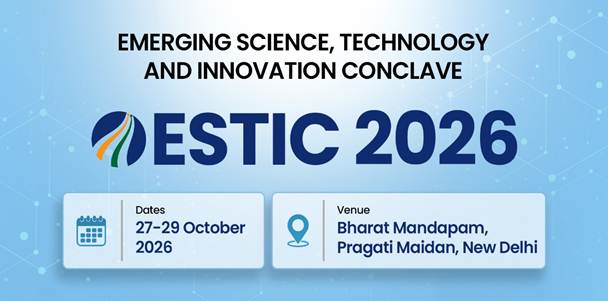
ESTIC-2026, the second edition of India’s Emerging Science, Technology and Innovation Conclave, will be held from 27–29 October 2026.The event will be held at Bharat Mandapam, New Delhi, under the theme “Creative Minds, Catalyzing Science, Empowering Technologies.” Organised by the Council of Scientific & Industrial Research (CSIR), ESTIC-2026 will advance emerging science and technology frontiers. These include Additive Manufacturing (AM) and other emerging technologies with potential for transformative applications. The conclave will catalyse strategic collaborations and support India’s vision of Viksit Bharat 2047.Spanning 12 thematic areas, the event will feature plenary sessions, technical discussions and exhibitions. Read More on Agenda: ESTIC 2026
|
Understanding Additive Manufacturing Technology
AM is not just another manufacturing tool - it is a form of digital engineering that brings in a digital file that completely controls the layer-by-layer material deposition and sometime material composition to build an object. It brings in convergence of computing, electronics, design software and materials science. Every AM object starts out as a digital file, so the technology is closely linked to tools like Computer-Aided Design (CAD), Artificial Intelligence and pattern recognition. AM works on a simple but powerful idea - building an object up, rather than cutting it down. Here is how a digital design turns into a physical object, step by step:
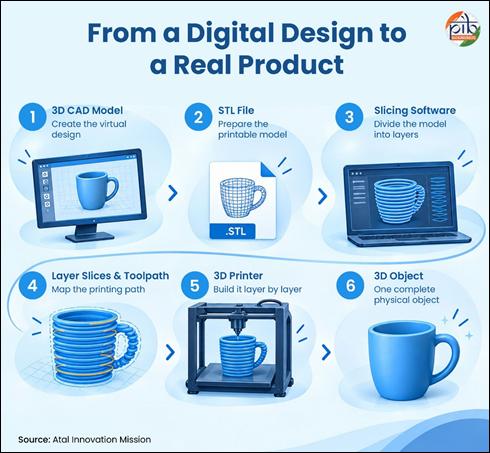
- Virtual design: The process begins with a digital design made in a CAD (Computer-Aided Design) file - either modelled from scratch or captured using a 3D scanner or now a days made using AI from mobile phone photos.
- STL file: A STL (Standard Tessellation Language) file represents a 3D model as a collection of triangular surfaces. It is one of the commonly used file formats for preparing models for AM. This file instructs what to build to the machine.
- Slicing: Slicing software divides this digital model into hundreds or thousands of horizontal layers. Once done it instructs machine how to print layer-by-layer.
- Printing: The sliced file is fed into the AM machine, which reads each layer and builds the object step by step.
- Additive Process: An AM object is built by laying down successive layers of material until it takes its final shape. Technology evolution has taken digital manufacturing to such accuracies in deposition and composition control that without the digital instructions printing process fails to build properly. Currently there are 40+ such processes in market and R&D stage.
- Final object: The printer fuses successive layers of material together into a single, complete three-dimensional object. Once printed, post processing is done to make it marketable.
|
Additive Manufacturing Materials
In myriad applications, the following material categories have been revolutionary in Additive Manufacturing.
- Thermoplastics: Thermoplastic polymers are the most popular types of AM materials. Acrylonitrile butadiene styrene (ABS), polycarbonate (PC) and polylactic acid (PLA) each offer distinct advantages in different applications. Water-soluble polyvinyl alcohol (PVA) is typically used to create temporary support structures, which are later dissolved away.
- Metals: Different metals and metal alloys are used in additive manufacturing, which include precious metals like gold and silver to strategic metals like stainless steel and titanium.
- Ceramics: A variety of ceramics including zirconia, alumina and tricalcium phosphate are also used in additive manufacturing. Also, alternate layers of powdered glass and adhesive are baked together to develop entirely new classes of glass products.
- Bio Materials: The biomaterials used in AM applications include the hardened material like silicon, calcium phosphate and zinc to support bone structures as new bone growth occurs. The bio-inks fabricated from stem cells are also being explored by researchers to form blood vessels, bladders and many other human organs. Also 3D Printing of human organs such as liver tissues, kidney, heart etc. are being printed using biomaterials and living cells.
|
Reshaping Key Sectors of the Indian Economy
AM is no longer confined to labs and prototypes. It is already being adopted across critical sectors of India's economy and Strategic Sector, backed by government and private players projects on the ground.
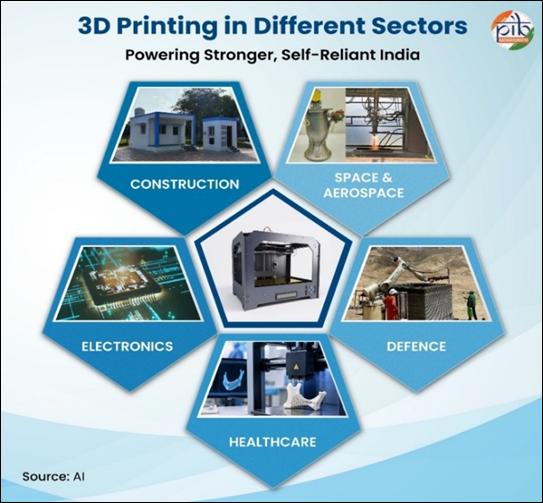
India's space programme is embracing additive manufacturing to build lighter, faster hardware. In May 2024, IIT Madras-incubated start-up Agnikul Cosmos launched Agnibaan - SOrTeD, featuring a single-piece, AM printed semi-cryogenic rocket engine. The mission demonstrated how additive manufacturing can enable complex engine designs and support faster, indigenous development of space hardware. NSAM is helping more such start-ups in their R&D for development of critical engine parts using AM.
The Armed Forces are turning to AM for faster, disaster-resilient construction. The Indian Army inaugurated its first AM-printed two-story dwelling unit at Ahmedabad, built in just 12 weeks, and has since extended the technology to precast defenses in operational terrains like Ladakh. NSAM is supporting all three branches of defense for establishing workshop level facilities for MRO applications.
Healthcare
India is building indigenous alternatives to imported medical technology through AM. MeitY has supported AM based medical device manufacturing and startups like OsteoForge that is AM printing natural silk-based implant development under NSAM. The Technology Development Board is supporting 3D-printed bone grafts made from indigenous bioceramic materials. The technology can create grafts customised to a patient’s specific needs and anatomy. It can reduce imports, strengthen domestic medical manufacturing and support more personalised healthcare.
India's network of AM centres is building indigenous capability in electronics-grade manufacturing. NSAM has successfully demonstrated AM printed electronics components such as batteries, antennas, varistors, capacitors and many more. A globally first, IISc has demonstrated Photonic Integrated Circuit blocks using AM printing.
India is exploring 3D printing as a potential solution for faster and more sustainable construction. The Kelvin 6K Pro, an on-site 3D construction printer, has demonstrated the ability to build 2,500 sq ft homes in under 30 days using low-carbon geopolymer material. The technology has the potential to reduce material and logistics costs, lower carbon emissions and improve construction efficiency. Early applications indicate potential for 30% lower material and logistics costs and 90% lower emissions compared with cement-based construction.
Behind this growing momentum lies a clear government push. Over the past few years, the Centre has moved from isolated pilot projects to a structured, mission-mode approach for Additive Manufacturing -backed by dedicated funding, institutions and a national strategy. NSAM is now developing concrete based supercapacitors for solar energy storage.
Government Policy Initiatives: Building an Indian AM Ecosystem
Recognizing AM as a strategic, next-generation manufacturing technology, the Government of India is building a structured national ecosystem. This effort is anchored in the National Strategy for Additive Manufacturing (NSAM). It is supported by growing national platforms, institutions and initiatives that are strengthening the ecosystem.
National Strategy for Additive Manufacturing (NSAM)
The Ministry of Electronics and Information Technology (MeitY) released the National Strategy for Additive Manufacturing (NSAM) in February 2022. NSAM serves as India’s guiding policy framework for 3D printing and additive manufacturing. Aligned with Make in India and Atmanirbhar Bharat, the strategy sets clear, time-bound national targets. These targets are being pursued through collaboration among the Centre, States, industry and academia.
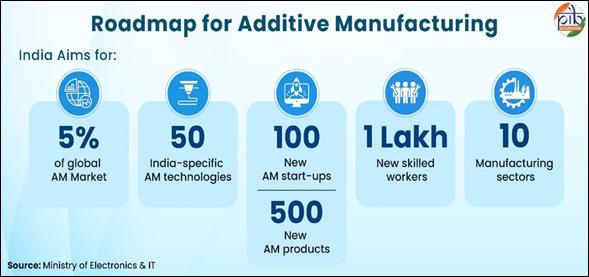
The national strategy aims to capture 5% of the global additive manufacturing market and add nearly US$1 billion to India’s GDP. It also targets the development of 50 India-specific additive manufacturing technologies, covering materials, machines, processes and software.
The strategy also seeks to nurture 100 new additive manufacturing start-ups and develop 500 new products. It also aims to train 1 lakh skilled workers for the additive manufacturing workforce. Another objective is to build additive manufacturing capabilities across 10 existing and emerging manufacturing sectors.
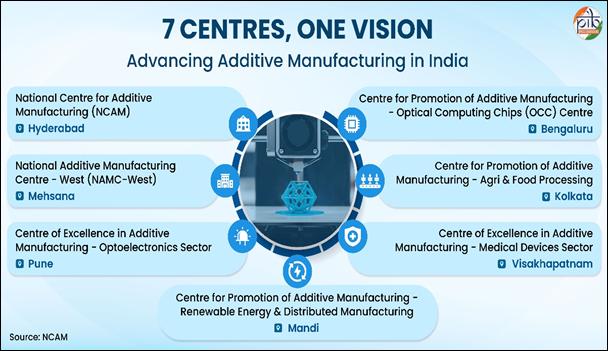
To further advance these objectives, the Government has established seven specialised Development and Deployment Centres. These centres support research and development, skilling and hands-on technology access.
|
Did you Know?
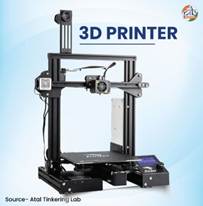
The Government of India is nurturing 3D printing skills at the school level through Atal Tinkering Labs (ATLs). Each lab receives a grant of ₹20 lakh to set up dedicated innovation workspaces of 1,200–1,500 sq ft, equipped with Do-it-Yourself (DIY) kits including 3D printers, Robotics, and Internet of Things (IoT). This gives students from Grade VI to Grade XII hands-on exposure to Additive Manufacturing early on - helping build India's future AM workforce from the classroom itself.
|
Progress Under NSAM
More than four years after its launch, the National Strategy for Additive Manufacturing (NSAM) has made steady and measurable progress. Government-supported initiatives have strengthened India’s additive manufacturing ecosystem through skilling, entrepreneurship, technology development and sectoral applications.
More than 1,54, 000 individuals have been trained in additive manufacturing-related skills, creating a growing skilled workforce. Fifty-six additive manufacturing start-ups have also been supported, strengthening India’s innovation and entrepreneurship base. The network of national centres has enabled the development of 65 India-specific technologies including materials, machines, Design for Additive Manufacturing (DfAM) and printed products. These capabilities are supporting the development of products and prototypes across aerospace, medical devices, electronics, energy, food processing and photonics.
NSAM 2.0 is being conceptualised to support India’s aspiration for AM market acceleration. The next phase plans to accelerate Intellectual Property Rights (IPR) generation, grow AM network through Digital Integration and proposes to develop globally competitive additive manufacturing technologies for commercialization. It aims to improve the affordability of machines and materials through clusters and strengthen the additive manufacturing electronics value chain.
NSAM 2.0 is planning to expand the additive manufacturing start-up base, provide extensive support to Indian defense and promote Sustainable Development Goal (SDG)-driven pilot programmes. It proposes to deepen international cooperation through standards, joint research and technology partnerships. These priorities can strengthen India’s technological capabilities and mainstream additive manufacturing across economic, industrial and societal applications.
|
National Additive Manufacturing Symposium (NAMS)
NAMS is a national platform for advancing India’s Additive Manufacturing (AM) ecosystem. It brings policymakers, scientists, industry, start-ups, academia and other AM stake holders together on a common platform. The platform promotes coordinated progress across policy, research, innovation and industry.
MeitY organised the 2nd NAMS edition on 13 March 2026 in New Delhi. NAMS 2026 strengthened collaboration across India’s AM ecosystem. MoUs were exchanged to deepen ecosystem partnerships, alongside the launch of new AM products. Panel discussions covered NSAM 2.0, defence adoption, industry perspectives and MeitY-supported R&D centres. The symposium also strengthened inter-ministerial coordination on AM applications. State Governments, industry and leading research institutions further strengthened the platform. These efforts highlight the growing relevance of AM across diverse sectors of the Indian economy.
|
Towards a Viksit Bharat
AM is steadily moving from India’s research labs into factories, defence establishments and hospitals. Backed by focused government policies, it is strengthening indigenous manufacturing and reducing reliance on imports. It is also supporting the vision of Atmanirbhar Bharat through greater domestic technological capabilities. As India scales its Additive Manufacturing ecosystem, it is creating skilled employment and strengthening its technology base. The technology also supports Industry 5.0 through digital production, advanced automation, distributed and flexible manufacturing. Its applications can further contribute to Sustainable Development Goals (SDGs) through resource efficiency, localised production and sustainable solutions. Together, these efforts position AM as an emerging contributor to India’s journey towards Viksit Bharat.
References:
NCAM
Atal Innovation Mission
Ministry of Electronics & IT
NIST
Others
Additive Manufacturing in India
*****
PIB Research
(रिलीज़ आईडी: 2319954)
आगंतुक पटल : 548