Ministry of Housing & Urban Affairs
Kerala’s EcoSense Scholarships: Empowering 46000 Students to Champion Waste Management
प्रविष्टि तिथि:
14 SEP 2026 5:26PM by PIB Delhi
From classrooms to communities, Kerala’s EcoSense initiative is turning students into active champions of waste management under Swachh Bharat Mission Urban 2.0. With nearly 46,000 scholarships awarded, the programme is building green skills and fostering sustainable habits among young citizens.
What if the journey towards a Garbage Free City could begin not at a waste processing facility, but inside a classroom? Kerala is doing exactly that.
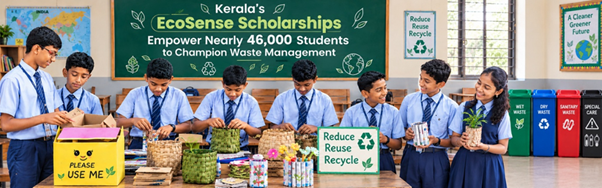
Across India, the Swachh Bharat Mission–Urban 2.0 (SBM-U 2.0) is driving a new generation of initiatives that go beyond infrastructure and waste management systems to focus on people, participation and behavioural change. By engaging children and youth in practical waste-management activities, these programmes are helping make segregation, reuse, resource conservation and sustainable living a part of everyday life.
Kerala’s Student Green Brigade Scholarship – EcoSense is a powerful example of this approach. Led by the Local Self Government Department, in collaboration with the General Education Department, Kerala, the initiative is turning schools into spaces where young minds do not just learn about waste management—they actively practise it.
Implemented under the leadership of the Local Self Government Department, in collaboration with the General Education Department, Government of Kerala, EcoSense has emerged as one of the State’s largest student-focused initiatives on waste management. The programme aims to provide scholarships to 50,000 students for their active engagement in waste management while nurturing a generation equipped with green skills and a strong sense of environmental responsibility.
The scholarship programme goes beyond creating awareness. It seeks to promote scientific waste management practices, encourage students to develop innovative solutions to local waste-related challenges, reduce waste generation and build practical understanding of sustainable waste management systems.
Under the scheme, 50 students from each Grama Panchayat, 75 students from each Municipality and 100 students from each Corporation are selected for the scholarship. This year, students from Classes 6 and 7 in the Upper Primary category, Classes 8 and 9 in the High School category, and first-year students of Higher Secondary and Vocational Higher Secondary categories were included.
Each selected student receives a scholarship of ₹1,500 along with a certificate of recognition, providing both encouragement and acknowledgement of their contribution towards Swachhata.
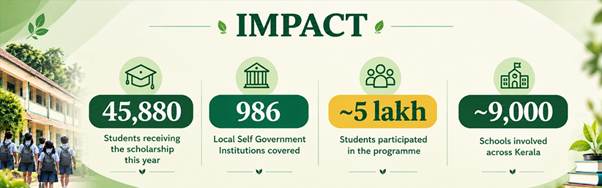
The scale of participation reflects the growing interest among Kerala’s students in environmental action. This year, the scholarship is being distributed to 45,880 students across 986 Local Self Government Institutions. Around five lakh students from nearly 9,000 schools participated in the programme, turning the initiative into a State-wide movement of learning and action.
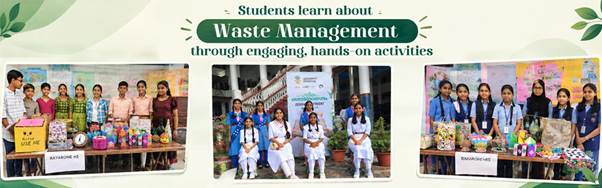
The programme was designed to give students hands-on exposure to waste management practices rather than limiting their engagement to classroom discussions. Through a range of activities, students explored waste management systems within their own homes, ways to reduce waste generation, adherence to the Green Protocol, and the principles of Green School and Clean School initiatives. They also gained practical knowledge of composting and the reuse of discarded materials.
At the school level, students and teachers took up diverse activities that translated these concepts into action. These included setting up bins for source-level waste segregation, developing systems to convert biodegradable waste into compost, establishing repair shops and promoting organic farming. Students also participated in household visits, swap shops and cleanliness clubs, while creatively reusing discarded materials through craft activities.
A particularly important aspect of the programme was the exposure provided through visits to Material Collection Facilities (MCFs) and Resource Recovery Facilities (RRFs). Such visits helped students understand what happens to waste after it leaves their homes and highlighted the importance of segregation at source for effective resource recovery and scientific waste management.
Students were also encouraged to take an active role in identifying and addressing waste-management concerns in their communities. Activities included reporting violations related to waste management and undertaking student-led household visits, enabling young participants to become ambassadors of responsible waste practices among their families and neighbourhoods.
Throughout November, Green Assemblies (Haritha Sabhas) were organised for children in schools across Kerala, creating another avenue for students to discuss environmental issues, share ideas and collectively explore solutions for better waste management.
By placing students at the heart of waste-management action, EcoSense demonstrates how youth can become powerful partners in building sustainable communities. From segregating waste at home and composting biodegradable waste to reusing discarded materials and understanding resource recovery, students are not merely learning about Swachhata—they are practising it.
*****
SK
(रिलीज़ आईडी: 2310134)
आगंतुक पटल : 275