Ministry of Statistics & Programme Implementation
MoSPI held Workshop on Data Harmonisation for Use of Administrative Data in Data Driven Governance
Pr. Secretary-2 to the PM: Trusted, timely and interoperable data is essential for evidence-based policymaking and data-driven governance
Secretary MeitY: Availability of high-quality data is fundamental to the successful deployment of AI for governance
Secretary, MoSPI: Harmonised, quality-assured and well-documented data is fundamental to an AI-ready government
प्रविष्टि तिथि:
08 SEP 2026 7:23PM by PIB Delhi
The Ministry of Statistics and Programme Implementation (MoSPI) organized a Workshop of Statistical Advisers (SAs) and Chief Data Officers of all Central Government Ministries, Departments and Organisations (MDOs) on September 08, 2026 at Rang Bhawan Auditorium, Akashwani Bhawan, Broadcasting House, Parliament Street, New Delhi – 110001 on the theme “Data Harmonisation for Use of Administrative Data in Data Driven Governance.” The workshop was aimed at strengthening the National Data System, promoting effective use and harmonisation of administrative data, and fostering greater coordination for data-driven governance and evidence-based policymaking across Government.
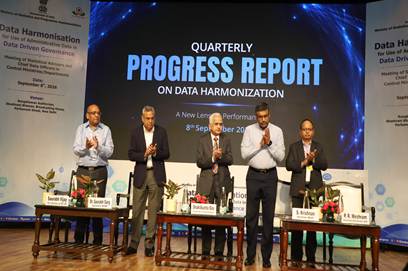
The inaugural session was graced by Shri Shaktikanta Das, Principal Secretary-2 to the Prime Minister, Shri S. Krishnan, Secretary, MeitY, Dr. Saurabh Garg, Secretary, MoSPI and Shri P. R. Meshram, Director General (Data Governance), MoSPI. The meeting was attended by Statistical Advisers, Chief Data Officers as well as other senior officers and other representatives from various Central Ministries/Departments of Government of India.
The Chief Guest, Shri Shaktikanta Das launched the Quarterly Progress Report (QPR) portal on Data Harmonisation (https://qpr.mospi.gov.in). The QPR Portal is a technology-enabled platform for use by all Central MDOs to report progress in identification and cataloguing of datasets made ready for dissemination, its metadata preparation, use of national and international standards, classifications and common unique identifiers in machine readable data, and performing quality checks as per Statistical Quality Assurance Framework (SQAF) by respective MDO. The QPR portal has automated validation, dashboards, cross-verification with the NMDS web portal and shall provide analytical insights across Ministries, Departments and Organisations
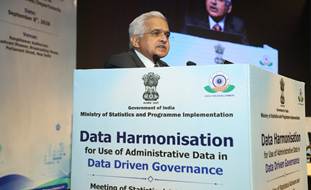
In his Keynote address, Shri Shaktikanta Das emphasised that trusted, timely and interoperable data is essential for evidence-based policymaking and data-driven governance. He called for greater use of administrative data and statistical expertise across Ministries/Departments for policy formulation, monitoring and outcome assessment. Key MoSPI initiatives, including NMDS 2.0, SQAF, statistical classifications, data lifecycle guidelines, e-Sankhyiki, Microdata Portal and QPR on Data Harmonisation, were highlighted as important enablers of a stronger administrative data ecosystem. He urged all Ministries/Departments to establish Data Governance Committees, publish data-sharing frameworks, maintain live dataset inventories and leverage existing national data-sharing platforms such as API Setu, data.gov.in, NDAP, AI Kosh, DigiLocker, Entity Locker, e-Sankhyiki and microdata portal. He stressed the need for a whole-of-government approach to build a modern, integrated, responsive and future-ready data ecosystem in line with the vision of Viksit Bharat 2047.
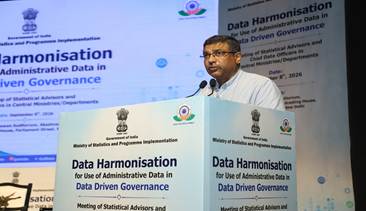
Shri S. Krishnan highlighted the importance of effective data sharing, harmonization and interoperability across Ministries/Departments to strengthen evidence-based policymaking and improve governance. It was emphasized that the availability of high-quality data is fundamental to the successful deployment of Artificial Intelligence (AI) for governance. He emphasized optimal utilization of government data in view of rapid digitization and the increasing availability of administrative data. Efforts should focus on utilizing such data effectively for improved welfare outcomes, policy formulation and delivery of government services. Whole-of-government approach should be adopted. Existing resources, including statistical officers, India AI Mission experts, NIC personnel and other data professionals working across Ministries/Departments, should be leveraged.
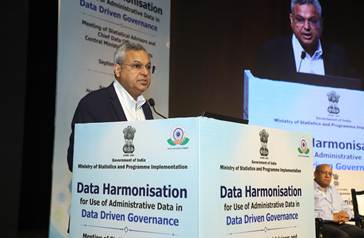
Dr. Saurabh Garg, Secretary, MoSPI, while setting the context for the meeting, underscored the need to move from siloed departmental data systems towards an integrated, interoperable and government-wide data ecosystem to support the vision of Viksit Bharat @2047. He emphasised harmonisation of concepts, definitions, classifications, identifiers, geographies, metadata and data structures for effective data utilisation. He highlighted the complementary roles of Statistical Advisers in statistical leadership and quality assurance and Chief Data Officers in data governance and interoperability, supported by the National Data Governance Committee and the QPR on Data Harmonisation. He stressed a “data discovery before data request” approach, noting that harmonised, quality-assured and well-documented data is fundamental to an AI-ready government. He called for continuous harmonisation, proactive data sharing and collective ownership of data as a national asset.
Shri P. R. Meshram, Director General (Data Governance), MoSPI, delivered the welcome address and highlighted the importance of data harmonisation and interoperability for strengthening data-driven governance and enabling effective use of administrative data across Government Ministries and Departments. The need to move beyond conventional data sharing towards common definitions, metadata, classifications, identifiers and interoperable systems was highlighted. The complementary roles of Statistical Advisors and Chief Data Officers (CDOs) in ensuring statistical quality, data governance and responsible data management were emphasised. He highlighted the importance of making data AI ready and machine readable. The road ahead is moving from structural interoperability to semantic interoperability, from isolated datasets to interoperable and linked data ecosystems, and from data availability to data readiness.
The technical sessions featured presentations on Data Harmonisation through the NMDS and QPR Portals; Model Data Sharing Framework and digital data-sharing mechanisms; institutional approaches to breaking data silos; AI-ready data ecosystems; Data DHARA methodology; India’s Digital Public Infrastructure; UPYOG; health data; and preparation of thematic and extended accounts to measure the contribution of an MDO in the economy.
The presentations highlighted how India can strengthen harmonisation, sharing and use of administrative data disseminated by any Ministry for AI-ready, data-driven governance by all Ministries. MoSPI showcased key initiatives including NMDS 2.0, SQAF, common identifiers and the QPR Portal, while MeitY presented the Model Data Sharing Framework and digital platforms for secure data sharing. The Ministry of Corporate Affairs demonstrated API-based interoperability, including beneficiary-validation use cases. National Urban Digital Mission and Government of NCT of Delhi’s Data DHARA highlighted the potential of harmonized data for real-time urban governance and improved service delivery. Other sessions covered interoperable cross-border trade data, AIKosh, health-data harmonisation, and MoSPI’s transition to the SNA 2025 framework. A key message was that data need not be centralised to generate value; use of common standards, common unique identifiers, APIs and governance mechanisms can enable interoperability across distributed data systems. The discussions emphasised the importance of preserving departmental ownership while ensuring privacy, security and responsible data sharing.
The workshop reaffirmed the commitment of MoSPI and participating Ministries/Departments to build a modern, harmonised, interoperable and data-driven National Data System for evidence-based governance.
******
SAMRAT
(रिलीज़ आईडी: 2307982)
आगंतुक पटल : 1182