PIB Backgrounder
7th Global Fintech Fest 2026
Potential to Impact
प्रविष्टि तिथि:
08 SEP 2026 6:01PM by PIB Delhi
Powering the FinTech Revolution
India is reshaping the global fintech landscape through scale, innovation and Digital Public Infrastructure (DPI). The introduction of Aadhaar, expansion of internet connectivity and development of Unified Payments Interface (UPI) transformed financial services. These innovations enabled digital identity, instant payments and consent-based data sharing at population scale. India’s experience demonstrates how technology can make financial services more accessible, efficient and inclusive.

This transformation has positioned India as a global centre for fintech innovation and digital finance. The Global Fintech Fest (GFF) 2026 reflects India’s growing global influence in this sector. The 7th edition of GFF is being held in Mumbai from 8 to 11 September 2026. It provides a platform for global dialogue, collaboration and innovation in financial technology.
Since its inception in 2020, GFF has grown into one of the world’s leading fintech gatherings. Its growth reflects increasing global interest in India’s digital financial architecture and fintech capabilities. The Fest provides an avenue to showcase India’s experience and exchange ideas with global innovators. It also strengthens engagement with developed economies, emerging markets and the Global South.
|
Institutions Driving the Success of GFF 2026
Payments Council of India (PCI), National Payments Corporation of India (NPCI) and Fintech Convergence Council (FCC) are the principal organizers of GFF. Additionally, GFF 2026 is supported by:
- Ministry of Electronics and Information Technology (MeitY)
- Department of Financial Services, Ministry of Finance
- New, Emerging and Strategic Technology (NEST) Division, Ministry of External Affairs
- NITI Aayog
- Reserve Bank of India (RBI)
- Securities and Exchange Board of India (SEBI)
- International Financial Services Centres Authority (IFSCA)
- Pension Fund Regulatory and Development Authority (PFRDA)
|
GFF 2026 - Powering the Next Wave of Financial Innovation
The 7th Global Fintech Fest 2026 is far more than a conference. It is the world's largest fintech festival, uniting the brightest minds to shape an AI-powered future. Every edition of the GFF journey has been driven by innovation and a shared vision of inclusive growth and prosperity.
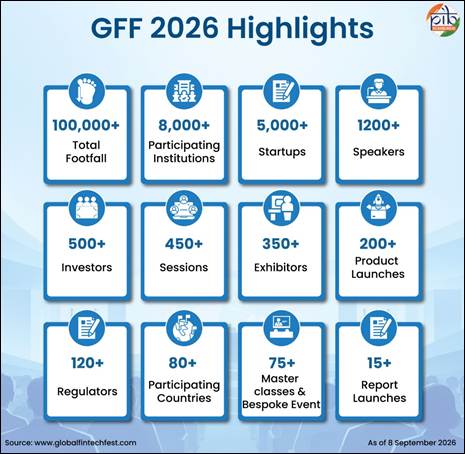
Global Fintech Fest - Theme & Agenda
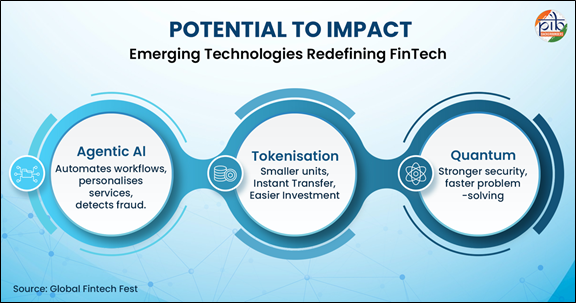
The theme of GFF 2026 is “Potential to Impact: Agentic AI | Tokenisation | Quantum: Trusted, Connected, Global Systems for Inclusive Finance.” It is built upon three foundational technologies that are shifting the landscape of global finance toward autonomous, programmable, and secure ecosystems.
- Agentic AI: It enables financial systems to sense, decide, and act in real time within strong governance frameworks. It orchestrates end-to-end workflows, strengthens regulatory oversight, enhances fraud prevention, and responsibly personalizes financial services at scale while empowering human decision-making through explainable intelligence.
- Tokenisation: It transforms assets into programmable digital units, enabling fractional ownership, instant settlement, and interoperable money. By unlocking liquidity and democratising access, it reshapes capital markets, payments, and participation across global financial systems.
- Quantum: Quantum technologies introduce a foundational shift in computation and security. From quantum-safe cryptography to advanced risk optimization, they strengthen systemic resilience and ensure long-term trust in the financial infrastructure of tomorrow.
Click Here to Access the Agenda GFF 2026
Understanding Fintech
FinTech is generally described as an industry that leverages technology to make financial systems and the delivery of financial services more efficient. It refers to “technologically enabled financial innovation” that can lead to new business models, applications, processes or products, with a significant impact on financial markets, institutions and the provision of financial services.
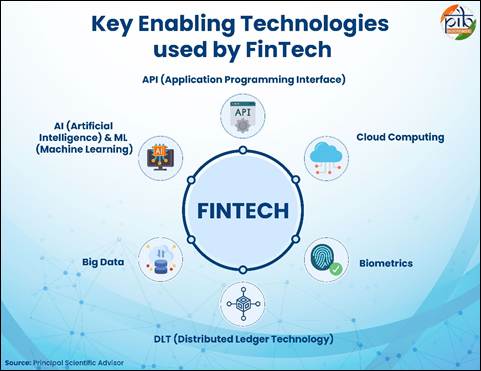
Key Enabling Technologies used by FinTech
- API (Application Programming Interface): APIs comprise a set of rules and specifications that software programmes use to communicate with each other. They allow new applications to be built on top of others.
- Cloud Computing: The use of an online network (‘cloud’) of hosting processors to increase the scale and flexibility of computing capacity, generating cost savings.
- Biometrics: The study of distinctive and measurable human characteristics that can be used to categorize and identify individuals.
- DLT (Distributed Ledger Technology): A digital system for recording the transaction of assets in which details are recorded in multiple places at the same time.
- Big Data: Voluminous amounts of structured or unstructured data that can be generated, analyzed and utilized by digital tools and information systems.
- AI (Artificial Intelligence) & ML (Machine Learning): IT systems that can perform functions that would otherwise require human capabilities. ML entails computers learning from data without human intervention.
Importance & Benefits of Fintech
FinTech has the ability to reshape the financial landscape in a fundamental way - offering consumers a wider choice of financial products at more competitive prices, while helping financial institutions operate more efficiently. FinTech is delivering measurable gains in efficiency, inclusion and financial stability across economies.
- FinTech has played a key role in making the financial sector more efficient. For example, UPI, recognised by the IMF as the world's largest real-time payment system, processed 2,365.8 crore transactions worth ₹29.88 lakh crore in July 2026 alone, with 741 banks live on the platform - transaction volumes have grown nearly 12,000-fold since FY 2016–17.
- By overcoming market failures such as information asymmetry or high transaction costs, FinTech helps enhance financial inclusion. India’s Financial Inclusion Index increased from 43.4 in March 2017 to 70.0 in March 2026.
- The growth of FinTech is diversifying credit sources beyond traditional banking channels. Greater diversity in credit provision can reduce systemic risks arising from dependence on a limited number of banks. This can strengthen the resilience, competition and stability of the financial ecosystem.
The Foundation of India's FinTech Success
India’s FinTech success is built on a decade of investment in Digital India and DPI. This foundation combines universal access, digital identity, interoperable payments and open digital networks. These capabilities have created an ecosystem where financial innovation can scale rapidly and inclusively. Click To read More: India’s Digital Public Infrastructure
- JAM Trinity: The Jan Dhan–Aadhaar–Mobile (JAM) Trinity provides the foundation for digital financial inclusion. Jan Dhan accounts provide access to formal banking, while Aadhaar enables secure digital identity. Expanding internet access connects citizens to digital financial services. As of 26th August 2026, 59.15 crore Jan Dhan accounts had been opened and Aadhaar enrolments crossed 144 crore by March 2026. It has created a large, accessible base for fintech services across the country.
- UPI: Unified Payments Interface (UPI) provides the interoperable payment infrastructure powering India’s digital transactions. UPI transactions reached 24,509 million in August 2026. The platform handles nearly 50% of global real-time digital transaction volume and operates in 11 countries. This open infrastructure allows fintech firms to build innovative payment solutions at population scale.
- Digital Identity and Documents: Trusted digital identity is essential for secure and efficient financial services. Aadhaar e-KYC enables digital customer verification while reducing paperwork and onboarding time. It has processed more than 2,458 crore transactionsas of 29 June 2026. DigiLocker has over 73.53 crore registered users and has issued 936.03 crore documents. These digital systems strengthen trust while simplifying customer onboarding and verification across financial services.
- Digital Welfare Delivery: Direct Benefit Transfer (DBT) uses digital financial infrastructure to transfer benefits directly into beneficiaries’ bank accounts. This reduces intermediaries, improves transparency and supports faster delivery of government benefits. Cumulative DBT transfers reached ₹53.26 lakh crore as of September 2026. Such large-scale digital transfers demonstrate the capacity of India’s financial infrastructure to deliver services efficiently.
- Open Digital Commerce: Open Network for Digital Commerce (ONDC) extends India’s interoperable digital approach beyond payments. By June 2026, ONDC had reached over 20 crore buyers and 5 lakh sellers across 1,000+ cities. Its Financial Services category is creating additional opportunities for digital financial products. This open architecture can help fintech firms reach new users and markets more efficiently.
A Robust, Trusted Regulatory Ecosystem
As India's FinTech sector has scaled, the Government and the Reserve Bank of India have continuously strengthened the regulatory and consumer-protection architecture that underpins public trust in digital finance.
- Self-regulation and standards: RBI's Framework for Self-Regulatory Organisation(s) in the FinTech Sector (SRO-FT, May 2024) promotes ethical conduct, market integrity and dispute resolution within the industry.
- Payment security: RBI's Master Directions on Digital Payment Security Controls (2021) mandate common minimum-security standards across various payment channels (including internet and mobile banking) to combat web and mobile app threats, while NPCI has deployed Artificial Intelligence (AI)/Machine Learning (ML) based fraud monitoring for UPI transactions.
- Data protection: The Ministry of Electronics and Information Technology notified the Digital Personal Data Protection Act in 2023 and the Digital Personal Data Protection Rules in 2025 to safeguard the personal data of individuals.
- Safe innovation testing: The Reserve Bank of India introduced the Regulatory Sandbox framework in August 2019, allowing innovative financial products and services to be tested in a controlled regulatory environment, with or without regulatory relaxations.
- Consumer protection in digital lending: A strengthened regulatory framework, a Digital Lending Apps (DLA) directory and cybercrime-reporting mechanisms (the National Cybercrime Reporting Portal at cybercrime.gov.in and Helpline 1930) safeguard citizens against fraudulent lending apps, while the public-facing SACHET portal facilitates complaints specifically regarding the illegal collection of deposits.
- The regulatory approach is therefore not limited to responding to innovation after it reaches the market. It creates institutional mechanisms through which responsible innovation can be tested, assessed and supported.
Way Forward
India’s FinTech ecosystem is built on scale, interoperability, innovation and institutional trust. Its Digital Public Infrastructure provides a strong foundation for accessible, affordable and inclusive financial services. The next phase should deepen digital sovereignty, technological self-reliance and responsible innovation. Open digital platforms can further democratise technology for citizens, start-ups and businesses.
Emerging technologies can enable smarter, safer and more efficient financial services. Artificial Intelligence, tokenisation, blockchain and quantum technologies can unlock new opportunities across the financial ecosystem. Strong cybersecurity, data protection and consumer safeguards will remain essential as digital finance expands. FinTech innovation should remain anchored in people-centric governance, inclusion and public value.
India can further share its digital expertise through partnerships with emerging economies and the Global South. This can strengthen India’s role as a trusted partner in building inclusive digital financial systems. The way forward is to build a sovereign, secure and inclusive digital financial ecosystem. This approach can position India as a global leader in shaping the future of people-centric digital finance.
References
Global FinTech Fest
PIB
Ministry of Finance
National Payments Corporation of India
Reserve Bank of India
Others
7th Global Fintech Fest 2026
*****
PIB Research
(रिलीज़ आईडी: 2307925)
आगंतुक पटल : 695