PIB Backgrounder
Nuclear Energy in India
Applications, Safety, and Preparedness
प्रविष्टि तिथि:
28 AUG 2026 10:15AM by PIB Delhi
|
India's nuclear energy programme is built on the principle of safety first. Guided by stringent regulatory oversight, multiple layers of protection and comprehensive emergency preparedness, it safeguards people and the environment while providing reliable low-carbon electricity. Beyond power generation, atomic energy supports healthcare, agriculture, food preservation, industry, scientific research and clean hydrogen production. Through the SHANTI Act, 2025, the Nuclear Energy Mission for Viksit Bharat and indigenous technologies, India is expanding nuclear energy as a safe, sustainable and future-ready pillar of national development.
|
Nuclear Energy for India's Inclusive Development
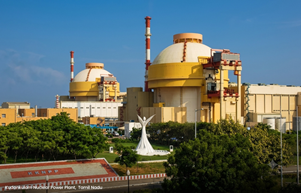
Nuclear energy has been an integral part of India's development journey since the Tarapur Atomic Power Station began operations in 1969. Today, it powers homes, industries, and economic growth with reliable, low-carbon electricity. Beyond power generation, nuclear technologies support healthcare, agriculture, food preservation, industry, water desalination, and scientific research. Safety remains the cornerstone of India's nuclear programme. Every nuclear facility operates under a robust regulatory framework with multiple safety barriers, continuous monitoring, emergency preparedness, and stringent security protocols.
India also works closely with the International Atomic Energy Agency (IAEA) to strengthen nuclear safety, security, and safeguards. India currently operates 24 nuclear power reactors across seven sites with a total installed capacity of 8.78 GW. Nine additional reactors are under construction, while preparations continue for 10 more units. The Nuclear Energy Mission for Viksit Bharat aims to achieve 100 GW of nuclear power capacity by 2047. The Union Budget 2025–26 allocated ₹20,000 crore for indigenous Small Modular Reactors. The SHANTI Act, 2025, further strengthens the framework for the safe, secure, and future-ready expansion of India's nuclear energy programme.
|
Nuclear Power: Carbon-free Source of Power
Nuclear power is India's most carbon-efficient clean energy source per unit of installed capacity. In FY 2025–26, one gigawatt of nuclear capacity avoided about 5.4 million tonnes of CO₂ equivalent emissions, compared with 2.7 million tonnes for hydropower, 1.6 million tonnes for wind, and 0.9 million tonnes for solar power. Since 1969, India's nuclear power programme has cumulatively avoided 851 million tonnes of CO₂ equivalent emissions- equivalent to the annual carbon sequestration of over 38 billion mature trees.
|
Nuclear Energy Applications Beyond Electricity
Nuclear energy technologies have diverse applications across sectors. These applications contribute to public welfare, technological advancement and sustainable national development.
Nuclear technology is transforming healthcare through early disease diagnosis, precision cancer treatment, and advanced medical research. Research institutions under the Department of Atomic Energy, including the Bhabha Atomic Research Centre (BARC), Indira Gandhi Centre for Atomic Research (IGCAR), Tata Memorial Centre (TMC), Tata Institute of Fundamental Research (TIFR), and Harish-Chandra Research Institute (HRI), are developing indigenous radiopharmaceuticals, advanced imaging technologies, and innovative cancer therapies.
The Government is also expanding access to affordable cancer care. In 2025, the 150-bed Homi Bhabha Cancer Hospital and Research Centre in Muzaffarpur was inaugurated. During FY 2024–25, the Tata Memorial Centre registered 1.3 lakh patients and screened around five lakh women for oral, breast, and cervical cancers. Indigenous radiation technologies also sterilised 1.53 crore medical devices, improving patient safety and reducing healthcare-associated infections.
Nuclear technology supports agriculture through the development of improved crop varieties using radiation-induced mutagenesis along with cross breeding. These varieties offer higher yields, larger seed size, improved quality traits, early maturity, and greater tolerance to drought, heat, salinity, and diseases. The DAE is also promoting radiation technologies for the preservation of food and agricultural products by extending shelf life, reducing post-harvest losses, enabling chemical-free preservation of grains and spices, and helping meet international phytosanitary requirements for exports.
BARC has developed 70 crop varieties, including TBM-9 banana and RTS-43 sorghum, released in 2025. These high-yielding and early-maturing varieties are cultivated across the country. BARC also collaborates with the Indian Council of Agricultural Research (ICAR) and agricultural universities to accelerate crop improvement and strengthen food security.
Radiation technology supports food preservation by extending the shelf life of agricultural produce, fish and spices while reducing spoilage. The shelf-life extension of mangoes has enabled cost-effective export by sea route, while the shelf-life extension of onions and potatoes reduces spoilage and provides economic benefits to farmers. Radiation processing of various food items is approved by the Food Safety and Standards Authority of India.
The government signed 17 MoUs in 2025to expand food irradiation infrastructure. Six gamma radiation processing facilities were commissioned, increasing the country's operational facilities to 40. These facilities help preserve the quality of fruits, vegetables, grains, and other perishable commodities.
Mining and Rare Earth Elements
Nuclear technology is playing an important role in strengthening India's critical mineral and rare earth ecosystem. Advanced nuclear analytical techniques support the exploration, characterisation and processing of mineral resources, improving the accuracy of ore assessment, extraction and quality control.
India has released its first Certified Reference Material, Ferrocarbonatite (FC) – BARC B1401, for Rare Earth Elements. It is the first of its kind in India and the fourth globally. It provides a standard benchmark for geochemical analysis, supporting reliable exploration, efficient extraction and process control in rare earth ore mining, while contributing to the country's critical mineral security.
Semiconductors and Electronics
Nuclear technology is contributing to the growth of India's semiconductor ecosystem through indigenous research and advanced materials development. High-purity isotopes and speciality materials produced using nuclear technologies are critical for semiconductor manufacturing, supporting precision fabrication, advanced electronics and strategic technology applications.
India has established its first Electronics-grade (99.8% purity) Boron-11 Enrichment Facility at Talcher for semiconductor applications. The enriched product has been successfully converted into purified enriched boric acid for further processing, strengthening the India Semiconductor Mission, reducing import dependence on critical electronic materials, and advancing technological self-reliance.
Hydrogen is widely regarded as a key energy carrier for the future and is expected to play an important role in the transition to clean and sustainable energy systems. Nuclear energy offers a carbon-free pathway for hydrogen production by providing both reliable electricity and high-temperature process heat, reducing dependence on fossil fuels and greenhouse gas emissions associated with conventional production methods
In 2026, India inaugurated the world's first hydrogen production facility using nuclear process heat at Kalpakkam. The indigenous technology supports clean energy, energy security and India's Net Zero and National Green Hydrogen Mission goals.
The expanding applications of nuclear technology reflect India's growing scientific and technological capabilities. Continued investments in research, innovation, and indigenous technologies will unlock new opportunities across strategic sectors, supporting economic growth, energy security, and national development.
India's Nuclear Plants Ensure Safety
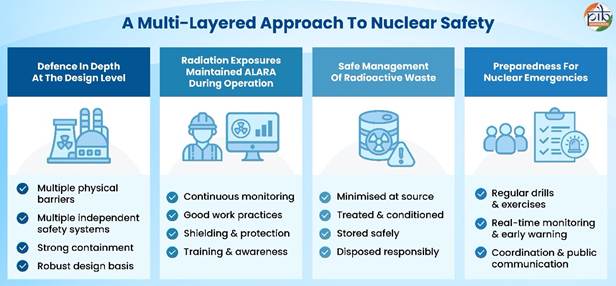
The accidental release of radiation and radioactive material into the surrounding environment and atmosphere is the primary safety concern associated with nuclear power plants. Indian nuclear power plants are designed, constructed, and operated with multiple layers of safety to protect people and the environment.
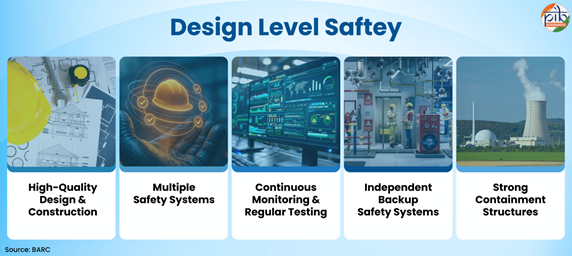
India's nuclear power plants follow the globally accepted Defence in Depth design philosophy, ensuring multiple layers of protection against accidents. Safety begins with high-quality design, construction, rigorous quality control, and fail-safe engineering. Continuous monitoring, regular testing, and redundant safety systems detect and manage equipment or human failures. Multiple physical barriers prevent the release of radioactive material into the environment. These include ceramic fuel pellets, sealed zirconium alloy fuel rods, a robust pressure vessel or pressure tubes, and a reinforced concrete containment structure. Independent backup systems provide emergency reactor shutdown, core cooling, and reliable power supply during unlikely events. Every plant is designed to withstand earthquakes, floods, cyclones, tsunamis, and other external hazards.
Radiological Protection during Operations
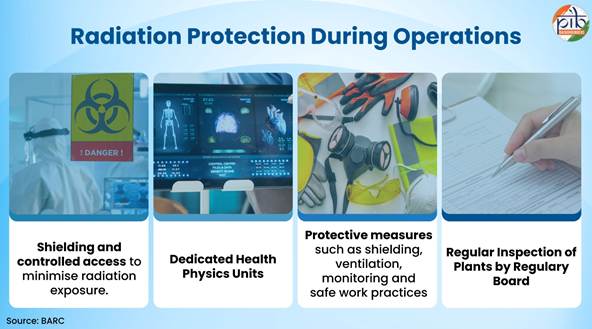
India's nuclear power plants follow the As Low as Reasonably Achievable (ALARA) principle to minimise radiation exposure. Plant layouts, shielding, and maintenance practices are designed to keep occupational radiation doses as low as possible. The AERB prescribes an average occupational dose limit of 20 millisieverts (mSv) per year over five years, with a cumulative limit of 100 mSv and a maximum of 30 mSv in any year. Every nuclear power plant has a dedicated Health Physics Unit that continuously monitors radiation levels, personnel exposure, plant systems, and environmental releases. Engineering controls, protective equipment, ventilation systems, and regular training further strengthen radiation safety.
|
Millisievert (mSv)
A mSv measures the effect of radiation on the human body. In India, the annual radiation dose limit for the public is 1 mSv, which is well within safe limits and ensures strong protection of people and the environment during normal nuclear power plant operations. AERB conducts periodic regulatory inspections to verify compliance with these radiation safety standards.
|
Management of Radioactive Waste
Safe radioactive waste management is central to India's nuclear programme. Every stage, from treatment to disposal, follows a rigorous, multi-layered regulatory framework. The Atomic Energy Regulatory Board (AERB) oversees all waste management activities. Operations comply with the Atomic Energy (Safe Disposal of Radioactive Wastes) Rules, 1987 and the AERB Safety Code on Radioactive Waste Management. The Environmental Survey Laboratories of the BARC continuously monitor environmental safety. Waste handling facilities also remain under round-the-clock surveillance.
Liquid radioactive waste is treated, diluted and discharged only after meeting stringent safety standards. Solid waste is processed and disposed of in specially engineered on-site facilities. Disposal methods are matched to the waste's radioactivity levels. The AERB prescribes site-specific discharge limits and regularly verifies compliance. Nuclear power plants continuously reduce waste generation through improved technologies and operational practices. This comprehensive approach protects people, safeguards the environment, and upholds the highest standards of nuclear safety.
|
Vitrification Technology
India is among the few countries with indigenous vitrification technology for the safe management of high-level radioactive waste. The Bhabha Atomic Research Centre (BARC) has developed this technology, which converts high-level radioactive waste into stable glass blocks for safe long-term management.
|
Collectively, these measures ensure the safe, secure, and reliable operation of India's nuclear facilities in line with stringent national regulations and international safety standards.
Preparedness for Nuclear Emergencies
India has established a multi-level governance framework for nuclear emergency preparedness, integrating national, state, district, and plant-level response mechanisms. Led by the DAE and regulated by the AERB, the framework ensures coordinated planning, rapid response, and public protection during any unlikely nuclear or radiological emergency.
- Integrated National Framework: Nuclear and radiological emergencies are covered under the National Disaster Management Plan and integrated into district disaster management plans.
- Dedicated National Coordination: The DAE leads technical preparedness and response through a dedicated Crisis Management Plan.
- Mandatory Emergency Preparedness: Every nuclear power plant maintains mandatory On-site and Off-site Emergency Response Plans approved by the AERB.
- Multi-Agency Emergency Planning: Nuclear power plants, District Administration and District Disaster Management Authorities conduct regular mock drills and emergency exercises.
- Capacity Building and Public Protection: Police, emergency responders and other agencies receive specialised training. Radiation detection equipment has been deployed at key locations.
- Medical Preparedness: The Ministry of Health and Family Welfare, Department of Atomic Energy and Nuclear Power Corporation of India Limited train medical professionals and maintain Radiation Emergency Medical Networks for specialised care.
- Exclusion and Emergency Planning Zones: Nuclear power plants are located in low-population areas, with dedicated safety zones and a 16-kilometre Emergency Planning Zone to support coordinated emergency response, if ever required.
- Monitoring: Every nuclear power plant has an Environmental Survey Laboratory that continuously monitors air, water, soil, vegetation and food during normal operations and any unlikely emergency.
|
PHWRs Built with Multi-Layered Safety
Indian Pressurised Heavy Water Reactors (PHWRs) are equipped with two independent and diverse shutdown systems. If abnormal operating conditions are detected, these systems automatically shut down the reactor, while dedicated cooling systems continue to remove heat from the reactor core to maintain safety.
|
These measures reflect India's commitment to protecting people, the environment, and critical infrastructure through a robust, internationally aligned nuclear emergency management system.
Nuclear Energy: Myths and Facts
Nuclear energy has transformed electricity generation, healthcare, agriculture and industry, yet several misconceptions continue to shape public perception. Scientific evidence and decades of safe operation provide a clear understanding of its safety, reliability and peaceful applications.
Myth: Living near a nuclear power plant is harmful to health.
Fact: Radiation from operating nuclear power plants remains well within prescribed safety limits and poses no increased health risk to nearby communities.
Myth: Radioactive waste cannot be managed safely and will permanently contaminate the environment.
Fact: Radioactive waste is safely managed through multiple protective barriers, continuous monitoring and strict regulatory oversight.
Myth: Any amount of radiation is harmful.
Fact: Radiation is a natural part of our environment. Low levels of radiation from the sun, soil, air and food are part of everyday life and are not harmful.
Myth: India's nuclear power plants are unsafe.
Fact: India has maintained a strong nuclear safety record for decades. Multiple safety systems and physical barriers ensure the safe operation of nuclear power plants.
Myth: Transporting nuclear material on our roads/railways is extremely risky for the public.
Fact: Nuclear material is transported in specially designed, tested containers that meet national and international safety standards.
Myth: Nuclear power harms the environment just like coal or oil.
Fact: Nuclear power generates clean, low-carbon electricity without burning fossil fuels, helping reduce carbon dioxide emissions by replacing coal.
Myth: Plutonium / Nuclear material: Touching it can be fatal.
Fact: Nuclear materials are handled under strict safety controls. Specialised procedures and protective equipment prevent exposure and ensure safe handling.
Myth: We should choose renewables instead of nuclear.
Fact: Nuclear and renewable energy complement each other. Nuclear provides reliable 24×7 electricity and requires much less land than solar.
India's nuclear programme is built on scientific excellence, stringent safety standards and regulatory oversight. Greater public awareness strengthens confidence in the safe, secure and peaceful use of atomic energy for national development.
|
Radiation Monitoring
Extensive health surveys around Uranium Corporation of India Limited's uranium mining areas in Jharkhand have found that the health issues observed among villagers are similar to those generally found in rural areas with comparable socio-economic conditions. There is no evidence that local disease patterns are linked to radiation exposure. Continuous health monitoring, environmental surveillance and community welfare programmes are being carried out by the UCIL in collaboration with the BARC and regulatory agencies.
|
Conclusion
India's nuclear programme reflects the Government of India's steadfast commitment to energy security, technological self-reliance, public welfare, and the highest standards of safety. Beyond generating clean electricity, nuclear technologies are transforming every sector across the country. Guided by transformative initiatives such as the Nuclear Energy Mission for Viksit Bharat and the SHANTI Act, India is building a resilient, innovation-driven, and future-ready nuclear ecosystem. Robust regulatory oversight, advanced reactor designs, and comprehensive emergency preparedness continue to ensure the safe and secure operation of nuclear facilities. Following the 2011 Fukushima accident, every Indian nuclear power plant underwent a comprehensive safety review, reaffirming the strength of India's reactor designs. All recommended short-term and medium-term safety enhancements have been completed, while long-term upgrades continue across existing and future reactors. As India advances towards Viksit Bharat 2047 and its Net Zero target by 2070, nuclear energy will remain a key pillar of sustainable development, energy security, and national progress.
References:
Department of Atomic Energy
Atomic Energy Regulatory Board (AERB)
Bhabha Atomic Research Centre (BARC)
Nuclear Power Corporation of India Limited (NPCIL)
Press Information Bureau
Click here to see PDF
*********
PIB Research
(रिलीज़ आईडी: 2304032)
आगंतुक पटल : 468