PIB Backgrounder
Ken-Betwa Link Project
Frequently Asked Questions (FAQs)
प्रविष्टि तिथि:
21 AUG 2026 4:25PM by PIB Delhi
About the Project
- What is the Ken-Betwa Link Project?
The Ken–Betwa Link Project (KBLP) is a major water-resources development project intended to address the long-standing water scarcity and irrigation challenges of the Bundelkhand region of Madhya Pradesh and Uttar Pradesh.
The project envisages transfer of water from the Ken basin to the Betwa basin through a system comprising the Daudhan Dam, link canal and associated works. KBLP is the first priority project under the National Perspective Plan for Interlinking of Rivers to enter the implementation stage.
- What is the scheme of the project?
This project involves transfer of water from the Ken to the Betwa River through construction of the 96.7 m high Daudhan Dam on the Ken River in Panna and Chhatarpur districts of Madhya Pradesh, about 40 km from Khajuraho. A 216.465 km-long Ken–Betwa Link Canal will take off near the Daudhan Dam and merge into Barua Sagar near Jhansi. Other components include the Lower Orr Project, Kotha Barrage, and Bina Complex Multipurpose Project.
The Project also includes various irrigation and water infrastructure works to be implemented by the Governments of Uttar Pradesh and Madhya Pradesh, including modernization and strengthening of existing canal systems, renovation of tanks and weirs, construction of barrages, development of pumping and pressurized pipe/micro-irrigation systems, stabilization and development of new command areas, and implementation of associated water supply and irrigation projects.
- What is the total cost of the project
The total cost of the project is ₹44,605 crore.
- What is the status of this project
The foundation stone of the project was laid by Hon’ble Prime Minister Shri Narendra Modi on 25th December 2024. The dam is under construction, while work on the canal is yet to begin. The Lower Orr Project, Kotha Barrage, and Bina Complex Multipurpose Project are under construction. Preparation of DPR of other state-specific projects of MP and UP is also under finalisation stage. The Project is scheduled for completion in 2030.
- Why is this project needed?
Bundelkhand region has historically faced recurrent water scarcity, dependence on rainfall, inadequate irrigation facilities, declining groundwater availability in several areas and vulnerability of agriculture to drought.
The Ken Betwa Link Project is designed to provide more dependable water availability for irrigation and drinking-water requirements while also generating renewable energy and supporting broader regional development. The project is therefore not merely an irrigation project; it is envisaged as a comprehensive water-security and regional-development initiative for Bundelkhand.
- What are the main benefits of the project?
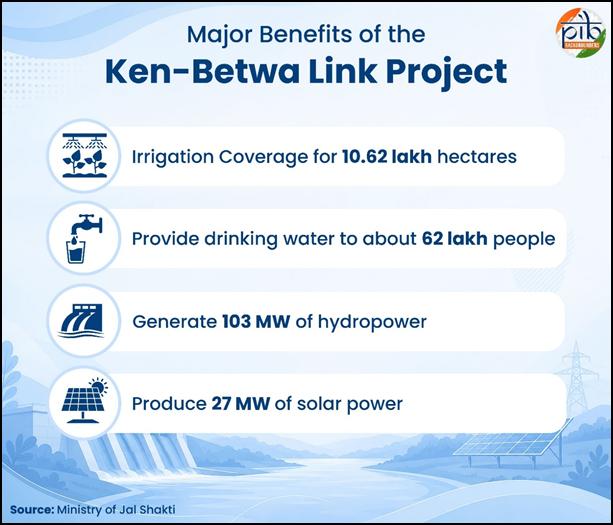
The Project will provide irrigation to 10.62 lakh ha, drinking water to about 62 lakh people, and generate 103 MW of hydropower and 27 MW of solar power. Thus, it will supply clean drinking water, electricity, and reliable year-round irrigation across vast farmlands in Madhya Pradesh and Uttar Pradesh, permanently resolving the long-standing water crisis in the Bundelkhand region.
- Which areas will benefit from this project?
The project will benefit the water-starved Bundelkhand region across Madhya Pradesh and Uttar Pradesh, covering districts such as Chhatarpur, Newari, Tikamgarh, Panna, Sagar, Damoh, Datia, Vidisha, Shivpuri, and Raisen in M.P., and Banda, Mahoba, Jhansi and Lalitpur in U.P.
- Will the Ken–Betwa Link Project create new jobs in the local area?
Yes. The Ken–Betwa Link Project (KBLP) is generating employment opportunities in the local area, particularly during the ongoing construction phase. Employment is being generated in civil construction, engineering, transportation, material supply, equipment operation, security, services and other ancillary activities. Local shops, transporters, suppliers and service providers are also benefiting from increased economic activity. In the long term, improved irrigation and water availability will support agriculture and allied activities, creating further livelihood and employment opportunities in the region.
- How will the Ken–Betwa Link Project improve agriculture in Bundelkhand?
The Ken–Betwa Link Project is providing more reliable irrigation water, reducing dependence on uncertain rainfall and helping farmers plan agricultural activities with greater confidence. The improved availability of irrigation water is expected to support increased cropping intensity, higher crop productivity, crop diversification, cultivation of high-value crops, reduced vulnerability to drought and improved farm incomes, thereby strengthening rural livelihoods in the Bundelkhand region.
- Will KBLP eliminate drought in Bundelkhand?
It would not be appropriate to claim that the project will completely eliminate drought.
Rather, KBLP is intended to substantially improve water security and drought resilience in its command and beneficiary areas by providing dependable irrigation and drinking-water support.
- Will groundwater levels improve?
The availability of surface water for irrigation and other uses can reduce excessive dependence on groundwater in appropriate areas. The project also envisages rejuvenation/feeding of tanks along the link canal, wherever technically feasible, which can contribute to groundwater recharge and local water security.
Actual groundwater improvement will depend on local hydrogeological conditions and sustainable groundwater-use practices.
- How does the wider region gain from this development?
By protecting crops from drought, it will boost harvests, reduce losses, and raise family incomes for farmers, while better utilities and transport links create new jobs and uplift everyday living standards for the entire community. It is expected to boost socio-economic prosperity in this backward region through increased agricultural activities, employment generation, and reduced distress migration. Better infrastructure attracts new schools, healthcare clinics, commercial markets, and agro-industries, transforming the area into a prosperous one.
- Will downstream villages face any water shortage?
No. Continuous minimum environmental water release is strictly maintained around the year to ensure that downstream farming, drinking water needs, and aquatic ecosystems remain undisturbed. Similarly, the water infrastructure created under the region would also enhance the groundwater in the region.
- How are flood risks managed during heavy monsoons?
The dam will act as a cushion against floods. Its automated spillway gates and 24/7 control rooms monitor water inflow to prevent sudden flooding in low-lying villages.
- Are the benefits of KBLP greater than its impacts?
The project has been evaluated through the prescribed technical, economic, environmental and social assessment processes. KBLP is intended to deliver large-scale benefits in irrigation, drinking water and renewable energy while implementing mitigation and R&R measures for unavoidable impacts.
The appropriate approach is therefore not to ignore the impacts, but to minimize, mitigate, compensate and responsibly manage them while delivering the intended public benefits.
- Is the Ken–Betwa Link Project beneficial only to farmers?
No. The Ken–Betwa Link Project (KBLP) provides benefits beyond irrigation to farmers. It supports farmers through irrigation facilities; rural and urban populations through drinking water supply; the energy sector through hydropower generation; and local communities through employment, infrastructure and increased economic activity. Overall, the project is strengthening water security, agricultural development and socio-economic growth in the Bundelkhand region.
- Will KBLP improve transportation infrastructure?
Major water infrastructure projects require construction and improvement of access roads, bridges, approaches and other associated infrastructure. Where such infrastructure is developed or upgraded as part of the project, it will facilitate improved connectivity to nearby areas.
- Will project roads benefit local communities?
Project-related roads and connectivity infrastructure will facilitate secondary benefits to surrounding communities and people at large such as:
- movement of agricultural produce;
- access to markets;
- access to schools and healthcare;
- construction and economic activities;
- movement of people and goods; and
- access to project facilities.
- Will KBLP directly develop a new transport corridor?
KBLP is primarily a water-resource and energy project. Any transport-related benefit should therefore be described in terms of project-associated roads, bridges and improved connectivity, rather than presenting KBLP as a dedicated transport project unless a particular transport facility has been formally approved as part of the project.
- Why is drinking-water supply an important component of the Ken–Betwa Link Project (KBLP)?
Drinking-water supply is an important component of KBLP because water security is essential not only for agriculture but also for the well-being of rural and urban communities. Reliable drinking water helps improve public health, sanitation and household security, reduces the time spent by families, particularly women, in collecting water, and supports education, livelihoods and overall quality of life. Thus, KBLP has both agricultural and human-development benefits.
Land, Villages and People Affected
- Why is land required for the Ken–Betwa Link Project (KBLP)?
Land is required for construction and development of various permanent and temporary project components of KBLP, including the Daudhan Dam and its appurtenant structures, reservoir/submergence area, Ken–Betwa Link Canal, powerhouses, access roads, project infrastructure, colonies, construction facilities and other ancillary works required for implementation of the project.
- How many villages are affected by the project in Madhya Pradesh?
22 villages are affected — 8 in Panna district and 14 in Chhatarpur district.
- Whether a public hearing was conducted for the Ken–Betwa Link Project?
Yes. Public hearings were conducted as part of the Environmental Clearance process for the Ken–Betwa Link Project, in accordance with the provisions of the EIA Notification, 2006. The concerns and suggestions raised by the local people and other stakeholders during the public hearing process were considered while finalizing the environmental assessment and mitigation measures for the project.
- Is land being taken without the consent of the people?
No. The Land acquisition is being taken as per the LARR Act 2013 and other state-applicable laws of GoMP. The consents have been obtained as per the Act and accordingly the rehabilitation plan is being implemented. Under this project, a comprehensive R&R package has been announced by GoMP under which all R&R works are being undertaken. The rehabilitation plan is consent-based, and all affected families were given a choice between compensation under the normal land acquisition law or a more generous Special Package.
- How will disputes regarding land ownership be handled?
Land ownership and entitlement issues are dealt with by competent revenue and land-acquisition authorities headed by the District Collector. Where there are disputes regarding title, succession, ownership or entitlement, the matter is processed in accordance with applicable law and established administrative/judicial procedures.
Compensation and the Special Rehabilitation Package
- Whether any special package for R&R under KBLP has been announced by GoMP?
Yes, the GoMP announced a Special Package for the Resettlement and Rehabilitation of Project Affected Families (PAFs) in 2023. Under the Special Package, compensation for acquired land is paid at either the rate determined by the Act or ₹12.50 lakh per hectare, whichever is higher, with compensation for houses, trees, wells, tube wells and other immovable assets similarly determined under the Act. Eligible families are receiving a grant of ₹7 lakh for a plot in rural areas (₹6.50 lakh in urban areas), or lump-sum assistance of ₹12.50 lakh where a plot is not opted for; eligible Scheduled Caste and Scheduled Tribe families in scheduled areas receive additional financial assistance under the approved package.
- Who is considered a Project Affected Family (PAF) for getting R&R assistance under the LARR Act, 2013?
A Project Affected Family means a family whose land, house, property, forest rights, or main source of livelihood is affected due to land acquisition for the project.
It includes:
- Landowners whose land is acquired;
- Persons whose livelihood is affected due to the acquisition;
- Tenants, agricultural labourers and share-croppers whose livelihood is affected;
- Scheduled Tribes and traditional forest dwellers whose recognised forest rights are affected; and
- Other eligible families covered under Section 3(c) of the RFCTLARR Act, 2013.
Such families may be eligible for Rehabilitation & Resettlement (R&R) benefits as provided under the Act and applicable rules.
- How is a family unit counted for R&R benefits in KBLP?
As per Section 3(m) of the LARR Act, 2013, a family includes the person, his/her spouse, minor children and dependent minor brothers and sisters.
For R&R benefits, the following are treated as separate family units:
- Adult sons or daughters (18 years or above), whether married or unmarried.
- Widows, divorcees and women deserted by their families are treated as separate families.
Thus, in KBLP, the number of PAFs is determined by identifying the eligible family units as per the LARR Act, 2013, based on the survey and verification of affected families.
- What support is available under KBLP for families who do not own land but whose livelihood is affected by the project?
Under the LARR Act, 2013, land ownership is not the only basis for R&R benefits. Eligible landless families whose main source of livelihood is affected due to KBLP have also been considered as Project Affected Families (PAFs), subject to the eligibility conditions under the Act and applicable State Government provisions.
Such eligible families are provided R&R benefits as applicable under the approved R&R provisions of KBLP.
- How are people assisted in earning their livelihood after relocation?
Under various schemes, they are provided dedicated livelihood restoration programs that provide vocational and skill-development training, financial grants for self-help groups, small business assistance, and priority employment in project operations.
- What compensation do people get for their land?
Families are paid either the rate fixed under the land acquisition law, or ₹12.50 lakh per hectare as per the Special Package announced by GoMP, whichever amount is higher.
- What about houses, trees and wells on the land?
Compensation for houses, trees, wells, tube wells and other fixed property is also given, calculated as per the law.
- What if a family wants a new house plot instead of just cash?
Eligible families can get a grant of ₹7 lakh for a plot in rural areas, or ₹6.50 lakh in urban areas.
- What if a family does not want a plot at all?
They can instead choose a one-time lump-sum payment of ₹12.50 lakh per family.
- Is there extra help for Scheduled Caste and Scheduled Tribe families?
Yes. Eligible SC and ST families living in Scheduled Areas get additional financial assistance on top of the standard package.
- Who approved this Special Package?
The Government of Madhya Pradesh approved it on 13 September 2023, following a decision of the State Cabinet on 9 September 2023.
- How much compensation has been paid so far?
As of the latest figures, awards worth about ₹360.66 crore have been passed, of which about ₹321.97 crore (around 89%) has already been paid to families. In village-habitation areas alone, over 94% of the awarded amount has been distributed.
- What about the total project-wide compensation figures?
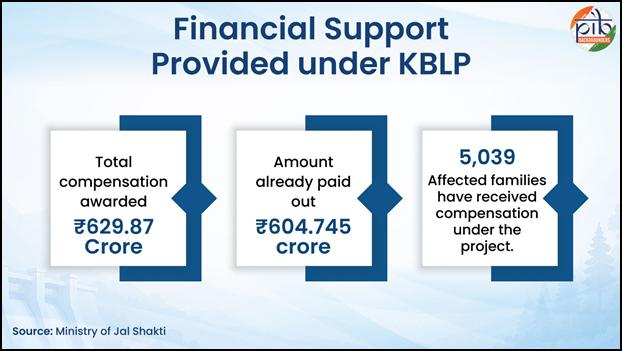
Across the project, awards worth about ₹629.87 crore have been passed for 5,039 affected families, and about ₹604.745 crore (around 96%) has already been paid out. The remaining amount will be released once the required legal formalities are completed.
- How is land compensation calculated and paid out?
Compensation is calculated transparently based on official market rates plus statutory resettlement allowances. Payments are transferred directly into verified bank accounts of landowners to prevent middlemen and unnecessary delays.
- Are there special healthcare and educational initiatives?
Yes. Regular free medical checkup camps, mobile health vans, school infrastructure upgrades, and student scholarships are actively provided under ongoing community welfare programs.
- What is KBLPA's approach towards affected families?
KBLPA recognizes that land acquisition affects not only land and property but also the lives and livelihoods of affected families. Accordingly, KBLPA is focusing on timely compensation, rehabilitation and resettlement, livelihood support, relocation wherever required, provision of basic civic amenities at resettlement sites, consultation with affected persons and grievance redressal. The objective is to ensure that Project Affected Families are treated with fairness, transparency and dignity throughout the rehabilitation and resettlement process.
- Will affected landowners receive compensation?
Yes, Eligible landowners and other persons having recognized rights/interests in land are entitled to compensation and other admissible benefits in accordance with the applicable statutory framework.
The compensation process is intended to ensure that affected persons receive the benefits to which they are legally entitled.
Making Sure No One Is Left Out
- What happens if someone's name was left out of the compensation list?
The district administration has re-surveyed affected villages in Chhatarpur and Panna at the request of displaced families, and people who were earlier left out have now been added to the compensation awards.
- Who checks that the process stays fair and accurate?
The District Administration continuously reviews land records. In addition, a National Monitoring Committee, set up under the land acquisition law, oversees the entire rehabilitation process.
- Who helps families with documentation and paperwork?
Dedicated Field Facilitation Officers visit villages weekly to assist families with entitlement verification, banking paperwork, and application submissions at zero cost.
- Can affected families still raise complaints or grievances?
Yes. Grievances are regularly received and resolved. For example, the administration has held special camps to hear and settle complaints from displaced families in the affected villages.
- What is KBLPA’s message to people affected by the project?
KBLPA’s message is clear: the development of Bundelkhand should go hand in hand with the rights, dignity and welfare of Project Affected Families. KBLPA is working with the concerned State Governments, district administrations and affected communities to implement land acquisition, Rehabilitation & Resettlement (R&R), and environmental measures in accordance with applicable laws, approved plans and prescribed procedures. The objective is to ensure fairness, transparency and responsible implementation of the project.
Support for Displaced Families
- Are the children of displaced families looked after?
Yes. Efforts are made to enrol their children in schools and Anganwadi centres so their education is not disrupted.
- Is healthcare support provided to displaced families?
Yes. Health camps have been organised where people are medically examined, medicines are distributed, and drinking-water handpumps are repaired.
- Do displaced families get access to other government welfare schemes?
Yes. Special camps are held so families can also benefit from other government schemes, such as those related to livestock, social security, and welfare schemes for women and girls.
- Does the government stay in touch with displaced families after they relocate?
Yes, Regular contact is maintained with displaced families so that any difficulty is quickly identified and their grievances are resolved fairly and speedily.
Rights of Tribal and Forest-Dependent Communities
- Are the rights of tribal communities protected in this project?
Yes. The rights of Scheduled Tribes and other forest-dependent communities are safeguarded under the Forest Rights Act, 2006, through a statutory process of recognising and settling forest rights.
- Was the consent of local communities taken before forest clearance?
The concerned District Collectors initiated the process for obtaining the free, prior and informed consent of the relevant Gram Sabhas, as required under the Scheduled Tribes and Other Traditional Forest Dwellers (Recognition of Forest Rights) Act, 2006. It was on this basis, and subject to compliance with applicable statutory requirements, that Forest Clearance for the project was accorded by MoEF&CC on 03.10.2023.
Environmental and Legal Clearances
- Has the project received all the required government clearances?
Yes. The project has received all the statutory clearances needed under law, including Environmental Clearance (2017), Wildlife Clearance (2016), Clearance from the Ministry of Tribal Affairs (2017), and Forest Clearance (2023).
- Will KBLP have environmental impacts?
Like any major water-resources infrastructure project, KBLP has environmental impacts that require careful assessment and management.
The project has therefore incorporated environmental safeguards and an Environmental Management Plan (EMP), along with compliance with applicable environmental, forest and wildlife-related requirements.
The approach is based on the principle that development and environmental protection must progress together.
- Whether the environmental impacts of KBLP were studied before implementation?
Yes. The environmental impacts of the Ken–Betwa Link Project (KBLP) were assessed through detailed environmental studies as part of the statutory clearance process. Based on these assessments, the project was granted Environmental Clearance on 25.08.2017, along with the required Wildlife Clearance and Forest Clearance, subject to prescribed conditions and mitigation measures.
The project is also implementing various environmental management, compensatory afforestation, wildlife conservation and biodiversity protection measures to address and minimize the identified environmental impacts.
- How is the loss of forest area and biodiversity in the core area of Panna Tiger Reserve (PTR) being compensated under KBLP?
The environmental impacts of KBLP, including unavoidable forest loss and impacts on biodiversity, are being addressed through a combination of compensatory afforestation, wildlife conservation and habitat management, catchment area treatment and implementation of the Integrated Landscape Management Plan (ILMP) for the Greater Panna Landscape.
In addition, an equivalent area of non-forest land has been provided adjacent to the core area of Panna Tiger Reserve for compensatory purposes, which will contribute to strengthening the habitat and conservation landscape around the Reserve.
Funds have also been provided as per the conditions of the Forest and Wildlife Clearances for implementing approved conservation and mitigation measures. These measures aim to compensate for unavoidable forest loss, minimize ecological impacts and strengthen biodiversity and wildlife conservation in the wider landscape.
- What is the concern regarding Panna Tiger Reserve?
The project has significant environmental and wildlife considerations because of its proximity and relationship with the Panna landscape. Accordingly, wildlife and forest-related safeguards have been incorporated into project planning and implementation.
The Government has also undertaken landscape-level planning and conservation measures in association with the project.
- What are the measures being taken to protect the environment and the wildlife
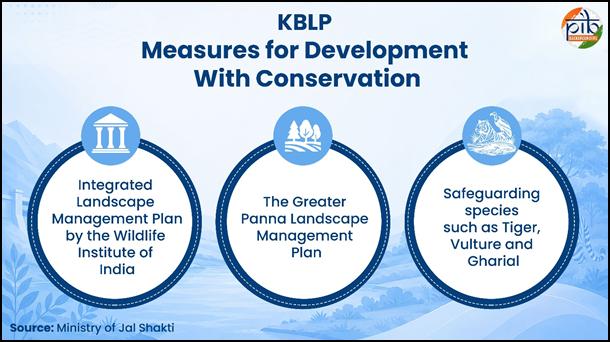
The project is aimed at not only providing water security in the Bundelkhand but also ensuring the overall conservation of the region and especially for landscape-dependent species such as Tiger, Vulture and Gharial. Apart from taking mitigation measures as per the approved Environmental Management Plan, the Wildlife Institute of India (WII) has prepared a comprehensive Integrated Landscape Management Plan (ILMP) for the conservation of wildlife and biodiversity not only in Panna Tiger Reserve (PTR) but also in surrounding areas. The Integrated Landscape Management Plan in Greater Panna Landscape (GPL) is one of the major and unique conservation measures being initiated in the conservation history of India.
- What is Greater Panna Landscape Council?
A comprehensive Integrated Landscape Management Plan (ILMP) has been prepared for the conservation of wildlife and biodiversity in Panna Tiger Reserve (PTR) & surrounding areas. To ensure systematic and time-bound implementation of the Greater Panna Landscape Management Plan, the Greater Panna Landscape Council (GPLC) has been constituted under the chairmanship of the Chief Secretary, Govt. of Madhya Pradesh, with members from all the stakeholders. Adequate financial provisions have been earmarked for the implementation of Environment Management Plan and Integrated Landscape Management Plan under the Ken-Betwa Link Project. This model will be a template for future development.
- What is compensatory afforestation?
Where forest land is diverted for approved project purposes, compensatory afforestation and other prescribed measures are undertaken in accordance with applicable forest legislation and approvals. These measures are intended to compensate for permitted diversion of forest land and contribute to long-term ecological restoration.
- Will KBLP affect biodiversity?
Environmental impacts on biodiversity have been considered as part of project planning. The project incorporates mitigation and conservation measures intended to reduce, manage and compensate for unavoidable impacts. Environmental monitoring will also be undertaken during construction and operation.
Looking Ahead
- What is being done to make sure the project stays on track?
Compensation and rehabilitation work continues in a transparent, fair and time-bound manner, with local officials in ongoing contact with affected families to resolve issues quickly.
- What is the larger goal of the project going forward?
The goal is to balance the region's development needs with the rights and welfare of affected families — completing rehabilitation with dignity while delivering long-term irrigation, drinking water and power benefits to Bundelkhand.
- Where can people get more information about the project?
More information is available on the official KBLPA website: www.kblpa.gov.in, the Ministry of Jal Shakti and the District Administrations of Chhatarpur and Panna.
References
Ministry of Jal Shakti
Click here to see PDF
PIB Research
(रिलीज़ आईडी: 2301975)
आगंतुक पटल : 330