PIB Backgrounder
Ayushman Bharat Digital Mission
India's Digital Health Backbone
प्रविष्टि तिथि:
06 JUL 2026 11:35AM by PIB Delhi
The Ayushman Bharat Digital Mission has built one of the world's largest digital health ecosystems, with over 104 crore health records linked to over 93 crore ABHA accounts. By eliminating paperwork and reducing waiting times, ABDM is seamlessly connecting patients to insurers, hospitals, and doctors on a single unified network.
Building a Digital Health Infrastructure
India is steadily progressing towards Universal Health Coverage, where everyone can access quality healthcare services without facing financial hardship.
Achieving this goal in a country as vast and diverse as India requires a strong digital backbone. A robust digital public infrastructure is essential for making healthcare delivery more seamless, efficient, and accessible.
A digitised health ecosystem:
- Enables the secure management of patient records
- Connects individuals with healthcare and insurance providers
- Enables seamless portability of health records, allowing citizens to securely access and share their health records at any ABDM-enabled healthcare facility across the country
- Generates anonymised health data.
This data can be used to improve healthcare planning and service delivery and power India's emerging artificial intelligence ecosystem. Innovations in disease surveillance, diagnostics, and healthcare management is a possibility with such an infrastructure in place.
Recognising this, the Government of India launched the Ayushman Bharat Digital Mission (ABDM) in September 2021 to develop an integrated, citizen-centric national digital health ecosystem.
Using an ABDM-enabled software, health facilities can create digital health records linked to the Ayushman Bharat Health Account (ABHA). Also, they can access the previous records of the patient digitally after taking the patient’s consent and exchange digital health records through the patient’s revocable, time-bound consent.
ABHA is a unique identifier like Aadhaar that securely links individuals to the wider health system. It helps patients access to digital health services. They can connect to insurers, healthcare facilities, doctors, and other services with all their medical history intact through this one interoperable network.
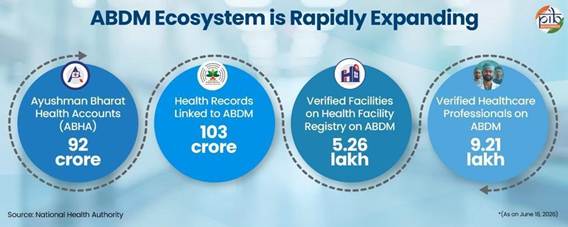
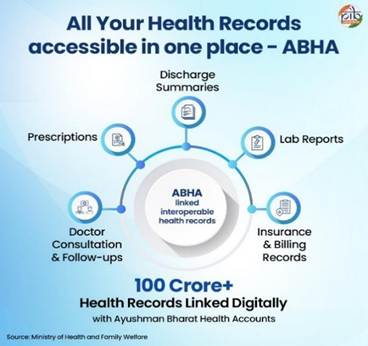
In a major milestone achieved in May 2026, over 100 crore health records are now linked to more than 90 crore ABHA accounts. This marks a significant progress in India's journey towards a connected digital public health ecosystem.
ABDM: A Complete Digital Health Ecosystem
Beyond the ABHA, ABDM is a full-fledged digital health ecosystem. It connects patients to records, links insurers to hospitals, and brings all healthcare providers onto one single network.
- ABHA number: A 14-digit unique health identifier that links all your health records across hospitals, labs, insurers, and national health programs with your consent.
- Healthcare Professionals Registry: A national registry of all healthcare professionals – from doctors to AYUSH practitioners – verified and digitally connected.
- Health Facility Registry: A national registry of health facilities – hospitals, clinics, labs, pharmacies – public and private, all in one place.
- Unified Health Interface: An open network for health services – like UPI for healthcare. Book appointments, consult doctors and discover services across any app.
- Aarogya Setu 2.0: It serves as a unified gateway to digital health services and a Personal Health Record (PHR), accelerating nationwide adoption of digital health.
Aarogya Setu 2.0

Originally developed as India's COVID-19 contact tracing application, Aarogya Setu has been transformed into a comprehensive citizen-facing digital health application under ABDM. It serves as a unified gateway to digital health services and a Personal Health Record (PHR), accelerating nationwide adoption of digital health.
Aarogya Setu 2.0 was launched on June 29, 2026, by the Minister of Health & Family Welfare Jagat Prakash Nadda as a revamped, citizen-facing digital health application under ABDM.
Key Features
- Access to ABDM-enabled services, including ABHA creation, health record management, and Scan & Register for seamless digital registration.
- Smart Reports which are backed by Optical Character Recognition (OCR) to read digital documents
- View Ayushman Bharat-Pradhan Mantri Jan Arogya Yojana (AB-PMJAY) wallet and private insurance details through NHCX for transparent coverage and claims information.
- Discover nearby healthcare facilities and view real-time blood unit availability via e-RaktKosh for timely access to critical care.
- Gain AI-driven health insights by combining uploaded records with ABDM-linked data for biomarker and wellness trend analysis.
- Ability to book both teleconsultations and in-person appointments through UHI for connected, accessible care.
- The user will be able to monitor and manage their health seamlessly with integrated vitals, personalised reminders, goal tracking, and wearable-device syncing for steps, calories, heart rate, and glucose levels.
- Access wellness content, including blogs, IEC materials, videos, and FAQs to stay informed and build health literacy.
ABDM: Cutting Waiting Times at Hospitals Through Online Appointment Registrations
The National Health Authority's Scan and Share service, launched in 2022 under ABDM has significantly streamlined outpatient registration by leveraging mobile technology and QR codes, ss per a study conducted by the Indian Institute of Health Management Research (IIHMR).
The service enables patients to scan a QR code at participating health facilities to generate a digital queue token, with demographic details securely retrieved from their Ayushman Bharat Health Account (ABHA) and integrated with the facility's Health Information System.
The IIHMR study found that Scan and Share reduced patient waiting times from approximately one hour to just 2 to 5 minutes. Over 23.21 crore ABHA-linked tokens were issued at healthcare facilities across the country (as on June 18, 2026).
Developed in collaboration with government agencies, healthcare providers, and patient advocacy groups, the service adheres to established data protection, security, and interoperability standards.
Connecting Healthcare Professionals & Facilities to ABDM
All healthcare facilities – public and private – can join the ABDM network. This includes hospitals, clinics, diagnostic laboratories and imaging centres, pharmacies, etc. Once connected to the system, patients can seamlessly link their health records across the system. Facilities are reimbursed for joining and can also get more exposure. Registration is simple and is available on the ABDM website.
Health Facility Registry:
The Health Facility Registry is a repository of public and private health facilities connected to ABDM.
Once a health facility enrols, patients can find it on the ABHA app. If they visit that facility for treatment, their health records are automatically linked and can be shared with the patient’s consent. Insurance coverage is also connected if the facility uses the National Health Claims Exchange (NHCX). This simplifies the entire process — from finding a provider and verifying identity to processing claims and managing queues.
Digital Health Incentive Scheme:
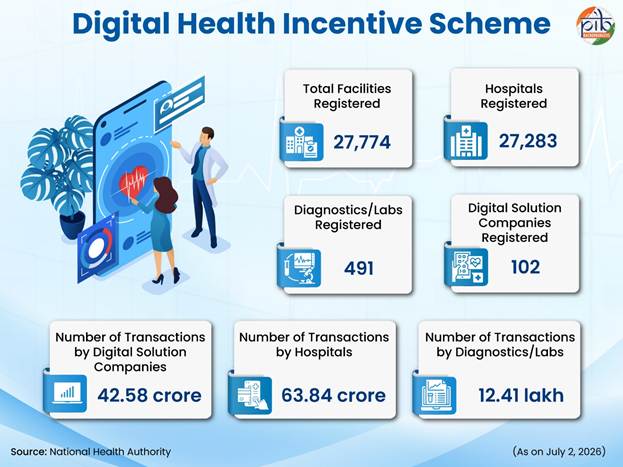
To encourage more facilities to join ABDM, the government runs the Digital Health Incentive Scheme. Health facilities are incentivised to join the ABDM ecosystem through:
- Reimbursement of expenses incurred for digitisation to all participating healthcare facilities
- Seamless access to the patient’s full health records, which makes administrative work easier.
Hospitals and Digital Solutions Companies (DSCs) earn cash incentives for creating interoperable digital health records. Both public and private sector players are incentivised through DHIS.
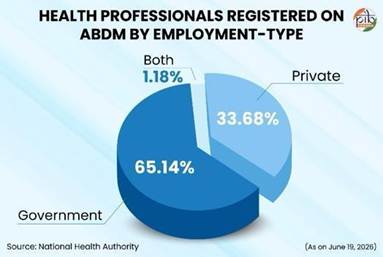
Who Is Eligible?
• All health facilities such as clinics, nursing homes and hospital
• Laboratory/radiology diagnostics centres and pharmacies
• Entities providing ABDM-enabled digital solutions (digital solution companies).
Amount paid through the scheme to (as on June 18, 2026):
- Hospitals: Rs. 107+ crore
- Diagnostics/Labs/Pharmacies: Rs. 2.95 crore
- Digital Solution Companies: Rs. 26+ crore
ABDM is Making Healthcare Delivery More Efficient
Dr. Praveen Sikka registered his Gurugram pharmacy on ABDM, which took about 2 hours. He notes that now patients can store and access all their health records in one place through the ABHA app. Dr. Sikka also benefits directly — through the DHIS incentive scheme, his pharmacy gets compensated for every health record linked to ABDM.
eSushrut@clinic Hospital Management Information System:
While initiatives such as Dr. Sikka's pharmacy illustrate how individual healthcare facilities are adopting digital health solutions under ABDM, the Government has also introduced a dedicated solution to support the digital transformation of smaller clinics.
Launched in June, eSushrut@Clinic is a plug and play, lightweight Hospital Management Information System (HMIS) developed by the Centre for Development of Advanced Computing (C-DAC). The platform enables small clinics to digitise patient records and streamline routine administrative functions in an affordable and standardised manner.
The system automates key operational processes, including patient registration, billing, and reporting. Access is granted only after verification of healthcare professionals and facilities through the Healthcare Professionals Registry (HPR) and the Health Facility Registry (HFR), ensuring that only verified providers use the platform.
To date, more than 2200 healthcare facilities have been onboarded, generating over 1633 health records. While eSushrut@Clinic provides a standardised framework for digitising records at smaller healthcare facilities, the next critical step is ensuring that these digital records can seamlessly integrate with the broader health financing and insurance ecosystem.
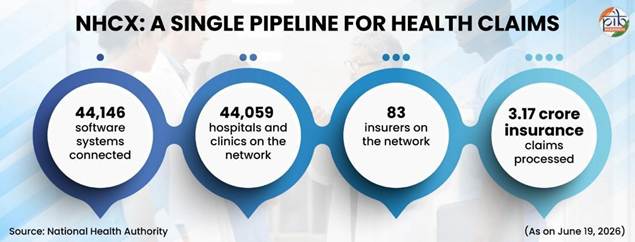
National Health Claims Exchange (NHCX) for Insurance Providers
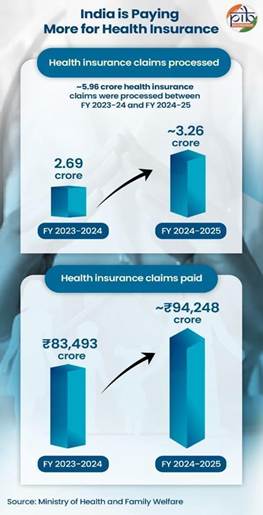
ABHA does not just help patients store and share their health data — it also helps streamline their health insurance claims processing. And with rising health insurance claims in India, the National Health Claims Exchange (NHCX) can fill a gap for patients during the tedious processing period. It can also make the claims process more structured and fitting for patients of non-communicable diseases that need regular, continuous treatments.
The NHCX establishes is a digital highway for exchanging claims-related information amongst payers, providers, beneficiaries, regulators and observers.
The system has many benefits:
- It speeds up decisions, reduces discharge times, and cuts hospital administrative costs.
- It leads to faster claims processing.
- Patients can see their benefits, medical history, and entitlements in one place.
- Providers can access a patient's full treatment history — with consent — reducing duplicate tests and improving clinical decisions.
- Insurers can make better decisions and design new products.
- Since patients can track every claim on one platform, it improves their financial security and planning, and health outcomes.
Unified Health Interface
Traditionally, patients and healthcare providers could interact only if they were using the same digital platform. UHI removes this constraint by enabling any patient using a UHI-enabled application to discover, connect with, and transact with any verified healthcare provider, regardless of the application used by the provider. Requests are routed through a common gateway operated by the National Health Authority (NHA), which authenticates patients using their ABHA credentials, while healthcare providers and facilities are verified through the HPR and HFR registries.
The UHI is built on four principles:
- Interoperability
- Fair discoverability for providers of any size
- Verification of only credentialed doctors and facilities
- Open protocols that any developer can build on
The UHI platform currently has five live services:
- Blood bank discovery
- PM Jan Arogya Yojana – which provides Rs. 5 lakh free public health insurance to the poorer sections of society – hospital search
- Jan Aushadhi Kendra – centres where generic medicines are available for 50-90% cheaper prices than market prices – discovery
- Ambulance booking
- Doctor consultation
Beyond enabling these everyday transactions, UHI also feeds into a much larger ambition. That is the usage of the data generated across ABDM to power public health research and policy.
ABDM is Central for India’s Public Health Data & AI Push
ABHA and the linked health records are fast emerging as a goldmine for public health research and policy. Health data on ABDM is anonymised. This data also allows the government to track disease prevalence, monitor public health trends, and design more targeted health programmes.
Privacy-By-Design
When patients upload health records on ABDM, the data stays with whoever created it — the hospital, lab, or insurer. There is no central government server storing all this data. Records are only shared within the ABDM network when the patient consents.
Apps and platforms cannot simply connect to ABDM. Every new app must first be tested in a "sandbox" — a safe, simulated version of the real system. It must also pass a security audit before going live. This audit checks how the app handles and protects patient data.
The data is also central to integrating artificial intelligence into healthcare. In February 2026, the government launched SAHI (Strategy for Artificial Intelligence in Healthcare for India) and BODH (Benchmarking Open Data Platform for Health AI) at the India AI Impact Summit 2026.
- SAHI provides structured guidance on ethics, accountability, safety, and collaboration, ensuring that AI deployment in healthcare remains transparent, inclusive, and people centric.
- BODH is a secure, federated ecosystem where developers can train AI models on-site without accessing raw patient data - returning only refined model weights to ensure total privacy.
Together, they represent India's commitment to building a trustworthy, inclusive, and globally competitive health AI ecosystem — one grounded in innovation, responsibility, and public trust.
Universal Health Coverage Through Digitisation
ABDM is one of the most ambitious and successful digital health programmes in the world. It is already delivering — shorter waiting times, paperless records, faster claims, and better access for millions of patients.
With over 104 crore health records now linked with over 93 crore ABHA, ABDM has marked another important milestone towards creating detailed and digital medical history accounts of patients over time. The government aims to expand the ABDM network to cover all patients and health facilities across India, working towards fully digital health records for every citizen.
References
Press Information Bureau (PIB)
Ministry of Health and Family Welfare / ABDM
Click here to see pdf
****
PIB Research
(रिलीज़ आईडी: 2281466)
आगंतुक पटल : 8590