Ministry of Panchayati Raj
National Study Report on Low Participation in Gram Sabha Across States/UTs Released in New Delhi
"Vibrant Gram Sabhas are Essential for Delivering Citizen-Centric Governance": Dr. R. Balasubramaniam
प्रविष्टि तिथि:
30 JUN 2026 6:07PM by PIB Delhi
The National Study Report on “Low Participation in Gram Sabha across States and Union Territories” was released today by Dr. R. Balasubramaniam, Member, NITI Aayog in the presence of Secretary, Ministry of Panchayati Raj, Shri Vivek Bhardwaj, senior officers of the Ministry, NIRD&PR along with academicians, researchers and various Panchayati Raj stakeholders in New Delhi. The report has been prepared by the National Institute of Rural Development and Panchayati Raj (NIRD&PR) for the Ministry of Panchayati Raj to assess the factors influencing public participation in Gram Sabha meetings and identify measures to strengthen citizen engagement in grassroots governance. The two-volume report analyses the barriers to effective participation in Gram Sabhas and puts forward evidence-based policy recommendations and strategic directions. It provides actionable inputs for strengthening policy frameworks, reinforcing institutional mechanisms, and promoting meaningful citizen participation in Gram Sabhas. It also gives a State/UT wise account of the factors affecting the Gram Sabha participation and the way forward while highlighting the best practices for enhancing Gram Sabha participation from 10 States. (Report Brief)
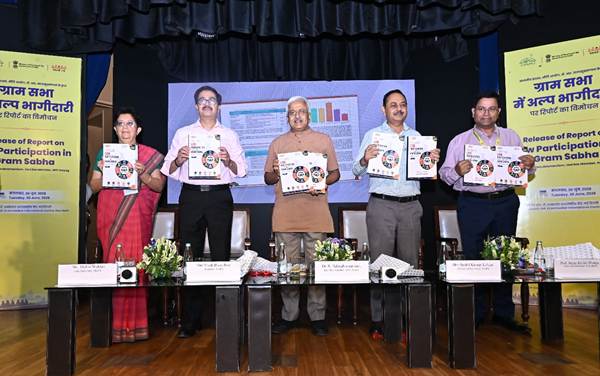
Delivering the keynote address, Dr. R. Balasubramaniam stated that Gram Sabha represents the truest expression of grassroots democracy in India, and its vitality determines how effectively the benefits of governance reach the last mile. He said that under the visionary leadership of Prime Minister Shri Narendra Modi, the Government has remained steadfast in its commitment to empowering every citizen by placing them at the center of governance and designing institutions/policies around their needs. He highlighted that the report provides evidence-based insights and a solution-oriented framework that can be effectively adopted across the country. Dr. Balasubramaniam said that the challenges to strengthening Gram Sabhas extend beyond low public participation and are deeply rooted in systemic and institutional barriers that require targeted reforms. Stressing upon the need to incentivize citizens, he stressed that people must be encouraged not only to participate in Gram Sabhas but also encouraged to take ownership of local development. He added that State institutions must create enabling mechanisms that foster meaningful and sustained public engagement, as genuine participation cannot be enforced but is built over time. He further observed that meaningful citizen participation is a gradual journey that begins with awareness, progresses to active engagement, and ultimately culminates in empowerment when the State responds to the aspirations of the Gram Sabha. He noted that studies such as this, strengthen the evidence base for policymaking, helping translate field experience into actionable insights for implementation, continuous institutional learning, and stronger grassroots democratic institutions as India progresses towards Viksit Bharat 2047.
Shri Vivek Bharadwaj, in his address, observed that the past decade has been one of remarkable transformation in rural India, characterized by near-universal access to basic amenities and a sustained commitment to deepening grassroots democracy. He said that the study provides valuable evidence-based insights for designing targeted interventions to enhance Gram Sabha participation, particularly among women, youth and marginalized communities. Shri Bhardwaj added that the Ministry will work closely with States/ UTs to implement the recommendations of the report, making Gram Sabhas more inclusive, participatory and outcome-oriented.
Dr. Anjan Kumar Bhanja, Associate Professor, NIRD&PR Hyderabad, presented the findings of the study. Based on one of the country's largest field-based assessments of Gram Sabha participation, the study covered nearly 7,800 respondents across about 400 Gram Panchayats in 26 States and Union Territories including 213 Districts and PESA and Women-Friendly Gram Panchayats, providing valuable evidence to strengthen citizen participation and grassroots democracy.
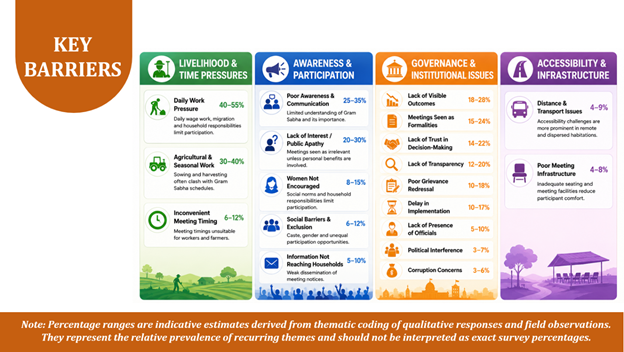
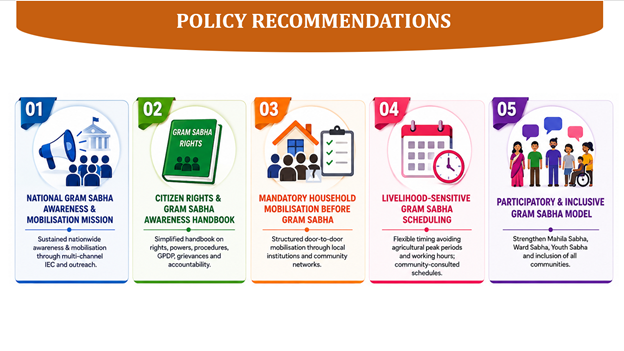
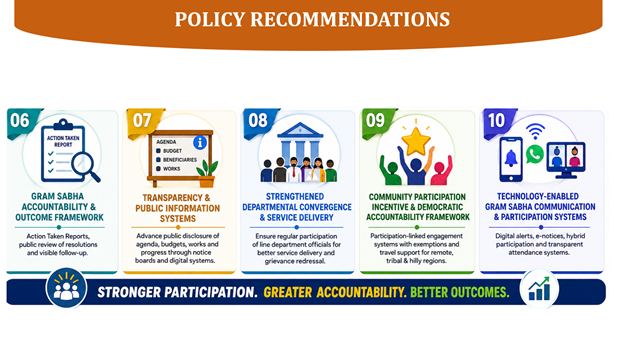
Report on Low Participation in Gram Sabha across States/UTs : Click Below
Volume 1, Volume 2
Graphical Summary of the Report
****
Aditi Agrawal
(रिलीज़ आईडी: 2279474)
आगंतुक पटल : 2833