PIB Backgrounder
Pradhan Mantri Krishi Sinchayee Yojana (PMKSY)
A Decade of Irrigation-Led Agricultural Transformation
प्रविष्टि तिथि:
30 JUN 2026 5:34PM by PIB Delhi
Over the past decade, PMKSY has played a pivotal role in strengthening irrigation infrastructure and promoting efficient water management across India. The PMKSY has emerged as a key driver of irrigation-led agricultural transformation, with central assistance exceeding ₹64,407 crore. Since 2016-17, PMKSY has benefited over 27 million farmers and created or restored irrigation potential across 24.61 million hectares. Under the Per Drop More Crop (PDMC) Scheme, since its inception, 110.92 lakh hectares have been brought under micro-irrigation. Union Budget 2026–27 allocated ₹6,587 crore to PMKSY to expand irrigation, improve water-use efficiency, and promote sustainable water management.
Nurturing Sustainability through Water Secure Farming
Water security is fundamental to enhancing agricultural productivity, strengthening climate resilience, and ensuring sustainable livelihoods for farmers. Optimizing cropping patterns and adopting efficient water application methods are essential to maximize the use of available water resources.
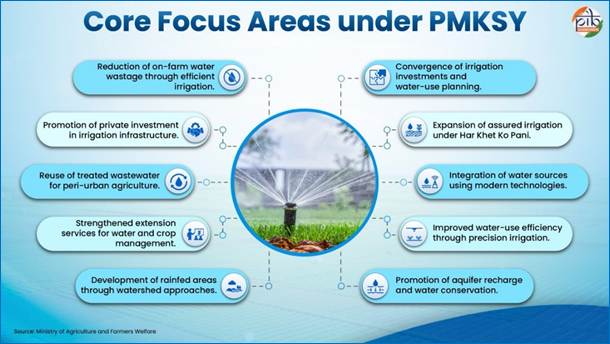
Launched on 1 July 2015, Pradhan Mantri Krishi Sinchayee Yojana (PMKSY) has completed more than 10 years of advancing irrigation-led agricultural transformation in India. The scheme expands assured irrigation, improves on-farm water efficiency, and promotes sustainable water conservation. It strengthens irrigation through rainwater harvesting and efficient farm-level water distribution under Jal Sanchay (rainwater storage) and Jal Sinchan (efficient water application).
Through these efforts, PMKSY contributes to wider irrigation coverage, enhanced crop productivity, and environmental sustainability. The judicious use of water improves soil health, enhances crop productivity, provides environmental benefits, and extends irrigation coverage from the same water source.
Transforming Irrigation through PMKSY
PMKSY combines irrigation expansion with water-use efficiency through four strategic components covering the entire irrigation value chain.
- Accelerated Irrigation Benefit Programme (AIBP): It focuses on the rapid completion of ongoing major and medium irrigation projects, including national projects. AIBP supports the timely creation of irrigation infrastructure and strengthens water availability for farmers. Since 2016–17, it has received ₹21,023 crore in central assistance, benefiting 17.30 million farmers. It makes it the largest PMKSY component by beneficiary coverage.
- In 2025-26, the government has approved the Modernization of Command Area Development and Water Management (M-CADWM) as a sub-scheme of PMKSY-AIBP. The government has allocated an initial outlay of ₹1,600 crore under this component. It complements AIBP by delivering water from major and medium irrigation projects through pressurized piped and micro-irrigation systems.
- Har Khet Ko Pani (HKKP): It focuses on creating new water sources through minor irrigation (both surface and groundwater) and expanding cultivable areas under assured irrigation. Since inception, 3,462 Surface Minor Irrigation (SMI) and Repair, Renovation & Restoration (RRR) schemes have been completed. It has also created 5.93 lakh hectares of irrigation potential, while groundwater interventions added 88.55 thousand hectares of irrigation coverage.
- Watershed Development: It enhances the productive potential of rainfed and degraded lands through integrated watershed management. Since 2016–17, it has received ₹12,432.09 crore in central assistance, benefiting 1.34 million farmers and supporting sustainable natural resource management.
- Per Drop More Crop (PDMC): It was an integral component of the PMKSY from 2015-16 to 2021-22, with a strong focus on maximizing water use efficiency at the farm level. From 2022-23, PDMC is a part of Pradhan Mantri Krishi Vikas Yojana(PM-RKVY). The scheme promotes micro-irrigation technologies such as Drip, and Sprinkler irrigation Systems.
Expanding Irrigation Access for Agricultural Growth
The Government approved the continuation of Pradhan Mantri Krishi Sinchayee Yojana (PMKSY) for 2021–26 with an overall outlay of ₹93,068.56 crore. The Union Budget 2026–27 allocated ₹6,587 crore to PMKSY for irrigation expansion, water-use efficiency, and sustainable water management.
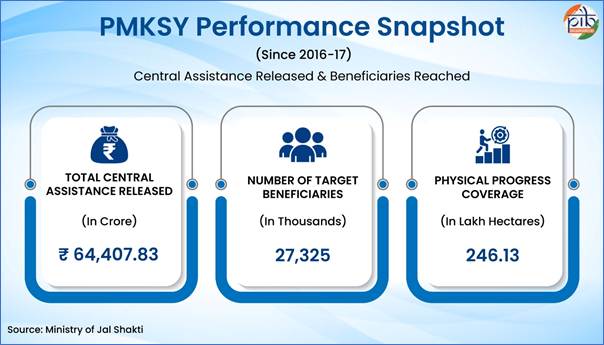
As of August 2025, PMKSY benefited over 27 million farmers through irrigation, micro-irrigation, watershed, and groundwater interventions, supported by ₹64,407 crore. Collectively, these initiatives have covered or developed more than 24.61 million hectares, strengthening water security and promoting sustainable agricultural growth.
Every Drop Counts: How Sprinkler Irrigation Transformed a Farming Enterprise
In Barabanki, Uttar Pradesh, brothers Uma Shankar Verma and Subhash Verma were engaged in farming since the early 1990s. They traditionally cultivated crops such as rice, wheat, mustard, banana, and mentha using conventional flood irrigation methods. However, this approach required substantial amounts of water and labor, often resulting in uneven crop growth and reduced productivity.
A significant transformation occurred in 2016 with the adoption of sprinkler irrigation under Pradhan Mantri Krishi Sinchayi Yojana (PMKSY). The new irrigation system improved resource efficiency and brought notable gains in agricultural performance. Crop yields increased by 25-30% after adopting sprinkler irrigation. The system ensured uniform crop growth and healthier root development.
The adoption of sprinkler irrigation reduced the use of water, electricity, labour, and fertilizers by nearly 50%. Labour requirements fell by 50-60%, lowering cultivation costs, while fertilizer consumption was reduced to about one-fourth of previous levels.
As a result, the farmers reported profits of around ₹60,000-70,000 per hectare. Their success encouraged neighboring farmers to explore and adopt sprinkler irrigation after observing its benefits firsthand. Their experience highlights PMKSY's “Per Drop More Crop” approach in promoting water conservation, enhancing farm productivity, and improving farmers’ incomes.
Enhancing Irrigation Efficiency through Micro-irrigation Technology
PMKSY components such as HKKP and AIBP focus on expanding irrigation infrastructure and increasing water availability to farms. PDMC complements these efforts by promoting efficient water use at the field level through micro-irrigation technologies. The component promotes efficient water conveyance and precision water application through drip, sprinkler, and other techniques. Drip irrigation, which delivers precise amounts of water and nutrients directly to the plant root zone. While sprinkler irrigation distributes water through pipes and spray heads, simulating natural rainfall. These technologies help conserve water, improve irrigation efficiency, and enhance crop productivity.
To promote its adoption, the Micro Irrigation Fund has been established under the National Bank for Agriculture and Rural Development (NABARD). Micro-irrigation (MI), including drip and sprinkler systems, is an advanced irrigation technology that delivers water efficiently to crops at the field level. Micro-irrigation delivers water directly to the roots, reducing waste and improving soil moisture, productivity, and climate resilience. Under the Per Drop More Crop (PDMC) component, small and marginal farmers receive 55% financial assistance for micro irrigation systems. Other farmers receive 45% financial assistance to install micro-irrigation systems. Since its inception, the PDMC Scheme has brought 110.92 lakh hectares under micro-irrigation, accounting for about 7.98% of India’s net sown area.
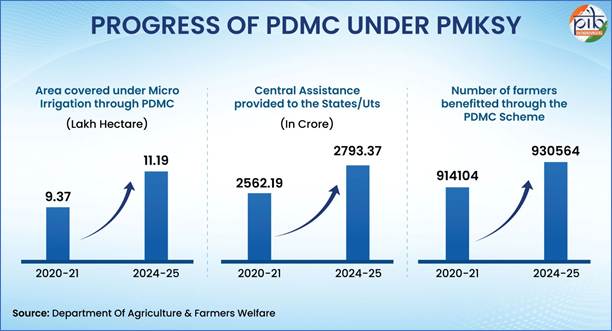
Around 9.3 lakh farmers receive annual support, highlighting the scheme’s role in promoting efficient water use and livelihoods.
Watering Growth: The Transformative Impact of PMKSY
Pradhan Mantri Krishi Sinchayee Yojana (PMKSY) has transformed India’s agricultural sector through sustainable water management and the expansion of irrigation coverage. PMKSY promotes efficient water use through Per Drop More Crop (PDMC), (presently part of PMRKVY), Har Khet Ko Pani (HKKP), and Watershed Development. Modern irrigation technologies, especially micro-irrigation, have strengthened climate-resilient and sustainable farming practices. PMKSY has benefited millions of farmers, including small and marginal cultivators, across the country. The scheme has expanded irrigation potential, improved rural livelihoods, and promoted environmental sustainability.
References
Ministry of Agriculture and Farmer’s Welfare
https://www.pib.gov.in/PressReleasePage.aspx?PRID=2120360
https://pmksy.gov.in/pdflinks/Guidelines_English.pdf
https://www.pib.gov.in/PressReleasePage.aspx?PRID=1524067®=48&lang=2#:~:text=It%20was%20restructured%20and%20renamed,with%20AIBP%20since%20XII%20Plan.
https://agritech.tnau.ac.in/agricultural_engineering/agriengg_faq_swc.html
https://sameti.assam.gov.in/schemes/pradhan-mantri-krishi-sinchayee-yojana-pmksy \
https://sansad.in/getFile/loksabhaquestions/annex/185/AU1388_YiT1U8.pdf?source=pqals
https://sansad.in/getFile/loksabhaquestions/annex/185/AU1424_eZX914.pdf?source=pqals
Ministry of Information and Broadcasting
https://www.youtube.com/watch?v=Np56e2GwCQo
Ministry of Jal Shakti
https://www.pib.gov.in/PressReleasePage.aspx?PRID=2157479
https://sansad.in/getFile/loksabhaquestions/annex/184/AU4423_eMn2Zt.pdf?source=pqals
https://sansad.in/getFile/loksabhaquestions/annex/184/AU1406_B0zGM0.pdf?source=pqals&utm
https://sansad.in/getFile/annex/259/AU364.pdf?source=pqars
https://sansad.in/getFile/annex/268/AU2808_Uj2WID.pdf?source=pqars
Ministry of Finance
https://www.indiabudget.gov.in/doc/OutcomeBudgetE2026_2027.pdf
Ministry of Rural Development
https://sansad.in/getFile/loksabhaquestions/annex/184/AS117_iDl9s0.pdf?source=pqals
PIB Backgrounders
https://static.pib.gov.in/WriteReadData/specificdocs/documents/2022/jul/doc20227169101.pdf
Click to See In PDF
***
PIB Research
(रिलीज़ आईडी: 2279431)
आगंतुक पटल : 6009