PIB Backgrounder
23rd Instalment of PM-KISAN
Direct Benefit Transfer of over ₹18,880 crore to 9.44 crore farmers
प्रविष्टि तिथि:
20 JUN 2026 6:35PM by PIB Delhi
The Prime Minister has released over ₹18,880 crore as the 23rd instalment of the Pradhan Mantri Kisan Samman Nidhi (PM-KISAN) scheme. The announcement for the release of funds was made on June 20, 2026, in Hooghly, West Bengal. Over 9.44 crore farmers have received financial assistance under this instalment. 2.18 crore of these are women farmers. More than 1 crore farmers attended this event virtually. Over ₹4.46 lakh crore has been disbursed since the scheme's launch in 2019. This makes PM-KISAN one of the world’s largest DBT initiatives. This day was also celebrated as the “PM KISAN Utsav Diwas”.
PM-KISAN: Strengthening Income Security for Farmers
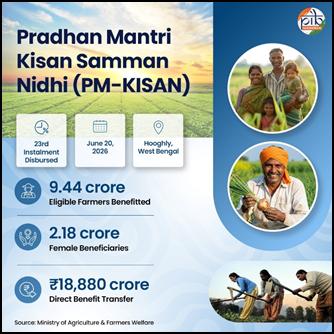
The 23rd instalment of the Pradhan Mantri Kisan Samman Nidhi (PM-KISAN) was disbursed on June 20, 2026 at Tarakeswar, Hooghly, West Bengal. Nearly 9.44 crore eligible farmers, including more than 2.18 crore women, received around ₹18,880 crore in direct financial assistance. The funds were transferred through the Direct Benefit Transfer (DBT) system, ensuring transparency and eliminating intermediaries. The scheme is widely regarded as a significant initiative towards ensuring ‘Annadata Samman’.
New Agricultural Initiatives to Empower Farmers in West Bengal
The government has launched several major agricultural initiatives alongside the 23rd PM-KISAN instalment in West Bengal:
- Pradhan Mantri Fasal Bima Yojana (PMFBY) and Restructured Weather-Based Crop Insurance Scheme (RWBCIS) will provide crop insurance coverage against natural disasters, pests, and adverse weather conditions. The schemes aim to cover 1.10 crore farmers across 30 lakh hectares with an insured value of ₹28,140 crore.
- Under the Digital Agriculture Mission, AgriStack will enable seamless access to credit, insurance, DBT, and procurement services in West Bengal.
- The National Mission on Natural Farming will promote sustainable, chemical-free agriculture through cluster-based adoption and farmer training. 346 natural farming clusters will cover 17,300 hectares and benefit 43,250 farmers.
- PM Dhan-Dhaanya Krishi Yojana was initiated in the four districts of West Bengal. The scheme will improve productivity, promote diversification, strengthen infrastructure, and enhance access to irrigation and institutional credit.
Direct Income Support to Small and Marginal Farmers under PM-KISAN
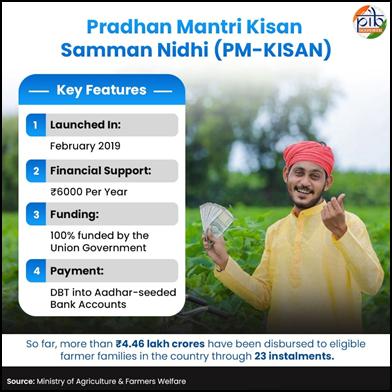
PM-KISAN is a centrally sponsored scheme launched on February 24, 2019. The scheme aims to provide assured income support to landholding farmer families nationwide with cultivable land. Under the scheme, each eligible farmer family receives annual financial assistance of ₹6,000. This is disbursed in three equal instalments of ₹2,000 through the Direct Benefit Transfer (DBT) mechanism into Aadhaar-seeded bank accounts.
So far, more than ₹4.46 lakh crore has been disbursed to eligible farmer families across the country through 23 instalments. The benefits of the scheme are provided to farmers upon seeding of land records in the PM-KISAN portal. They are also required to link their bank accounts with Aadhaar and complete the e-KYC verification. Reflecting the government’s continued commitment to strengthening farmers’ income security, the Union Budget 2026–27 has allocated ₹60,000 crore for the PM-KISAN scheme.
The scheme seeks to increase the income of small and marginal farmers by providing financial support for agricultural inputs. This helps in improving crop health and productivity. Providing direct financial assistance also helps reduce farmers’ reliance on informal credit sources and supports the continuity of agricultural activities. PM-KISAN stands out as one of the largest Direct Benefit Transfer (DBT) initiatives globally. This underscores its significant institutional mechanism for delivering financial support directly to farmers. More than 23 percent of beneficiaries are women, which highlights the inclusive outreach of this scheme.
Case Study: Impact of PM-KISAN on Farm Income in Uttar Pradesh
The Agro-Economic Research Centre, University of Allahabad, conducted a study in 2022, sponsored by the Ministry of Agriculture and Farmers Welfare. The study was focused on the impact of PM-KISAN in Uttar Pradesh.
Key findings of the study are as follows:
- Most beneficiaries were small and marginal farmers with holdings below two hectares.
- Beneficiary farmers regularly received ₹6,000 annually under PM-KISAN.
- Agricultural spending focused mainly on ploughing, fertilisers, and seeds.
- Paddy yield was 3.08% higher on beneficiary farms as compared to non-beneficiary farms.
- Wheat yield was 1.93% higher on beneficiary farms as compared to non-beneficiary farms.
- Beneficiary households recorded higher net farm income than non-beneficiaries.
- This represented a 9.85% increase in household farm income.
PM-KISAN improved farmers’ liquidity and supported the purchase of agricultural inputs. This has enhanced farmers’ risk-taking capacity and supported agricultural production.
The PM-KISAN Fund Transfer Journey
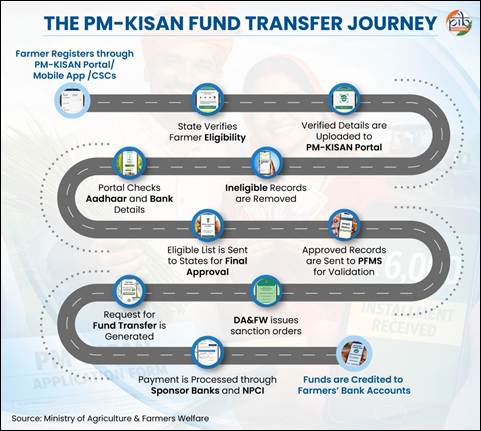
The process begins with farmer registration through the PM-KISAN portal, mobile app, or Common Service Centres (CSCs). State governments verify eligibility and upload beneficiary details to the portal. The system then validates Aadhaar and bank account details and screens out ineligible applicants. After final state approval, the data is sent to the Public Financial Management System (PFMS) for account verification. Eligible records are used to generate fund transfer requests and payment orders. The Department of Agriculture and Farmers Welfare issues sanction orders. Payments are then processed through sponsor banks and the National Payments Corporation of India (NPCI). Finally, funds are credited directly to farmers’ bank accounts, ensuring fast, transparent, and efficient delivery of benefits.
Targeting, Beneficiary Identification, and Database Management
State Governments are responsible for identifying eligible farmer households and developing a comprehensive beneficiary database. This database includes key details such as name, age, category, Aadhaar number, bank account information, and mobile number. States ensure the accuracy of these records to prevent duplicate payments. These records are regularly updated, digitized, and linked to Aadhaar and bank account information to enable seamless DBT of benefits.
The lists of eligible beneficiaries are publicly displayed at the village level to promote transparency. This also enables farmers, who may have been inadvertently excluded, to seek inclusion through the appropriate grievance redressal mechanisms. Additionally, States and UTs conduct recovery proceedings for the benefits that have been disbursed to ineligible individuals. These include income tax payers, government employees, public sector undertaking (PSU) personnel, and holders of constitutional posts. As of December 2025, a total amount of ₹416.75 crore has been recovered from ineligible beneficiaries nationwide.
Strengthening Access and Inclusion under PM-KISAN
The Government has taken several initiatives to ensure eligible farmers can easily access PM-KISAN benefits. These efforts focus on improving registration, verification, and grievance redressal through digital and on-ground interventions. More than 5 lakh Common Service Centres have been onboarded to support farmer registration and e-KYC completion. Special saturation drives have also expanded coverage under the scheme. During the Viksit Bharat Sankalp Yatra, more than 1 crore eligible farmers were added under PM-KISAN. Over 25 lakh farmers were added under the Government’s 100-day initiative. A special drive in September 2024 further enabled the inclusion of over 30 lakh farmers by clearing pending self-registration cases.
Multi-Tier Monitoring and Grievance Redressal Framework
Monitoring of the PM-KISAN is undertaken through a multi-tiered institutional framework operating at the national, state, and district levels. At the national level, the review mechanism is chaired by the Cabinet Secretary. State and District Monitoring Committees supervise implementation within their respective jurisdictions.
Farmers can register grievances through the PM-KISAN portal and the Centralized Public Grievance Redressal and Monitoring System (CPGRAMS). This facilitates timely resolution and transparent grievance management. During FY 2024–25, a total of 24,605 grievances were recorded on the PM-KISAN portal.
Technology-Enabled Service Delivery System under PM-KISAN
PM-KISAN is supported by a farmer-centric digital infrastructure that streamlines access and enhances transparency in the delivery of benefits. Aadhaar-based authentication forms a key pillar of the system, facilitating secure beneficiary identification and payment verification. Farmers can complete e-KYC using:
- OTP-based authentication
- Biometric authentication
- Face authentication
The PM-KISAN web portal serves as the central digital platform for beneficiary registration, verification, and data management. It maintains a unified national database of farmers and facilitates fund transfers through integration with the Public Financial Management System (PFMS). It also enables real-time monitoring of financial transactions nationwide. The portal further provides location-wise lists of beneficiary farmers, thereby enhancing transparency in programme implementation.
Complementing the portal, the PM-KISAN mobile application, launched in 2020, extends these services to mobile users. The application enables farmers to undertake self-registration, track the status of benefit transfers, and complete e-KYC verification. In 2023, the application was upgraded with a Face Authentication feature. This allows farmers to complete e-KYC by scanning their faces, thereby eliminating the need for OTP or fingerprint-based verification. Hence, this measure has been proven instrumental in improving accessibility of this scheme.
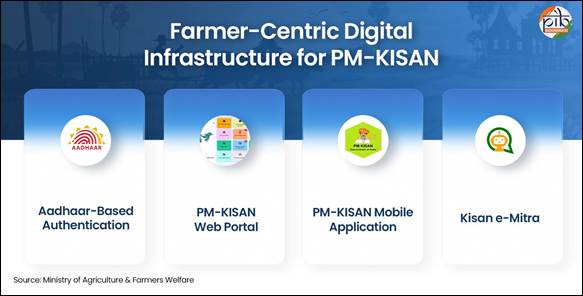
Artificial Intelligence (AI) Support System: Kisan-eMitra
In September 2023, the Government introduced Kisan-eMitra, an AI-enabled chatbot integrated with the PM-KISAN digital ecosystem. It was developed with technical support from the EkStep Foundation and BHASHINI. The chatbot provides farmers with real-time information on payments, registrations, and eligibility under the scheme in multiple Indian languages.
The platform offers 24/7 assistance in 11 major languages: Hindi, English, Tamil, Bengali, Odia, Malayalam, Gujarati, Punjabi, Telugu, Marathi, and Kannada. Hence, this improves accessibility for a diverse user base. Through voice- and text-based queries, farmers can check the status of their applications, track payment updates, and obtain scheme-related information.
The Future of Farmer-Centric Agricultural Development
The Pradhan Mantri Kisan Samman Nidhi (PM-KISAN) extends beyond a conventional income-support programme. It reflects a broader policy orientation toward farmer-centric and inclusive agricultural development. It enables a shift from entitlement-based assistance to empowerment-oriented support. Thus, the scheme helps redefine the relationship between public institutions and the farming community.
PM-KISAN has done more than just offer financial help. It has given farmers the confidence to try new things. It ranges from investing in better seeds, trying new crops, to improving their farm practices. For many in India’s villages, it has been a game changer, offering not just support, but hope and a sense of security for the future.
References
Ministry of Agriculture & Farmers Welfare
https://www.nic.gov.in/project/pm-kisan/
https://sansad.in/getFile/annex/270/AU3226_xbrVz9.pdf?source=pqars
https://www.allduniv.ac.in/upload/file_collection/PM_Kisan_PDF_Final.pdf
PIB Backgrounders
https://www.pib.gov.in/PressReleasePage.aspx?PRID=2242295®=48&lang=2
Click here to see pdf
***
PIB Research
(रिलीज़ आईडी: 2275744)
आगंतुक पटल : 5694