PIB Backgrounder
Reforms to Expand Foreign Participation in G-Secs
प्रविष्टि तिथि:
06 JUN 2026 1:33PM by PIB Delhi
Strengthening Bond Markets, Attracting Foreign Investment
The Government is undertaking sustained reforms to strengthen India's standing as a leading destination for global investment. To deepen the capital market, it has introduced a series of reforms to increase Foreign Portfolio Investor (FPI) participation in Government Securities (G-Secs). Key measures include tax exemptions on interest income, long-term capital gains (LTCG) and short-term capital gains (STCG), expansion of specified securities under the Fully Accessible Route (FAR), and streamlined investment norms.
These reforms aim to attract stable long-term foreign capital, deepen the G-Sec market, and strengthen India's debt market by broadening and diversifying the investor base. Greater foreign participation will provide an additional source of funding for infrastructure, manufacturing, urban development, climate initiatives, and other national priorities. It will also improve market liquidity and price discovery, support the development of a smoother yield curve, reduce government borrowing costs, strengthen financial market benchmarks, and enhance the transmission of monetary policy across the economy.
The reforms are poised to attract long-term institutional investors such as pension funds, insurance companies, and sovereign wealth funds, leading to more stable and sustained capital inflows. They are also expected to boost foreign exchange inflows and strengthen the resilience of India's financial markets.
|
Decoding FIIs, FPIs, G-Secs, BIS
Foreign Institutional Investment (FII) is a category of FPI that refers specifically to investments made by foreign institutional investors such as mutual funds, pension funds, insurance companies, and hedge funds. These institutions invest pooled funds in financial markets and typically play a more active role in investment research and decision-making.
Foreign Portfolio Investment (FPI) refers to investments made by foreign individuals, institutional investors, or funds in financial instruments such as stocks, bonds, mutual funds, and government securities. FPIs do not participate in the management or decision-making of the companies in which they invest and are generally considered passive investors.
Government Securities (G-Secs), are tradeable debt instruments issued by the central/ state governments to fund public projects, manage fiscal deficits, control market liquidity.
The Bank for International Settlements (BIS) is an international financial institution owned by central banks. It serves as a forum for monetary and financial cooperation among central banks globally. It also acts as a banker and asset manager for central banks and international organizations.
|
What Changes in Taxation
Prior to the latest reform, Foreign Institutional Investors (FIIs), including SEBI-registered Foreign Portfolio Investors (FPIs), were taxed under Section 210 of the Income-tax Act, 2025. Any income earned from investments in Government Securities (G-Secs) was subject to tax.
Specifically:
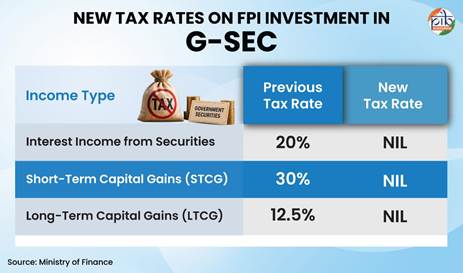
- Interest income earned on G-Secs was taxed at 20% for FIIs/FPIs.
- Short-term capital gains arising from the sale of G-Secs were taxed at 30%, depending on the nature of the transaction.
- Long-term capital gains were taxed at 12.5%.
- As a result, a portion of the returns earned by foreign investors from holding or trading G-Secs was payable as tax in India.
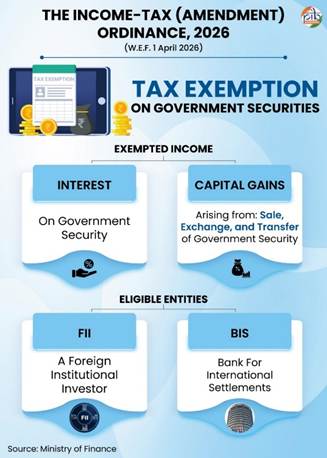
Recognising the importance of a competitive tax framework in attracting global capital, the Government has introduced a tax exemption for FPIs/FIIs investing in G-Secs.
Under the new regime, FPIs/FIIs will be exempt from:
- Interest income earned from G-Secs; and
- Capital gains arising from the sale, transfer, exchange or redemption of G-Secs.
The exemption will apply to income arising on or after 1 April 2026. The Income-tax (Amendment) Ordinance, 2026 inserted specific provisions granting this exemption to FIIs investing in G-Secs.
|
Classification of Capital Gains
Long-Term Capital Gains (LTCG) arise when a Government Security is held beyond the prescribed holding period.
- Listed G-Secs: More than 12 months.
- Unlisted G-Secs: More than 24 months.
Short-Term Capital Gains (STCG) arise when a Government Security is held for less than the prescribed holding period.
- Listed G-Secs: Up to 12 months.
- Unlisted G-Secs: Up to 24 months.
|
G-Sec Market Reforms
Foreign investors can invest in Indian G-Secs through routes such as the General Route and the Fully Accessible Route (FAR). General Route is the standard channel for foreign investors. It allows them to buy and sell permitted Indian G-secs, but comes with certain restrictions, such as caps on how much can be invested in a particular security, how long it must be held, and an overall investment limit. FAR is an open-access channel where foreign investors can invest in select G-Secs without restrictions that apply under the General Route.
As on 12 May 2026, FPIs held G-Secs worth ₹3,75,171 crore, accounting for 3.34% of the total outstanding G-Secs stock of ₹112.42 lakh crore. Notably, FAR accounted for the majority of these investments, with FPI holdings of ₹3.21 lakh crore, representing 6.74% of the ₹47.63 lakh crore outstanding stock eligible under FAR.
FPI Investments in Government Securities (as on 12 May 2026)
|
Route
|
FPI Holdings
|
Outstanding Stock
|
Share
|
|
General Route
|
₹54,091 crore
|
₹64.78 lakh crore
|
0.83%
|
|
FAR
|
₹3,21,080 crore
|
₹47.63 lakh crore
|
6.74%
|
|
Total
|
₹3,75,171 crore
|
₹112.42 lakh crore
|
3.34%
|
Recognising its strong investor interest, the Government has introduced further reforms to expand the scope of FAR and encourage greater foreign participation in the G-Sec market.
Expansion of the Fully Accessible Route (FAR)
The Government has now expanded the list of securities eligible under the FAR, broadening investment opportunities for foreign investors across a wider range of G-Secs.
The FAR framework will now include:
- New issuances of 15-year Government Securities;
- New issuances of 30-year Government Securities;
- New issuances of 40-year Government Securities; and
- Sovereign Green Bonds (SGrBs) issued in FAR-eligible tenors.
The expansion is expected to broaden investment opportunities across the maturity spectrum and encourage greater participation in long-duration sovereign debt instruments.
Relaxation of Investment Restrictions under the General Route
To facilitate greater FPI participation in G-Secs, the Government has removed:
- Short-term investment limit;
- Concentration limit; and
- Security-wise investment limit.
However, the overall investment limits remain unchanged at:
- 6% of the outstanding stock of Central Government Securities; and
- 2% of the outstanding stock of State Government Securities (SGSs).
Further, the existing 'General' and 'Long-Term' categories for FPI investments will be merged into a single investment limit for Government Securities and State Government Securities respectively.
Towards Deeper, More Globally Integrated Capital Markets
By simplifying market access and reducing operational complexities, these measures will provide a more seamless investment experience aligned with leading global markets. Over time, they are expected to support greater inclusion of Indian bonds in global indices, attract long-term foreign capital, expand participation in both debt and equity markets, and further integrate India's financial system with the global economy. These reforms will encourage wider participation from global investors seeking opportunities in one of the world's fastest-growing major economies.
References
Ministry of Finance
https://www.pib.gov.in/PressReleasePage.aspx?PRID=2269169®=48&lang=2
https://x.com/finminindia/status/2062769417390588095?s=48&t=CSE0glwGSDCXRHUtG7cLjw
Ministry of Law and Justice
chrome-extension://efaidnbmnnnibpcajpcglclefindmkaj/https://static.pib.gov.in/WriteReadData/specificdocs/documents/2026/jun/doc202665883801.pdf
Reserve Bank of India
https://www.rbi.org.in/commonman/english/scripts/FAQs.aspx?Id=711#1
Click Here To See PDF
*********
PIB Research
(रिलीज़ आईडी: 2269719)
आगंतुक पटल : 8809