Integrated Strategies Defeated Left-Wing Extremism
Posted On:
24 NOV 2026 11:26AM
|
India has achieved the historic milestone of becoming effectively free from Left-Wing Extremism (LWE), with no district in the country remaining LWE-affected. This transformation was driven by an integrated strategy combining security operations, infrastructure expansion, rehabilitation of surrendered cadres, tribal welfare, and improved governance. The coordinated approach sharply reduced violence, restored state presence in remote regions, and accelerated inclusive development, creating a lasting foundation for peace and prosperity.
|
New Era of Peace and Security
For nearly six decades, India grappled with Left-Wing Extremism (LWE). It was not a distant or abstract challenge, but a lived reality for millions of tribal families, villages cut off from roads, schools, and the broader promise of inclusive development. Violence was persistent, and uncertainty defined everyday life.
On 31 March 2026, this changed, marking a historic milestone in India’s internal security journey as the country became effectively free from Naxalism. When the current government assumed office in May 2014, the Red Corridor remained one of the most serious internal security challenges. Earlier approaches were largely fragmented and incident-driven, managing symptoms rather than addressing the structural roots of the problem. A more comprehensive and integrated strategy was subsequently pursued to resolve it.
Over the last twelve years, the transformation was guided by three mutually reinforcing strands of action. Restoring trust and faith in the State involved strengthened security operations, improved inter-agency coordination, structured surrender and rehabilitation frameworks, and sustained community outreach. Expanding infrastructure meant improving physical and digital connectivity, extending governance presence into remote areas, and creating durable economic opportunities. Delivering welfare focused on dignity, inclusive service delivery, cultural inclusion, and the mainstreaming of affected communities into the national development process.
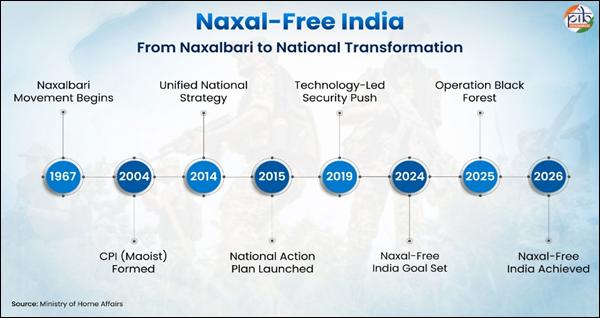
Each of these strands reinforced the other. Security created space for development. Development deepened trust. Trust accelerated welfare delivery. It was not a sequence; it was an inseparable chain of progress.
Restoring Faith in the State
This effort focused on rebuilding trust and faith through sustained state presence in vulnerable and remote regions. It strengthened coordination between security agencies and governance institutions to ensure effective responsiveness. The approach bridged long-standing gaps between communities and the state system.
Peak of Violence Before 2014
LWE grew from the Naxalbari uprising of West Bengal in 1967, inspired by Maoist ideology and the doctrine of armed revolution. Its guiding principle was simple and violent: power flows from the barrel of the gun. Nearly 92 per cent of Naxalites' weapons were looted directly from police armouries. Over time, several extremist organisations merged under CPI (Maoist) in 2004, making it India's biggest internal security challenge.
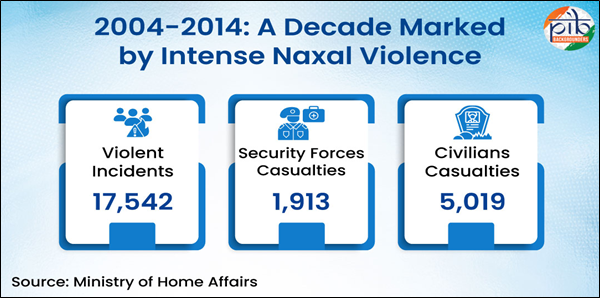
The decade from 2004 to 2014 was among the most violent in LWE history. Violence peaked in 2010 with 1,936 incidents and 720 civilian deaths in a single year. The full decade recorded 17,542 violent incidents, 1,913 security force deaths, and 5,019 civilian deaths.
There was no consistent national policy. State governments operated in silos. Even then government publicly acknowledged in 2009 that Naxalism was the biggest internal security challenge facing India, one that exceeded even Kashmir and the Northeast in geographic spread.
Policy Shift: From Scattered Response to Unified Strategy
The first decisive action came in 2015 with the approval of the National Policy and Action Plan to address LWE. This replaced the earlier, ad hoc approach with a structured, whole-of-government framework. Security measures focused on strengthening the State security apparatus, filling security gaps in remote areas and improving coordination between State Police and CAPFs. It deployed Central Armed Police Forces (CAPF), provided specialised training, and allocated funds through the Security Related Expenditure, Special Infrastructure Scheme, and Special Central Assistance (SCA) schemes, while addressing socio-economic root causes alongside security. Till now, approximately ₹4318.52 crore have been released since the inception of SCA Scheme in 2017.
Under the Special Infrastructure Scheme (SIS), projects worth ₹1,761 crore have been sanctioned for erstwhile LWE-affected States to strengthen Special Forces, Special Intelligence Branches, District Police and the construction of Fortified Police Stations.
Since 2014-15, ₹3,877.98 crore has been released under the Security Related Expenditure (SRE) Scheme to support operational needs, capacity building and training of security forces, rehabilitation of surrendered Left Wing Extremism cadres, and ex gratia assistance to families of martyred security personnel and civilians.
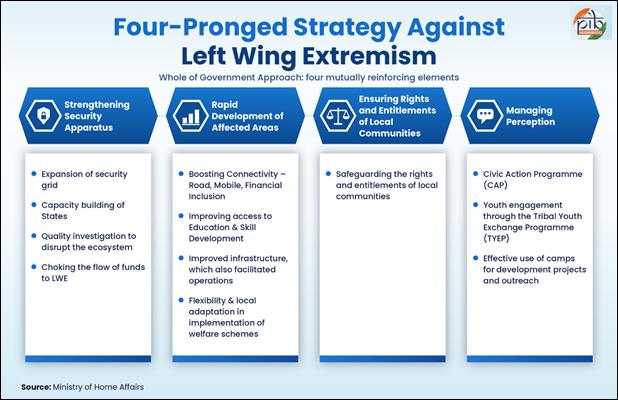
For the first time, India implemented a structured and comprehensive approach based on four-pronged strategy against LWE- Strengthening the Security Apparatus, Rapid Development, Ensuring Rights & Entitlements and Managing Perception. The government’s response was guided through a more centrally coordinated framework under the Ministry of Home Affairs, bringing greater coherence to policy implementation.
The goal of making India free from the fear and violence of Naxalism was achieved through focused planning and coordinated action. On 24th August 2024, the Government of India set a target to make the country Naxal-free by 31 March 2026. The target was achieved on schedule through intensified security operations, stronger coordination, infrastructure expansion, and accelerated development outreach.
Building the Security Grid
The Government systematically filled the security vacuum in Naxal-affected areas through infrastructure expansion, specialised forces, and improved operational coordination. This integrated approach enhanced state presence, mobility, intelligence sharing, and counter-insurgency capabilities across the Red Corridor.
668 new security camps were constructed, compared to just 169 before 2014. Additionally, 615 Fortified Police Stations (FPS) have been established to tighten the security grid, improve area domination, and sustain continuous operations in remote forest zones. 68 night-landing helipads were built for rapid deployment in remote areas, enabling troop movement, casualty evacuation, and surveillance. Security forces received 400 bullet-proof and blast-proof vehicles, and 5 hospitals were constructed for their welfare and medical support.
Integration of Elite Forces: CoBRA, DRG, STF and Greyhounds
A layered, specialised security architecture was developed, bringing together CoBRA (Commando Battalion for Resolute Action), CRPF, District Reserve Guard (DRG), and elite state units such as Jharkhand Jaguar, Chhattisgarh Police units, and Andhra Pradesh's Greyhounds. Joint training across DRG, STF, CRPF, and CoBRA created an integrated, interoperable force with a clear command structure.
Technology: The Game Changer
After 2014, the Central Government transformed counter-Naxal operations through the extensive use of modern technology. Unmanned Aerial Vehicles (UAVs), drones, satellite imagery, and AI-based data analysis enabled real-time monitoring and precise surveillance. Advanced location-tracking systems, scientific call-log analysis, mobile data analytics, and social media monitoring were operationalised. The Ministry of Home Affairs used technology-driven inputs to track movements, analyse communication patterns, and sharpen operational efficiency.
Landmark Operations to Trace, Target, Neutralise
The Government's "Trace, Target, Neutralise" doctrine delivered remarkable results. Through sustained security operations and focused intelligence-based strategies, the Government reclaimed areas that had been under LWE influence for over three decades.
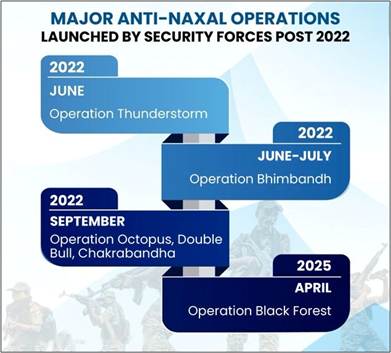
A series of coordinated operations, including Operation Black Forest, Operation Octopus, Operation Double Bull, Operation Thunderstorm, Operation Bhimbandh, and Operation Chakrabandha, significantly weakened Maoist networks across affected regions. Among them, Operation Black Forest emerged as a major breakthrough, dismantling a key Maoist stronghold, leading to the elimination of over 30 Maoists, and triggering a sharp rise in arrests and surrenders. Operation Double Bull resulted in Gumla, Lohardaga, and Latehar districts becoming Naxal-free. Collectively, these operations restored state presence in long-affected areas, reduced extremist influence, and created conditions for improved security, governance, and development outreach.
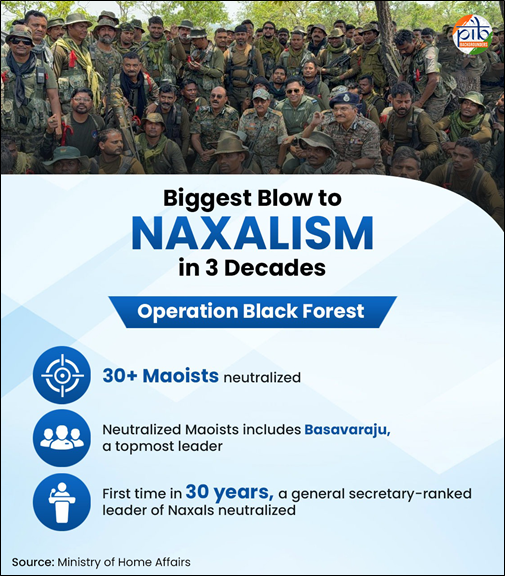
All Polit Bureau Members (PBM)/Central Committee Members (CCM) of CPI (Maoist) have been neutralised. Since 2014, a total of 41 PBM/CCM have been neutralised.
Choking the Support System
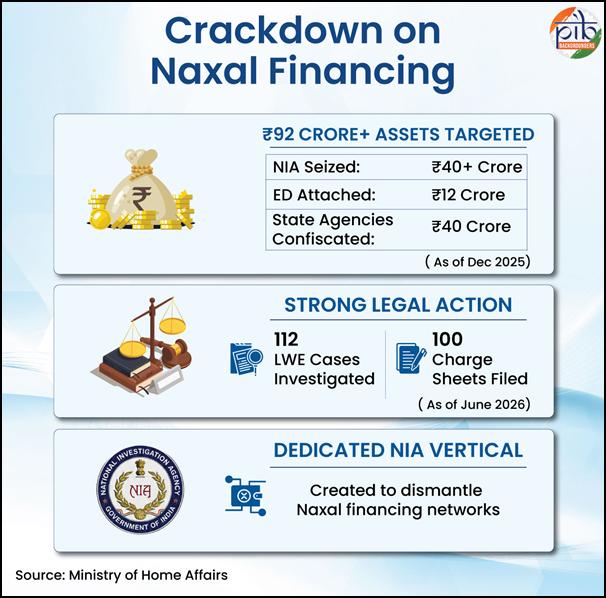
The Union Government adopted a comprehensive All-Agency approach, targeting not just armed cadres, but the entire ecosystem supporting them. For development, this meant a Whole-of-Government approach. For security operations, it meant a Whole-of-Agency strategy. A dedicated vertical was established within the National Investigation Agency (NIA) to disrupt Naxal financing networks. As of December 2025, the NIA had seized assets worth over ₹40 crore. The Enforcement Directorate (ED) attached assets worth ₹12 crore, while State agencies confiscated an additional ₹40 crore. As of June 2026, the total number of Left Wing Extremism (LWE) cases by the NIA reached 112, with 100 charge sheets filed.
Red Carpet for Surrender
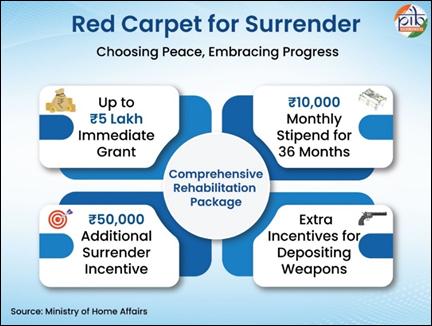
The Government's firm security response has been complemented by a rehabilitation-focused approach, with a clear message: "For those who lay down their arms, there is a red carpet." Surrendering cadres receive an immediate grant of ₹5 lakh for higher-ranked cadres and ₹2.5 lakh for others, along with a monthly stipend of ₹10,000 for 36 months. An additional incentive of ₹50,000 is provided for surrender, which is doubled in cases of group surrenders, along with extra compensation for depositing weapons.
The rehabilitation policy has contributed to a steady rise in surrenders. Till November 2026, approximately 8,526 Naxalites laid down their arms. These efforts have been strengthened by civil society members, journalists, community leaders and public representatives, who have helped build confidence in rehabilitation measures and encouraged affected individuals to return to the mainstream.
Recent developments have further demonstrated the effectiveness of this combined strategy of sustained security operations and rehabilitation. On 28 July 2026, under 'Nayi Disha, Nayi Pahal' anti-Naxal campaign, 16 active Maoists from the Kolhan and Latehar regions surrendered in Ranchi. The surrendered cadres included one Regional Commander, three Zonal Commanders, three Sub-Zonal Commanders, six Area Commanders and three cadre-level members. They surrendered with 11 sophisticated firearms, 38 magazines and 1,562 rounds of ammunition.
Additionally, on 29 July 2026, eight more Maoists carrying a combined reward of ₹49 lakh surrendered before the Bijapur Police, marking another significant success in the campaign against Left Wing Extremism. On the same day, security forces also arrested top Maoist leader and Politburo member, carrying a reward of ₹1 crore, from the Dhanbad-Giridih border. During the intelligence-based joint operation, a Regional Committee Member carrying a reward of ₹15 lakh, one Maoist cadre, and two villagers were also apprehended.
These security achievements extended well beyond restoring order. They created the foundation for long-term development. Every fortified police station, every CAPF camp, and every surrendered cadre expanded the reach of governance into previously inaccessible areas. Security opened the door for roads, schools, healthcare facilities, banking services, and digital connectivity to reach tribal communities. It was this restoration of stability and trust that laid the groundwork for the infrastructure transformation that followed.
Building a New Future: Infrastructure and Connectivity
The resolve to end Naxalism was never merely about eliminating Naxalites. It was about ensuring that every facility available in big cities reaches the poor tribals of the region, so their children, too, can have a bright future. This Phase focused on expanding infrastructure, connectivity, and governance outreach in remote regions. It improved access to essential services, roads, and digital networks. These efforts helped integrate previously underserved areas with mainstream development and governance systems.
A total of 15,189 kilometres of roads have been constructed under the two LWE-specific schemes, the Road Requirement Plan (RRP) and the Road Connectivity Project for LWE Affected Areas (RCPLWEA), to strengthen road connectivity in affected regions.
Several infrastructure projects in erstwhile LWE-affected areas had remained stalled due to Maoist threats and security-related challenges, with contractors often reluctant to participate in bidding for such works. Border Roads Organisation (BRO) has been tasked to undertake construction of such critical roads and bridges in these areas.
Digital & Mobile Connectivity
Telecom connectivity has emerged as the foundational bedrock of progress in modern societies. It’s even more important in case of rural tribal communities as it acts as a crucial catalyst for socio-economic development, bridging the digital divide, providing access to education and health, and fostering economic opportunities. Keeping this in mind, 9,561 towers have been commissioned. In the areas that were most LWE affected, 96% of villages (44,728 out of 46592 villages) now have mobile connectivity, opening doors to education, online delivery of services & economic growth.
Rail connectivity has emerged as a major driver of economic integration in erstwhile LWE areas. A 95-km railway line between Dalli Rajhara and Rowghat has already been completed, while the 140-km Rowghat–Jagdalpur phase has been approved. Additionally, a 153-km railway line between Dantewada and Manuguru has also been sanctioned. The 150-km Kirandul–Jagdalpur doubling project has made significant progress, with the Jagdalpur–Kamalur and Bacheli–Kirandul sections (totalling 130 km) already commissioned and the project nearing completion.
The Central Government significantly expanded financial inclusion in LWE-affected districts over the last twelve years. During April 2015 to March 2026, 1,804 bank branches opened, 1,321 ATMs installed, 74,720 banking correspondents appointed, and 6,025 post offices established.
Responsive and Inclusive Governance
The Government recognised that implementation challenges in tribal regions required flexibility and local adaptation rather than rigid adherence to standard procedures. Special campaigns were organised with UIDAI and the postal department to ensure Aadhaar coverage in remote tribal areas. In Bastar division of Chhattisgarh, 294 post offices were opened following physical surveys that accounted for the area's unique geographical and terrain conditions. Due to weak internet connectivity and banking infrastructure, cash wage payments and offline attendance systems were permitted in certain LWE areas under the earlier version of the Viksit Bharat Guarantee for Rozgar and Ajeevika Mission (Gramin) (VB-G-RAM G) scheme. Under the Swachh Bharat Mission, toilet construction funds were routed through Village Sanitation Committees in areas with inadequate banking access. An offline application was also introduced to enable officials to issue Ayushman Bharat cards in remote villages.
These examples demonstrate the importance of adaptive governance in ensuring last-mile delivery of welfare schemes.
The Bastar region of Chhattisgarh has long faced challenges in healthcare access due to its remoteness and LWE violence. To address this issue, the Government sanctioned a 240‑bed Super Specialty Hospital at Government Medical College, Jagdalpur under the Pradhan Mantri Swasthya Suraksha Yojana (PMSSY). The hospital is operational and it was inaugurated by the Hon’ble Union Home Minister on 18th May 2026. Further, 11 CAPF field hospitals established for security personnel have also been opened to local tribal communities, thereby extending access to healthcare facilities to the local population.
Education & Skill Development
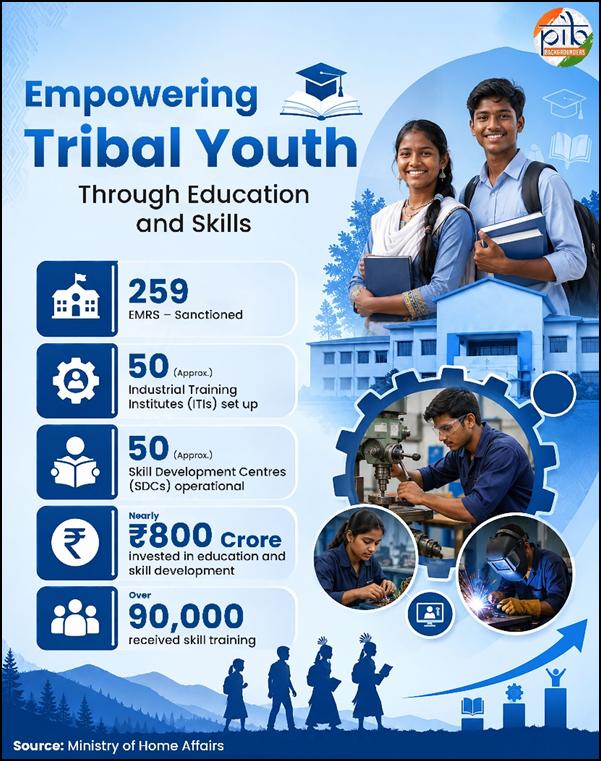
During the last twelve years, 259 Eklavya Model Residential Schools (EMRS) have been sanctioned by the Government of India. Also, 179 EMRS Schools have been made functional. Additionally, 47 Industrial Training Institutes (ITIs), and 49 Skill Development Centres (SDCs) were also developed in these areas. Altogether with an investment of nearly ₹800 crore. These expanded education, vocational training, and employment opportunities for tribal youth, helping integrate remote communities with the mainstream economy. Skill training was provided to over 90,000 youth and women.
Under the Tribal Youth Exchange Programme (TYEP), tribal youth from erstwhile LWE-affected areas are taken on exposure visits across the country to promote national integration, cultural awareness and developmental exposure. Since 2014, a total of 37,655 tribal youth have participated in the programme.
Under the Civic Action Programme, the Government of India provides financial assistance to the CAPFs to undertake welfare-oriented activities in their operational areas. These include organising medical camps, sports competitions and distributing essential items among local communities. Since 2014, ₹221.88 crore has been released under the programme, helping strengthen trust and bridge the gap between the security forces and local communities.
This infrastructure, roads connecting villages, mobile towers enabling communication, banks facilitating economic participation, and schools opening doors for tribal youth, translated directly into welfare on the ground. It created the physical and institutional platform upon which genuine welfare, dignity, and cultural renaissance could finally be delivered.
Overall infrastructure development in the affected region strengthens regional integration through sustained infrastructure development. Improved connectivity drives economic opportunity and mobility. Long-term investments ensure durable and inclusive growth pathways.
|
Did you know?
Presently, 38 districts in India have been categorised as Legacy and Thrust Districts, where continued security and developmental support is being provided.
|
People’s Welfare & Dignity
This final strand of the strategy emphasises welfare delivery with dignity and inclusivity. It strengthens last-mile service delivery for marginalised communities. The approach ensures equitable access to essential public services.
Strengthening Tribal Livelihoods
A sustained focus on tribal welfare has played a vital role in reducing LWE's influence, by expanding development, improving access to opportunity, and strengthening the connection between tribal communities and democratic institutions. Alongside security measures, the Government has ensured that development reaches remote tribal regions through better education, infrastructure, healthcare, housing, and livelihood support.
The rehabilitation framework for surrendered cadres has encouraged their integration into mainstream society through skill development, livelihood assistance, housing support under Pradhan Mantri Awas Yojana, and financial assistance for self-employment. Development grants were provided to villages that eliminated Naxal influence and established democratically elected panchayats. Children of surrendered cadres received free education up to Class XII, helping families build a more secure future.
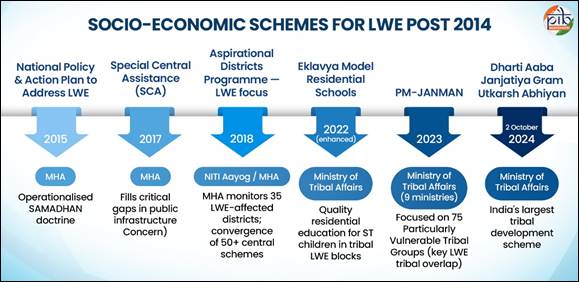
Several targeted initiatives accelerated this transformation. The National Policy and Action Plan combined security, development, protection of community rights and perception management. A total of 21,26,273 title deeds were distributed under the Forest Rights Act. Special Central Assistance built critical public infrastructure in the most affected districts. The Aspirational Districts Programme converged multiple welfare schemes to improve outcomes in health, education, financial inclusion, and connectivity.
Education emerged as a key pillar of transformation. Enhanced support for Eklavya Model Residential Schools (EMRS) expanded access to quality residential education for Scheduled Tribe children, including those in Left-Wing Extremism (LWE)-affected regions. The PM-JANMAN initiative further focused on Particularly Vulnerable Tribal Groups (PVTGs) by improving access to housing, safe drinking water, education, healthcare, and essential connectivity, helping bring underserved communities into the mainstream of development.
The launch of the Dharti Aaba Janjatiya Gram Utkarsh Abhiyan further strengthened efforts to bridge infrastructure gaps in tribal villages.
Through coordinated interventions by multiple ministries, this programme aims to improve living standards, expand economic opportunities, and ensure tribal communities participate fully in India's development journey.
Case Study: Chhattisgarh's Journey from Naxalism to Development
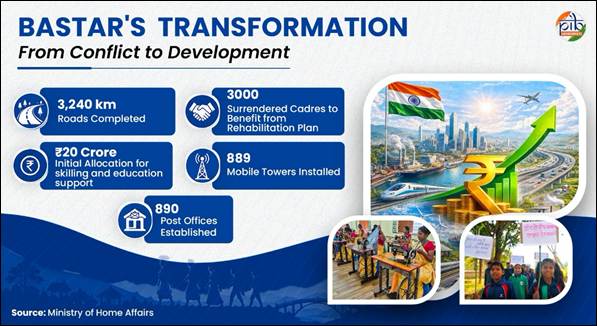
For decades, Bastar in Chhattisgarh remained one of the country's most Naxal-affected regions. Limited connectivity, weak administrative presence, and difficult terrain enabled extremist groups to establish a strong foothold. In the last 12 years, a coordinated strategy combining security, development, and tribal participation transformed the region's trajectory.
A key turning point came in 2017 with the formation of the Bastariya Battalion. The battalion recruited 1,143 personnel, including around 400 local youth from Bijapur, Sukma, and Dantewada. Local participation strengthened intelligence networks, improved trust between security forces and tribal communities, and helped restore confidence in state institutions.
As security conditions improved, development gained momentum. More than 3,240 kilometres of roads were constructed across the Bastar region, covering Bastar, Bijapur, Dantewada, Sukma, Narayanpur, Kanker, and Kondagaon districts. Also 889 mobile towers were installed to improve digital connectivity. Villages that were once isolated became connected to markets, schools, healthcare facilities, banking services, and government programmes.
The Government also focused on rehabilitation and reintegration. A dedicated plan was prepared for around 3,000 surrendered cadres, supported by an initial allocation of ₹20 crore for skill development, education, and livelihood opportunities. The initiative aimed to replace the cycle of violence with pathways to economic empowerment.
In May 2026, the Shaheed Veer Gunda Dhur Seva Dera initiative was launched in Chhattisgarh to convert security gains into lasting development. Around 1/3rd of CAPF camps are being transformed into Integrated Development Centres providing access to government schemes, healthcare, banking, agricultural support, skill development, and other citizen services. The establishment of one such Centre in Netanar, the birthplace of Veer Gundadhur, symbolises the return of governance to areas once affected by extremism.
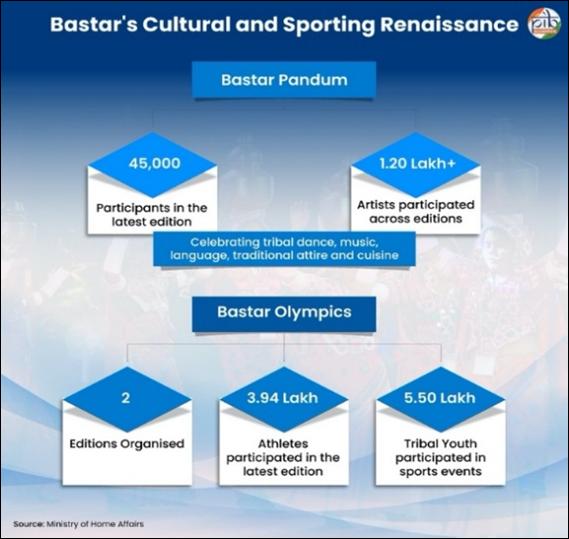
Alongside infrastructure and welfare, cultural initiatives such as Bastar Pandum and the Bastar Olympics strengthened community participation and tribal identity. These platforms brought together lakhs of tribal youth and artists, promoting social integration and creating new opportunities for engagement and leadership.
The transformation of Bastar demonstrates that lasting peace is achieved when security measures are followed by development, welfare delivery, and community empowerment. Chhattisgarh's experience shows how sustained government presence, local participation, and inclusive growth can turn a conflict-affected region into a pathway for development and prosperity.
Results of a Decade of Transformation
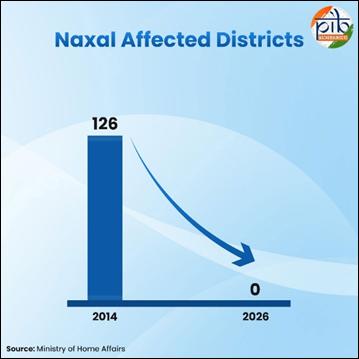
The number of Left Wing Extremism-affected districts declined from 126 in 2014 to zero by March-April 2026. Further, the count of the most affected districts has also declined from 35 to zero, making a decisive shift in the security landscape.
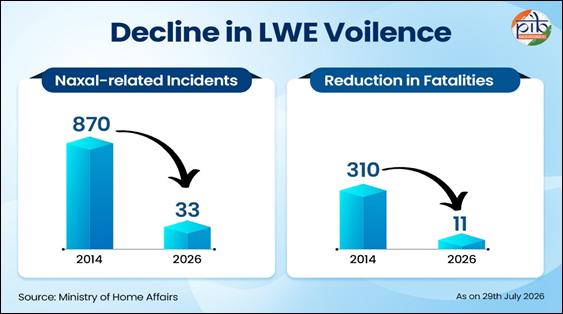
The impact became visible across all major indicators of violence. The year 2010 marked one of the deadliest phases in the history of Naxalism, with 1,936 Naxal-related incidents and 1,005 fatalities reported. Since then, sustained security operations, development interventions, and improved governance significantly weakened Left Wing Extremism (LWE) networks. Naxal-related incidents declined sharply from 870 in 2014 to just 33 in 2026 (as on 29 July 2026). During the same period, fatalities reduced from 310 to 12. The sustained fall in violence indicates the weakening operational capabilities of Naxal groups and the gradual restoration of security, connectivity, and public confidence in affected regions. The trend reflects a significant improvement in the security environment. Areas once affected by frequent violence have witnessed a marked improvement in peace and public safety.
Consolidating Gains: Key Steps Since June 2026
After the country became free from LWE, the Government shifted its focus to consolidating security gains and accelerating development. Several major steps were taken after June 2026 to sustain peace and progress in erstwhile affected areas.
Security Camps Turned into Integrated Development Centres (Seva Dera Kendras): One-third of the security camps in LWE-free areas are being converted into Seva Dera Kendras for citizen services. This marks a clear shift from security consolidation to people-centric governance in erstwhile affected regions.
The following facilities will be provided at these centres:
- Jan Suvidha Kendra: Providing information on and access to all Government schemes and online digital services to local residents under one roof.
- Community Development: Improving the quality of life through skill development, women empowerment, employment-oriented training, nutrition and healthcare services.
- Social Development: Promoting tribal culture, folk arts and traditional festivals, while providing sports facilities and opportunities to the youth.
- Economic Development: Increasing income and employment opportunities for local communities through processing, branding and sale of agricultural produce and Minor Forest Produce (MFP), such as Mahua, Tamarind and Tendu leaves.
As a pilot project, a Memorandum of Understanding (MoU) has been signed with the National Institute of Design (NID), Ahmedabad, for transforming five security camps in the Bastar region of Chhattisgarh into Shaheed Veer Gundadhur Seva Dera Kendras.
NID has completed the feasibility study, and work has commenced. The MHA's Special Central Assistance (SCA) Scheme will meet the expenditure.
Survey of Welfare Saturation: As reported to Parliament in August 2026, the Ministry of Home Affairs surveyed seven erstwhile LWE-affected districts of south Chhattisgarh to assess the extent of saturation of various government welfare schemes, developmental initiatives and the potential for livelihood generation through an independent agency. The survey has collated details of education levels, health indicators, and the availability of basic services such as primary schools, anganwadi centres, and secondary health facilities etc. Insights of the survey are helping the Union Home Ministry and the State Government in fulfilling the objective of bridging the developmental gaps and ensuring livelihood.
Support for Victims of Naxal Violence: On 15 October 2026, the Minister of Home Affairs addressed a ceremony for distributing assistive devices to persons with disabilities. Victims of Naxal violence were among the beneficiaries of this initiative under the ongoing Seva Sankalp Abhiyan.
First Diwali in a Naxal-Free India: On 8 November 2026, the Prime Minister celebrated Diwali with security forces at the CoBRA Operations Base, Karanpur, Bastar. He described it as the first Diwali when every district in the country is free from Naxalism. He noted that no CRPF jawan lost his life while on duty in the past year, marking the first such achievement in 47 years.
A Defining Chapter in India's Security and Development Story
India's achievement of a Naxal-Free India stands among the most important internal security successes in the country's independent history. It reflects the impact of decisive leadership, sustained policy implementation, and a multi-dimensional strategy combining security, development, and rehabilitation.
Over the last decade, India transformed its approach to Left-Wing Extremism, from reactive containment to proactive elimination. The next phase is to consolidate these gains, prevent any relapse, complete the rehabilitation of affected communities and ensure that the gains in security are matched by sustained development, effective governance and the full delivery of rights and public services.
The achievement of a Naxal-Free Bharat is not merely the end of an insurgency. It is the beginning of a new chapter of peace, inclusion, and progress for some of India's most vulnerable communities.
References:
Prime Minister’s Office
Ministry of Home Affairs
Parliament of India
Prasar Bharati
Press Information Bureau (Research Unit)
Social Media
Click here to see PDF
*********
PIB Research
(Explainer ID: 160893)
आगंतुक पटल : 316
Provide suggestions / comments