Farmer's Welfare
Blooming Beyond Borders
“The Rise of India’s Floriculture Economy”
Posted On:
23 NOV 2026 1:37PM
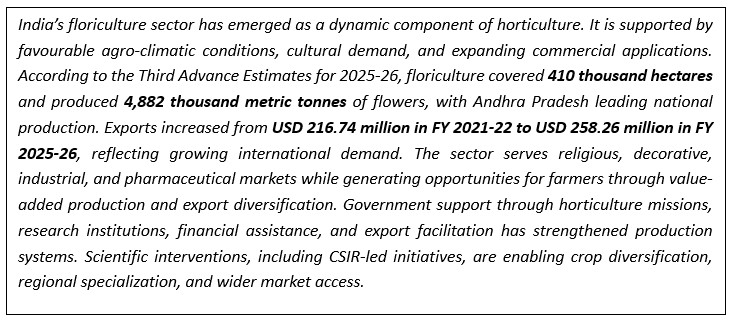
Roots of a Blooming Industry
India is a land of remarkable natural diversity, stretching from snow-bound mountains and fertile plains to arid deserts and long coastlines. These varied agro-climatic conditions support the cultivation of an extraordinary variety of flowers that bloom across regions and seasons. Coupled with the deep cultural, spiritual, and emotional significance of flowers in India, these natural advantages have fostered a thriving floriculture sector.
Recognising its economic and aesthetic potential, the government has identified floriculture as a “sunrise industry”. What was once a relatively niche segment within Indian agriculture has evolved into a dynamic component of the horticulture sector. The sector contributes to farmer incomes, agricultural exports, and rural enterprise development while increasingly adopting modern cultivation practices and technologies. Today, floriculture encompasses a diverse range of products, production systems, and value-added applications. Rising consumer demand, widening market opportunities, policy support, and technological advancements are driving its continued growth.
Inside India’s Floral Economy
Floriculture is the art and science of growing flowers to achieve high standards of flower quality and aesthetic appeal. As an integral branch of horticulture, it includes the cultivation of flowers and ornamental crops from planting to harvesting. The sector also involves the production of planting material through seeds, cuttings, budding, and grafting. It further includes the marketing of flowers and flower-based products.
Floriculture Product Categories
Loose flowers are harvested and marketed without long stems. These are generally sold by weight and are commonly used for garlands and gajras. Examples include marigolds and jasmine.
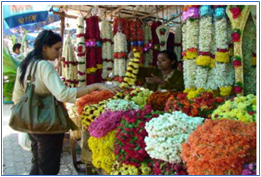
Retail Shop selling loose flowers as Garlands
Cut Flowers are harvested and marketed with stems. These are commonly used in bouquets and vase arrangements. Examples include roses, gerberas, carnations, orchids, and lilies.
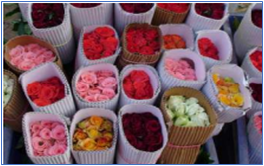
Cut flowers sold in bunches as bouquets
In addition to flowers, floriculture includes cut foliage, potted and bedding plants, and ornamental planting materials like seeds for propagation and landscaping.
Flowers that Shape the Market
India cultivates a variety of flowers tailored to domestic and international demand. Key varieties include:
- Roses: Widely grown in Karnataka and Maharashtra; high in export value.
- Marigolds: Popular in religious ceremonies; extensively grown in Tamil Nadu and Madhya Pradesh.
- Carnations, Chrysanthemums, Gerberas: Grown in controlled environments for export.
- Lilies and Orchids: High-end flowers grown in select regions like Sikkim and Mizoram.
The demand for exotic flowers has increased, with orchids and anthuriums becoming commercially viable in the north-eastern region. These flowers are also gaining traction in urban landscaping, event decor, and the wellness industry.
From Open Fields to Protected Farms
Cultivation of flowers in India takes place through both open-field and protected systems like greenhouses, depending on crop requirements. Open-field cultivation is commonly used for crops such as Chrysanthemum, Rose, Gaillardia, Lily, Marigold, Aster, and Tuberose.
Rising demand for quality flowers and year-round availability have encouraged greater adoption of protected cultivation such as greenhouses. Greenhouses are particularly important for export-oriented crops such as Gerberas and Carnations. This ensures better control over temperature, humidity, and other growing conditions. This helps ensure uniform quality, improved productivity, and compliance with international market standards.
Beyond Bouquets: The Many Uses of Floriculture
Flowers play an important role in everyday life in India and are closely linked with cultural, social, and religious practices. Beyond these traditional uses, floriculture has evolved into a diversified sector with expanding applications in perfumery, cosmetics, and pharmaceuticals.
Key domestic uses:
- Religious and social practices- Flowers such as Jasmine, Marigold, and Crossandra are commonly used in worship, social ceremonies, and personal decoration.
- Lifestyle and decorative uses- Increasing urbanisation and rising disposable incomes have driven demand for bouquet gifting, venue decoration and beautification of residential and commercial spaces.
- Perfumery and cosmetics- Flowers, including Jasmine, Lavender, and Rose petals, are used as raw material in fragrance and cosmetic products.
- Pharmaceutical applications- Floricultural crops such as Calendula, Hibiscus, and Chamomile are utilised in pharmaceutical preparations.
- Dye and colour extraction- Marigold and Hibiscus are used for natural dyeing and colour extraction.
Mapping India's Flower Belt
Supported by favourable climatic conditions and expanding market demand, floriculture cultivation has expanded across several regions of the country. According to the Third Advance Estimates for 2025-26, the total area under floriculture cultivation stood at 410 thousand hectares. During the same period, production included 3,653 thousand metric tonnes of loose flowers and 1,229 thousand metric tonnes of cut flowers. Total floriculture output amounted to 4,882 thousand metric tonnes, reflecting the scale and commercial significance of floriculture cultivation in India.
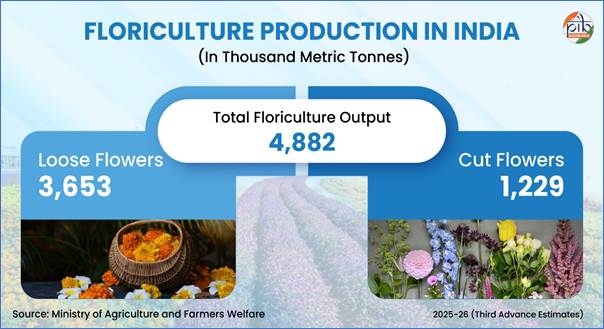
The States Driving Floral Production
Floriculture production in India is concentrated in a few leading states. According to the Third Advance Estimates for 2025-26, Andhra Pradesh accounted for about 31 percent of the country’s total flower production. It is followed by Tamil Nadu (14 percent), Madhya Pradesh (11 percent), Karnataka (10 percent), and West Bengal (8 percent). Other major producers included Chhattisgarh, Gujarat, Uttar Pradesh, Maharashtra, Odisha and Telangana.
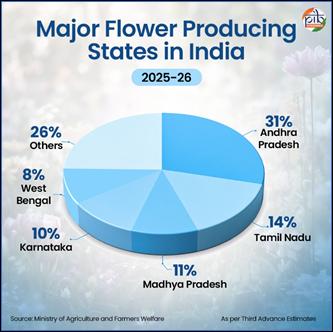
The Northeastern states together accounted for about 4 percent of India’s total flower production, with Assam contributing substantially through both loose and cut flowers. This was followed by Nagaland, particularly in cut flowers. This distribution reflects the diverse geographical spread of floriculture across the country.
A strong production base and diversified cultivation systems have also supported India's growing presence in the international flower trade.
India's Growing Footprint in Global Flower Markets
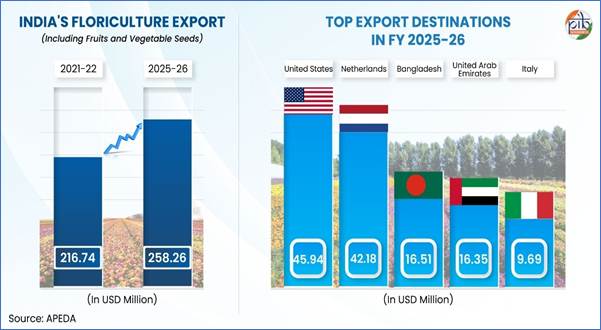
Floriculture forms part of value-added agricultural exports and provides additional income opportunities beyond traditional crop cultivation. India’s floriculture exports have followed a clear upward trend over the past few years, signalling increasing international demand for Indian floral products. Exports of floriculture, including fruits and vegetable seeds, rose from USD 216.74 million in FY 2021-22 to USD 258.26 million in FY 2025-26. This growth reflects rising international demand for Indian floral products and strengthening export competitiveness.
India’s Top Global Destinations
In FY 2025-26, India’s floriculture and seeds recorded strong demand across key international markets. The United States emerged as the top destination, with exports worth USD 45.94 million. It was followed by the Netherlands, a significant base of the international flower trade, with USD 42.18 million. Bangladesh accounted for floriculture imports worth USD 16.51 million. The United Arab Emirates and Italy imported products valued at USD 16.35 million and USD 9.69 million, respectively. This highlights India’s expanding footprint in traditional and emerging markets for floriculture exports.
A Diverse Floral Export Portfolio
This export performance is supported by a diverse range of floricultural crops that are commercially relevant in the global cut flower trade. Prominent export crops from India include Rose, Carnation, Chrysanthemum, Gerbera, Gladiolus, Gypsophila, Liatris, Nerine, Orchids, Achillea, Anthurium, Tulip, and Lilies, enabling the country to cater to varied market preferences and quality requirements worldwide.
Further, floriculture exports from India comprise multiple product categories, each catering to specific international markets:
- Fresh cut flowers are exported mainly to Europe, Japan, Australia, the Middle East, and the United States of America
- Loose flowers are supplied largely to markets serving expatriate Indian communities in the Gulf region
- Cut foliage is exported primarily to European countries
- Dry flowers are exported to a wide range of destinations, including the United States of America, Europe, Japan, Australia, the Far East, and Russia
- Potted plants are exported to a limited number of countries.
Among these export segments, dry flowers constitute a major share of India’s total floriculture exports, owing to their longer shelf life and wider market reach.
Export Breakthrough from the North East
In February 2025, the first-ever export consignment of Anthurium flowers from Mizoram to Singapore was flagged off. This marked a significant milestone for floriculture exports from India’s North Eastern Region. The consignment contained 1,024 Anthurium cut flowers (weighing 70 kg) packed in 50 corrugated boxes. The initiative was led by APEDA in collaboration with the Department of Horticulture, Government of Mizoram. It highlights new overseas market linkages and emerging trade opportunities for floriculture growers in the region.
Enabling Growth Through Policy Support
The government has initiated a range of developmental programmes to promote floriculture across the country. These efforts focus on production, infrastructure, research, capacity building, and export facilitation.
Key areas of government support include:
- Policy and Institutional Support- Developmental initiatives are implemented primarily through the Mission for Integrated Development of Horticulture (MIDH), including the National Horticulture Mission (NHM), the Horticulture Mission for North East and Himalayan States, and the National Horticulture Board.
- Financial assistance and credit support - The National Bank for Agriculture and Rural Development (NABARD) provides financial assistance to farmers to adopt protected cultivation and precision farming practices, thereby improving productivity and quality.
- Seed production and planting material - To meet growing demand for flower seeds, several seed companies have established production units in major flower-growing states. Thus, supporting the availability of quality planting material.
- Incentives and concessions - Concessions are provided on seeds, planting materials, equipment, and air freight to support floriculture exports and improve competitiveness in international markets.
- Export Promotion - Export-related support is provided through the Ministry of Commerce, mainly via the Agricultural and Processed Food Products Export Development Authority (APEDA).
- Training and capacity building- The Government has introduced various training programmes for farmers and entrepreneurs. These programmes are strengthening farmers’ technical skills, promoting the adoption of modern practices, and enterprise development in floriculture.
- Research and development - Floriculture research is carried out at multiple institutions under the Indian Council of Agricultural Research (ICAR) and the Council of Scientific and Industrial Research (CSIR). The research is also conducted in the horticulture departments of State Agricultural Universities, and under the All India Coordinated Floriculture Improvement Project.
The sector continues to benefit from policy support, financial assistance, and institutional backing. Improved frameworks and targeted interventions will further enhance India's competitiveness in the floriculture trade.
Cultivating Innovation: From Scientific Research to High-Value Floriculture
As floriculture becomes increasingly market-oriented, advances in research and technology are improving productivity, quality, and product diversification.
CSIR Floriculture Mission
The Council of Scientific and Industrial Research (CSIR) has developed two flagship programmes to strengthen India’s flower and aroma sectors through science-driven interventions.
- The CSIR Floriculture Mission, launched in 2021, seeks to enhance farmers’ incomes, support entrepreneurship, and promote technology-led development in the floriculture industry.
- As of December 2025, under this mission, more than 2,208 hectares have been brought under floricultural cultivation.
- This has benefitted16,220 individuals across 399 clusters in 26 states and union territories of the country.
The programme has also developed and transferred multiple technologies to entrepreneurs and conducted numerous training and capacity-building initiatives.
- The CSIR Aroma Mission, launched in 2017, focuses on improving rural livelihoods through the cultivation and processing of aromatic crops. Thesecrops provide quality raw materials for the aroma and essential oil industry.
- As of December 2025, aromatic crop cultivation had expanded to more than 51,000 hectares.
- The mission had also established over 4,500 aroma clusters across 28 States, including 20 clusters in tribal areas.
- The mission prioritised skill development, with 2,096 training and awareness programmes training 1.22 lakh persons. These included10,000 women and supported more than 110 entrepreneurs in developing value-added products.
- In total, these interventions have generated around 1 crore rural employment opportunities and enabled the production of over 6,000 tonnes of essential oils. The output valued at aboutRs.600 crore supplied key inputs to the aroma and allied industries.
These research initiatives highlight the importance of scientific support in strengthening India's floriculture sector.
From Laboratory to Field: The Story of India’s Exotic Flowers
|
Tulips in the Himalayas: A Garden of Possibilities
In the Himalayan region (Palampur), scientific research under the CSIR - Institute of Himalayan Bioresource Technology (IHBT)-Floriculture Mission, has helped convert natural climatic advantage into structured floriculture opportunity. Leveraging cool temperatures and suitable agro-ecological conditions, tulip cultivation has been supported through research-driven interventions. The work has focussed on planting material selection, flowering cycles and crop management practices. These efforts have enabled the successful growth of tulips meeting international quality parameters. They have also strengthened the region’s position in premium ornamental flower segments. As of May 2026, the Tulip Garden at Palampur attracted more than 1.5 lakh visitors, highlighting its potential to support floriculture-based tourism.
The Himalayan tulip initiative demonstrates how targeted technological interventions can support crop diversification. It also highlights the potential for strengthening regional specialisation in high-value floriculture.
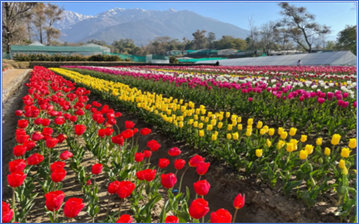
Tulip Garden at CSIR-IHBT Palampur, Himachal Pradesh
|
|
Eustoma in Odisha: A New Bloom of Hope
In contrast to the cool Himalayan landscape, another CSIR laboratory has created floral history. The successful cultivation of Eustoma in parts of Odisha (Sambalpur) represents a breakthrough in adapting exotic flowers to non-traditional environments. Once considered unsuitable for warmer regions, the crop was grown with scientific guidance on temperature management, disease control and cultivation practices. The outcome demonstrated that innovation can overcome climatic constraints, opening new income avenues for farmers. The Odisha experience highlight show science-led cultivation can connect farmers with high-value markets.
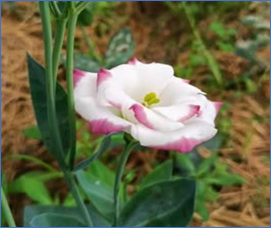
First Bloom of Eustoma in Odisha
|
For visitors walking through the tulip fields of Palampur or admiring the pastel blooms of Eustoma in Sambalpur, the experience extends beyond visual appeal. It represents the quiet yet impactful transformation of laboratory knowledge into practical field-level success. Here, innovation takes root and strengthens India's evolving floriculture landscape.
A Sector Poised for Sustainable Growth
India’s floriculture sector has moved beyond a niche segment of horticulture to become a diversified and commercially significant agricultural activity. Its growth is anchored in the country’s rich agro-climatic diversity, expanding domestic demand, stronger market linkages, and growing export opportunities. The sector’s future lies in moving from cultivation to value creation. Greater adoption of protected cultivation, precision technologies, improved planting material, post-harvest management, and quality standards can strengthen productivity and market competitiveness. With continued policy support, stronger institutions, and better market linkages, floriculture can boost farm incomes, rural enterprises, and agricultural exports.
The sector’s expanding footprint, from traditional flowers to exotic varieties and value-added applications, also opens avenues for regional specialization and new entrepreneurial opportunities. As India looks towards a more diversified and technology-enabled agricultural economy, the future of floriculture holds the promise of growing both value and livelihoods- “one bloom at a time”.
Top of FormReferences
Ministry of Agriculture and Farmers Welfare
https://www.csir.res.in/en/csir-science-stories/indias-exotic-flower-revolution#:~:text=Eustoma's%20success%20proves%20that%20India's,of%20400%20farmer%20clusters%20nationwide.&text=By%20connecting%20Himalayan%20farmers%20with,flowering%20of%20India's%20scientific%20spirit.
https://epubs.icar.org.in/index.php/IndHort/article/view/160122/57269
https://megagriculture.gov.in/PUBLIC/floriculture_default.aspx
https://purulia.gov.in/horticulture/
https://agriwelfare.gov.in/hort-state-level
https://ccsniam.gov.in/img/saraswati_Finalreport.pdf
Ministry of Commerce and Industry
https://apeda.gov.in/Floriculture
https://apeda.gov.in/FloricultureAndSeeds
https://agriexchange.apeda.gov.in/
https://www.investindia.gov.in/blogs/indian-floriculture-sunrise-sector
https://www.ibef.org/research/case-study/india-s-floriculture-sector-blooming-with-export-potential-and-rural-prosperity
https://www.pib.gov.in/PressReleasePage.aspx?PRID=2113965®=3&lang=2
Ministry of Science & Technology
https://www.pib.gov.in/PressReleasePage.aspx?PRID=2198763®=3&lang=2
https://www.pib.gov.in/PressReleasePage.aspx?PRID=2266281®=48&lang=2
Ministry of Education
https://cbseacademic.nic.in/ecbse/pdfs/Basic%20Horticulture-I%20%28SH%29%20-%20XI.pdf
https://ncert.nic.in/vocational/pdf/kegr101.pdf
PIB Backgrounder
https://www.pib.gov.in/PressNoteDetails.aspx?ModuleId=3&NoteId=155126&id=155126®=48&lang=2
Click here to see pdf
PIB Research
Bottom of Form
(Explainer ID: 160886)
आगंतुक पटल : 106
Provide suggestions / comments
इस विज्ञप्ति को इन भाषाओं में पढ़ें:
हिन्दी