Social Welfare
Naturopathy: Natural Healing for a Healthy India
Treatment, Training, Research and Care Across the Country
Posted On:
17 NOV 2026 9:58AM
Naturopathy is a drug-free, cost-effective system that helps the body heal itself through diet, fasting, water, mud, massage and natural living. India observes National Naturopathy Day on 18 November, and the 9th edition will be held at Nagamangala, Karnataka, under the theme ‘Prakrutik Chikitsa, Swasth Bharat’. The National Institute of Naturopathy, Pune, runs Nisarg Gram, a 250-bedded naturopathy hospital with the first Bachelor of Naturopathy and Yogic Sciences (BNYS) college under the Central Government.
Healing with Nature
Naturopathy rests on a simple idea: the body has the power to heal itself. Rooted in the healing wisdom of many cultures, it is a cost-effective, drug-free approach that uses natural materials for health care and healthy living. It works by boosting the body’s own vitality, with the help of the five elements of nature: earth, water, air, fire and ether.
Naturopathy is a system of natural treatment and also a way of life. It calls for a “Return to Nature”: simple eating and living habits, and a life in harmony with oneself, society and the environment. It has the potential to promote health, prevent illness, cure it and help in recovery.
Treatments in Naturopathy
A naturopath treats with what nature provides: fasting and diet, hydrotherapy (treatment with water), mud packs, cold packs, baths and massages. At Nisarg Gram, the Pune campus of the National Institute of Naturopathy, treatment sections also offer magnetotherapy (treatment with magnets), chromotherapy (colour therapy) and physiotherapy, along with a yoga hall and a Saatvik diet centre.
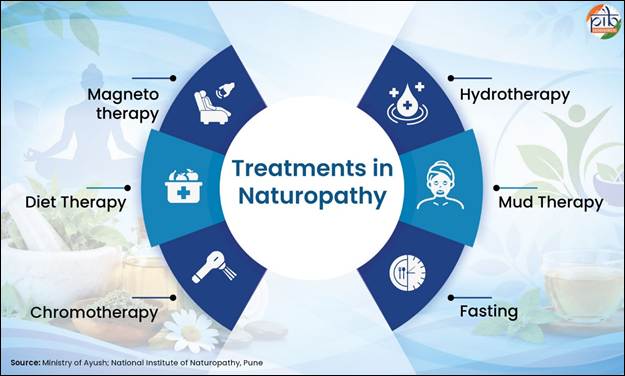
Naturopathy is reported to be effective in chronic, allergic, autoimmune, degenerative and stress-related disorders. Its emphasis on nutrition, natural therapies and lifestyle change has found new relevance as attention grows to lifestyle-related disorders, obesity, stress and healthy ageing. A Healthy diet, physical activity, adequate rest and stress management can support preventive healthcare across age groups.
Naturopathy and Yoga in India
In India, naturopathy goes hand in hand with yoga. In the words of the National Institute of Naturopathy, Indian naturopathy includes yoga along with ancient Indian concepts such as a ‘Panchabhuta-based understanding of health and disease’, the Panchabhuta being the five elements of nature named above. Over time, it has grown into a holistic system that treats and prevents disease and teaches people to live a healthy life close to nature. Yoga and Naturopathy are listed together among the Ayush systems, along with Ayurveda, Unani, Siddha, Sowa Rigpa and Homoeopathy. At the National Conference on Naturopathy 2026, the Ministry of Ayush reiterated that Yoga and Naturopathy complement each other. The Government has built a full system around this pairing: a degree that joins naturopathy with yogic sciences; a research council for both, the Central Council for Research in Yoga and Naturopathy (CCRYN); central registration of practitioners; and the country’s first national naturopathy hospital.
9th National Naturopathy Day: Prakrutik Chikitsa, Swasth Bharat
The 9th National Naturopathy Day will be observed on 18 November 2026 at the Central Research Institute of Yoga and Naturopathy (CRIYN), Nagamangala, Karnataka. Its theme, ‘Prakrutik Chikitsa, Swasth Bharat’, puts prevention first: good diet, physical activity, yoga and stress management, with a focus on preventing obesity. The observance aligns with the Prime Minister’s vision of a Fit and Healthy India. Shri Prataprao Jadhav, Union Minister of State (Independent Charge) for Ayush and Minister of State for Health and Family Welfare, said:
“Naturopathy encourages us to recognise the close relationship between lifestyle, nature and overall health. Our emphasis is on strengthening its scientific foundation through credible research, quality education and responsible integration with conventional healthcare.”
Mahatma Gandhi and the Origin of Naturopathy Day
Naturopathy Day honours a commitment Mahatma Gandhi made to nature cure. On 18 November 1945, he became the Lifetime Chairman of the All India Nature Cure Foundation Trust in Pune and signed its deed. The Ministry of Ayush declared the date to be observed every year as Naturopathy Day, beginning in 2018. Gandhi is considered the founding figure of naturopathy in India. In 1946, he led a nature cure campaign at Uruli Kanchan, a village near Pune. Writing that year, he said:
“I hold that where the rules of personal, domestic and public sanitation are strictly observed and due care is taken in the matter of diet and exercise, there should be no occasion for illness or disease. Where there is absolute purity, inner and outer, illness becomes impossible. If the village people could but understand this, they would not need doctors, Hakims or Vaidyas.” (Harijan, 26 May 1946)
National Institute of Naturopathy and Nisarg Gram
The National Institute of Naturopathy (NIN), Pune, came into existence on 22 December 1986, at the nature cure centre handed over to the Government of India on 17 March 1975. Its home, “Bapu Bhavan”, is named after Mahatma Gandhi. NIN is an autonomous body under the Ministry of Ayush, and its Governing Body is headed by the Union Minister of Ayush. NIN works to:
- provide and encourage facilities for standardisation and dissemination of existing knowledge in naturopathy and yoga;
- promote quality training and education in naturopathy and yoga by establishing a Nature Cure University;
- conduct, facilitate and encourage research in all aspects of human health; and
- establish a living memorial to Mahatma Gandhi.
NIN runs special Out-Patient Department (OPD) clinics for common needs: a Maternal Care OPD for health before and after childbirth, a Diabetes OPD that works through diet, yoga and lifestyle change, and a Mind-Body Medicine OPD that uses yoga, meditation and relaxation for stress and anxiety.
On 25 February 2024, Prime Minister Shri Narendra Modi inaugurated ‘Nisarg Gram’, the new campus of NIN in Pune. Spread over 25 acres and built at a cost of Rs. 213.55 crore, it has a 250-bedded hospital, a centre for research and extension services, and a Naturopathy Medical College for undergraduate, postgraduate and paramedical courses. It is the first national naturopathy hospital, where lifestyle-related metabolic disorders can be addressed through natural therapies.
|
Nisarg Gram at a Glance
|
|
Campus: 25 acres, Yewalewadi, Pune
Cost: Rs. 213.55 crore
Hospital: 250 beds, the first national naturopathy hospital
College: Naturopathy Medical College, with 100 BNYS seats in 2026-27
Facilities: yoga hall, Saatvik diet centre, hydrotherapy, magnetotherapy, chromotherapy, massage and physiotherapy
|
Reaching Tribal Communities
With the help of the Tribal Development Department, Government of Maharashtra, NIN has set up Nisarg Arogya Sadhana Kendra, a full-fledged yoga and naturopathy hospital for tribal people at Gohe (Budruk), Ambegaon taluka, Pune district. The unit has 20 beds, separate wards for men and women, a yoga hall and a diet centre. It aims to meet the nutritional needs of the community through locally available resources and to offer a self-sustaining model of health care through natural therapies. The unit also serves as a training centre where tribal youth learn to bring the skills of naturopathy and yoga into their own health practices. Its Treatment Assistant Training Course has an admission capacity of 40 tribal students a year.
Naturopathy calls for a life in harmony with nature. That is common ground with tribal communities, whose knowledge and harmony with nature are recognised each year on Janjatiya Gaurav Diwas, observed on 15 November, the birth anniversary of Bhagwan Birsa Munda. The Government is building on this ground. On 16 January 2026, the Ministry of Tribal Affairs held a national capacity-building programme for tribal healers in Hyderabad, in collaboration with the Ministry of Health and Family Welfare, the Indian Council of Medical Research and the Ministry of Ayush, to engage the healers as community-level partners in health outreach in tribal areas. The Ministry has set an indicative national target to enable the recognition of one lakh tribal healers. During Janjatiya Gaurav Pakhwada 2026, a capacity building conclave in Hyderabad on 1 and 2 November brought together around 1,500 traditional healers from 9 States and Union Territories for training.
Training the Next Generation of Naturopaths
A growing system needs trained doctors, and the Government has built a clear path for them.
NIN is the first Central Government institution in the country to offer the Bachelor of Naturopathy and Yogic Sciences (BNYS) programme in affiliation with a Central University, Shri Lal Bahadur Shastri National Sanskrit University, New Delhi. A BNYS student lives on campus for 5½ years: 4½ years of academic and clinical training, followed by a one-year Compulsory Rotatory Residential Internship. For the academic session 2026-27, 100 seats are offered at Nisarg Gram, with classes set to begin on 30 November 2026.
Across the country, 71 naturopathy undergraduate colleges had an admission capacity of 5,214 students while 6 postgraduate colleges had a capacity of 144 students, as on 1 April 2024. As on 1 January 2024, 5,083 naturopathy practitioners were registered with State Boards and Councils.
The Naturopathy Registration Board (NRB), constituted by the Ministry of Ayush under the aegis of NIN, provides central registration to naturopathy practitioners and accredits naturopathy institutions and hospitals. BNYS graduates from universities recognised by the University Grants Commission can apply for its Central Registration Certificate.
NIN also runs short skill development courses. Courses in acupressure, naturopathy and naturopathy cooking are mostly for self-help, so that people can care for their own health and that of their families, under the motto of “Self Health Reliance”. Courses in massage, fitness training and yoga help people support themselves professionally.
Building the Evidence: Research and New Hospitals
Research gives naturopathy its scientific footing. Vaidya Rajesh Kotecha, Secretary, Ministry of Ayush, said:
“Scientific validation is essential for strengthening the credibility and wider application of naturopathy. Through CCRYN and other institutions, we are encouraging systematic research, clinical evaluation and collaboration so that naturopathic practices can be assessed through appropriate scientific methods and translated into responsible healthcare approaches.”
Research Council, Institutes and Hospitals
The Central Council for Research in Yoga and Naturopathy (CCRYN), fully funded by the Ministry of Ayush, has been engaged in research, promotion and development in yoga and naturopathy since 1978. The Council has 22 units across India. The Ministry’s five research councils together published 653 research papers during 2025-26.
India now has 200-bed Yoga and Naturopathy hospitals at Jhajjar in Haryana and Nagamangala in Karnataka, along with postgraduate institutes for Yoga and Naturopathy education and research. The CRIYN at Jhajjar, an apex research and education facility built on 19 acres for Rs. 63.88 crore, was inaugurated by the Prime Minister on 25 February 2024, the same day as Nisarg Gram. In 2024, the Prime Minister also laid the foundation stones of two more CRIYNs, at Khorda in Odisha and Raipur in Chhattisgarh. As of 1 April 2024, Naturopathy care is available in 35 hospitals with 1,663 beds and in 95 dispensaries across the country.
The National Institute of Naturopathy (NIN) also has a dedicated Research Department and an Institutional Ethics Committee registered with the Department of Health Research. It runs research methodology workshops, Good Clinical Practice training, observational studies, systematic reviews and collaborative research. Its ongoing in-house studies look at different methods of fasting, hip baths and wet sheet packs, the effect of sun exposure on type 2 diabetes, an integrated naturopathy and yoga programme and its effect on gut microbiota (the microbes that live in the gut), and naturopathy and yoga for osteoarthritis of the knee.
India’s Traditional Systems and the World
India is drawing more patients from abroad. The number of international patients visiting India, for all kinds of care rose from 1,82,945 in 2020 to 6,44,387 in 2024, and Yoga, Ayurveda and wellness-based therapies have emerged as major contributors to this growth. India’s traditional systems, Ayurveda, Yoga, Naturopathy, Unani, Siddha and Homoeopathy, are increasingly being chosen by international patients for the management of chronic diseases, lifestyle disorders, rehabilitation and wellness programmes.
India’s wellness tourism centres on preventive and holistic well-being through traditional systems such as Yoga, Ayurveda and Naturopathy. To make such care easier to reach, the Government introduced a dedicated Ayush Visa on 27 July 2023 for foreign nationals and their attendants seeking treatment under Ayush systems. The Prime Minister had announced the visa at the Global Ayush Investment and Innovation Summit in Gandhinagar in April 2022. It is part of India’s roadmap for the Heal in India initiative, which promotes India as a destination for medical value travel. Ayush Centres will also form part of five proposed Regional Medical Value Tourism Hubs announced in the Union Budget in February 2026, combining advanced medical treatment with traditional therapies, wellness services and rehabilitation.
Carrying Nature Cure Forward
Naturopathy works with simple means: good food, rest, movement and the healing power of nature. India has given this system a national institute and the first national naturopathy hospital, a degree under a Central University, research institutes and hospitals, central registration, and Ayush care at health centres across the country. On 18 November 2026, as the 9th National Naturopathy Day is observed at Nagamangala, the focus is on good diet, physical activity, yoga and healthy living for every age, under the vision of ‘Prakrutik Chikitsa, Swasth Bharat’.
References
Ministry of Ayush
https://www.pib.gov.in/PressReleasePage.aspx?PRID=2335313
https://www.pib.gov.in/PressReleasePage.aspx?PRID=2217203
https://www.pib.gov.in/PressReleasePage.aspx?PRID=2222044
https://www.pib.gov.in/PressReleasePage.aspx?PRID=1945070
https://www.pib.gov.in/PressReleasePage.aspx?PRID=2319947
https://www.pib.gov.in/PressReleasePage.aspx?PRID=2224733
https://www.pib.gov.in/PressReleasePage.aspx?PRID=2209263
https://www.pib.gov.in/PressReleasePage.aspx?PRID=2087319
https://www.pib.gov.in/PressReleasePage.aspx?PRID=2008908
https://www.pib.gov.in/PressReleasePage.aspx?PRID=1987900
https://www.pib.gov.in/PressReleasePage.aspx?PRID=2178490
https://www.pib.gov.in/PressReleasePage.aspx?PRID=1678010
https://www.pib.gov.in/PressReleasePage.aspx?PRID=1674434
https://www.pib.gov.in/PressReleasePage.aspx?PRID=1660260
https://www.pib.gov.in/PressReleasePage.aspx?PRID=1697470
https://sansad.in/getFile/lsapps/loksabhaquestions/annex/188/AU1041_6OkVSb.pdf?source=lsapps
https://ayush.gov.in/assets/pdf/whatsnew/Approved-Ayush-in-India-2024-Single.pdf
Ministry of Tribal Affairs
https://www.pib.gov.in/PressReleasePage.aspx?PRID=2335189
https://www.pib.gov.in/PressReleasePage.aspx?PRID=2248346
Prime Minister’s Office
https://www.pib.gov.in/PressReleasePage.aspx?PRID=2206712
PIB Backgrounders
https://www.pib.gov.in/PressReleasePage.aspx?PRID=2257447
National Institute of Naturopathy, Pune
https://ninpune.ayush.gov.in/#!/aboutUs
https://ninpune.ayush.gov.in/#!/missionObjectives
https://ninpune.ayush.gov.in/#!/aboutNisargGram
https://ninpune.ayush.gov.in/#!/naturopathy
https://ninpune.ayush.gov.in/#!/specialOPDs
https://ninpune.ayush.gov.in/#!/ninTribalUnit
https://ninpune.ayush.gov.in/#!/ongoingIMRprojects
https://ninpune.ayush.gov.in/#!/skillDevelopment
Indian Council of Medical Research
https://www.icmr.gov.in/icmrobject/static/icmr/dist/images/pdf/gandhi-and-health/Gandhi_Quote_Book_final_30092020.pdf
Click here to see pdf
PIB Research
(Explainer ID: 160838)
आगंतुक पटल : 426
Provide suggestions / comments