Social Welfare
Leading Through the Storm
Governance, Leadership, and Scale in India’s COVID-19 Response
Posted On:
16 NOV 2026 11:01AM
India’s COVID-19 response shows leadership as a chain of timely decisions, clear mandates and constant course correction. The Government acted before the first case, delegated legal powers and built Empowered Groups that were reshaped as needs changed. The first national serosurvey guided the staged reopening, while private laboratories, hospitals and industry were brought in. Under second-wave pressure, oxygen was allocated to States and vaccination opened to all adults. The effort was sustained until the World Health Organization (WHO) withdrew the emergency status on 5 May 2023. As on 31 December 2025, 97% of the population aged 12 years and above has received at least one dose of COVID-19 vaccine, while 90% of this population is fully vaccinated against COVID-19. A total of 22.89 crore precaution doses have been administered across the country.
A Mission Without a Manual
When an unfamiliar virus reached India, there was no vaccine, no proven treatment and little time. India’s response, from January 2020 to May 2023, unfolded through five phases of preparedness, containment and adaptation. Airport screening, risk assessment and inter-ministerial coordination began before the first case, giving the country a head start. As transmission spread, the response widened to containment, emergency healthcare capacity, oxygen allocation and support for States. Vaccination and phased reopening followed, and the effort lasted until WHO ended the emergency in May 2023. Behind each phase stood leadership choices: acting early, assigning clear roles, following evidence and adjusting course. It is a case of leadership as mission, showing how decisions were taken and carried out.
The Challenge
The World Health Organization was notified on 31 December 2019 of pneumonia cases of unknown cause in Wuhan. For India, the early risk was importation through air travel, with preparation time very limited. The Government therefore faced a sequence of connected challenges, each requiring leadership decisions at national scale.
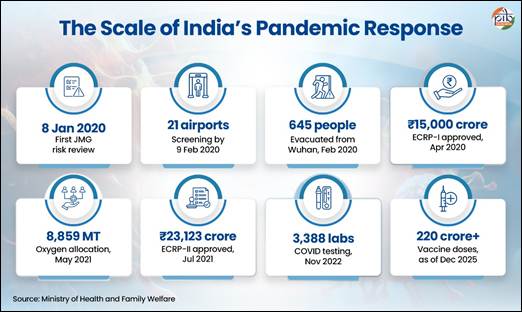
- ECRP: India COVID-19 Emergency Response & Health System Preparedness Package
- JMG: Joint Monitoring Group
Leadership in Action
1. Anticipation: Acting Before the First Case
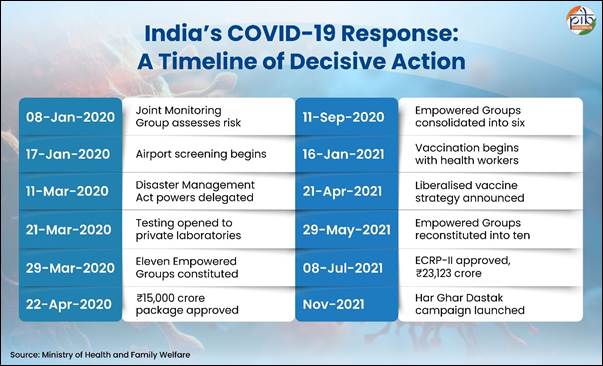
The Joint Monitoring Group, a standing technical forum of health officials and experts chaired by the Director General of Health Services, met on 8 January 2020 to assess risk and review readiness. Screening of international passengers began on 17 January and extended to 21 airports within a week. This preceded India's first case, reported in Thrissur, Kerala, on 30 January 2020. Seven multidisciplinary Central teams were deputed on 25 January to review airport screening and to assess end to end management of referred suspected cases at the designated hospitals.
The Health Ministry wrote to four other ministries, and the Cabinet Secretariat convened inter-ministerial meetings. A national operations centre, managed by the National Centre for Disease Control, was activated on 8 February. In February 2020, the Government evacuated 645 persons from Wuhan and placed them in quarantine at two centres.
2. Mandate: Law, Structure and Clear Roles
On 11 March 2020, powers under the Disaster Management Act, 2005 were delegated to the Union Health Secretary. Two days later, States were advised to invoke that Act and the Epidemic Diseases Act, 1897, where necessary. On 29 March, eleven Empowered Groups were constituted, each assigned a defined area of responsibility. The areas ranged from the medical plan and testing to supply chains, communication and public grievances. The Cluster Containment Plan of 2 March covered case identification, contact tracing and containment of the surrounding area. A plan for large outbreaks, with a checklist of district-level actions, was shared with States on 4 April. On 28 April, the Union Health Secretary asked all Chief Secretaries to continue essential medical services. A Group of Ministers reviewed progress, and its 14th meeting on 5 May 2020 heard several Empowered Groups. Empowered Groups were led by named senior officials, such as the Union Home Secretary and the Secretary, Ministry of Electronics and Information Technology.
What are the Empowered Groups?
Eleven Empowered Groups were constituted on 29 March 2020, each assigned a defined area, from the medical plan and testing to supply chains and communication. They were consolidated into six in September 2020 and reconstituted into ten in May 2021.
3. Adaptability: A Command Structure That Evolved
The structure was reshaped as needs changed. Eleven groups became six in September 2020; the six were reconstituted into ten on 29 May 2021. The May 2021 reconstitution created separate groups for oxygen, vaccination and testing. Containment also became local, with districts zoned red, orange or green and States asked to strengthen contingency plans. A September 2020 review by the Principal Secretary to the Prime Minister named unlocking with precautions a priority.
4. Evidence: Decisions Guided by Data
The first national serosurvey in May and June 2020 estimated that about 0.73% of the population had been infected. This showed that a large proportion of the population remained susceptible, and reopening proceeded in stages, with workplace guidelines in May and procedures for offices, places of worship, hotels, restaurants and shopping malls in June. In the fourth round of the national serosurvey, 67.6% of the population had antibodies.
What is a Serosurvey?
A serosurvey is a test of blood samples from a cross-section of the population for antibodies, to estimate the share already infected.
Technology and genomics also supported decisions. Close to 9 crore people had downloaded the Aarogya Setu app by 4 May 2020. Genome sequencing of virus strains from patients across the country had also been initiated by then. INSACOG, the Indian SARS-CoV-2 Consortium on Genomics, was established in December 2020 as the genomic surveillance network. In March 2021, the National Institute of Virology reported the spread of the Delta variant in Maharashtra.
5. Enablement: Bringing Many Hands In
Testing opened to private laboratories on 21 March 2020; by 24 March, 118 laboratories were able to test 12,000 samples daily. Domestic production of Personal Protective Equipment (PPE) increased from nil on 1 March to approximately 4.5 lakh coveralls per day by May. HLL Lifecare, a public-sector company, became the single procurement agency, and evaluated bids went daily to the Empowered Group. States were advised to add beds with private hospitals, using PMJAY (Pradhan Mantri Jan Arogya Yojana) and CGHS (Central Government Health Scheme) rates as reference.
The Group of Ministers also stressed quality control, with random batch sampling of PPEs, masks and ventilators. Empowered Group briefings to the Prime Minister covered partnership with the private sector, NGOs and international organisations. In April 2021, the Prime Minister asked officials to explore using civil society volunteers for non-specialised tasks.
6. Presence: Leading From the Front and in the Field
Reviews chaired by the Prime Minister, Cabinet Secretary and Union Health Minister brought Central ministries and States together. Periodic reviews examined local developments, identified implementation gaps and considered measures needed in affected areas. Multidisciplinary Central teams were deputed to States in 2020 and 2021 to review readiness and containment. Senior Ministry officials were oriented to serve as State nodal officers, with a national training of trainers. Decisions reached States through letters, website advisories and video conferences with States, Union Territories and airport health officers.
Between 20 March and 11 May 2020, the Prime Minister met all Chief Ministers five times virtually. In June 2020, the Prime Minister directed city and district-wise bed planning with States and Union Territories. The June 2020 review also appreciated outstanding work by several States, districts and cities in containing the outbreak. On 27 April 2021, the Prime Minister stressed proper implementation of COVID-19 strategies by agencies in States.
7. Decisiveness: Oxygen and Vaccines Under Pressure
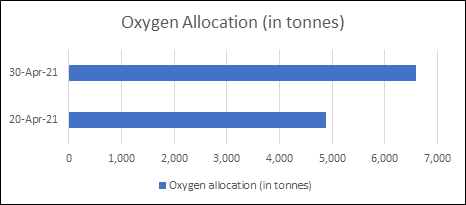
On 15 April 2021, an Empowered Group met on the oxygen situation in twelve States. It mapped supply with industry, regulators and manufacturers, and allocated defined quantities to States for following days. Communicated allocations rose from 4,880 tonnes on 20 April to 6,593 tonnes on 30 April. States were also asked to set up oxygen plants at hospitals in remote areas, alongside the allocations. The 21 April liberalised strategy permitted flexible pricing and procurement, encouraging manufacturers to expand vaccine production.
Vaccination preparations preceded any vaccine approval, from a task force in April 2020 to a December dry run. From 1 May 2021, all adults became eligible for vaccination, after phased expansion that began with health workers on 16 January 2021. On 27 April 2021, Empowered Groups on oxygen, medical infrastructure and communication briefed the Prime Minister directly.
8. Endurance: Sustaining the Effort
On 8 July 2021, the Cabinet approved Phase II of the India COVID-19 Emergency Response and Health System Preparedness Package (ECRP-II) with an outlay of ₹23,123 crore. The package was directed at district and sub-district capacity and implemented through the National Health Mission. It provided for central hospitals, war rooms and IT systems, genome sequencing, surveillance at 28 points of entry and central procurement of essential supplies. Reported outputs include 663 new laboratories, 697 liquid oxygen tanks, 63 field hospitals and 200 telemedicine hubs.
India crossed one billion doses of vaccination on 21 October 2021. The Union Health Minister asked State and Union Territory Health Ministers on 27 October to start house-to-house vaccination.
The COVID-19 vaccination campaign ‘Har Ghar Dastak’ was launched on 3 November 2021. It aimed at awareness, mobilisation and vaccination of all eligible beneficiaries with the first dose, and of all those due for the second dose, through house-to-house visits in all States and Union Territories.
Vaccination extended to adolescents aged 15 to 18 from 3 January 2022 and 12 to 14 in March 2022. Precaution doses were also offered, including a free drive of 75 days beginning in July 2022. A Revised Surveillance Strategy in June 2022 emphasised early detection, variant tracking and genomic surveillance.
Guidelines on vaccination, home isolation, international arrivals and surveillance were revised periodically from December 2021. In May 2022, India's more than 10 lakh Accredited Social Health Activists (ASHAs) received the WHO Director-General's Global Health Leaders Award. On 5 May 2023, WHO withdrew the Public Health Emergency of International Concern declared on 30 January 2020.
Performance of Vaccination Drive
As on 31 December 2025, 97% of the population aged 12 years and above has received at least one dose of COVID-19 vaccine, while 90% of this population is fully vaccinated against COVID-19. A total of 22.89 crore precaution doses have been administered across the country.
Five Phases at a Glance
|
PHASE 1
Prepare
Jan to Feb 2020
|
PHASE 2
Contain
Mar to Apr 2020
|
PHASE 3
Reopen and prepare
May to Dec 2020
|
PHASE 4
Vaccinate and surge
Jan to Jun 2021
|
PHASE 5
Build and adapt
Jul 2021 to May 2023
|
- Joint Monitoring Group risk review, 8 Jan
- Airport screening from 17 Jan
- First case reported, 30 Jan
- 645 evacuated from Wuhan
|
- Cluster Containment Plan, 2 Mar
- Private laboratories open, 21 Mar
- Nationwide Lockdown - 25 Mar
- 11 Empowered Groups formed
|
- First serosurvey: estimated 0.73% of the population infected
- Staged reopening with guidelines
- Empowered Groups consolidated into six
- Genomic network, Co-WIN pilot
|
- Vaccination begins, 16 Jan
- Second wave above 4 lakh cases a day
- Oxygen allocated to 12 States
- All adults eligible for vaccination from 1 May
|
- ECRP-II, ₹23,123 crore
- One billion doses crossed
- Har Ghar Dastak campaign
- WHO emergency status withdrawn, 5 May 2023
|
How the Response Was Delivered
Leadership worked through five levels, from apex reviews to districts, with each level reporting upward and acting downward.
|
Level
|
Execution
|
|
Apex
|
Periodic reviews by the Prime Minister's Office, with Empowered Groups reporting on progress.
|
|
Group of Ministers
|
Union Health Minister chaired the 14th meeting on 5 May 2020, reviewing containment, supplies, technology and relief.
|
|
Empowered Groups
|
Senior officials led the groups, among them the Union Home Secretary and the Secretary, Ministry of Electronics and Information Technology.
|
|
States
|
Five virtual meetings of the Prime Minister with all Chief Ministers, 20 March to 11 May 2020.
|
|
Districts
|
Red, orange and green zones guided local plans, covering 130, 284 and 319 districts respectively, as on 5 May 2020.
|
The Takeaway: Leadership as Mission
India’s COVID-19 response was not won by one decision, but by a chain of timely ones. Leaders acted before the first case, gave every task an owner, and let evidence guide each step. They reshaped institutions as the virus changed, and brought industry, laboratories and civil society into one effort. In the second wave, they made hard calls on oxygen and vaccines, then sustained the effort until 2023. The lesson for leaders is clear: anticipate early, empower widely, review often, and adapt without hesitation. That is leadership as mission: a steady purpose, carried out through a plan that never stopped learning.
References
Ministry of Health and Family Welfare
https://www.mohfw-dohfw.gov.in/static/uploads/2026/06/cb5989724e38171c770da36265e9161a.pdf
https://www.pib.gov.in/PressReleasePage.aspx?PRID=1654451®=48&lang=2
https://www.pib.gov.in/PressReleasePage.aspx?PRID=1602564®=48&lang=2
https://www.pib.gov.in/PressReleasePage.aspx?PRID=1602287®=48&lang=2
https://www.pib.gov.in/PressReleaseDetail.aspx?PRID=1887285®=3&lang=2
https://www.pib.gov.in/PressReleasePage.aspx?PRID=2037420®=48&lang=2
https://www.pib.gov.in/PressReleasePage.aspx?PRID=1621207®=48&lang=2
https://www.pib.gov.in/PressReleaseIframePage.aspx?PRID=1653681®=48&lang=2
https://static.pib.gov.in/WriteReadData/userfiles/PPT%20June%2011%20Media%20Briefing.pdf
https://www.pib.gov.in/PressReleasePage.aspx?PRID=1777164®=48&lang=2
https://www.pib.gov.in/PressReleasePage.aspx?PRID=1707177
https://www.pib.gov.in/PressReleasePage.aspx?PRID=1765379
https://www.pib.gov.in/PressReleasePage.aspx?PRID=1787282
https://www.dhr.gov.in/static/uploads/2025/08/64b2db6cf294425c80b8689ba77630b3.pdf
Ministry of Commerce & Industry
https://www.pib.gov.in/Pressreleaseshare.aspx?PRID=1717459®=48&lang=2
PIB Backgrounders
https://www.pib.gov.in/PressNoteDetails.aspx?NoteId=154668&ModuleId=3®=48&lang=2
https://static.pib.gov.in/WriteReadData/specificdocs/documents/2021/dec/doc2021122421.pdf
Prime Minister's Office
https://www.pib.gov.in/PressReleasePage.aspx?PRID=1715188®=48&lang=2
https://static.pib.gov.in/WriteReadData/ebooklat/Flip-Book/Flip-Book/files/basic-html/page5.html
https://www.pib.gov.in/PressReleasePage.aspx?PRID=1631389
https://www.pib.gov.in/PressReleasePage.aspx?PRID=1714439
https://www.pib.gov.in/PressReleasePage.aspx?PRID=1612890®=48&lang=2
Leading Through the Storm
*****
PIB Research
(Explainer ID: 160810)
आगंतुक पटल : 362
Provide suggestions / comments