Culture & Tourism
India Cine Hub
Streamlining Film-Shooting Permit Applications
Posted On:
22 SEP 2026 1:54PM
The India Cine Hub (ICH) is a single-window digital portal that simplifies film permits, visa processing, and vendor access for domestic and global creators. Managed by the National Film Development Corporation of India (NFDC), it eliminates multi-state bureaucratic friction by consolidating state approvals, police clearances, and co-production applications into one central system. This streamlined approach makes filming across India faster and far more accessible, helping fuel the country's rapidly growing entertainment economy.
Making Filmmaking Easy in India
India, renowned for its rich cultural art forms and vibrant films, is steadily emerging as a global powerhouse in film, television and online content creation. This sector alone generated USD 13.1 billion in revenue in the financial year 2024, up 18 percent since 2019. This growth is expected to continue at a rate of 6-10 percent in the coming years and is estimated to reach a combined revenue of about USD 17.5-19.7 billion in the financial year 2029. Fuelled by a young population, a rapidly expanding 5G network, and ultra-affordable data, India is rapidly expanding its content ecosystem.
India is not just producing films and digital content; it is also a thriving filming location for domestic and international filmmakers. Its diverse geography spans from the scenic Himalayas to the white-sand beaches in the Andaman & Nicobar Islands. Featuring UNESCO World Heritage sites like Rajasthan's forts and palaces, India has emerged as an attractive location for filmmakers and tourists alike.
The Government has been initiating a series of reforms to further incentivise filmmaking in India. One key measure the government has put in place is streamlining shooting permits for films and live events across Indian locations through the India Cine Hub (ICH).
The India Cine Hub (ICH) is a digital, single-window platform designed to streamline the process of obtaining film permits across the country. By simplifying regulatory procedures and facilitating coordination with relevant authorities, it promotes ease of doing business and strengthens India’s position as an attractive global filming destination. Through collaboration with States and Union Territories, the platform also enables them to showcase their diverse filming locations, infrastructure and resources, creating opportunities for tourism and local economic development. By bringing greater efficiency, transparency and accessibility to the filmmaking process, the India Cine Hub is creating a more enabling ecosystem for filmmakers and supporting India’s emergence as a preferred destination for film production.
Beyond film permits, the platform is expanding to support Live Event Permissions as the core digital infrastructure for the Live Events Development Cell (LEDC). Through a venue-mapping approach, event proposals are routed to relevant local authorities and nodal officers for centralized coordination-with 9 premier venues already onboarded.
India Cine Hub: Single Portal for Film Permits
Run by the National Film Development Corporation of India (NFDC), the ICH acts as a digital single-window portal for filming permits. The NFDC is mandated to promote Indian cinema. Furthermore, it operates as an organisation under the Indian Union Government.
NFDC: Promoting the Indian Film Industry
The NFDC was established in 1975 by the Government, and it is mandated with the promotion and growth of the Indian film industry. Over time, it expanded by absorbing the Film Finance Corporation, Indian Motion Picture Export Corporation, and, following a 2020 government mandate, the Films Division, Directorate of Film Festivals, National Film Archive of India, and Children’s Film Society, India. Today, it serves as a fully integrated entity for film development, production, promotion, and preservation across all Indian languages.
Main Focus:
1. Co-produces film projects through public-private partnerships.
2. Provides line production for foreign shoots in India and overseas animation services.
3. Hosts Film Bazaar India, a major South Asian co-production and distribution market alongside the International Film Festival of India (IFFI), Goa.
Core Principles
Mission: Foster cinematic excellence and cultural diversity by supporting multilingual Indian films.
Vision: Drive domestic and global appreciation for independent Indian cinema.
Objectives:
a.Nurture talent via script development, workshops, and co-productions.
b.Promote Indian culture through cinema worldwide.
c.Maintain an agile organisation responsive to industry needs.
Features of India Cine Hub
The India Cine Hub offers the following features to creators interested in filming content or hosting live events in India:
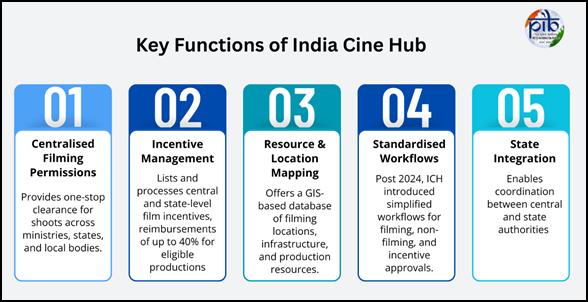
- Provides a unified portal for domestic and international creators to apply for filming permissions. It integrates state-level systems, providing a common application form for states without online processing.
- International creators can apply for filming permissions through the ICH, which facilitates obtaining a Film Visa.
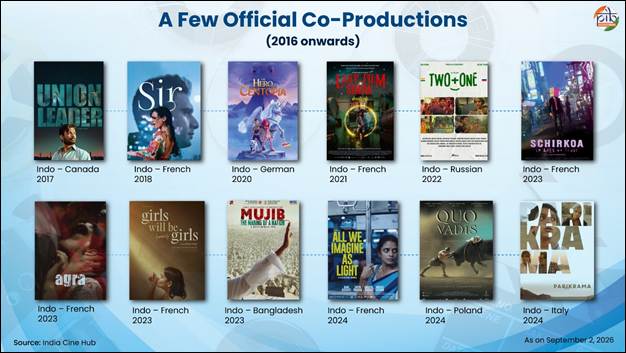
- Processes applications for permission to undertake co-production ventures and provides detailed guidelines regarding such treaties.
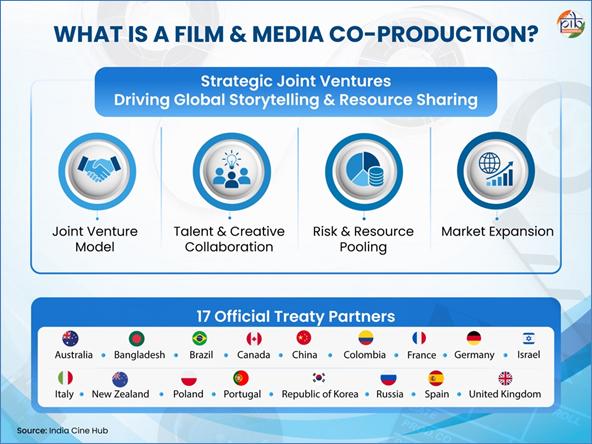
- Offers comprehensive guidelines on film visas, regulations, aerial filming, animal filming, forests, and filming at monuments.
- Provides a comprehensive GIS-based location directory and information on shooting locations, relevant permit authorities, and India's filming hubs.
India's Film Cities
India has various major production hubs, employing over 1.6 lakh people. The cities with such hubs are Mumbai, Hyderabad, Chennai, Kolkata, Bengaluru, Thiruvananthapuram/ Kochi, Guwahati, Bhubaneswar, and Delhi. Of these, three are established and pivotal film cities: Film City in Mumbai (Maharashtra), Ramoji Film City in Hyderabad (Telangana), and Noida Film City in Noida (Uttar Pradesh). These cities are contributing to India's emergence as a one-stop destination for media and entertainment services by attracting filmmakers from across the world.
Mumbai Film City
The Mumbai Film City in Goregaon, Mumbai, is one of the largest studio complexes in the world and has all the facilities that filmmakers need. It covers more than 520 acres and has approximately 42 outdoor shooting locations. Film City boasts a varied natural topography including hills, valleys and ravines, flat open spaces, natural woods, shrubbery and water bodies. The Film City was established in 1977 by the Maharashtra state government, and it was renamed Dadasaheb Phalke Chitranagari in the year 2001 to commemorate the founder of the Indian film Industry.
Ramoji Film City (Hyderabad)
Ramoji Film City, set up by Ramoji Group in 1996, was certified by the Guinness World Records as the world’s largest film studio complex. It is also the world’s largest integrated film city and India's only thematic holiday destination. Nearly 40 Indian films can be produced simultaneously in the complex, manned by a workforce of 6,000 personnel. It is spread over 2,000 acres, provides over 500 locations, and can cater to 20 international films simultaneously.
Noida Film City
The Noida Film City has various film studios and media houses. It houses satellite channels, multiplex offices, publication companies, radio broadcasting, audio industry giants, and film companies. It is spread across 100 acres. It has 16 studios and 350 channels broadcasting to 162 countries. It is the hub of television and media businesses. Around 17,000 media professionals are engaged in Film City, generating a wider economic impact through employment and livelihood opportunities for approximately 1.5 lakh people across associated and supporting sectors.
Development of New Film Cities
Digital content and media are now one of the largest media segments in India. India is also one of the youngest (15-29 years) consumers of digital content, with a large cohort of content creators. This generation is not only driving demand for global content but also actively shaping trends through short-form video, gaming, live streaming, and vernacular content platforms. India's internet footprint is also expanding. Internet subscribers increased from 25.15 crore in 2014 to 109.2+ crore at the end of March 2026. Wireless data cost dropped drastically from Rs.308/GB in 2014 to Rs. 7.51/GB in 2026, making digital services more affordable. 5G services are now available in 99.9% of districts across all States and Union Territories.
With rising demand for digital content led by a digitally savvy consumer base, and expanding internet infrastructure coupled with affordable wireless data services, this sector is expected to explode. To keep up, states such as Uttar Pradesh, Punjab, Madhya Pradesh, Assam, Chhattisgarh, Odisha and Bihar are building film city infrastructure in collaboration with private players. Driven by regional cinema and filming incentives from states, employment in the segment may grow at ~3.2%, leading to employment of about 200,000 people across the country by 2030. India is rapidly transitioning from being the world’s largest consumer base for digital content to becoming a formidable global powerhouse in content creation, innovation, and distribution.
- Lists verified film and non-film resource directories detailing local vendors across states, including:
- Post-production companies
- Property rentals
- Filmmakers and talent
- Film studios
- Equipment rentals
- Casting agencies
- Catering units
- Hotels and accommodations
- Medical facilities
- Security services
- Travel operators
Promoting Indian Tourism Through Made in India Films
Indian films have often led to higher tourism. One of the many such films that promoted the Indian film industry is 3 Idiots. After the movie, tourist arrivals in Ladakh increased 2.4-fold, according to the EY-FICCI Report. Similarly, Krrish filmed in Singapore through a collaboration with the Singapore Tourism Board, boosted Indian tourists in the country from six to seven million. Beyond domestic hits and regional favorites like Rajasthan, India’s visual diversity and cost-effective production environment continue to attract major global projects, ranging from Oscar-winning films like Slumdog Millionaire and Life of Pi to original productions by global streaming platforms like Netflix and Amazon Prime.
Madhya Pradesh won the "Most Film Friendly State" award at the 68th National Film Awards for its inclusive tourism ecosystem, while states like Rajasthan, Uttar Pradesh, Keralam and Uttarakhand actively lure filmmakers with infrastructure incentives, government location fee waivers and subsidies of up to Rs. 2 crore. Film tourism generates local employment and pours into local rural economies, while showcasing and preserving India's cultural heritage.
- Built with robust encryption, the portal is scalable to handle large volumes of applications and user traffic.
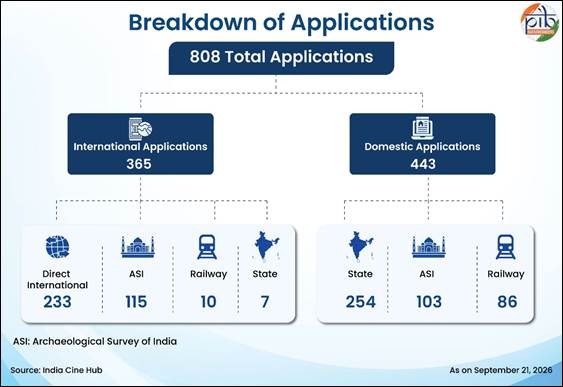
Additionally, a dashboard tracks total applications, providing a breakdown of approvals across state, national, and international levels.
Positioning India as a Premier Filming Hub
India’s film industry, among the world’s largest, plays an important role in promoting film tourism by bringing lesser-known destinations into the public imagination and transforming filming locations into travel attractions that showcase the country’s diverse cultural heritage. Supporting this potential, the India Cine Hub (ICH) serves as a centralised, single-window platform that simplifies the regulatory processes associated with film production. Filmmakers can apply online for shooting permits, while applications are digitally routed to relevant Ministries and State Nodal Officers, facilitating coordination for multi-agency clearances, location permissions, and film visas through a streamlined process.
References
Ministry of Information & Broadcasting
https://indiacinehub.gov.in/
https://www.pib.gov.in/PressReleasePage.aspx?PRID=2279150®=48&lang=1
https://nfdcindia.com/company-profile/en
Ministry of Commerce and Industry
https://www.investindia.gov.in/team-india-blogs/exploring-potential-film-tourism-india-catalyst-economic-growth-and-cultural
PIB Backgrounders
https://www.pib.gov.in/FactsheetDetails.aspx?Id=150840®=3&lang=2
Deloitte
https://www.deloitte.com/in/en/Industries/telecom-media-entertainment/perspectives/economic-impact-of-the-film-television-and-online-curated-content.html
EY
https://www.ey.com/content/dam/ey-unified-site/ey-com/en-in/insights/media-entertainment/documents/ey-a-studio-called-india-v1.pdf
Click here to see pdf
PIB Research
(Explainer ID: 160076)
आगंतुक पटल : 228
Provide suggestions / comments