Economy
PM Vishwakarma: Strengthening Traditional Artisans and Craftspeople
Posted On:
16 SEP 2026 11:14AM
As PM Vishwakarma approaches three years, its registration target of 30 lakh beneficiaries has been achieved. The scheme has also delivered skill training, toolkits, credit support, digital incentives and market linkages. Beneficiaries are also being onboarded on the Udyam Assist Platform and connected with wider market channels, including GeM, e-commerce platforms, trade fairs and exhibitions. The scheme is built around Samman, Samarthya and Samriddhi and also seeks to strengthen the Guru-Shishya parampara and family-based practice of traditional skills.
|
Supporting Traditional Artisans and Craftspeople
India’s traditional artisans and craftspeople form an important part of the country’s local economy and cultural heritage. Many of these occupations depend on manual skills, family-based knowledge and small-scale enterprise. PM Vishwakarma was launched on 17 September 2023 to provide end-to-end support to such artisans and craftspeople.
PM Vishwakarma is built around the three pillars of Samman, Samarthya and Samriddhi, reflecting respect, capability and prosperity for traditional artisans and craftspeople. The scheme also seeks to strengthen and nurture the Guru-Shishya parampara or family-based practice of traditional skills.
The Central Sector Scheme has an outlay of ₹13,000 crore for FY2023-24 to FY2027-28, covering 18 traditional trades. The scheme seeks to improve the quality and reach of artisans’ products and services and facilitate their integration with domestic and global supply chain.
As the scheme approaches 3 years on 17 September 2026, its registration target of 30 lakh beneficiaries has already been achieved.
Scheme Framework and Key Components
PM Vishwakarma brings multiple forms of support within one framework. Its major components are recognition, skill upgradation, toolkit incentive, credit support, incentive for digital transactions and marketing support.
- On completion of the registration and verification process, beneficiaries are provided recognition through a PM Vishwakarma Certificate and ID Card.
- Through skill upgradation, beneficiaries are introduced to modern tools, best practices and innovative designs. Training also covers digital transactions, marketing and entrepreneurial knowledge.
- Basic Training runs for 5–7 days, while Advanced Training is for 15 days or more. Trainees receive a stipend of ₹500 per day.
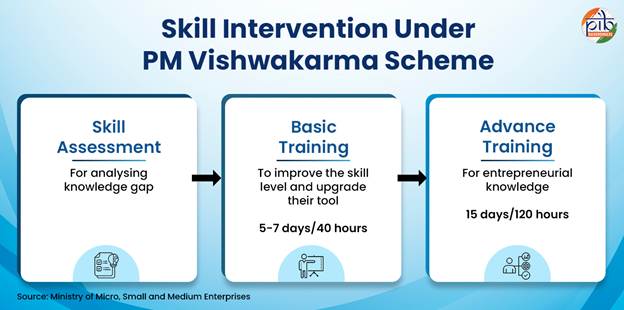
Modern toolkits of up to ₹15,000 are also provided to the eligible beneficiaries of the Scheme.
Access to formal credit is a central part of PM Vishwakarma. The scheme provides collateral-free Enterprise Development Loans of up to ₹3 lakh in two tranches. The first tranche is up to ₹1 lakh with an 18-month tenure. Beneficiaries completing Basic Training are eligible for the first tranche of loan. The second is up to ₹2 lakh with a 30-month tenure.
The loans are provided at a fixed concessional rate of interest of 5%, with interest subvention to the extent of 8% borne by Government. Eligibility for the second tranche is linked to repayment of the first tranche and adoption of digital transactions or completion of Advanced Training.
Digital and Marketing Support
PM Vishwakarma combines financial support with digital and marketing assistance. Beneficiaries can receive Rs. 1 for each digital pay-out or receipt in their bank account, up to a maximum of 100 eligible transactions per month. Marketing support includes trade fairs, exhibitions, branding and e-commerce platforms such as GeM, advertising and publicity. It encourages artisans to adopt formal business practices and reach wider markets.
Eligibility, Registration and Formalisation
PM Vishwakarma is open to artisans and craftspeople aged 18 years or above who work with their hands and tools in one of the 18 notified family-based traditional trades. They should be working in the unorganised sector on a self-employment basis.
- Applicants should not have availed loans under similar credit-based government schemes for self-employment or business development during the previous five years.
- Registration and benefits are restricted to one member of a family, comprising the husband, wife and unmarried children.
- A person in government service and their family members is not eligible.
Beneficiaries of MUDRA and PM SVANidhi who have fully repaid their loans are eligible under PM Vishwakarma.
|
Self-Employed Worker & Unorganised Sector?
A self-employed worker is one who is not employed by an employer but works independently in an occupation. The unorganised sector broadly covers informal enterprises and workers outside the organised sector.
|
|
Trades Covered under PM Vishwakarma
|
|
Carpenter
|
Boat Maker
|
Armourer
|
|
Metalsmith
|
Hammer and Tool Kit Maker
|
Locksmith
|
|
Goldsmith
|
Potter
|
Sculptor, Stone Breaker
|
|
Cobbler / Shoesmith / Footwear Artisan
|
Mason
|
Basket / Mat / Broom Maker / Coir Weaver
|
|
Doll & Toy Maker
|
Barber
|
Garland Maker
|
|
Washerman
|
Tailor
|
Fishing Net Maker
|
Applications can be submitted through Common Service Centres (CSCs) only.
Three-tier Verification and Approval
- Verification: At the Gram Panchayat or Urban Local Body level.
- Vetting and Recommendation: By the District Implementation Committee.
- Approval: By the Screening Committee.
PM Vishwakarma beneficiaries are also onboarded on Udyam Assist Platform as entrepreneurs in the formal MSME ecosystem. This enables them to access applicable government benefits.
|
Udyam Assist Platform
It is an online system for registering informal micro enterprises and providing them with an Udyam Registration Number and certificate.
|
Progress under PM Vishwakarma
Skill Upgradation and Toolkit Support
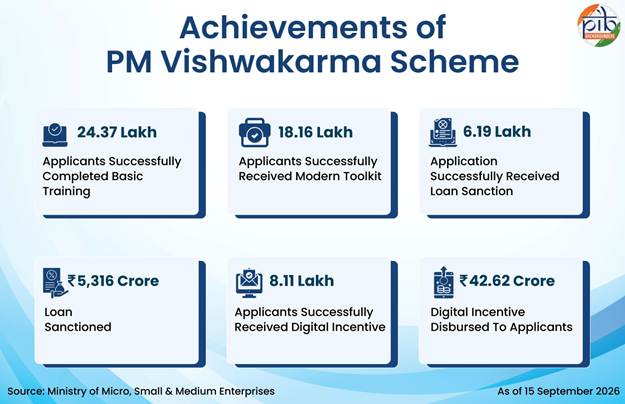
As of 15 September 2026, over 24.37 lakh artisans had received basic skill training, and more than 18.16 lakh had received toolkits.
Strengthening Access to Institutional Credit
More than 6.19 lakh loans worth ~₹5,316 crore have been sanctioned under the scheme. This credit support is aimed at helping beneficiaries purchase inputs, upgrade tools, expand operations and strengthen their enterprises.
Over 8.11 lakh beneficiaries have received digital incentives with more than ₹42 crore disbursed as incentive.
More than 12,000 artisans have also been trained in the use of AI tools for branding, product design, packaging and marketing.
Market Access and Outreach
- More than 1,500 awareness programmes and camps, over 50 workshops, 82 trade fairs,37 State-level exhibitions and more than 50 flash mobs had been organised across the country.
- First PM Vishwakarma National Exhibition cum Trade Fair was organized from 17th Jan 2026 to 31st Jan 2026 at Dilli Haat. At this event, more than 117 artisans participated across India where they have made the record sales of more than 2 Crore Rupees. This event was visited by Foreign Diplomats of various countries, many senior officials of India Government and received the footfall of more than 60,000 people.
- More than 30,000 Vishwakarma beneficiaries have been onboarded on various e-Commerce platforms such as Government e-Marketplace, ONDC, Meesho, Amazon Fabindia, Sulekha etc.
- The Ministry of MSME also signed an MoU with Amazon to facilitate onboarding of eligible artisans on its marketplace.
- PM Vishwakarma is also using the One Station One Product (OSOP) initiative to provide market access to Divyangjan Vishwakarma artisans. Dedicated retail outlets at selected high-footfall railway stations provide space to showcase and sell their products. More than 42 Divyangjan beneficiaries from different trades had been facilitated with stalls across 14 States/UTs.
- PM Vishwakarma stalls have also been opened at airports, including Bhopal and Chandigarh in collaboration with AVSAR scheme of Ministry of Civil Aviation.
- To promote the packaging and branding of PM Vishwakarma products, multiple workshops been organized across 6 cities in collaboration with Indian Institute of Packaging to train 1500 Vishwakarmas (250 Artisans per city)
- To promote tribal artisans and to expand their market reach, ministry in collaboration with TRIFED organized multiple Tribal Artisan Melas to link the tribal PMV artisans with reputed platforms like Tribes India etc.
- Multiple PM Vishwakarma stalls are set up in star category hotels and resorts at Bihar, Gujarat, Goa, Himachal Pradesh, Odisha, Puducherry etc. (such as Hotel Taj, Radisson, Adbuz, etc. across states)
Beneficiary Experiences and Evaluation Findings
The scheme is being implemented across a diverse range of traditional occupations and regions. The following case studies present the experiences of beneficiaries from two different trades and States.
|
Beneficiary Stories
|
|
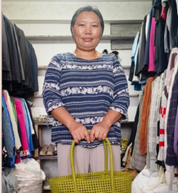
Smt. Villi, a basket maker from Zunheboto, Nagaland, completed skill training under PM Vishwakarma and availed a ₹1 lakh collateral-free loan. She used the loan to purchase raw material and expand her enterprise. Her monthly income increased by around 40% to nearly ₹15,000.
|
|
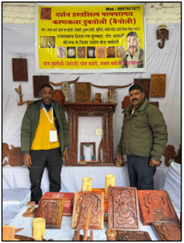
Mr. Darshan Lal, a woodcarver from Chamoli, Uttarakhand, has been practicing the craft for over three decades. His family tradition is associated with artisans involved in the construction of the Badrinath temple. Under PM Vishwakarma, he received skill training, a toolkit and access to affordable credit. In 2026, he also participated in the PM Vishwakarma Haat in Delhi, his first exhibition in the national capital, providing him an opportunity to showcase his products to a wider market.
|
|
Concurrent Evaluation by IIM Mumbai
A concurrent evaluation of PM Vishwakarma by IIM Mumbai covered 11,591 beneficiaries across all States and Union Territories. The evaluation also included feedback from banks, Common Service Centres, India Post personnel and training centres.
According to the evaluation, 93% of the beneficiaries surveyed reported a moderate to significant increase in income following training. The finding indicates that skill upgradation was associated with tangible economic gains for a large share of the surveyed beneficiaries.
|
Sustaining Traditional Skills and Livelihoods
PM Vishwakarma places traditional occupations within a national framework of support while retaining their local and family-based character. The scheme also seeks to strengthen the continuity of traditional skills and the Guru-Shishya tradition associated with many of these occupations. By supporting artisans and craftspeople across different stages of their work, it aims to create livelihood opportunities while helping traditional knowledge and skills remain relevant in a changing economic environment.
References:
Ministry of Micro, Small & Medium Enterprises
https://www.pib.gov.in/PressReleasePage.aspx?PRID=1959098&lang=2®=3
https://www.pib.gov.in/PressReleasePage.aspx?PRID=2291931&lang=1®=48
https://www.pib.gov.in/PressReleasePage.aspx?PRID=2236871&lang=1®=3
https://www.pib.gov.in/PressReleasePage.aspx?PRID=2198702&lang=1®=3
https://www.pib.gov.in/PressReleasePage.aspx?PRID=2202916&lang=1®=3
https://www.pib.gov.in/PressReleasePage.aspx?PRID=2286958&lang=1®=3
https://www.pib.gov.in/PressReleaseIframePage.aspx?PRID=2253553&lang=2®=48
https://www.msme.gov.in/static/uploads/2026/05/3040dc36fd7023c4d4d1f647ee816165.pdf
https://pmvishwakarma.gov.in/
https://www.pib.gov.in/PressReleasePage.aspx?PRID=2271522&lang=1®=6
https://dic.py.gov.in/sites/default/files/pm-vishwakarma.pdf
Ministry of Commerce & Industry
https://www.dpiit.gov.in/static/uploads/2026/03/863a5fef349d79a1bba316c4b51eaacb.pdf
PIB Archives
https://www.pib.gov.in/PressReleasePage.aspx?PRID=2298755&lang=1®=3
https://www.pib.gov.in/PressReleasePage.aspx?PRID=2260904&lang=1®=3
https://www.pib.gov.in/PressReleasePage.aspx?PRID=2278107&lang=1®=1
https://www.pib.gov.in/PressNoteDetails.aspx?ModuleId=2&NoteId=157068&lang=1®=3
Rajya Sabha Secretariat
https://www.pib.gov.in/PressReleasePage.aspx?PRID=2238242&lang=1®=1
Click here to see pdf
****
PIB Research
(Explainer ID: 159998)
आगंतुक पटल : 193
Provide suggestions / comments