Farmer's Welfare
Fueling the Blue Economy
Six Years of Empowering India’s Fisheries Sector under PMMSY
Posted On:
10 SEP 2026 12:15PM
The Pradhan Mantri Matsya Sampada Yojana (PMMSY) has strengthened India’s fisheries sector. The Government allocated a record ₹2,500 crore in BE 2026–27 under PMMSY, reaffirming its commitment to the sector. Fish production increased from 141.64 lakh tonnes in 2019-20 to a record 197.75 lakh tonnes in 2024-25. Fisheries exports rose from ₹46,663 crore in 2019–20 to ₹73,890 crore in 2025–26, reflecting strong sectoral growth. The scheme created employment opportunities for 58 lakh persons in fisheries and aquaculture-related activities. It also approved ₹2,797 crore for cold-chain and marketing infrastructure, strengthening post-harvest management and market connectivity. Additionally, 2,195 FFPOs were supported through projects worth ₹544.86 crore, strengthening collective empowerment.
Strengthening India’s Blue Economy
India's fisheries sector is a vital economic pillar, sustaining nearly three crore livelihoods, especially among marginalised and coastal communities. As a recognised Sunrise Sector, it has seen consistent growth driven by policies that boost production, exports, infrastructure, and technology adoption. To further unlock this potential, the Government introduced the Pradhan Mantri Matsya Sampada Yojana (PMMSY), focused on fostering inclusive and sustainable growth across the sector. As PMMSY completes six years on 10 September 2026, it stands as a landmark in the transformation of the Indian fisheries sector towards modernisation, sustainability, and prosperity. Since its launch in 2020, the scheme has built stronger infrastructure, opened up new opportunities, and provided consistent support to fishers and fish farmers across the country. Building on the Blue Revolution scheme, PMMSY was conceived to address critical gaps across the fisheries value chain.
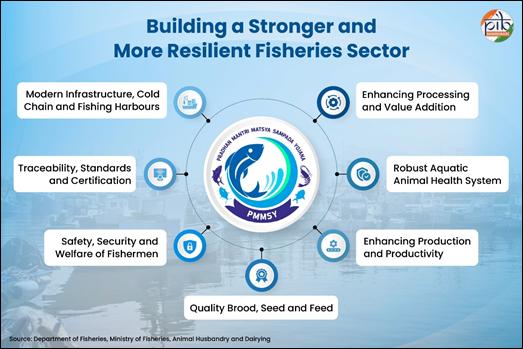
The Government has been implementing PMMSY since 2020–21, with a total outlay of ₹20,750 crore. The Government reaffirmed its commitment by allocating a record ₹2,500 crore in BE 2026–27 under PMMSY, strengthening fisheries infrastructure and livelihoods. The scheme has also continued to support large-scale investments in fisheries and aquaculture infrastructure. As of 11th August 2026, during the period 2020–21 to 2025–26, the Department of Fisheries has approved fisheries and aquaculture projects worth ₹21,394.88 crore, including a Central share of ₹9,510.89 crore. These approvals, based on proposals received from States, Union Territories and various implementing agencies, are supporting infrastructure development and strengthening the fisheries value chain across the country.
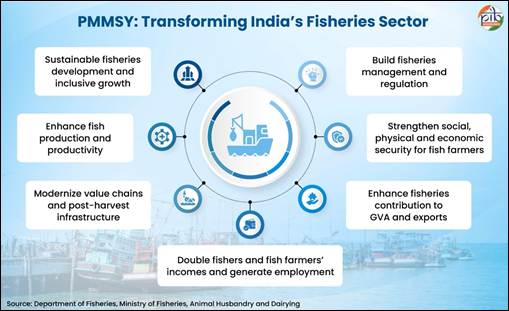
PMMSY has focused on transforming India’s fisheries sector by enhancing production and productivity, modernising the value chain, generating livelihood opportunities, increasing incomes, boosting exports and GVA, strengthening fishers’ security and welfare, and improving fisheries management and regulation.
Success Story: From Ice Plant to Greater Prosperity
In Porbandar, Gujarat, Mr. Pravinbhai Babulal Masani has spent over two decades building his fishing enterprise. With extensive experience in the industry, he understood that investing in a new ice plant could strengthen his business. However, the high cost of establishing an ice plant was beyond his financial capacity. The Pradhan Mantri Matsya Sampada Yojana (PMMSY) provided him with an opportunity through financial assistance for establishing ice plants.
In 2021–22, Mr. Masani successfully received a ₹48 lakh subsidy under PMMSY. With this support, he established a 30 MT/day ice plant, enabling him to produce high-quality ice blocks for fishing boats. The new facility helps fishing boats carry sufficient ice to keep fish fresh and reduce spoilage during fishing operations. This has strengthened Mr. Masani’s fishing business, improved his earnings, and supported a better livelihood for his family. His journey demonstrates how targeted support under PMMSY can help fishers invest in essential infrastructure, strengthen their businesses, and contribute to fisheries growth.
Transforming India’s Fisheries Sector through PMMSY
The PMMSY is an umbrella scheme comprising Central Sector (CS) and Centrally Sponsored Scheme (CSS) components.
Central Sector (CS): Fully funded and implemented by the Central Government. The Central Sector component supports genetic improvement, innovation, technology demonstrations, training, aquatic quarantine, harbour modernisation, disease surveillance and fisheries data systems. It also strengthens the National Fisheries Development Board (NFDB) and fisheries institutions, fisher safety, FFPOs, cooperatives and SHGs, while promoting certification, traceability, accreditation and labelling. The Pradhan Mantri Matsya Kisan Samridhi Sah-Yojana (PM-MKSSY) is a Central Sector sub-scheme. It operates under the broader ambit of PMMSY. The scheme complements and reinforces PMMSY's overarching objectives. Its specific mandate is to strengthen the development of the fisheries sector.
Pradhan Mantri Matsya Kisan Samridhi Sah-Yojana (PM-MKSSY)
The Pradhan Mantri Matsya Kisan Samridhi Sah-Yojana (PM-MKSSY) is a Central Sector sub-scheme implemented under the umbrella of the PMMSY. Operational across all States and Union Territories for four years from 2023-24 to 2026-27, it carries an estimated financial outlay of ₹6,000 crore.
The scheme facilitates the structural transformation of the fisheries sector by advancing formalisation, expanding insurance coverage, strengthening access to institutional finance, and promoting quality assurance and traceability across the fisheries value chain. It aims to enhance financial resilience, risk mitigation, and market integration for fishers, aquaculture farmers, and allied stakeholders, thereby fostering a more organised, transparent, and sustainable fisheries sector.
Centrally Sponsored Scheme (CSS): Partially funded by the Central Government and implemented by States and Union Territories. CSS activities include:
- Enhancement of Fish Production and Productivity: Focuses on increasing fish production and productivity through technology infusion and improved fisheries practices. It covers inland fisheries, marine fisheries, mariculture, seaweed cultivation, development of fisheries in Himalayan and North-Eastern States/UTs, and ornamental fisheries.
- Infrastructure and Post-Harvest Management: Strengthens fisheries infrastructure through fishing harbours, fish landing centres and post-harvest facilities. It also supports cold-chain infrastructure, deep-sea fishing, integrated modern coastal fishing villages, markets and marketing infrastructure.
- Fisheries Management and Regulatory Framework: Promotes monitoring, control and surveillance, insurance for fishing vessels and fishers, and fisheries extension and support services. It also strengthens the safety and security of fishers at sea while supporting the livelihood and nutritional needs of fishers.
PMMSY: Strengthening Production, Infrastructure and Livelihoods
The PMMSY has made significant contributions over the past six years towards increasing fish production, enhancing fisheries exports, and creating livelihoods and employment opportunities.
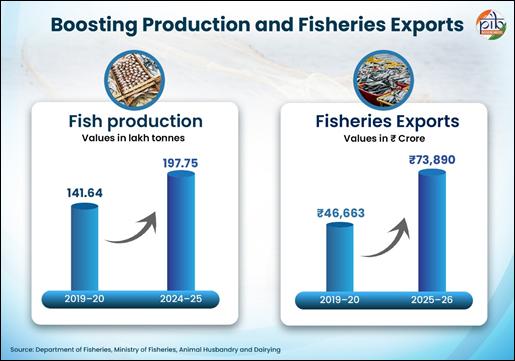
- Fish production increased from 141.64 lakh tonnes in 2019-20 to a record 197.75 lakh tonnes in 2024-25.
- --The scheme has created direct and indirect employment opportunities for 58 lakh persons in fisheries and aquaculture-related activities.
- Fisheries exports increased from ₹46,663 crore in 2019-20 to ₹73,890 crore in 2025-26.
Expanding Modern Aquaculture and Fisheries Infrastructure
- Under PMMSY, 12 Integrated Aquaparks have been approved at a total cost of ₹713.80 crore.
- During the last 5 years (2020-25), projects worth ₹198.17 crore have been approved towards seaweed cultivation and its allied activities.
- 52,058 reservoir cages and 23,285.06 hectares of pond area have been approved for inland aquaculture. The scheme has also supported 12,081 Recirculatory Aquaculture Systems (RAS) and 4,205 Biofloc units.
- 2,672 ornamental fish rearing and integrated ornamental fish units have been supported under PMMSY.
Strengthening Fisheries Infrastructure and Value Chain
The Government is strengthening fisheries infrastructure under PMMSY, with a focus on fishing harbours, fish landing centres, cold chains, transportation and marketing facilities. During the last five years, the Department of Fisheries has approved ₹3,741.89 crore for 28 fishing harbour development/modernisation projects, 25 fish landing centre projects and 23 dredging projects.
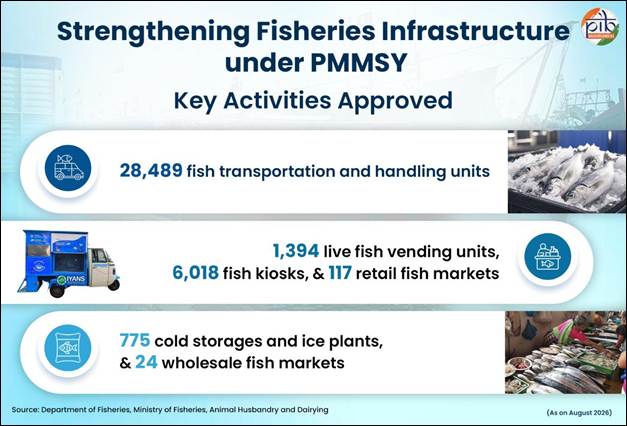
Additionally, ₹2,797 crore has been approved for the development of cold-chain and marketing infrastructure. As of 11th August 2026, the approved projects include:
- 28,489 fish transportation units
- 1,394 live fish vending units, 6,018 fish kiosks, 117 retail fish markets
- 775 cold storage & ice plants and 24 wholesale fish markets.
These interventions are strengthening post-harvest management, cold chains, transportation, and market access for inland fisheries produce.
Empowering Communities through Collective Action, Resilience and Technology
The PMMSY is strengthening fisheries through infrastructure development, community empowerment, climate resilience and technology adoption.
Promoting Collective Empowerment through FFPOs
The Pradhan Mantri Matsya Sampada Yojana (PMMSY) provides financial assistance for establishing Fish Farmers Producer Organizations (FFPOs) to economically empower fishers and fish farmers and strengthen their bargaining power. From FY 2021–22 to FY 2025–26, the Department of Fisheries approved projects worth ₹544.86 crore to establish 2,195 FFPOs nationwide, supporting incubation, management costs, and equity grants.
Building Climate-Resilient Coastal Communities
Under PMMSY, the Department of Fisheries has identified 100 coastal fishermen villages as Climate Resilient Coastal Fishermen Villages (CRCFV) to strengthen climate resilience and make them economically vibrant. The initiative is being implemented under the Central Sector component of PMMSY, with a unit cost of ₹200 lakh per village, fully funded by the Government, and supports resilient infrastructure, livelihoods and post-harvest facilities for coastal fishing communities.
Technology-Driven Aquaculture
The scheme promotes technology-driven aquaculture systems that enhance productivity while optimising land and water use. It supports high-density, water-efficient models such as Recirculatory Aquaculture Systems (RAS) and Bio-floc technology, improving output, water quality, resource efficiency and environmental sustainability.
- Recirculatory Aquaculture System (RAS): RAS filters and recirculates water, removing waste and impurities while enabling intensive fish farming with minimal land and water.
- Bio-floc Technology: It is a sustainable aquaculture method that recycles nutrients in water using beneficial microbes. These microbes form clumps called bio-floc, which serve as natural feed and also help clean the water. This method requires little or no water exchange, making it ideal for high-density fish farming with minimal resources. It boosts productivity while being environmentally friendly, earning it the name “green soup” or heterotrophic ponds in aquaculture circles.
Digital Transformation of Fisheries
Beyond modernising production systems, PMMSY is also driving the digital transformation of the fisheries sector. The National Fisheries Digital Platform (NFDP) was launched under PM-MKSSY in September 2024. It aims to advance digital governance and formalisation in the fisheries and aquaculture sector. The NFDP creates work-based digital identities and a comprehensive stakeholder database to formalise the sector. Operationally, it functions as a single-window digital system, enabling beneficiaries to access institutional credit, aquaculture insurance, traceability mechanisms, and performance-linked incentives. The platform also supports fisheries cooperatives, training, and capacity-building initiatives. As of 8 September 2026, the NFDP platform has recorded over 37.01 lakh individual registrations, with total registrations crossing 37.23 lakh.
Contribution to SDG 14: Life Below Water
PMMSY promotes sustainable and responsible fisheries and aquaculture, supporting the sustainable use of aquatic resources. The scheme also promotes sustainable fish production methods and modern aquaculture practices, including Bio-floc, RAS, cage culture and mariculture. These interventions contribute to SDG 14 (Life Below Water) by supporting sustainable management of fisheries and aquaculture and strengthening aquatic resource conservation.
Towards Sustainable Fisheries and Blue Economy Growth
The fisheries sector occupies an important place in India’s agricultural and rural economy, contributing to livelihoods, food security, employment and exports. The Pradhan Mantri Matsya Sampada Yojana (PMMSY) is driving the transformation of India’s fisheries sector by strengthening production, infrastructure, technology, livelihoods and sustainability. Its investments in modern infrastructure, cold-chain facilities, technology-driven aquaculture and digital platforms are strengthening the fisheries value chain. Continued support for fishers, fish farmers and coastal communities can create opportunities for higher incomes and improved market access. These efforts also contribute to Sustainable Development Goal 14 (Life Below Water) by promoting sustainable use and conservation of aquatic resources. With sustained investments, PMMSY has laid the foundation for a modern, competitive and sustainable fisheries sector. As India advances its Blue Economy vision, PMMSY will continue to play a pivotal role in enhancing livelihoods, strengthening food security, boosting exports and promoting responsible utilisation of aquatic resources.
References
Ministry of Fisheries, Animal Husbandry and Dairying
https://sansad.in/getFile/lsapps/loksabhaquestions/annex/188/AU1400_wqgu0V.pdf?source=lsapps
https://www.pib.gov.in/PressReleasePage.aspx?PRID=2286997®=48&lang=1
https://www.pib.gov.in/PressReleasePage.aspx?PRID=2205029®=3&lang=1
AU3898_WKn6Y0.pdf
https://cof.gujarat.gov.in/ViewFile?fileName=5ZzVmugN0TiBNluOINM7wcaKIboe27p1WeHt%E2%9C%A47qxzBWO42UynszvkodMqi58s6jqLM26puQ%E2%9C%A45b5kcswdgvaGVqwfndgS9e2SOAr1Befbe3VReOJCVLnLPhhtseT%E2%9C%BFPdzucS8UOwM0pFg%E2%9C%A4HzBVL%E2%9C%A4W%E2%9C%BFjA%E2%99%AC%E2%99%AC
https://www.myscheme.gov.in/schemes/pmmsy
https://www.pib.gov.in/PressReleasePage.aspx?PRID=2221582®=48&lang=2
https://www.pib.gov.in/PressReleasePage.aspx?PRID=2237418®=3&lang=1https://www.pib.gov.in/PressReleasePage.aspx?PRID=2290431®=3&lang=1
https://sansad.in/getFile/lsapps/loksabhaquestions/annex/188/AU1394_tAzKmS.pdf?source=lsapps https://sansad.in/getFile/lsapps/loksabhaquestions/annex/188/AU3898_WKn6Y0.pdf?source=lsapps
https://www.pib.gov.in/PressReleasePage.aspx?PRID=2221582®=48&lang=2
https://pmmsy.dof.gov.in/assets/documents/10%20Years%20Achievement_English.pdf
https://www.pib.gov.in/PressReleasePage.aspx?PRID=2304929®=3&lang=1
https://nfdp.dof.gov.in/nfdp/#/
https://www.dof.gov.in/static/uploads/2026/06/c591f3591c5923975e7f220bcbc093f0.pdf
https://www.pib.gov.in/PressReleasePage.aspx?PRID=2291663®=48&lang=1
https://www.pib.gov.in/PressReleasePage.aspx?PRID=2225765®=3&lang=2
PIB Backgrounders
https://www.pib.gov.in/PressNoteDetails.aspx?NoteId=155080&ModuleId=3®=3&lang=1
https://www.pib.gov.in/PressNoteDetails.aspx?NoteId=155173&ModuleId=3®=3&lang=2
Click here to see pdf
PIB Research
(Explainer ID: 159943)
आगंतुक पटल : 167
Provide suggestions / comments