Rural Prosperity
Vibrant Villages Programme
Strengthening India's Frontiers Through Inclusive Development
Posted On:
06 SEP 2026 10:52AM
The Vibrant Villages Programme (VVP) has redefined the role of India's border villages. They are no longer remote outposts. They are now strategic partners in national security and development. The programme is implemented through VVP-I and VVP-II, with a combined outlay of Rs 11,639 crore. It is expanding road connectivity, electricity, telecommunications, healthcare, education and livelihood opportunities across villages along India's international land borders. VVP seeks to build vibrant, resilient and prosperous border communities. It improves quality of life and creates sustainable economic opportunities. In doing so, it strengthens India’s border security by sustaining thriving communities along its frontiers.
Why the Border Village Matters
India shares over 15,000 kilometres (km) of international land border with seven neighbouring countries. The longest stretch runs 4,096.7 km along the border with Bangladesh. China follows at 3,488 km and Pakistan at 3,323 km. Nepal, Myanmar, Bhutan and Afghanistan account for the remainder.
For decades, many border villages remained isolated by difficult terrain, weak connectivity, limited infrastructure and few livelihood opportunities. These challenges triggered out-migration, leaving several frontier areas sparsely populated. To address these longstanding issues, the Vibrant Villages Programme (VVP) was launched in 2023. It seeks to accelerate the comprehensive development of selected villages along India's borders. Recognising border residents as the eyes and ears of the border guiding forces, it aims to build vibrant, secure and prosperous frontier communities. The programme also marks a shift in perspective by treating these settlements not as the nation's last villages, but as its first.
Starting with northern border villages, the Government has expanded the programme across the entire land frontier in phases. Empowered border communities form the foundation of a secure and strong Viksit Bharat@2047.
|
Did You Know? The first warning of the 1999 Kargil intrusion did not come from a radar or a patrol. On 3 May 1999, local residents were the first to report suspicious movement in the Kargil sector. This underscores the importance of border communities as the first line of defence for the nation.
|
Two Phases, One Frontier Mission
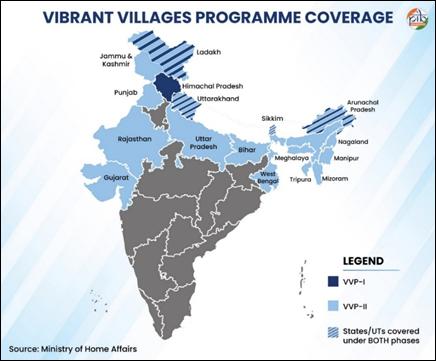
The Government is implementing the Vibrant Villages Programme in two phases that together cover India's entire international land border. VVP-I covers villages along the northern border. VVP-II extends the same approach to the other international land borders. Together, the two phases aim to cover more than 2616 villages with a combined outlay of Rs. 11,639 crore.
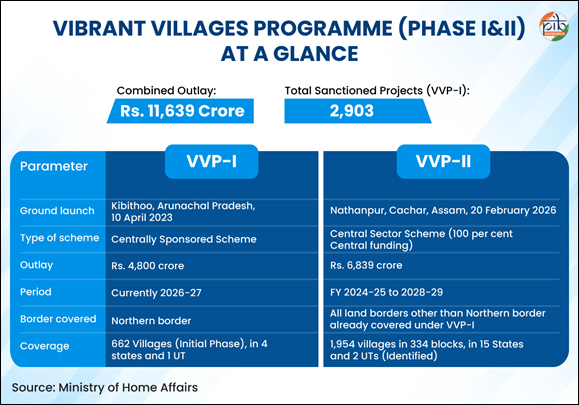
The two phases differ in design but share a single purpose. VVP-I is a Centrally Sponsored Scheme implemented with the States, while VVP-II is a Central Sector Scheme funded fully by the Centre. Both phases of the initiative aim to improve living conditions, generate local livelihoods and empower border communities. They work to strengthen the nation's border security by developing "first villages" as vibrant centres of growth.
VVP-I: Strengthening Northern Border Communities
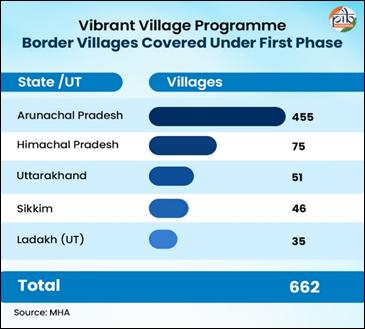
The first phase of the VVP was announced in the Union Budget 2022-23 for villages along the northern border. It was launched at Kibithoo in Anjaw district of Arunachal Pradesh on 10 April 2023. The villages in 46 blocks abutting northern border in 4 States and 1 UT in 19 Districts were identified out of which 662 strategic villages were taken on priority for comprehensive development covering a population of about 1.42 lakh. These are Arunachal Pradesh, Himachal Pradesh, Sikkim, Uttarakhand and the Union Territory of Ladakh. The scheme was approved with an outlay of Rs 4,800 crore. This covers the financial years 2022-23 to 2026-27. Out of this amount, Rs 2,500 crore was earmarked for road connectivity. The programme aims to bridge the development gap in remote border villages. It strives to provide quality infrastructure and essential services to them comparable to those available elsewhere in the country.
|
Did You Know? Kibithoo was chosen to launch the VVP due to its strategic location, history and development needs. Located in Arunachal Pradesh's Anjaw district, it is among India's easternmost inhabited villages. The area witnessed fierce fighting during the 1962 India–China War. Remote terrain, sparse connectivity and out-migration have long constrained development. Launching the Programme from Kibithoo reflected the Government's vision of bringing development first to the nation's frontier.
|
Key interventions under VVP-I
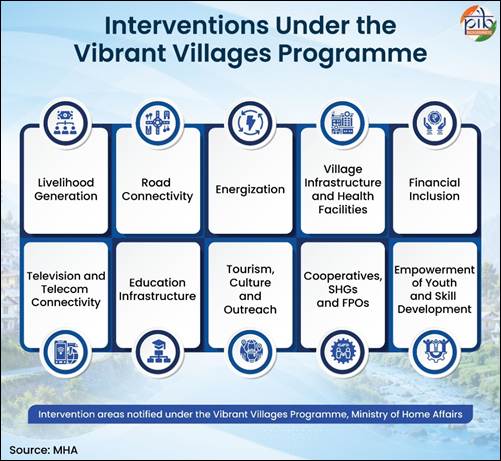
The programme supports all-weather roads, drinking water, reliable electricity, mobile and internet connectivity, and essential healthcare and education infrastructure. It also promotes tourism facilities and multi-purpose community centres to improve livelihoods and the overall quality of life. Livelihood support is organised on a hub-and-spoke model. It encourages social entrepreneurship, the empowerment of youth and women, the promotion of tourism and local culture, and one-block-one-product enterprises. By creating convergence, VVP-I established the delivery model that the second phase now carries to the rest of the land border.
|
Did You Know? India has been supporting border villages for nearly four decades. The Border Area Development Programme (BADP) was launched in 1986-87 along the western border. It was later expanded to cover villages within 10 km from the first habitation from international border. It covered 111 districts across 16 States and 2 Union Territories, and sanctioned over 39,000 development works since 2004-05. The programme is now in its sunset phase. Building on this foundation, VVP focuses on selected border villages. It ensures they receive every applicable government scheme, helping people stay in their villages and strengthen border security.
|
VVP-II: Extending the Model to All Land Borders
The Union Cabinet approved VVP-II on 2nd April, 2025. Unlike the first phase, VVP-II is funded entirely by the Centre and implemented by the Ministry of Home Affairs (MHA). It was formally launched on 20th February, 2026 at Nathanpur village in Cachar district of Assam. The scheme carries an outlay of Rs. 6,839 crores till financial year 2028-29.
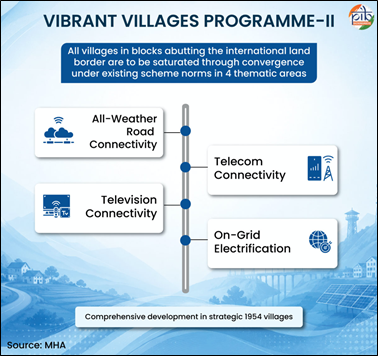
It has identified 1,954 villages for comprehensive development in 334 blocks abutting the international land borders. These blocks lie in 15 States and 2 Union Territories. The States/UTs are Arunachal Pradesh, Assam, Bihar, Gujarat, Manipur, Meghalaya, Mizoram, Nagaland, Punjab, Rajasthan, Sikkim, Tripura, Uttarakhand, Uttar Pradesh, West Bengal, Jammu and Kashmir (UT) and Ladakh (UT). Blocks on the northern border, already covered under VVP-I have been excluded to avoid duplication of efforts.
Interventions under VVP-II
The Government of India approved a comprehensive package under VVP-II to strengthen border villages. The scheme supports infrastructure, value chains through cooperatives and self-help groups (SHGs), SMART classrooms, tourism circuits and sustainable livelihoods. It also promotes road connectivity, healthcare, financial inclusion, skill development, and telecom connectivity. The objective is to improve living conditions, generate livelihoods and encourage people to stay in border villages. It extends the Vibrant Villages Programme to India's entire land border under a unified development framework.
|
Did You Know? VVP-II seeks to build prosperous and secure border areas. It places special emphasis on preventing and controlling trans-border crime through stronger border communities.
|
Delivering Development Through Scheme Convergence
The VVP implementation is guided by Village Action Plans. This is to be achieved through border-specific, State-specific and village-specific interventions based on local needs. The programme follows a convergence-based approach, ensuring saturation of schemes under existing norms. All-weather roads are being developed under the Pradhan Mantri Gram Sadak Yojana (PMGSY)-IV of the Ministry of Rural Development.
Since the border villages face unique challenges, a High-Powered Committee chaired by the Cabinet Secretary may recommend relaxations in scheme guidelines to address them. The Ministry of Home Affairs is the nodal ministry. It works closely with State Governments, district administrations and border guarding forces for coordinated planning and implementation.
Impact on the Ground
Since its launch, Vibrant Villages Programme-I has laid the foundation for inclusive and sustainable development in northern border villages.
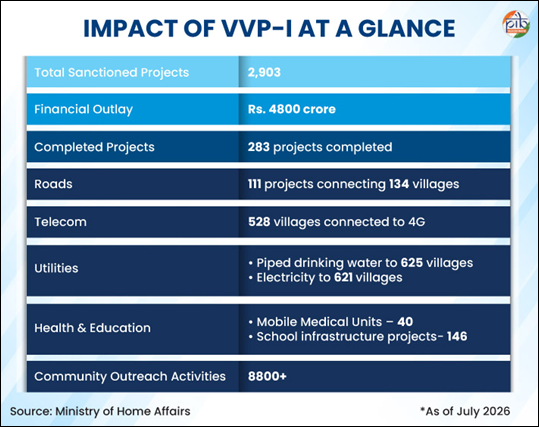
As of July, 2026, the Ministry of Home Affairs has sanctioned 1,248 projects with an outlay of Rs. 3,020.32 crore. A further 1,655 projects have been sanctioned by Central Ministries and Departments under convergence. An amount of Rs. 953.47 crore has been released to the States and the Union Territories, while 283 projects have been reported completed by them. A state/UT wise table for the sanctioned projects is given below.
|
S. No.
|
State or Union Territory
|
Projects sanctioned by MHA
|
|
1.
|
Arunachal Pradesh
|
832
|
|
2.
|
Himachal Pradesh
|
98
|
|
3.
|
Ladakh (UT)
|
79
|
|
4.
|
Sikkim
|
87
|
|
5.
|
Uttarakhand
|
152
|
|
|
Total
|
1,248
|
Connectivity: roads and long span bridges
In all, 111 road projects with an outlay of Rs. 2,481.93 crore have been sanctioned. These roads will connect 134 villages that had no road access earlier. A total of 35 long span bridges were also sanctioned under these projects. Better roads are expected to ease travel, widen local markets and support tourism in these villages.
Tourism as a new source of income
Tourism has become one of the most visible components of the programme on the ground. Under VVP-I, 327 tourism projects with an outlay of Rs. 145 crores have been approved. These include viewpoints, adventure tourism, eco-tourism, eco-resorts, trek routes and tourist centres.
Outreach and service delivery
More than 8,800 activities were held up to 31st July, 2026. These include awareness drives, service delivery camps, health and veterinary camps, and skill training. Arunachal Pradesh recorded 2,990 activities, and Ladakh recorded 2,221 activities. Uttarakhand held 2,038, Himachal Pradesh 1,037 and Sikkim 530 activities.
|
Did You Know? The Viksit Vibrant Village Programme transforms border villages into living classrooms for India's youth. In 2026, over 400 volunteers from every State and Union Territory spent a week in 74 border villages across Ladakh, Himachal Pradesh and Uttarakhand. They engaged in community service, cultural exchange and grassroots development.

|
VVP: Impact Beyond Infrastructure
The impact of the Vibrant Villages Programme extends beyond infrastructure to strengthen security, livelihoods, governance and community resilience.
Security: A populated and confident border belt supports the work of the border-guarding forces. Both phases seek to create a strong frontier population acting as a strategic asset to the nation.
Demography & Reverse Migration: Livelihood opportunities and improved connectivity give families reason to remain in the border villages. In Arunachal Pradesh, people of border villages of Kurung Kumey, Dibang Valley and Shi-Yomi districts are returning to their villages. This signifies the impact of the programme.
Economy: Border tourism, cooperatives, SHGs and Farmer Producer Organisations are creating a local income base in areas where economic opportunity was previously limited. Local procurement by the border guarding forces adds an assured market within the village itself.
Governance: The saturation approach brings every eligible household in these villages within the reach of existing Central and State schemes. Village Action Plans give the district administration a single instrument for sequencing that work across several departments.
Collectively, these four strands describe a single idea: that development and security are not competing claims on the frontier but reinforce one another.
|
Did You Know? In Arunachal Pradesh, the Indo-Tibetan Border Police (ITBP) procures milk, vegetables, eggs and grains directly from vibrant villages. A border post thereby becomes a dependable customer for the farms beside it.
|
Towards a Connected and Self-Reliant Frontier
The Vibrant Villages Programme is a promise that India's frontier communities will share fully in the nation's progress. Better infrastructure, sustainable livelihoods and convergence of government schemes are creating opportunities closer to home. At the same time, border tourism and local enterprise are unlocking the region's potential. As these villages become more vibrant, prosperous and self-reliant, they will continue to strengthen India's borders and advance the vision of a secure, inclusive and Viksit Bharat by 2047.
References
Prime Minister’s Office
Cabinet
Ministry of Home Affairs
Ministry of Youth Affairs and Sports
Press Information Bureau (Research Unit)
Sansad TV
Click here to see pdf
PIB Research
(Explainer ID: 159861)
आगंतुक पटल : 5372
Provide suggestions / comments