Economy
Roads Reimagined: The Rise of India’s Electric Vehicles Ecosystem
Posted On:
05 AUG 2026 11:37AM
India is rapidly shifting to electric vehicles (EVs). eMobility is now turning into a key driver of economic growth, energy security, and a cleaner future. EV sales have grown ~46x since 2016, showing strong consumer shift. Exports have surged from USD 1.2 million in 2020 to USD 84 million in 2024. This is positioning India as an emerging EV hub. Government schemes like National Mission on Manufacturing, PLI Scheme for Automobile & Auto Components Industry and PM Electric Drive Revolution in Innovative Vehicle Enhancement Scheme (PM E-DRIVE) are strengthening a more self-reliant eMobility ecosystem.
|
India’s Move Towards Electric Mobility
Daily commutes in crowded cities and last-mile connectivity in small towns are being fundamentally reimagined across India. At the core of this transition is electric mobility. This technological shift is becoming central to the country’s climate strategy and sustainable transportation vision. Propelled by Government incentives, rising environmental awareness, rapid technological progress, EVs have become a national priority shaping the future of the automobile industry.
India’s mobility transition is not just an environmental imperative but also an economic opportunity. It is reshaping one of its largest and most influential industries. This shift is emerging as a strategic lever to strengthen energy security. Further, it is reducing dependence on fossil fuel imports, and driving an efficient, low-carbon growth pathway for the economy.
What is an Electric Vehicle (EV)?
An EV is a vehicle powered by an electric motor that uses energy stored in a battery. It can be recharged from an external power source.
There are four types of EVs:
-Battery EVs (BEVs), that are fully electric.
-Hybrid EVs (HEVs) & Plug-in HEVs, that combine an internal combustion engine and an electric motor to power the vehicle. PHEVs additionally have externally rechargeable battery packs for extended electric-only operation.
-Fuel Cell EVs (FCEV), in which electric energy is produced from chemical energy.
|
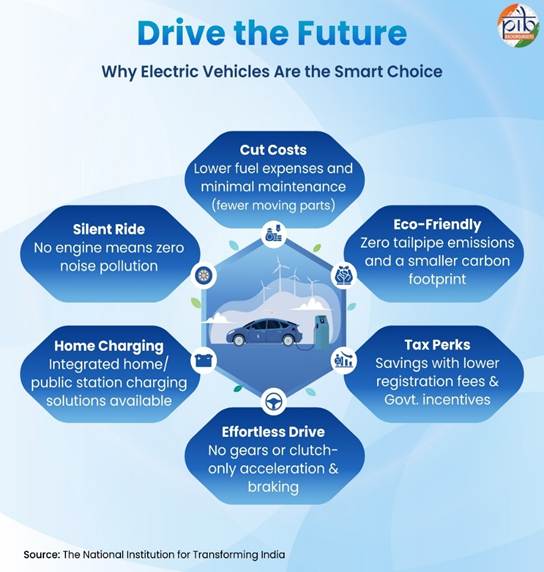
India’s EV Revolution: The Last Decade
India’s journey towards electric mobility began in 2015. It was marked by the launch of the National Electric Mobility Mission Plan and FAME scheme to incentivize the adoption of EVs. This move was driven by clear strategic priorities. These included reducing the rising import bill on petroleum fuels and tackling worsening urban air pollution. It also aimed to lower greenhouse gas emissions from the transport sector, which accounts for ~9% of India’s total emissions.
National Electric Mobility Mission Plan (NEMMP 2020)
The NEMMP 2020 outlines a strategic roadmap to accelerate the adoption and domestic manufacturing of EVs in India. It has the twin objective of strengthening energy security and promoting clean, sustainable mobility.
Faster Adoption and Manufacturing of (Hybrid &) EVs in India (FAME India)
Under the NEMMP 2020 framework, the FAME India scheme was launched in 2015 to drive EV adoption. The scheme offered incentives to buyers, supports creation of charging infrastructure, and manufacturing. Phase I continued until March 2019, followed by Phase II, implemented over five years until April 2024.
|
DID YOU KNOW?
EV adoption has seen a multifold surge, growing from 0.08% in FY15-16 to 8.26% in FY25-26.
|
A decisive turning point came in the post-COVID period, in FY22. Supported by targeted policy incentives, enhanced subsidies, and improved vehicle availability, EV adoption entered a phase of accelerated growth. This period also marked a structural shift in the market. While early adoption during FY20–FY21 was dominated by e-rickshaws, electric two-wheelers soon gained significant traction. By FY25, they were a leading segment, signaling a broader transition from informal, shared mobility to mainstream private, commercial adoption.
India in the Fast Lane: Scaling EV Growth Amid Global Expansion
Worldwide, consumer adoption of EVs is rising. Many competitively priced models with improved driving ranges are entering the market. Along with this, there is rapid expansion of public charging infrastructure. In India, this momentum is mirrored by strong policy support, rising sales and registrations. It is further backed by a growing ecosystem of domestic manufacturing, charging networks- leading to an increase in EV adoption.
India’s EV Scorecard- Rising Sales, Registrations and Exports
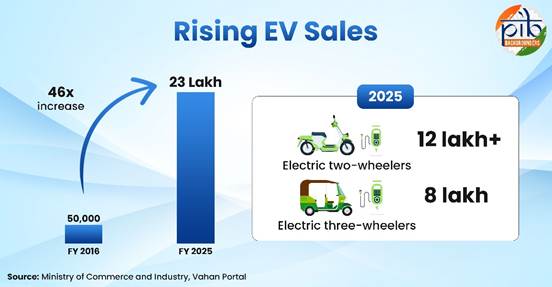
From a relatively small base of ~50,000 EVs sold in 2016, 2.3 million units have been sold in 2025. This reflects 46 times growth in India’s EV market. India’s growth has outpaced global trends, where EV sales increased ~20 times- from 918,000 in 2016 to 18.78 million in 2024.
DID YOU KNOW?
In 2025, Uttar Pradesh emerged as the largest EV market. With 4 lakh+ units, it represented 18% of national EV sales. It was followed by Maharashtra with 2.66 lakh units (12%) & Karnataka with 2 lakh units (9% of total sales).
|
India’s EV penetration was merely one-fifth of the global penetration in 2020. It ramped up to over two-fifth of the global penetration in 2024. Much of this progress was driven by motorised two-wheelers (12.8 lakh units) and three-wheelers (8 lakh units) sold in 2025.
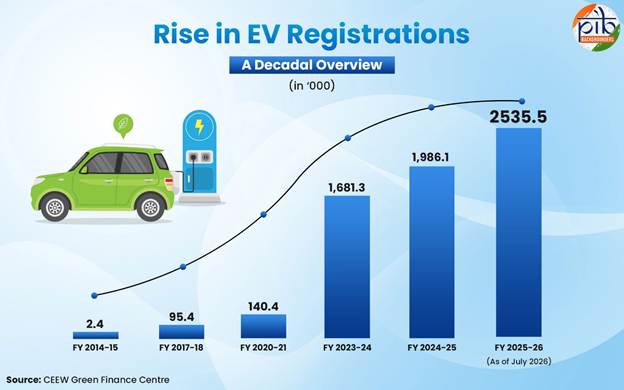
There has been a significant growth in EV registrations in the past decade, at a CAGR of over 62%. This indicates rapid acceleration in EV adoption. Policy support, technological advancements, and growing consumer confidence in electric mobility are major driving forces.
After considerable domestic uptake in recent years, Indian EVs have begun making strong headway in international markets. Exports have risen from USD 1.2 million in 2020 to USD 84 million in 2024.Top export destinations included Nepal, Indonesia and Japan.
On the infrastructure side, India’s public EV charging network is expanding rapidly. According to Bharat Heavy Electricals Limited (BHEL), 16,561 of the 52,718 public charging stations available as of July 2026 are equipped with fast EV charging facilities.
The e-Amrit tool helps locate charging station based on one’s location. Major industry players are actively enhancing charging infrastructure. For instance, in 2024, Hyundai Motor India expanded its ultra-fast network with 11 new stations in key cities. These included Mumbai, Pune, Ahmedabad, Hyderabad, Gurugram, and Bangalore, and along major highways.
India Electric Mobility Index (IEMI)
In a significant push towards a cleaner transport future, NITI Aayog launched the IEMI in August 2025. A first-of-its-kind framework, it tracks and compares the progress of States and Union Territories in advancing electric mobility. The index evaluates performance across 16 indicators across three pillars-transport electrification, charging infrastructure readiness, and EV research & innovation. This offers a clear snapshot of each region’s ecosystem strength.
Based on scores, regions are classified as Frontrunners (leading with robust ecosystems), performers (making progress) and aspirants (requiring intervention). Delhi, Maharashtra, and Chandigarh have emerged as Frontrunners, showcasing strong and mature EV ecosystems.
|
Domestic Manufacturing at Speed: Powered by Startups and AI
India is transitioning from an assembly-led market to a comprehensive EV manufacturing hub. Supported by a growing supplier ecosystem, domestic production now covers battery packs, motors, drivetrains, power electronics, wiring, and charging equipment. Leading Original Equipment Manufacturers (OEMs) like Tata Motors, Mahindra, TVS, Bajaj Auto are expanding capacity through investments in R&D, gigafactories, dedicated EV platforms. Simultaneously, global players like VinFast, Tesla, and major Korean and Japanese battery firms are exploring large-scale manufacturing in India. This expansion is strengthening localization, enhancing cost competitiveness, and positioning India as an integral part of global EV supply chains.
“e VITARA”, Suzuki’s first Made-in-India global strategic Battery EV
A historic milestone was achieved in August 2025 in India’s green mobility journey. This was marked by the inauguration of Suzuki’s first global strategic Battery Electric Vehicle (BEV), the “e VITARA”. The Made-in-India BEVs are aimed to be exported to 100+ countries, including advanced markets such as Europe and Japan. With this milestone, India became Suzuki’s global manufacturing hub for EVs.
|
Indian startups are witnessing the potential of EVs. They are catalyzing the availability of charging infrastructure, improving battery-level innovation, promoting low-cost manufacturing and offering data-driven solutions. With ~400 EV startups currently operating in India, they are emerging as central players in shaping India’s evolving EV ecosystem.Besides, the advancing EV ecosystem is leveraging Artificial Intelligence (AI) to enhance the overall driving experience. Features such as voice-enabled navigation, real-time traffic insights, and intelligent route planning are central to this. AI is also contributing to safer and more inclusive mobility by enabling voice-based controls, connected features, and accessibility-focused functionalities.
Rising Investment Momentum
Investment activity in the sector has remained strong. India’s EV ecosystem raised over USD1.4 billion in FY 2025, ~27% higher than 2024.EV manufacturers attracted the bulk of this funding, securing around USD 1.2 billion. In this, Delhi emerged as the top city for EV investments.
Strategic Policy Interventions for India’s EVs
The Government has been driving electric mobility since 2015 with multiple schemes for the auto industry. It has adopted a strategic approach to accelerate EV adoption through targeted policy interventions, financial incentives, and mission-driven initiatives. Key initiatives like FAME, PLI scheme for Advanced Chemistry Cells, battery localization aim to build a strong, future-ready mobility ecosystem.
States are emerging as key drivers of India’s EV transition through progressive policies, charging infrastructure expansion, strong investment support.
- As of December 2025, 29 states and UTs had notified EV policies, with 4 more in draft stages.
- Incentives like 15–25% capital subsidies, preferential land allotment, stamp duty waivers, and up to 100% SGST reimbursement reduce investor costs.
- Leading states like Tamil Nadu, Maharashtra, Karnataka, Gujarat, Haryana, Uttar Pradesh have become major EV hubs, anchoring robust manufacturing ecosystems.
Delhi’s EV Policy
The Delhi EV Policy is one of the most progressive EV policies in India. It aims to reduce vehicular emissions and improve air quality in the city.
In June 2026, the Government approved a comprehensive scheme to replace old, high-emission trucks and buses in Delhi-NCR. The initiative aims to improve air quality and promote cleaner mobility. With an outlay of ₹9,585 crore, the two-year scheme will support the replacement of around 2.07 lakh commercial vehicles, including 1.91 lakh trucks and 16,329 buses in Delhi-NCR (Delhi, Haryana, Rajasthan, Uttar Pradesh).
|
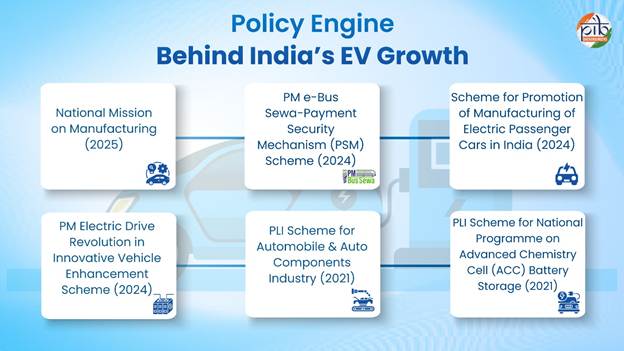
National Mission on Manufacturing (NMM)
The NMM (2025) identifies EVs as a key “seed” sector for innovation-led growth. The Mission has ambitious targets for 2035. It aims to double the manufacturing sector’s contribution to GDP from 12.9% (2023) to 25%. Further, NMM intends to create 143 million jobs, whilst boosting merchandise exports to USD1.2 trillion. It strengthens India’s EV ecosystem by promoting advanced manufacturing, fostering technology development, integrating EV production into global value chains. Through targeted cluster-based interventions and policy support, NMM seeks to accelerate domestic EV manufacturing capacity.
PM Electric Drive Revolution in Innovative Vehicle Enhancement Scheme (PM E-DRIVE Scheme)
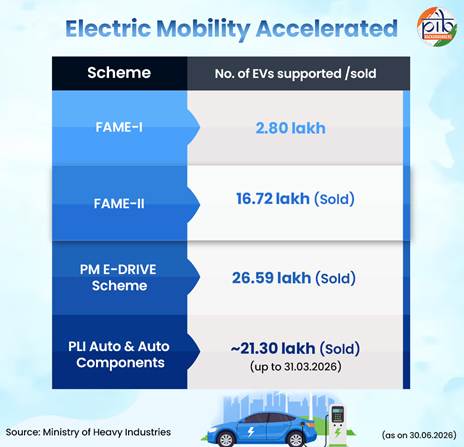
The PM E-DRIVE Scheme, notified in 2024, is a key initiative of the Ministry of Heavy Industries (MHI). It aims to accelerate EV adoption through targeted demand incentives, support for domestic manufacturing, and expansion of charging infrastructure.The scheme has an outlay of ₹10,900 crore and covers multiple segments including e-2Ws, e-3Ws, e-trucks, e-buses, and e-ambulances. Under the Scheme, the Phased Manufacturing Programme (PMP) mandates domestic manufacturing of specified EV components.
The PM E-DRIVE Scheme aims to support over 28 lakh EVs. Out of this, 22.12 lakh have already been sold as of January 2026. This has been driven by upfront incentives that reduce purchase costs for consumers. The scheme prioritizes public transport electrification. ₹4,391 crore has been allocated for 14,028 e-buses in the country. Out of this, 13,800 buses have been allocated to seven major cities, including Bengaluru, Delhi, Mumbai, Hyderabad, Ahmedabad, Pune and Surat. Tenders for 10,900 e-buses allocated in Phase I, have already been concluded. ₹2,000 crore has been earmarked for nationwide EV charging EV Public Charging Stations (EVPCS) across the country.Furthermore, ₹780 crore has been allocated for modernization and upgradation of vehicle testing agencies under MHI.
The scheme is set to address critical challenges related to environmental pollution and fuel security while advancing sustainable transportation solutions. It represents a crucial step toward a cleaner, more sustainable future for transportation in India.
PM e-Bus Sewa-Payment Security Mechanism (PSM) Scheme
The PM e-Bus Sewa–PSM Scheme (2024) provides payment security coverage to each bus deployed for up to 12 years. These buses are typically deployed within two years of contract signing.A total of 10,000 electric buses are to be deployed via Public Private Partnership (PPP) model (Government–private sector collaboration). This aims to strengthen city bus operations in urban areas. Encompassing a range of interventions, the scheme provides government support including bus operations, depot infrastructure, charging networks, green mobility initiatives.
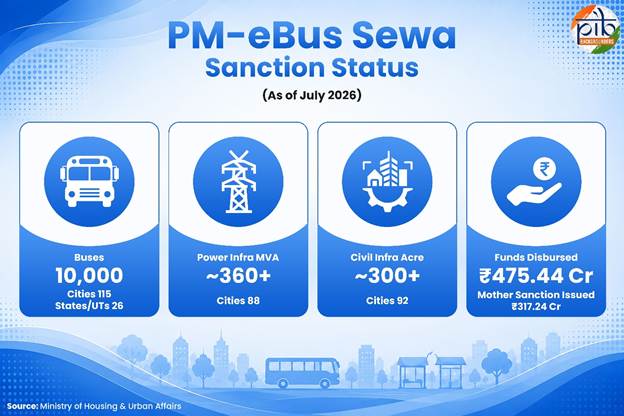
In February 2026, 50 electric buses were flagged off in Bhavnagar, Gujarat. Other cities like Nagpur in Maharashtra, Chandigarh, and Guwahati in Assam have also been included in the initial rollout.
Scheme for Promotion of Manufacturing of Electric Passenger Cars in India (SPMEPCI)
SPMEPCI scheme (2024) promotes electric car manufacturing. It mandates a minimum investment of ₹4,150 crore. They must also achieve at least 25% Domestic Value Addition (DVA) by year three and 50% by year five. The MHI launched the scheme with the vision of a cleaner, greener, and more self-reliant India. By promoting EVs, it aims to cut air pollution, reduce oil imports and trade deficit, driving innovation, jobs, economic growth.
PLI Scheme for Automobile & Auto Components Industry (PLI-Auto Scheme)
The PLI-Auto Scheme (2021) aims to strengthen India’s manufacturing capabilities in Advanced Automotive Technology (AAT), including EVs. The scheme provides financial incentives to promote domestic manufacturing with a minimum 50% domestic value addition. It also aims to attract investments across the automotive value chain.Underscoring its strong electric mobility focus, a cumulative incentive of ₹2,377.56 crore has been disbursed to approved applicants. Out of this, ₹2,319.88 crore has been allocated to EV manufacturers across segments, including e-2Ws, e-3Ws, e-4Ws, e-buses (January 2026).
The PLI scheme, aligned with the Aatmanirbhar Bharat vision, has emerged as a key driver of industrial growth across 14 sectors, boosting competitiveness in electronics, pharmaceuticals, and automobiles.
|
PLI scheme for National Programme on Advanced Chemistry Cell (ACC) Battery Storage (PLI ACC Scheme)
The PLI ACC Scheme (2021) has an outlay of ₹18,100 crore and aims to promote domestic battery manufacturing.It intends to establish a cumulative ACC capacity of 50 GWh in India. The scheme also supports development of advanced, long-range EV batteries through incentives linked to sales. Post gestation period, the scheme has entered its performance phase, spanning 1 January 2025 to 31 December 2029.
ACCs are new-gen advance energy storage technologies. They can store electric energy as electrochemical or chemical energy and convert it back to electric energy as/when needed.
|
Batteries account for 35-40% of an EV’s total cost-the largest single component. Hence, scaling up domestic ACC manufacturing is critical to reducing vehicle prices, enhancing energy security, creating jobs, boosting global competitiveness.
EVs in India attract a concessional GST rate of 5%, which applies to all electric cars, two-wheelers, and three-wheelers. This makes them significantly cheaper to tax than conventional vehicles.
Driving Forward: India’s EV Growth Outlook
India is reshaping itself from an import-dependent market into a globally competitive hub for EV production. This is aligned with its strategic priorities of energy security, reduced oil imports, and achieving the 2070 net-zero vision.
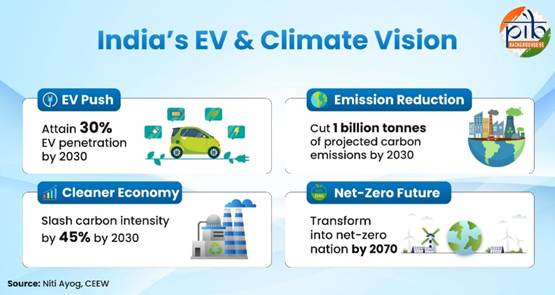
The focus is on complete domestic EV production through the 'Make in India' initiative.
- India’s EV market, valued at USD 3.71 billion in 2025, is projected to grow to USD 191.04 billion by 2034, at a CAGR of 54.94%.
- The Indian EV battery market is likely to grow from USD 2.71 billion in 2025 to USD 15.90 billion by 2034, at a CAGR of 21.70%.
- India aims for 30% of all vehicle sales to be electric by 2030, aligning with the global EV30@30 initiative.
- The EV ecosystem is strengthened with the establishment of 1.32 million charging stations across India by 2030.
With demand and production incentives, localization policies, early charging infrastructure, India has entered a decisive phase of scale. As global supply chains realign, India is expected to be one of the most attractive destinations for EV manufacturing investment.
As domestic capabilities strengthen, India is poised to emerge as an export hub. This applies to various variants-electric two wheelers, compact EVs, battery packs, and key drivetrain components. This is supported by R&D investment and global partnerships.
Looking ahead, the Government is developing the next phases of Corporate Average Fuel Efficiency (CAFE) norms, CAFE III (2027–2032) and CAFE IV (2033–2037). These propose stricter CO₂ emission targets based on the Worldwide Harmonised Light Vehicle Test Procedure (WLTP). The proposed limits stand at 91.7 g CO₂/km for CAFE III and 70 g CO₂/km for CAFE IV. These standards are expected to be implemented alongside a super-credit mechanism. This is poised to enable OEMs to more easily meet compliance targets through increased EV sales rather than through sales of conventional cars and non-plug-in hybrids.
India’s Corporate Average Fuel Efficiency (CAFE) norms were introduced in 2017. They are designed to steer OEMs towards producing more fuel-efficient, lower-emission passenger vehicles, including EVs. By incentivizing efficiency improvements across vehicle segments, these norms play a critical role in advancing EV adoption. They also reduce overall fuel consumption and CO₂ emissions at scale.
|
At The Threshold of Transformation
India stands at the cusp of a defining mobility transformation. Demand is surging, manufacturing is scaling up, and technological capabilities are advancing. Consequently, the country is fast emerging as a global hub for R&D and EV manufacturing. Key drivers like better finance access, rising awareness, tech advances, reliable charging, a skilled workforce are accelerating India’s EV transition. A reform-driven policy environment further provides compelling and durable advantage at scale.
The road ahead will be shaped by deeper supply chain integration, accelerated localization of batteries and a robust charging infrastructure. Together, these pillars are poised to define India’s leadership in the global EV landscape.
References
Prime Minister's Office
https://www.pib.gov.in/PressReleasePage.aspx?PRID=2160822®=3&lang=2
Ministry of Heavy Industries
https://www.pib.gov.in/PressReleasePage.aspx?PRID=2200852®=3&lang=1
https://www.pib.gov.in/PressReleasePage.aspx?PRID=2237556®=3&lang=1
https://www.pib.gov.in/PressReleasePage.aspx?PRID=2117485®=3&lang=2
https://www.pib.gov.in/PressReleasePage.aspx?PRID=2222608®=3&lang=2
https://www.pib.gov.in/PressReleasePage.aspx?PRID=2227596®=3&lang=2
https://heavyindustries.gov.in/en/pli-scheme-national-programme-advanced-chemistry-cell-acc-battery-storage
https://sansad.in/getFile/rsnew/Committee_site/Committee_File/ReportFile/17/215/332_2026_3_14.pdf?source=rajyasabha
https://www.pib.gov.in/PressReleasePage.aspx?PRID=2222604®=3&lang=1
https://www.pib.gov.in/PressReleasePage.aspx?PRID=2237554®=3&lang=2
https://sansad.in/getFile/loksabhaquestions/annex/187/AU1779_LB4HdS.pdf?source=pqals
https://www.pib.gov.in/PressReleasePage.aspx?PRID=2260368®=3&lang=1
https://www.pib.gov.in/PressReleasePage.aspx?PRID=2287125®=3&lang=1
https://www.pib.gov.in/PressReleasePage.aspx?PRID=2287131®=3&lang=1
Ministry of Housing and Urban Affairs
https://pm-ebus-sewa.mohua.gov.in/
Ministry of Environment, Forest and Climate Change
https://teriin.org/files/EV-Charging-in-India-Ecosystem-Perspectives-and-Skilling-Opportunities.pdf
Ministry of Finance
https://www.indiabudget.gov.in/economicsurvey/doc/echapter.pdf
https://www.pib.gov.in/Pressreleaseshare.aspx?PRID=1580536®=3&lang=2
Ministry of Road Transport & Highways
https://vahan.parivahan.gov.in/vahan4dashboard/vahan/dashboardview.xhtml;jsessionid=7E3B85C812D7040175EF101A79811DD4
https://sansad.in/getFile/annex/270/AU585_GCe0A2.pdf?source=pqars
Ministry of Commerce and Industry
https://www.investindia.gov.in/team-india-blogs/governments-ev-policies-driving-indias-green-revolution
https://www.investindia.gov.in/team-india-blogs/inside-indias-ev-manufacturing-ecosystem-key-investment-trends-government-policies
https://www.startupindia.gov.in/content/sih/en/ams-application/accelerator-program.html?applicationId=5ce7f127e4b08f8b1a974283
Government of NCT of Delhi
https://transport.delhi.gov.in/transport/delhi-ev-policy
Cabinet
https://www.pib.gov.in/PressReleasePage.aspx?PRID=2268342®=3&lang=1
Council on Energy, Environment and Water
https://www.ceew.in/gfc/publications/navigating-indias-electric-mobility-transition#:~:text=At%20the%20national%20level%2C%20India's,began%20to%20surge%20from%20FY22
https://www.ceew.in/gfc/solutions-factory/publications/CEEW-Navigating_India%27s_Electric_Mobility_Transition_WEB.pdf
https://www.ceew.in/gfc/tools_and_dashboards/electric-mobility/national-volume-monitor
https://www.ceew.in/press-releases/india-on-track-to-exceed-2030-ndc-target-on-carbon-emissions-reduction
https://www.ceew.in/news/cop-26-ceew-unpacks-indias-2070-net-zero-target-and-other-climate-mitigation-measures
International Energy Agency
https://iea.blob.core.windows.net/assets/7ea38b60-3033-42a6-9589-71134f4229f4/GlobalEVOutlook2025.pdf
US Department of Energy
https://afdc.energy.gov/vehicles/electric
https://afdc.energy.gov/laws/12660%20;%20https://afdc.energy.gov/vehicles/electric
IBEF
https://www.ibef.org/industry/electric-vehicle
https://www.ibef.org/news/india-s-electric-vehicle-market-accounts-for-8-of-new-vehicle-registrations-in-2025-vahan-portal-data
Others
https://ddnews.gov.in/en/indias-ev-sales-cross-2-3-million-in-2025-market-share-rises-to-8/
https://www.newsonair.gov.in/indias-electric-vehicle-market-accounts-for-8-of-new-vehicle-registrations-in-2025-vahan-portal-data/
https://ddnews.gov.in/en/pm-modi-flags-off-50-electric-buses-for-gujarats-bhavnagar-under-pm-e-bus-sewa-scheme/
https://www.newsonair.gov.in/over-29000-public-ev-charging-stations-installed-in-india-mos-bhupathiraju-srinivasa-varma/
https://www.iea.org/reports/global-ev-outlook-2026
Niti Aayog
https://niti.gov.in/sites/default/files/2025-08/Electric-Vehicles-WEB-LOW-Report.pdf
https://niti.gov.in/sites/default/files/2026-01/Trade_Watch_Quarterly_April_June_Q1_FY26.pdf
https://e-amrit.niti.gov.in/charging-map
https://niti.gov.in/sites/default/files/2025-08/India-Electric-Mobility-Index-2024-Report.pdf
https://e-amrit.niti.gov.in/benefits-of-electric-vehicles
https://www.pib.gov.in/PressReleseDetailm.aspx?PRID=2152243®=3&lang=2#:~:text=It%20enables%20states%20to%20benchmark,learn%20from%20each%20other's%20successes.%E2%80%9D
PIB Archives
https://www.pib.gov.in/PressNoteDetails.aspx?NoteId=155094&ModuleId=3®=3&lang=2
https://www.pib.gov.in/PressNoteDetails.aspx?NoteId=157304&ModuleId=3®=3&lang=1
Click here to see Pdf
PIB Research
(Explainer ID: 159436)
आगंतुक पटल : 2882
Provide suggestions / comments