Economy
Nine Years of GST: Simplifying Taxation, Strengthening India
Posted On:
30 JUN 2026 2:14PM
GST has marked a major shift in India’s indirect tax system by replacing fragmented central and state taxes with an integrated framework. It has helped create a common national market and support the vision of One Nation, One Tax. Since its implementation in 2017, GST has evolved through continuous reforms, digital systems and stronger Centre-State coordination. The Next-Generation GST reforms of 2025 further simplified the structure through lower rates, exemptions and easier processes. These measures aim to benefit households, MSMEs, farmers, artisans, exporters and various trade sectors.
|
GST: A Milestone in India’s Tax Reform Journey
The launch of Goods & Services Tax (GST) on 01st July 2017, marked a historic achievement in India’s reform journey. The principle of “One Nation, One Tax” has now become a reality, helping India move towards an integrated tax system.
Over the past nine years, GST has strengthened India’s vision of ‘Ek Bharat - Shreshtha Bharat’. It has brought transparency, accountability and economic growth through rationalised tax rates and standardised procedures.
|
GST subsumed 17 different taxes and 13 cesses into a common framework. Earlier, India’s indirect tax system included several Central and State-level taxes, creating differences in rates and structures. This added hidden costs for trade & industry and led to cascading of taxes, often described as “tax on tax”. Also, supported by a strong IT infrastructure, it aimed to broaden the tax base and improve tax discipline.
|
Salient features of GST
The structure of GST brought together several key features defining how the tax would be levied and administered.
Applicability: Under GST, tax is charged on the “supply” of goods or services, rather than on manufacture, sale or service separately.
Destination-based Consumption Tax: GST is a destination-based consumption tax. This means the tax accrue to the State where the goods or services are finally consumed.
Coverage and uniformity: It applies to almost all goods and services, with alcoholic liquor for human consumption kept outside its scope. It also brings greater uniformity by applying common tax rates across the country. There are 5 goods on which GST can be levied as and when approved by the GST Council.
GST Council: The Council guides key decisions on GST and supports its implementation across the country.
|
Building co-operative federalism
The GST Council has strengthened co-operative federalism by bringing the Centre and States together in decision-making. It is a statutory body that has played an important role by regularly reviewing issues and responding to emerging challenges. This flexible approach has allowed timely changes and course corrections in the tax system to support the economy.
|
Goods and Services Tax Network (GSTN): GSTN, a 50% Centre: 50% State Government owned company, provides the common digital infrastructure for the GST system. It supports the Centre, States, taxpayers and other stakeholders by enabling various digital services.
Dual GST: GST follows a dual structure where Centre levies Central Goods and Services Tax (CGST) and States levy State Goods and Services Tax (SGST) on intra-state supplies. Integrated Goods and Services Tax (IGST) is levied on all inter-State supply of goods and services. IGST rates are generally 2x CGST/SGST.
Next-Generation GST Reforms
The 56th meeting of the GST Council approved the Next-Gen GST reforms to improve the lives of common people and simplify tax processes for businesses. The reforms revised rates and exemptions, which came into effect from 22nd September 2025. Hailed as GST 2.0, these reforms mark a new phase of tax reform that reinforce growth prospects.
A detailed overview is available here: GST Reforms 2025: Relief for Common Man, Boost for Businesses.
|
Key Measures
|
|
Streamlined Rate Structure: The tax structure has primarily moved to two slabs - 5% and 18%.
|
|
Luxury and Sin Goods Tax: A 40% rate on luxury and sin goods has been introduced to help maintain revenue balance while ensuring a fairer tax structure. This includes lottery/ online gaming, tobacco, aerated drinks, high-end cars, yachts and private aircrafts.
|
|
Easier Compliance: GST 2.0 also makes registration and return filing easier, while speeding up refunds and lowering costs. This brings procedural ease for businesses, especially MSMEs and startups.
|
Lower Costs, Wider Impact
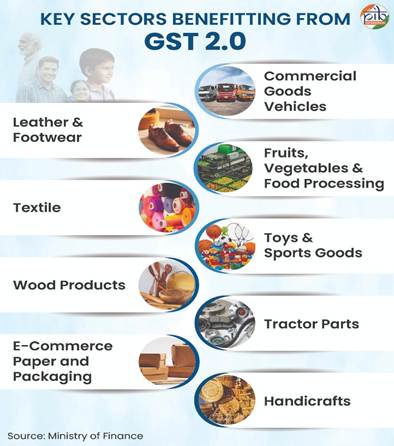
Beyond rate reduction, GST 2.0 is supporting India’s growth cycle by lowering costs, improving affordability, encouraging compliance and economic activity. With a wide sectoral reach, GST 2.0 aims to benefit exports, artisans, farmers and sustainable manufacturing.
|
Relief for Households and Consumers:
|
|
Cheaper goods and services bring rise in consumption and support savings.
|
|
GST exemptions on insurance and essential medicines strengthen household protection and improve access to healthcare.
|
|
|
|
Boost for MSMEs and Industry:
|
|
Reduced GST rates on key inputs and sectors such as cement, handicrafts lower production costs and improve business competitiveness.
|
|
A simplified structure reduces classification-related disputes and makes tax decisions easier for businesses. Over time, this helps expand the tax base and support revenue growth.
|
|
Correction of inverted duty structures boost domestic value addition and promote exports.
|
Easing Compliance for MSMEs and Small Taxpayers
Several measures have also been introduced over time to make compliance easier for MSMEs, startups and small taxpayers.
Higher Exemptions: Effective from April 2019, the GST registration limit for goods suppliers was increased from ₹20 lakh to ₹40 lakh. The composition scheme limit was also increased from ₹75 lakh to ₹1.5 crore (other than some special category states).
|
Composition Scheme
The Scheme is designed for small taxpayers allowing them to pay GST at a fixed rate on turnover. It involves fewer documents and simpler return-filing requirements.
|
Simpler Return Filings: The quarterly return filing and monthly payment (QRMP) scheme has been introduced in 2020 to allow for quarterly filing of returns. It covers taxpayers with annual turnover of up to ₹5 crore.
Further, taxpayers with no transactions can also file NIL monthly GST returns even through SMS.
Support for small businesses and e-commerce sellers: Small taxpayers making intra-state supply of goods through e-commerce operators have been exempted from mandatory GST registration from October 2023.
Ease based registration scheme has also been introduced for low-risk applicants, allowing registration within three working days.
Relief in disputes and past demands: Amendment has been made to reduce the pre-deposit amount required for filing GST appeals.
A waiver of interest and penalties for certain demand notices has also been provided, subject to certain conditions. This covers fiscal years 2017-18, 2018-19 and 2019-20.
Rise of Data-Driven Tax Administration under GST
GST reforms have increasingly shifted tax administration towards a technology-driven framework.
The Goods and Services Tax Network (GSTN) portal and e-invoicing have made administration more transparent by enabling real-time capture of invoice data. This has enabled reduced manual reporting, improved accuracy and helped minimise mismatches in reporting.
Automation has also made filing processes easier for taxpayers. The matching of supplier tax liability with recipient input tax credit (ITC) has streamlined processes. Pre-filled returns, simplified reconciliation and real-time validation have reduced errors and lowered the overall procedural requirements.
|
Using AI and Data Analytics for Strengthening GST
Advanced technologies such as artificial intelligence, machine learning and data analytics are being used for monitoring in a more targeted manner. They help identify possible tax evasion by analysing data patterns and risk indicators. These tools have been applied across various processes such as registration, scrutiny etc. This allows the system to focus on high-risk taxpayers, while easing regulatory requirements on compliant taxpayers.
|
The impact of these measures extends beyond improving administrative efficiency and has supported India’s broader macroeconomic stability. They have made collections more predictable, thereby supporting stronger revenue buoyancy and greater fiscal transparency.
Formalisation Gains Reflect in GST Growth
GST collections have become a high-frequency signal of economic activity. Rising revenues reflect not only higher consumption and trade, but also a wider taxpayer base, stronger reporting systems and better compliance.
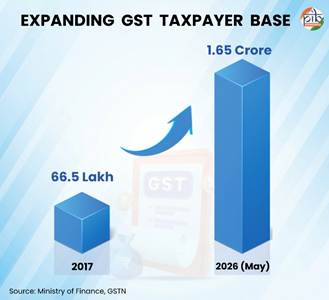
The number of GST taxpayers increased from 66.5 lakh in 2017 to 1.65 crore as on May 2026. This points to greater formalisation of the economy.
Gross GST collection stood at around ₹7.4 lakh crore in 2017-18 and has increased steadily over the years.
Over the last five years, collections rose from ~₹13.76 lakh crore in 2021-22 to ~₹22.27 lakh crore in 2025-26. The momentum has continued into 2026-27, with GST collections reaching around ₹4.37 lakh crore during April-May 2026.
GST’s Continuing Reform Journey
The significance of GST Day goes beyond commemorating the launch of a landmark tax reform. It reflects India’s continued effort to create a simpler, more transparent and integrated indirect tax system. Reforms under GST 2.0 build on this progress by addressing the needs of citizens & businesses, and supporting India’s progress towards a Viksit Bharat.
References
Prime Minister's Office (PMO)
https://www.pib.gov.in/PressReleasePage.aspx?PRID=2163986&lang=1®=3
Ministry of Finance
https://www.indiabudget.gov.in/budget2017-2018/es2016-17/echap01_vol2.pdf
https://www.pib.gov.in/PressNoteDetails.aspx?ModuleId=3&NoteId=155151®=48&lang=2
https://dor.gov.in/concept-note-gst
https://cbic-gst.gov.in/pdf/01012018-GST-Concept-and-Status.pdf
https://gstcouncil.gov.in/about-us
https://sansad.in/getFile/loksabhaquestions/annex/186/AU2414_pElIGR.pdf?source=pqals
https://sansad.in/getFile/loksabhaquestions/annex/185/AU3545_9tJ3Tw.pdf?source=pqals
https://sansad.in/getFile/loksabhaquestions/annex/183/AU2272_Pzuq3S.pdf?source=pqals
https://sansad.in/getFile/loksabhaquestions/annex/187/AU1430_6jAjKo.pdf?source=pqals
https://tutorial.gst.gov.in/downloads/news/monthly_gst_data_for_mar_2026_for_publishing_final.pdf
https://tutorial.gst.gov.in/downloads/news/final_monthly_gst_data_for_may_2026_for_publishing.pdf
https://sansad.in/getFile/annex/250/AU233.pdf?source=pqars
https://www.gstn.org.in/
World Bank
https://documents1.worldbank.org/curated/en/348501542614212003/pdf/India-develoment-Update-GST-December-2017.pdf
Press Information Bureau
https://www.pib.gov.in/PressNoteDetails.aspx?NoteId=154789&ModuleId=3®=48&lang=2
https://www.pib.gov.in/PressNoteDetails.aspx?NoteId=155151&ModuleId=3®=48&lang=1
https://www.pib.gov.in/PressNoteDetails.aspx?NoteId=155156&ModuleId=3®=48&lang=1
https://www.pib.gov.in/PressNoteDetails.aspx?ModuleId=3&NoteId=151915®=48&lang=2
Nine Years of GST
***
PIB Research
(Explainer ID: 159075)
आगंतुक पटल : 196
Provide suggestions / comments