Technology
INDIA'S SPACE ODYSSEY
Building India's Space Future
Posted On:
21 JUN 2026 2:51PM
India's space journey over the last 12 years reflects the spirit of Vishwas, Vikas and Jan Kalyan. Driven by Aatmanirbhar Bharat, Make in India and the vision of Viksit Bharat 2047, the nation has emerged as a leading space power. Landmark achievements include Chandrayaan-3's lunar south pole landing, Aditya-L1's solar mission, and preparations for Gaganyaan and a national space station. Space startups have grown from one in 2014 to over 400 as on Feb 2026. Liberalised Foreign Direct Investment (FDI) norms, greater private participation, and NSIL-led commercialisation have accelerated growth. These achievements reflect a confident and self-reliant India using space technology for development, global partnerships, and inclusive progress.
The Rise of a Global Space Power
Over the last twelve years, India's space programme has emerged as a symbol of national confidence, technological self-reliance, and global ambition. What began as a scientific endeavour has evolved into a strategic national asset that supports development, strengthens security, drives innovation, and enhances India's standing in the world. This journey reflects the spirit of 12 Years of Vishwas Ke, Nirman Ke and Jan Kalyan Ke—building trust through achievement, creating new opportunities through innovation, and delivering benefits that reach every citizen.
Three defining pillars have shaped this transformation. Firstly, India's Space Capability has extended the nation's reach beyond Earth through landmark missions, advanced launch systems, and indigenous technologies. Additionally, building National Capacity has leveraged space-based applications to strengthen governance, connectivity, disaster management, agriculture, healthcare, education, and economic growth. Moreover, the global
partnerships and collaborative leadership have enhanced India's credibility as a trusted space partner, expanding international cooperation and reinforcing its role in the peaceful and responsible use of space.
These achievements tell the journey of a nation that is not only reaching new frontiers in space but also harnessing space technology to empower its people, strengthen its institutions, and elevate India's standing in the global arena. It is a journey guided by national purpose, and focused on improving lives.
India’s Space Capability Reaching Beyond Earth
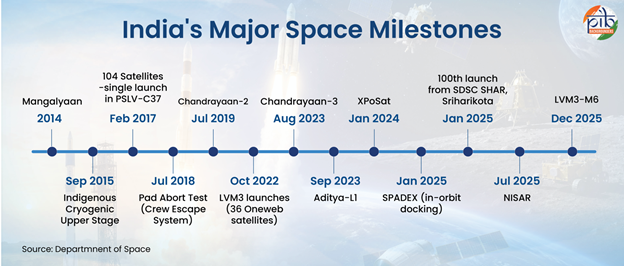
Over the past decade, India has steadily expanded the scope of its space programme. It began with a focus on space exploration, which has now evolved into a broader effort to advance scientific research, develop cutting-edge technologies, and strengthen national capabilities. Today, India is pursuing ambitious goals across deep-space exploration, space science, human spaceflight, and orbital infrastructure. These achievements reflect growing confidence, technological maturity, and a long-term vision for India's role in the global space ecosystem
Lunar Exploration - The Chandrayaan Programme
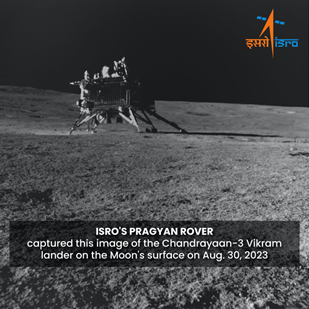
India's lunar journey reflects a sustained commitment to scientific discovery and technological advancement. The foundation was laid with Chandrayaan-1 in 2008, India's first mission to the Moon. The mission transformed global understanding of lunar resources by discovering evidence of water molecules and hydroxyl on the Moon's surface. Its Moon Impact Probe also provided valuable insights into the lunar exosphere. Further, Chandrayaan-2, launched in 2019, strengthened India's lunar programme. Operating from an altitude of 100 kilometres, it provided some of the highest-resolution images of the lunar surface and captured details as fine as 30 centimetres. Chandrayaan-1and Chandrayaan-2 established India as a serious contributor to global lunar science and laid the groundwork for future exploration.
That foundation further culminated in a historic achievement on 23 August 2023. Chandrayaan-3 made India the first country to achieve a soft landing near the Moon's south pole and the fourth nation after the United States, Russia, and China to successfully soft-land on the lunar surface. The Vikram lander touched down at 69.3° South latitude, a region never previously reached by any spacecraft. Scientific instruments conducted in-situ studies and confirmed the presence of Sulphur through direct elemental analysis. India's lunar ambitions continue to grow. Chandrayaan-4, planned for 2027, aims to land on the Moon, collect samples, and return them to Earth. The Chandrayaan-5/LUPEX (LUnar Polar EXploration) mission, will explore water and other volatile materials in permanently shadowed regions near the lunar south pole, taking India deeper into the next era of lunar exploration.
The Mars Orbiter Mission, popularly known as Mangalyaan, marked India's entry into interplanetary exploration. On 24 September 2014, the spacecraft successfully entered Martian orbit, making India the first country to reach Mars on its maiden attempt. With this achievement, ISRO became only the fourth space agency in the world to place a spacecraft in orbit around Mars after United States' NASA, Russia's Roscosmos, and the European Space Agency (ESA). Originally designed for a six-month mission, Mangalyaan remained operational for more than eight years, far exceeding expectations. The mission generated valuable scientific data on Mars' atmosphere, exosphere, surface features, and interactions with solar winds. Beyond its scientific contributions, Mangalyaan demonstrated India's ability to execute complex deep-space missions with remarkable efficiency and established the country as a credible participant in planetary exploration.
Aditya-L1: India's First Solar Observatory
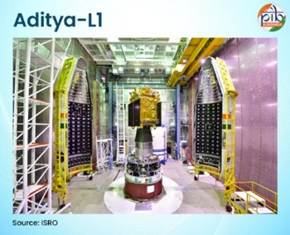
India expanded its space ambitions beyond planetary exploration with Aditya-L1, the country's first dedicated solar mission. Launched in 2023, the spacecraft was successfully placed in a halo orbit around the Sun-Earth L1 Lagrange Point, nearly 1.5 million kilometres from Earth. This unique position enables uninterrupted observation of the Sun and its dynamic activity. The mission studies the solar corona, solar winds, and space weather phenomena that influence Earth's environment and technological systems. Aditya-L1 has also been opened to the national scientific community as a proposal-driven observatory. Scientific data are regularly released in the public domain, strengthening global solar research. More than 27 TB of solar observation data have already been disseminated, making the mission an important contributor to international scientific knowledge.
Space Astronomy and Space Docking: Expanding Frontiers of Capability
India has strengthened its position in advanced space science through astronomy and in-orbit technology demonstrations. AstroSat, India's first multi-wavelength space observatory, completed a decade in orbit in September 2025 and has contributed several important scientific discoveries. XPoSat, launched on 1 January 2024, further expanded India's capabilities in X-ray astronomy. Both missions continue to operate as proposal-driven observatories serving researchers worldwide.
India also achieved a major technological breakthrough through the Space Docking Experiment (SPADEX) in January 2025. The mission made India the fourth nation after the United States, Russia, and China to demonstrate autonomous docking and undocking in space. ISRO also demonstrated power transfer between docked satellites, tested a robotic arm in microgravity. The successful development of the indigenous Bharatiya Docking System marks a major milestone, enabling the seamless conduct of India’s landmark upcoming missions such as the Bharatiya Antriksha Station (BAS), Chandrayaan-4, and Gaganyaan. Read More: SpaDeX Mission: Revolutionising Space Exploration
Venus Orbiter Mission: Exploring Earth's Sister Planet
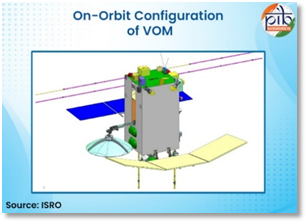
Building on its achievements at the Moon and Mars, India is preparing its first mission to Venus. The Venus Orbiter Mission, approved by the Government of India, is targeted for launch in March 2028. The mission will study Venus' geology, surface composition, atmosphere, ionosphere, and resurfacing processes. Scientists will also examine how solar activity influences the planet's atmospheric and near-space environment. The mission represents a significant technological leap for India's space programme. It will attempt advanced capabilities such as aerobraking and sophisticated thermal management systems to operate in Venus' extreme conditions. These technologies are being undertaken by ISRO for the first time and will further strengthen India's expertise in deep-space exploration and planetary science.
Gaganyaan: India's First Human Spaceflight Programme
Approved in January 2019, the mission aims to send up to three Indian astronauts into a 400-kilometre orbit for up to three days before bringing them safely back to Earth. The programme includes two uncrewed missions and one crewed mission. The programme entered in its final phase in 2025. Beyond space exploration, Gaganyaan is strengthening Indian industry, creating new technologies, and bringing India closer to becoming one of the few nations capable of independently sending humans to space.
|
Did You Know?
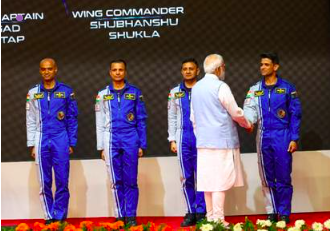 As part of preparations for Gaganyaan, India participated in the ISRO-NASA supported Axiom-4 mission to the International Space Station in 2025. Group Captain Shubhanshu Shukla travelled aboard the SpaceX Dragon spacecraft launched by Falcon 9 on 25 June 2025. During the mission, he conducted seven microgravity experiments developed by Indian research institutions. The studies examined muscle regeneration, algal growth, crop viability, microbial survivability, cognitive performance, and cyanobacterial behaviour in space. The mission concluded successfully on 15 July 2025 with safe undocking, re-entry, and splashdown. Beyond its scientific outcomes, Axiom-4 provided India with valuable operational experience in astronaut training, human spaceflight procedures, microgravity research, and international collaboration, strengthening the country's readiness for future crewed missions. As part of preparations for Gaganyaan, India participated in the ISRO-NASA supported Axiom-4 mission to the International Space Station in 2025. Group Captain Shubhanshu Shukla travelled aboard the SpaceX Dragon spacecraft launched by Falcon 9 on 25 June 2025. During the mission, he conducted seven microgravity experiments developed by Indian research institutions. The studies examined muscle regeneration, algal growth, crop viability, microbial survivability, cognitive performance, and cyanobacterial behaviour in space. The mission concluded successfully on 15 July 2025 with safe undocking, re-entry, and splashdown. Beyond its scientific outcomes, Axiom-4 provided India with valuable operational experience in astronaut training, human spaceflight procedures, microgravity research, and international collaboration, strengthening the country's readiness for future crewed missions.
|
Bharatiya Antariksh Station (BAS) is India's planned space station and a key pillar of Space Vision 2047. BAS will be a five-module space station in Low Earth Orbit, designed to support long-duration human space missions and advanced scientific research in microgravity. In September 2024, the Union Cabinet approved the development and launch of the first module, BAS-01, by 2028 as part of the expanded Gaganyaan programme. The station will enable research in life sciences, medicine, and emerging technologies while supporting future human exploration missions beyond Earth orbit.
India's progress in space reflects a clear shift from enhancing capability to building leadership. The country is not only expanding the frontiers of scientific discovery but also developing technologies that will shape the future of space exploration. With ambitious missions, advanced research programmes, and a strong long-term roadmap, India is strengthening its position among the world's leading spacefaring nations.
Building Capacity Through Private Participation, Innovation, and Technological Development
India's space programme has evolved from a scientific endeavour into a powerful instrument of national development. Through private sector powering India's space transformation, an expanding Indigenous Space Technology Stack, the growth of NavIC – India's Indigenous Navigation System, advanced Launch Vehicles, and space-based public services, India has strengthened national capacity in governance, connectivity, disaster resilience, innovation, and economic development. Today, space technology is not only enabling missions beyond Earth but also transforming everyday life across the country.
Private Sector Powering India's Space Transformation
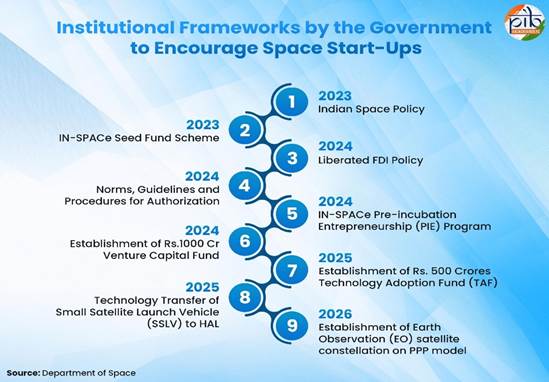
India has transformed its space sector from a government-led programme into a vibrant national ecosystem. The opening of the space sector for private players in 2020, followed by the Indian Space Policy 2023, enabled greater private participation across the space value chain. Start-ups, industry, and research institutions now play an increasingly important role in innovation, manufacturing, launch services, and satellite applications. Government initiatives such as the liberalised Foreign Direct Investment policy, the IN-SPACe Seed Fund Scheme, the Pre-incubation Entrepreneurship Programme, the ₹1,000 crore Venture Capital Fund, and the₹500 crore Technology Adoption Fund have strengthened the ecosystem.
|
Did You Know?
In February 2024, the Government liberalised the Foreign Direct Investment (FDI) policy for the space sector, allowing up to 100% FDI in selected activities. Up to 74% FDI is permitted under the automatic route for satellite manufacturing and operations, satellite data products, and ground/user segment services. Up to 49% FDI is allowed for launch vehicles, related systems, and spaceports, while 100% FDI under the automatic route is permitted for manufacturing satellite and ground-segment components and subsystems.
To further boost private participation, the Indian National Space Promotion and Authorisation Centre (IN-SPACe) introduced the Norms, Guidelines and Procedures (NGP) 2024. The framework provides clear authorization, eligibility, and compliance requirements for space activities, bringing greater transparency, predictability, and investor confidence to India's rapidly expanding space ecosystem.
|
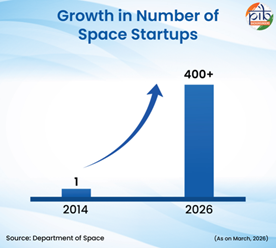
The scale of change is striking. In 2014, India had just one registered space start-up. As on Feb 2026, that number had crossed 400. Investment in Indian space start-ups exceeded $500 million, with nearly $150 million attracted in 2025 alone. Companies such as Pixxel, Dhruva Space, Skyroot Aerospace, Agnikul Cosmos, and Bellatrix Aerospace have emerged as pioneers of a new space era.
Commercialisation: Expanding India's Space Economy
India’s space economy, is currently valued at $8 billion with a share of 2–3% in the global space economy. It is projected to grow five-fold to $40–45 billion over the next decade, with its global share targeted at 8% by 2030. Over the last twelve years, the Government has significantly accelerated the commercialisation of the space sector through major institutional reforms and private sector participation.
NewSpace India Limited (NSIL), established in 2019, and IN-SPACe established in 2022, have created a strong institutional framework for industry participation, technology transfer, and private investment. While NSIL commercialises ISRO's technologies, launch services, and satellite services, IN-SPACe facilitates and authorises private-sector activities through a single-window mechanism.
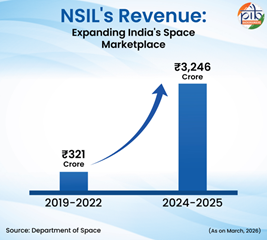
These reforms have delivered measurable outcomes. According to the Economic Survey 2025-26, NSIL revenues increased from ₹321.77 crore in FY 2021-22 to ₹3,246.09 crore in FY 2024-25. As of 31 January 2026, IN-SPACe had facilitated 71 ISRO technology transfers to industry and startups. Six Indian Non-Governmental Entities launched 18 satellites, while 25 payloads were flown or scheduled on POEM (PSLV Orbital Experimental Module) platforms. The approval of an Earth Observation satellite constellation under the PPP model in 2026 and the transfer of SSLV technology to HAL in 2025 further strengthened India's commercial space ecosystem.
Self-Reliant Space Transportation
India has achieved self-reliance in space transportation systems to launch satellites up to 10 tons to Low Earth Orbit (LEO) and 4.2 tons to Geo-Synchronous Transfer Orbit (GTO) through the currently operational PSLV, GSLV and LVM3 launch vehicles. These launch vehicles have enabled independent space access to satellites for earth observation, communication, navigation and space exploration. In order to enhance the launch vehicle capabilities towards meeting the expanded space vision, Government has approved the development of a Next Generation Launch Vehicle (NGLV) which will provide a maximum payload capability of 30 tons to Low Earth Orbit. Towards achieving low-cost access to space, reusable launch vehicle technologies are also being developed including a partially reusable variant of NGLV with 14 tons payload capability to LEO. Another development is of a winged body upper stage which will fly back from the orbit to the Earth and autonomously land on a runway.
|
Did You Know?
India is expanding its Space Launch Infrastructure rapidly
📌 India's second spaceport is coming up at Kulasekarapattinam, Tamil Nadu.
📌The foundation stone for the Small Satellite Launch Vehicle (SSLV) Complex was laid on 28 February 2024 to support 20–25 orbital launches annually, with the first SSLV launch targeted for FY 2026–27.
📌 In January 2025, Third Launch Pad at Sriharikota at a cost of ₹3,984.86 crore approved. The facility will support next-generation launch vehicles, human spaceflight missions, and future lunar exploration.
|
Advances in Propulsion Technologies
ISRO is steadily building the next generation of India’s space transportation technologies. From electric propulsion systems (EPS) that can extend satellite life to advanced cryogenic and semi-cryogenic engines, these breakthroughs will significantly improve mission flexibility, payload performance, and cost efficiency. The first satellite using Electric Propulsion System (EPS) for mission operations is targeted for launch during 2026–27, marking a major step towards more efficient and long-duration space missions.
India has also achieved important breakthroughs in throttling capabilities of the Vikas Engine, a critical step towards reusable rockets with vertical take-off and landing capabilities. The new Bootstrap Ignition Technology for the CE20 cryogenic engine now enables multiple engine restarts during missions, enhancing operational flexibility. Meanwhile, the upgraded upper stage of the Small Satellite Launch Vehicle (SSLV) has reduced stage mass and improved payload capacity by nearly 90 kg, strengthening India’s capability for cost-effective small satellite launches.
Reusable Launch Vehicles (RLV)
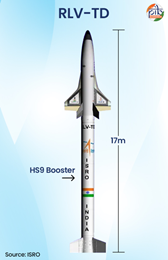
ISRO’s RLV-TD programme marks a major step towards low-cost and reusable space transportation systems. Designed like a futuristic aircraft, the winged vehicle combines the complexity of both launch vehicles and aeroplanes. The programme aims to develop critical technologies for fully reusable launch systems, which can significantly reduce the cost of accessing space. RLV-TD serves as a flying test bed for advanced technologies such as hypersonic flight, autonomous landing, and integrated flight management etc.
India has already achieved significant milestones under the programme. ISRO successfully flight-tested RLV-TD on 23 May 2016 from SDSC SHAR, Sriharikota, validating autonomous navigation, guidance and control systems, reusable thermal protection systems, and re-entry mission management technologies. The programme has since completed three successful autonomous runway landing experiments.
Indigenous Electronics and On-board Systems
ISRO jointly with Semiconductor Laboratory (SCL), Chandigarh developed VIKRAM3201, India’s first fully indigenous 32-bit space microprocessor, along with KALPANA32 for high-reliability space missions. This reduces dependence on foreign components and improves mission safety.
India's growing space capacity reflects the broader story of national transformation over the past 12 years. Continuous investments in technology, infrastructure, and innovation have expanded the country's capabilities and reduced dependence on external systems. Anchored in the spirit of Make in India, these efforts are creating new opportunities for science, industry, and development. They are accelerating India's journey towards Viksit Bharat and strengthening its position as a leading spacefaring nation.
Indian Space Sector Credibility on the Global Stage
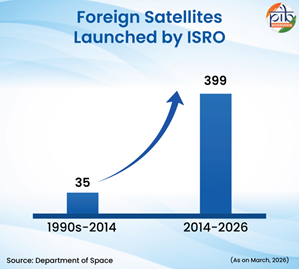
International cooperation has remained a cornerstone of India’s space programme since its inception. Over the last 12 years, India has significantly expanded global space partnerships, strengthening scientific collaboration, technology exchange, and joint mission development. ISRO launched 35 foreign satellites between the 1990s and 2014. After 2014 and as on March 2026, the number increased sharply to 399 foreign satellite launches. Additionally, as of 2026, India has signed more than 300 space cooperation agreements with 61 countries and 5 multilateral organisations. These partnerships cover satellite missions, data sharing, ground stations, scientific research, and capacity building. Key international collaborations and strategic partnerships developed over the last decade are outlined below.
|
Did You Know?
India leads the BIMSTEC Space Programme as part of its “Neighbourhood First” policy. The initiative strengthens regional cooperation through space technology, disaster management, and capacity building. The North Eastern Space Applications Centre (NESAC) conducts specialised training programmes for BIMSTEC countries in space applications and satellite technologies. India has also proposed regional nano-satellites, local ground stations, and shared earth observation data for climate and disaster management. The BIMSTEC Centre for Weather and Climate supports regional forecasting and disaster preparedness. An Expert Group on Space Security Cooperation further strengthens regional resilience and strategic collaboration.
|
India-Russia Partnership: Supporting India's Human Spaceflight Ambitions

India's human spaceflight programme has benefited from a long-standing partnership with Russia. Building on decades of space cooperation, ISRO and ROSCOSMOS signed an MoU in 2018 to support the Gaganyaan mission. Russia has provided astronaut training, technical expertise, and support in critical areas such as life-support systems, crew safety, and human spaceflight technologies. This collaboration has strengthened India's preparedness for its first indigenous crewed mission and reflects growing international confidence in India's expanding space ambitions.
|
Did you know? India's space partnership with Russia dates back to 1975, when the Soviet Union launched India's first satellite, Aryabhata. Russia also enabled India's first human spaceflight milestone when Wing Commander Rakesh Sharma travelled to space aboard Soyuz T-11 in 1984. Today, the partnership extends to Gaganyaan, satellite navigation cooperation through GLONASS and NavIC, and future space exploration initiatives, highlighting the enduring credibility and strategic depth of India-Russia space cooperation.
|
India's growing reputation in space is reflected in its collaboration with leading global space agencies. A major example is the NASA-ISRO Synthetic Aperture Radar (NISAR) mission, jointly developed by ISRO and NASA and launched on 30 July 2025 aboard GSLV-F16 from Sriharikota. NISAR will monitor changes in land, glaciers, forests, and oceans, helping scientists better understand climate change, natural disasters, and environmental challenges. The mission combines the expertise of two of the world's leading space agencies and demonstrates India's ability to undertake complex international projects.
ISRO and the French space agency CNES

India's expanding global partnerships are also reflected in the TRISHNA (Thermal InfraRed Imaging Satellite for High-resolution Natural Resource Assessment) mission, being jointly developed by ISRO and the French space agency CNES. Scheduled for launch in 2026, TRISHNA will provide high-resolution thermal imaging of Earth's land and coastal regions with a revisit frequency unmatched by existing missions. The satellite will help monitor crop water stress, irrigation needs, water resources, urban ecosystems, glaciers, and climate-related changes. Combining a thermal infrared instrument from CNES and an optical sensor from ISRO, the mission demonstrates India's growing credibility as a trusted partner in advanced Earth observation and climate science, while supporting sustainable agriculture and environmental management worldwide.
ISRO and the Japan Aerospace Exploration Agency (JAXA)

India's growing credibility in deep-space exploration is further reflected in the Chandrayaan-5/LUPEX (Lunar Polar Exploration) mission, a landmark collaboration between ISRO and the Japan Aerospace Exploration Agency (JAXA). Scheduled for launch in 2027–28 aboard Japan's H3 rocket, the mission will combine an Indian-developed lander with a Japanese rover to explore the Moon's polar region. Building on the success of Chandrayaan-3 and the planned lunar sample return of Chandrayaan-4, LUPEX will search for lunar water and ice deposits, drill beneath the surface, and conduct advanced in-situ scientific investigations. The mission also includes instruments from NASA and the European Space Agency (ESA), highlighting India's ability to lead complex multinational scientific collaborations and contribute to the next phase of global lunar exploration.
Partnership with the European Space Agency (ESA)

On 7 May 2025, ESA and ISRO signed a Joint Statement of Intent to work together on future human space missions. The partnership focuses on activities in Low Earth Orbit and, in the future, on Moon exploration. Both agencies will collaborate on technologies that allow spacecraft from different countries to work together, as well as on astronaut training and space research. The agreement also opens opportunities for European astronauts to participate in missions related to India's planned Bharatiya Antariksh Station (BAS) and for joint scientific missions to the Moon. Building on their cooperation during the Axiom Ax-4 mission, ESA and ISRO are working to make future space missions more connected, efficient, and collaborative. This partnership highlights the growing international trust in India's space capabilities and its increasing role in shaping the future of human space exploration.
India-Germany Space Cooperation
India has successfully launched 11 German satellites using Indian launch vehicles, highlighting growing international confidence in India's space capabilities. During a high-level meeting on2 June 2026, India and Germany identified new opportunities for collaboration in satellite communications, optical communications, human spaceflight, microgravity research, Earth observation, drone technologies, and future space exploration missions. The discussions built upon the long-standing partnership between ISRO and the German Aerospace Centre (DLR) and focused on advancing joint research, innovation, and technology development in emerging space domains.
Italy-India Joint Strategic Action Plan 2025-2029

India and Italy elevated their space cooperation under the India-Italy Joint Strategic Action Plan announced on 18 November 2024 during the G20 Summit in Rio de Janeiro. The two countries agreed to expand collaboration between the Indian Space Research Organisation (ISRO) and the Italian Space Agency (ASI) in Earth observation, heliophysics, and space exploration, with a particular focus on lunar science. Both sides also committed to advancing research and development for the peaceful and sustainable use of outer space while promoting greater commercial cooperation involving industries, MSMEs, and startups.
ISRO and the Saudi Space Agency

India and Saudi Arabia elevated their space cooperation on 23 April 2025 through an MoU between ISRO and the Saudi Space Agency. The agreement promotes collaboration in satellite development, space science, exploration, research, innovation, and capacity building. It also encourages entrepreneurship and academic engagement in space technologies, reflecting a shared commitment to peaceful and developmental uses of outer space.
ISRO and the Mauritius Research and Innovation Council
India's long-standing space partnership with Mauritius entered a new phase on 1 November 2023. ISRO and the Mauritius Research and Innovation Council (MRIC) signed an MoU to jointly develop a small satellite, with the Union Cabinet taking note on 5 January 2024. The project strengthens satellite development capabilities, supports the use of Mauritius' ground station, and reinforces a partnership dating back to 1986. The satellite is expected to be realised within 15 months at an estimated cost of ₹20 crore, funded by the Government of India.
Regional Partnerships in Space Sector with Bhutan
India's space cooperation has strengthened regional partnerships, particularly with Bhutan. On 19 November 2020, India and Bhutan signed an MoU on Cooperation in the Peaceful Uses of Outer Space, approved by the Union Cabinet on 30 December 2020. The agreement covers Earth observation, satellite communication, satellite navigation, space science, planetary exploration, and developmental applications of space technology. A Joint Working Group was established to implement collaborative projects, supporting governance, resource management, communication, and scientific research through space-based solutions.
Space for Citizens - Applications That Touch Everyday Life
Over the last decade, India's space programme has evolved into a critical national infrastructure supporting governance, development, environmental management, and disaster resilience. Satellite-based data, geospatial technologies, and digital platforms are enabling data-driven decision-making, improving transparency, and enhancing the effectiveness of government programmes across sectors.
NavIC - India's Indigenous Navigation System
NavIC is India's indigenous satellite navigation system. It provides accurate positioning, navigation, and timing services across India and up to 1,500 kilometres beyond its borders. Developed to reduce dependence on foreign navigation systems, NavIC strengthens India's technological self-reliance and strategic capacity. The system operates through a constellation of satellites providing continuous regional coverage. To strengthen the network, the first second-generation satellite, NVS-01, was launched in May 2023, followed by NVS-02 in January 2025. Five second-generation satellites, from NVS-01 to NVS-05, are planned to enhance reliability and ensure uninterrupted services.
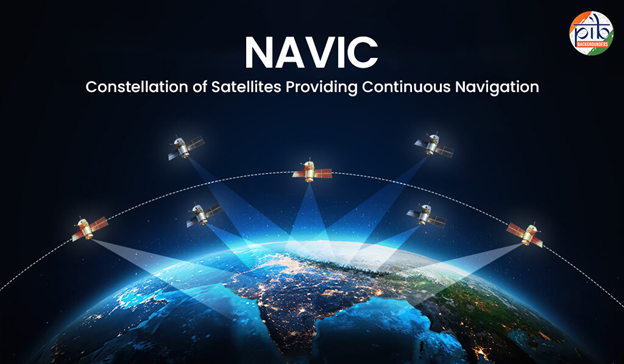
NavIC has become an important part of India's digital and physical infrastructure. It supports power-grid synchronisation, real-time train tracking, vehicle monitoring, Aadhaar device geo-tagging, and public safety alert systems. Its adoption is growing rapidly across logistics, vessel monitoring, geo-fencing, and location-based services. ISRO has also partnered with industry, including Qualcomm, to integrate NavIC into mobile chipsets, expanding its reach to everyday users.
|
Did You know:
In 2025, India signed an agreement with South Africa to establish a NavIC reference station. The initiative will strengthen the performance and reach of India's indigenous satellite navigation system beyond national boundaries. The partnership enhances navigation cooperation and demonstrates growing international confidence in India's space-based positioning and timing capabilities.
|
Data-Driven Governance
Ministry of Agriculture & Farmers Welfare, Ministry of Jal Shakti, Ministry of Rural Development, and State Governments increasingly utilise geospatial information, thematic applications, and digital platforms for governance and public service delivery. Satellite-based data supports improved planning, real-time monitoring, resource management, and efficient implementation of development programmes across sectors.
Food & Water Security
Space technology strengthens food and water security through satellite-based monitoring and forecasting. Crop acreage mapping, production forecasting, drought assessment, and crop yield estimation support agricultural planning and insurance programmes. Hydro-informatics services under the National Hydrology Project and the India Water Resources Information System (India-WRIS) improve water resource planning and management.
Disaster Management & Early Warning
India’s space infrastructure has strengthened disaster preparedness and emergency response. Satellites support monitoring of cyclones, floods, landslides, forest fires, and other natural hazards. The National Database for Emergency Management (NDEM 5.0) provides real-time geospatial information and decision-support tools. The Satellite Aided Search and Rescue (SASAR) programme supports distress alert and emergency response services.
Governance & Rural Development
Geospatial technologies support transparent implementation of major government programmes. These include MGNREGA, PMGSY, PMKSY, AMRUT, green cover monitoring, and the National Addressing System. Satellite-based platforms support evidence-based planning and monitoring from national to village levels.
Supporting Coastal Communities
Potential Fishing Zone (PFZ) advisories help fishermen identify productive fishing areas. These advisories reduce fuel consumption and search time. Indigenous Distress Alert Transmitters (DATs) improve safety by enabling emergency alerts from fishing vessels.
Satellites Based Solution in Health and Education
ISRO provides telemedicine services in remote and high-altitude regions. Telemedicine nodes operate in Jammu & Kashmir, Leh, Ladakh, Siachen, and other strategic areas. Around 179 telemedicine nodes are operational, including nearly 80 in high-altitude regions. These services improve access to specialist healthcare.
Additionally, Satellite communication has also expanded access to quality education across India. Under PM e-VIDYA, 370 educational television channels are delivered through GSAT-15 and GSAT-9 satellites. These services support digital learning, teacher training, and educational outreach in remote regions.
|
Did You Know
South Asia Satellite (GSAT-9) is a 2,230-kg geostationary communication satellite providing coverage over Afghanistan, Bangladesh, Bhutan, Maldives, Nepal and Sri Lanka. It was launched on 5 May 2017 aboard the GSLV-F09 rocket from Sriharikota, as a gift to neighbours in the SAARC region. Built by ISRO and funded entirely by India at a total cost of approximately ₹450 crore, the satellite carries 12 Ku-band transponders, with each participating country receiving access to one transponder. The satellite supports DTH (direct-to-home) broadcasting, telemedicine, tele-education, banking connectivity, weather forecasting and disaster management links across the region. It has a designed mission life of 12 years. Pakistan opted out of the project; as a result, the original name "SAARC Satellite" was changed to "South Asia Satellite."
|
Geoportals and Citizen-Centric Digital Platforms
ISRO operates specialised geoportals providing satellite-derived information for governance and public use. Bhoonidhi, MOSDAC, VEDAS, and Bhuvan support Earth observation, weather services, infrastructure monitoring, flood management, and digital addressing through DIGIPIN integration.
In last decade, space technology has become integral to everyday life in India. Space-based applications now support governance, healthcare, education, disaster management, and livelihoods. These advancements reflect India’s commitment to inclusive development through science and technology. As India advances towards Viksit Bharat, the space programme continues to strengthen public service delivery and improve citizens’ lives.
Towards becoming a Responsible Space Power
Over the last twelve years, India’s space programme has shown how technological advancement can directly support national development. Space technology now supports governance, strengthens economic growth, and improves everyday life. India’s progress has been driven by indigenous innovation, scientific excellence, and public welfare. Simultaneously, India has emerged as a trusted global space partner through international cooperation, commercial launches, and knowledge sharing. The country continues to promote the peaceful and responsible use of outer space. As India advances towards Space Vision 2047, the focus remains on expanding scientific frontiers while creating benefits for society. The journey ahead aims to build a stronger, self-reliant, and globally respected India through space-led innovation and development.
References
Department of Space
Indian Space Research Organisation
Other Government / Official Sources
INDIA'S SPACE ODYSSEY
****
PIB Research
(Explainer ID: 158973)
आगंतुक पटल : 14957
Provide suggestions / comments