Infrastructure
Ashtalakshmi – The North-East at the Heart of India’s Growth Story
Posted On:
20 JUN 2026 8:53AM
|
Over the past twelve years, the North-East has witnessed a remarkable shift in its development landscape. This change has been driven by sustained policy support, infrastructure expansion, and inclusive development initiatives. Improved road, rail, air, and digital connectivity have reduced geographic isolation. They have also strengthened regional integration and economic access. At the same time, major gains in access to water, sanitation, housing, healthcare, and education have improved quality of life. These improvements are visible across both urban and rural communities. The region has also emerged as a key pillar of India’s clean energy transition and Act East vision. This shift has been supported by investments in hydropower, gas infrastructure, and cross-border connectivity. Together, these efforts position Ashtalakshmi as a model of sustainable and inclusive development within Viksit Bharat.
|
The North-East at the Centre of Transformation
Where hills reach up to meet the clouds, and rivers inspire music, art and literature, India’s North East tells a story of possibility. Home to eight distinct states, the region is collectively known as “Ashtalakshmi”. In Indian tradition, Goddess Lakshmi symbolises happiness, health, prosperity and good fortune. She is known to have eight different forms or manifestation, representing different aspects or sources of prosperity. Collectively these are known as Ashtalakshmi. In the same spirit, each of the eight Northeastern states has its own distinctive richness and diversity. Together, they become “Ashtalakshmi”, a vital source of the country’s prosperity and well-being. Assam, Arunachal Pradesh, Manipur, Meghalaya, Mizoram, Nagaland, Tripura, and Sikkim together form this vibrant region. Their strategic location and rich cultural heritage make the North East central to India’s growth story.
Over the last twelve years, a new chapter has unfolded across this landscape. A region that was once defined as distant and remote, is now shaped by access, connectivity, and expanding opportunity. Roads are reaching farther, rail lines are expanding, and airports and waterways are opening new routes. Improved transport infrastructure has brought better access to water, housing, sanitation, energy, healthcare, and education. Agriculture and rural livelihoods have gained momentum through focused support and stronger market linkages. At every step, progress has become inclusive, responsive, and grounded in local realities.
Guided by sustained policy support since 2014, this journey reflects a clear and balanced vision. Development aligns with ecological sensitivity, resource efficiency, and long-term sustainability. Ashtalakshmi today stands at the core of a more connected, capable, and inclusive Viksit Bharat.
Dedicated Policy Push for the Northeast
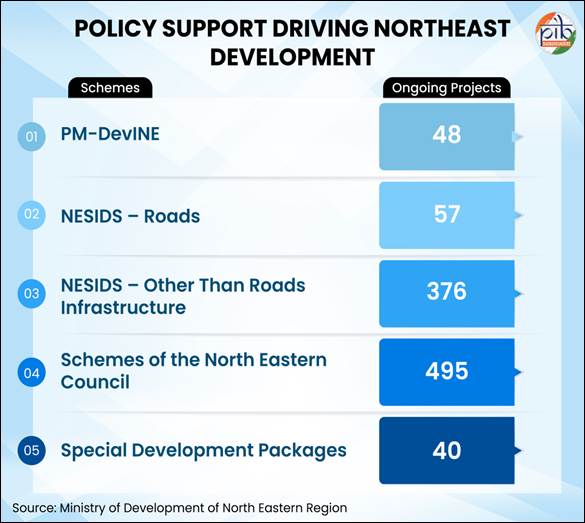
Over the past decade, development in the Northeast has been supported by a targeted policy architecture. This approach combines dedicated schemes and financial support, ensuring that development is both region-specific and outcome-oriented. The Ministry of Development of North Eastern Region (MDoNER) is providing financial assistance to the eight Northeast states. This is being done through five Central Sector Schemes. A total of 3,746 projects have been sanctioned. Out of these, 2,730 projects have been completed at an approved cost of over ₹27,963 crore.
PM-DevINE: Targeted Infrastructure and Social Development
The Prime Minister’s Development Initiative for North East Region (PM-DevINE) represents a major policy intervention aimed at accelerating development through high-impact projects. It is a 100% centrally funded scheme with an outlay of ₹6,600 crore for 2022–23 to 2025–26. 48 projects relating to infrastructure, livelihood, social development and filling developmental gaps are under implementation through the PM-DevINE scheme. 3 projects have already been completed, including a Centre of Excellence and Passenger Ropeway Systems.
NESIDS – Roads
The North East Special Infrastructure Development Scheme (NESIDS) – Roads was launched in 2017–18 and extended until March 2026. The scheme focuses on projects that improve access to remote areas and strengthen market connectivity. It also supports projects with strategic and security importance. Only proposals that create physical assets such as roads, bridges, and supporting infrastructure are eligible for funding. 70 projects have been completed for construction and widening of roads while 57 projects are under implementation through NESIDS – Roads.
NESIDS – Other Than Roads Infrastructure (OTRI)
NESIDS – Other Than Roads Infrastructure (OTRI) is a key component of the NESIDS Central Sector Scheme. The scheme provides financial assistance to all eight Northeastern states for infrastructure development. 1,234 projects have been completed among various sectors. These include primary and secondary healthcare, education, power, water supply, roads and bridges, etc. 376 projects are under implementation through NESIDS – Other Than Roads Infrastructure.
Schemes of the North Eastern Council (NEC)
The North Eastern Council is the nodal agency for the economic and social development of the North Eastern Region. The schemes under NEC aim to support holistic development. Project selection is done in coordination with the respective State Governments. Implementation is undertaken by designated state or central agencies. 495 projects are under implementation across the schemes of the NEC. The NEC focuses on areas of regional importance, including livelihoods such as bamboo and piggery, tourism development, higher education and healthcare, etc. 1,344 projects across irrigation and flood control, science, and technology sectors have been completed among many others.
Special Development Packages (SDPs) for Assam and Tripura
The Special Development Packages (SDPs) for Assam and Tripura aim to promote inclusive development and sustain peace in the region. The focus is on generating employment through infrastructure and livelihood projects. Youth and women will benefit through skill development and entrepreneurship initiatives. There are 40 ongoing projects under this. These projects bring marginalized communities into the mainstream and strengthen social inclusion, along with boosting tourism and local economic activity. Among the completed works are 79 projects such as Integrated Skill Development Centres, RCC bridges, and roads.
Act East Policy & Strategic Integration
The Act East Policy has been a key pillar of India’s external engagement since 2014. The policy places the Northeast at the centre of India’s engagement with Southeast Asia. It recognises its strategic location and economic potential. Over the past decade, the policy has focused on connectivity, trade, cultural linkages, and border infrastructure. It is transforming the region into a bridge between India and Association of Southeast Asian Nations (ASEAN). This shift marks a transition from viewing Northeast as a frontier region to the gateway for regional integration and growth.
Strengthening Cross-Border Connectivity
A central focus of the Act East Policy has been the development of cross-border connectivity infrastructure. This links the Northeast with neighbouring countries. The India–Myanmar–Thailand Trilateral Highway is a flagship project under this framework. It aims to connect Moreh in Manipur to Mae Sot in Thailand via Myanmar. The project is steadily advancing the development of a vital land corridor for cross-border trade and movement.
The Kaladan Multi-Modal Transit Transport Project is another major initiative. It aims to enhance connectivity between the Northeast and Myanmar. The project connects Sittwe port in Myanmar to Paletwa through an inland waterway. This reduces transportation time and costs, delivering significant benefits to Tripura. Once fully operational, the project will facilitate the movement of key commodities, including exports such as rice, timber, seafood, petroleum products, and textiles. It will also enable imports of construction materials.
Enhancing Trade and Economic Integration
The Act East Policy has strengthened trade linkages between the Northeast and Southeast Asia. Border trade points and infrastructure are being developed to facilitate smoother movement of goods. The development of Integrated Check Posts (ICPs) at locations such as Moreh has improved customs, immigration, and cargo handling facilities. The policy also supports the development of Border Haats, which promote local trade and livelihoods in border communities. These markets strengthen people-to-people ties and support micro-level economic activity. Some of these include the border haats at Kamalasagar in Tripura, Bholaganj in Meghalaya, etc.
Connectivity Revolution: Bridging Geography, Enabling Growth
Connectivity has been one of the most critical enablers of transformation in the Northeast. For decades, the region’s economic potential remained constrained by difficult terrain, limited infrastructure, and high logistics costs. Since 2014, a coordinated push across transport modes has aimed to overcome these structural barriers.
Road Infrastructure: From Last-Mile Access to Economic Corridors
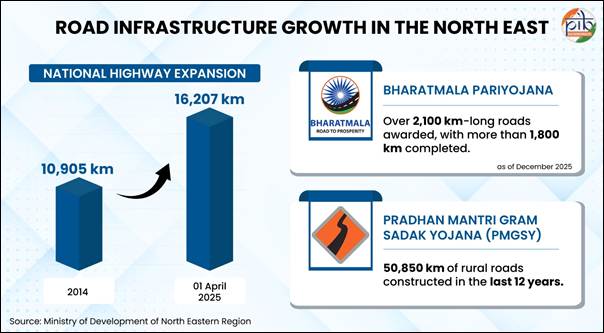
Road connectivity forms the backbone of mobility in the Northeast. The expansion of the National Highways network reflects this shift. The total length has increased from 10,905 km in 2014 to 16,207 km as of 01 April 2025. This expansion has improved interstate connectivity and reduced travel time between key economic centres.
- A major driver of this transformation is the Bharatmala Pariyojana, a centrally sponsored programme focused on corridor-based highway development. Unlike earlier approaches, Bharatmala prioritises economic corridors, border roads, and connectivity to ports and trade routes. In the Northeast, over 2,100 km-long roads have been awarded, with more than 1,800 km completed as of December 2025.
- At the grassroots level, the Pradhan Mantri Gram Sadak Yojana (PMGSY) has transformed rural access. The scheme provides all-weather roads to unconnected habitations. In the Northeast, 50,850 km of rural roads have been constructed under PMGSY in the last 12 years. These roads have significantly improved access to education, healthcare, and markets, particularly for remote communities.
Rail Connectivity: Integrating the Region with the National Grid
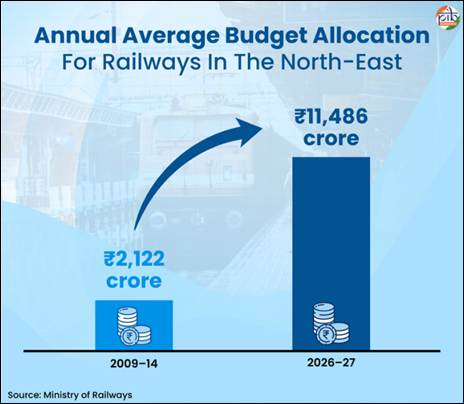
Railways have emerged as a transformative mode of connectivity in the Northeast. Historically limited to parts of Assam, the network is now expanding into hill states through some of the most complex engineering projects in India. The annual average budget allocation for railways has increased sharply, rising from ₹2,122 crore during 2009–14 to ₹11,486 crore in 2026–27. This reflects sustained focus on expanding and modernising rail infrastructure in the Northeast.
The scale of expansion is evident in track commissioning. It increased from 333 km during 2009–14 to over 1,900 km during 2014–26. This reflects a sustained effort to extend rail connectivity into previously inaccessible regions. Many Northeastern states were first connected to the Broad Gauge Network in the last ten years. Rail electrification has also made significant progress in recent years. Arunachal Pradesh, Meghalaya, Nagaland, Tripura, and Mizoram have achieved 100% electrification of railway tracks, while Assam is nearing completion of full electrification. This expansion is improving operational efficiency and reducing dependence on diesel traction across the region.
Service modernisation has also progressed alongside network expansion. The Vande Bharat Express between Guwahati and New Jalpaiguri marks the entry of semi-high-speed, energy-efficient trains in the region. The rollout of Amrit Bharat Express trains is improving affordable long-distance connectivity for passengers. Station infrastructure is being upgraded under the Amrit Bharat Station Scheme, with around 60 stations in the Northeast identified for redevelopment. This includes 50 stations in Assam, 4 in Tripura, among others. These upgrades focus on passenger amenities, accessibility, and integration with other transport modes.
Bridges and Tunnels: Engineering Connectivity Across Natural Barriers
The Northeast’s geography is defined by major river systems and mountainous terrain. The past decade has seen a decisive shift towards permanent, high-capacity engineering solutions in the form of bridges and tunnels. Some of these include:
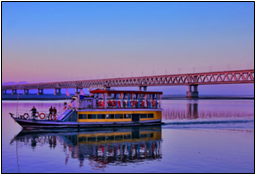
Bogibeel Bridge: The Bogibeel Bridge, inaugurated in 2018, is a combined road and rail bridge across the Brahmaputra River. It connects the Dibrugarh and Dhemaji districts of Assam, enabling faster and more reliable access. The city is an important centre for healthcare, education, and commerce. This is especially beneficial for communities located north of the Brahmaputra. In addition to transport, the Bogibeel Bridge and the adjoining Bogibeel Ghat support river tourism activities. These include river cruises and houseboat experiences.
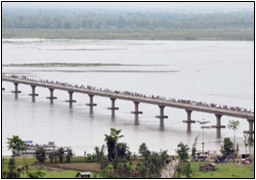
Dhola–Sadiya Bridge: The Dhola–Sadiya Bridge, also known as the Bhupen Hazarika Setu was inaugurated in 2017. It provides the first permanent road connection between northern Assam and eastern Arunachal Pradesh. Built as a beam bridge, it spans the Lohit River, a major tributary of the Brahmaputra. It connects Dhola in Tinsukia district to Sadiya in the north. The bridge stretches 9.15 kilometres and is designed to carry 60-tonne military tanks. These include the Indian Army’s Arjun and T-72 models.
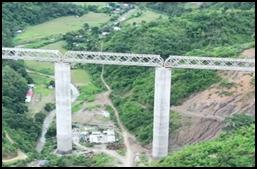
Noney Bridge: The Noney Bridge in Manipur, part of the 111-km Jiribam–Imphal railway project, will transform connectivity in remote northeastern regions. Constructed across the Aling River, the bridge stands 141 metres tall, making it the world’s tallest railway pier bridge. It will surpass Montenegro’s Mala-Rijeka viaduct, which currently holds the record at 139 metres. Stretching 703 metres in length, the bridge is being built using advanced hydraulic auger technology for its massive piers. The ambitious railway project is being developed at an estimated cost of Rs 374 crore.
Sela Tunnel: The Sela Tunnel was dedicated to the nation during the Viksit Bharat Viksit North East programme in Itanagar, Arunachal Pradesh in March 2024. It has been constructed by the Border Roads Organisation (BRO) at an altitude of 13,000 feet on the Tezpur–Tawang route. The tunnel has been built at a cost of ₹825 crore. It ensures all-weather connectivity in a strategically important border region. The project holds significant strategic value for the Armed Forces while supporting socio-economic development in the region. Built using the New Austrian Tunneling Method, it reflects that sustained engineering effort can transform remote mountain communities.
Beyond these flagship projects, multiple bridges have strengthened intra-regional connectivity. Since 2014, more than 500 rail flyovers and under-bridges have been constructed. This has improved safety at crossings and ensured smoother movement of both rail and road traffic. These projects represent a shift towards efficient, reliable, and climate-resilient infrastructure.
Air Connectivity: Expanding Reach in a Difficult Terrain
Air connectivity plays a critical role in the Northeast due to its terrain and dispersed settlements. The UDAN (Ude Desh ka Aam Nagrik) scheme has been instrumental in expanding regional aviation. The scheme aims to make air travel affordable and connect underserved and unserved airports. The North East has witnessed the development of 8 new airports like Pakyong, Jorhat, Tezu, etc. Along with this, around 90 regional routes have been operationalized. These routes connect smaller towns with regional hubs and major cities.
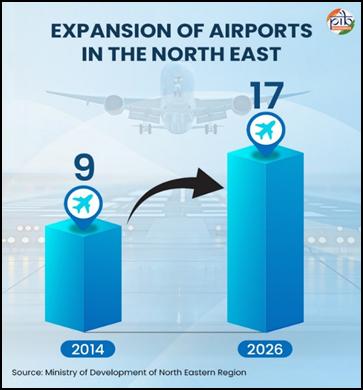
The number of airports in the North East has increased from 9 in 2014 to 17 in 2026, reflecting a 78% rise. Air connectivity has significantly reduced travel time. Journeys that earlier took several hours or days by road can now be completed within hours. This is critical for medical emergencies, disaster response, and administrative access. The expansion of regional aviation has also supported tourism growth. Improved accessibility to eco-sensitive destinations has created livelihood opportunities while maintaining environmental balance.
Inland Waterways: Reviving Rivers for Sustainable Transport
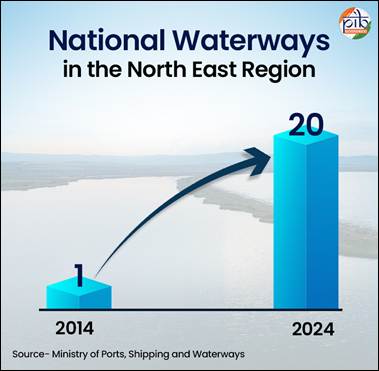
The Northeast has a natural advantage with rivers forming extensive navigable transport networks. Brahmaputra, identified as National Waterway-2, serves as the region’s primary inland transport corridor. It connects key locations in Assam and links the Northeast with mainland India through the Indo-Bangladesh Protocol route. This is an inland water transit network that enables cargo movement between India and Bangladesh through designated river routes. River-cruise tourism is also being promoted through dedicated terminals at Guwahati, Neamati, Biswanath Ghat, Silghat, and Guijan. At the same time, National Waterway-16 on the Barak River is also being developed. Key projects include terminal upgrades at Badarpur and Karimganj, fairway development, navigational aids, and amphibian dredgers. Reflecting this growing focus, the number of National Waterways in the Northeast increased from 1 in 2014 to 20 in 2024.
Digital Connectivity: Enabling the Next Phase
Connectivity in the Northeast is now expanding beyond physical infrastructure. Multiple government-funded projects, including BharatNet and those supported by Digital Bharat Nidhi, have enhanced digital connectivity in the Northeast. As of December 2025, 6,355 Gram Panchayats have been made service-ready for high-speed internet services. During the same period, 3,718 mobile towers have been commissioned, covering 5,366 villages and locations across the region. The region has transitioned from limited access to integrated infrastructure. Investments across transport modes have reduced isolation and improved economic opportunities. The region is now better connected, more accessible, and positioned for long-term growth and regional integration.
Energy Security & Green Growth
Energy development in the Northeast is shifting toward cleaner and more resilient systems. The region’s natural resources support this energy transition. Targeted public investment is helping move from energy deficits to a secure and sustainable framework. These initiatives ensure both grid-connected and remote areas receive reliable energy benefits. The focus remains on reducing carbon intensity while improving affordability.
Hydropower Development: Scaling Renewable Capacity with Stability
Hydropower plays a central role in the Northeast’s energy strategy. The region accounts for a substantial share of India’s hydropower potential. Development activities have gained momentum in recent years. Several projects have been initiated across the region.
- In March 2024, the foundation stone of 2,880 MW Dibang Multipurpose Hydropower Project was laid in Itanagar, Arunachal Pradesh. It is designed to generate electricity while supporting effective flood control. This will create the tallest dam structure in the country. The project will generate about 11,223 million units of hydropower annually, ensuring a reliable supply of clean and green energy.
- The 2,000 MW Subansiri Lower Hydroelectric Project is located on the Assam–Arunachal Pradesh border. It is designed as India’s largest run-of-the-river hydropower project with 8 units being commissioned in phases. It will generate about 7,422 million units of renewable electricity annually.
- Small hydropower projects are also expanding in Northeast India due to its vast untapped potential. The Government has approved the Small Hydro Power Development Scheme for FY 2026-27 to FY 2030-31 with an outlay of ₹2,584.60 crore. The scheme aims to add around 1,500 MW of new capacity across the region.
North East Gas Grid: Expanding Clean Energy Access and Regional Integration
The North East Gas Grid represents a major step in strengthening clean energy infrastructure across the region. The project commenced in 2020 and is currently under implementation. Designed as an integrated pipeline network, it aims to connect all eight Northeastern states and link them with the national gas grid. The project envisages a pipeline network of around 1,656 km, creating a unified system for gas transportation across difficult terrain.
A major milestone has been achieved in the project. This includes the construction of a 24-inch diameter natural gas pipeline under the Brahmaputra River using the Horizontal Directional Drilling (HDD) method. This sets a record as the longest hydrocarbon pipeline river crossing in Asia and the second-longest in the world. Advanced engineering techniques have enabled the project to achieve this while overcoming geographical challenges.
Solar and Decentralised Energy in Northeast India
Solar and decentralised energy systems are emerging as a key pillar of Northeast India’s evolving energy landscape. The region is receiving focused policy support from the Ministry of New and Renewable Energy. This includes an earmarked 10% share of its annual scheme budget. A 20 MW solar park has been commissioned in Champhai district of Mizoram, marking steady progress in grid-connected solar development. Rooftop solar is promoted under schemes like PM Surya Ghar to expand household-level adoption. Off-grid solar solutions are also encouraged to improve electricity access in remote and difficult terrains.
Decentralised renewable systems, including solar pumps under PM-KUSUM, are being deployed to support agriculture and rural livelihoods. Mini-grids and standalone systems are helping reduce dependence on diesel-based power generation. A 25 MW green hydrogen plant is being developed in Assam, indicating early movement towards emerging clean energy technologies. Skill development initiatives have trained over 2,000 individuals under various programmes such as Suryamitra, Varunmitra and Jal Urjamitra.
Water Sanitation and Urban Transformation
Over the last 12 years, the North East has seen major improvements in basic services and urban infrastructure. These changes have strengthened public health and improved the overall quality of life. Initiatives such as Jal Jeevan Mission, Swachh Bharat Mission, and PMAY have expanded rural tap water coverage, improved sanitation, waste management, and housing access. At the same time, investments in healthcare and education infrastructure have made communities more resilient and inclusive.
Jal Jeevan Mission (JJM): Water at the Doorstep
JJM, launched in August 2019, targeted a functional household tap connection (FHTC) for every rural home. Across the eight Northeastern states, Arunachal Pradesh and Mizoram have achieved 100% coverage.
Jal Jeevan Mission: Tap Water Coverage in North East India (As on 17 June 2026)
|
States
|
Coverage (%)
|
|
Arunachal Pradesh
|
100%
|
|
Assam
|
81.80%
|
|
Manipur
|
79.63%
|
|
Meghalaya
|
83.95%
|
|
Mizoram
|
100%
|
|
Nagaland
|
95.08%
|
|
Sikkim
|
92.09%
|
|
Tripura
|
86.41%
|
| |
|
|
JJM 2.0 has been approved in March 2026. The mission has been extended to December 2028, with an enhanced outlay of ₹8.69 lakh crore. It is not just an extension of the earlier mission. It is a shift from building infrastructure to ensuring reliable, sustainable water service delivery for every rural household.
Clean Villages, Healthier Lives: Swachh Bharat Mission
Limited access to sanitation once affected daily life across rural Northeast India. Swachh Bharat Mission (Gramin), launched in October 2014, set out to make India Open Defecation Free (ODF). All eight Northeastern states have been declared ODF. Approximately 57 lakh Individual Household Latrines (IHHLs) were constructed across the region between 2014 and 2026.
Swachh Bharat Mission(G) Phase II (2020 onwards) shifts focus from building toilets to sustaining usage and managing waste. The new targets include ODF Plus villages with solid and liquid waste management, plastic waste management, and faecal sludge treatment. Top performing states include Sikkim and Tripura, achieving 100% ODF Plus villages. Mizoram and Sikkim have led in waste segregation at source. Women Self-Help Groups in Tripura and Assam now manage waste collection at the village level, earning through user fees and the sale of compostable waste.
Infrastructure for People: Health and Education
Healthcare Infrastructure
Investment in health infrastructure has scaled significantly over the past twelve years. Pradhan Mantri Swasthya Suraksha Yojana (PMSSY) has strengthened healthcare infrastructure across the North East over the last decade. All India Institute of Medical Sciences (AIIMS) Guwahati, now fully functional, serves as the region’s major tertiary healthcare institution. 12 medical colleges have been approved under the Centrally Sponsored Scheme for new medical colleges in the region. Under Ayushman Bharat PM-JAY, more than 2.43 crore Ayushman cards have been created in the region (April 2026), supporting over 46 lakh hospital admissions across more than 900 empanelled hospitals. Over 8,200 Health and Wellness Centres provide primary healthcare, diagnostics, and maternal care. eSanjeevani telemedicine is active in all eight states, connecting remote villages to doctors via mobile-based video consultations. A total of 388 Jan Aushadhi Kendras provide affordable medicines and reduce out-of-pocket expenditure.
Education Infrastructure
School and higher education infrastructure has expanded steadily across the North East under Samagra Shiksha and other national initiatives. The region now has 96,496 schools in the Primary and Higher Secondary education sector, 79 universities, 1,001 colleges, 224 standalone higher and technical education institutions, 11 Central Universities and 110 Industrial Training Institutes (ITIs). Nearly 48 Eklavya Model Residential Schools have expanded across remote and tribal districts as of 2026 along with many Kendriya Vidyalayas and Navodaya Vidyalayas. Indian Institute of Technology Guwahati, NIT Sikkim, and NIT Nagaland support regional innovation and skilled workforce development. Student enrolment in higher education increased from 9.36 lakh (2014-15) to 12.02 lakh (2021-22). Under the National Apprenticeship Promotion Scheme, 47,116 apprentices were engaged and 33,849 completed training by March 2026. A total of 622 Atal Tinkering Labs have been established across schools in the region, promoting innovation and scientific learning.
A Roof Over Every Head: Housing for the North East
Pradhan Mantri Awas Yojana (Gramin), launched in 2016, provides financial assistance to eligible rural families for constructing pucca houses. Hilly states in the North East receive a higher unit cost. As of March 2026, over 28 lakh houses have been completed under PMAY-Gramin across the eight North Eastern states. Beneficiaries receive a toilet under Swachh Bharat Mission (SBM), a tap connection under Jal Jeevan Mission (JJM), an LPG connection under Ujjwala Yojana, and electricity under Saubhagya. 100% household electrification has been achieved across all eight Northeastern states under the Saubhagya Scheme, ensuring electricity reaches every home.
In urban areas, PMAY-Urban has provided 3.24 lakh houses to Economically Weaker Sections (EWS) and Low-Income Groups (LIG). The Beneficiary-Led Construction (BLC) component enables families to receive direct financial assistance to build or upgrade their own homes. This suits the North East's diverse construction traditions and local preferences for house design and materials. Under PMAY-Urban 2.0, launched in 2024, additional urban households in NE towns are being covered.
|
State Name
|
PMAY-Gramin (As on 03.02.2026)
|
PMAY-Urban (As on 02.02.2026)
|
|
Target Allocated
|
Houses Completed
|
Houses Sanctioned
|
Houses Completed
|
|
Arunachal Pradesh
|
35,937
|
35,591
|
13,346
|
8,471
|
|
Assam
|
29,87,868
|
21,22,269
|
1,87,028
|
1,44,107
|
|
Manipur
|
1,08,550
|
56,724
|
56,047
|
22,466
|
|
Meghalaya
|
1,88,034
|
1,55,930
|
7,072
|
2,841
|
|
Mizoram
|
29,967
|
25,303
|
39,616
|
33,946
|
|
Nagaland
|
48,830
|
36,298
|
31,067
|
30,147
|
|
Sikkim
|
1,399
|
1,393
|
299
|
219
|
|
Tripura
|
3,76,913
|
3,73,794
|
90,315
|
81,921
|
|
Total (NE)
|
37,77,498
|
28,07,302
|
4,24,790
|
3,24,118
|
Agriculture and Allied Sector of NER
Agriculture and allied activities play a vital role in the economy of the North Eastern Region (NER) of India. The region possesses rich agro-climatic diversity, abundant natural resources, high rainfall, and significant biodiversity. This created strong potential for diversified, sustainable agricultural development. Horticulture, fisheries, animal husbandry, organic farming, bamboo cultivation, and forest-based livelihoods form important components of the rural economy across the northeastern states.
Fisheries-Led Rural Growth
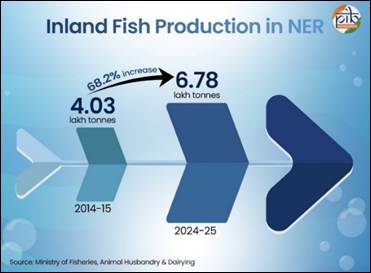
Inland fish production in the North-Eastern Region (NER) increased from 4.03 lakh tonnes in 2014-15 to 6.78 lakh tonnes in 2024-25. It reflects a growth of over 68%. Assam remained the largest contributor, accounting for over 70% of the region’s total inland fish production. During the same period, Assam’s inland fish output increased substantially from 2.83 lakh tonnes to 5.29 lakh tonnes.
To strengthen fisheries development and improve fisher livelihoods, the Department of Fisheries has undertaken several initiatives, such as:
- sanctioned 3,823 Kisan Credit Cards for fishers.
- approved 70 recreational fisheries units under Pradhan Mantri Matsya Sampada Yojana (PMMSY).
- approved 501 Fish Farmers Producer Organizations (FFPOs) at a total project cost of ₹122.40 crore.
- approved 644 Ornamental Fisheries Units under Pradhan Mantri Matsya Sampada Yojana to promote diversification and income generation within the fisheries sector.
Transforming Dairy and Livestock System
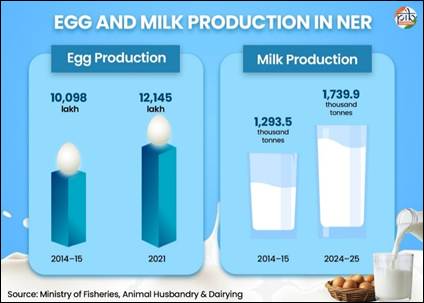
The first In Vitro Fertilization (IVF) Laboratory in the NER was established in Guwahati, Assam, under the Rashtriya Gokul Mission with an investment of ₹28.93 crore. Inaugurated in October 2025, the facility is expected to strengthen dairy development and improve cattle genetics across the northeastern States. The livestock and dairy sector in the region have also recorded steady growth. The total egg production in the NER increased from 10,098 lakh in 2014-15 to 12,145 lakh in 2021. Similarly, milk production rose from 1,293.5 thousand tonnes in 2014-15 to 1,739.9 thousand tonnes in 2024-25. This signifies the sustained expansion in dairy production and allied livestock activities.
Agarwood Economy and Export Expansion
As of January 2026, India hosts nearly 150 million agarwood trees, with about 90% located in the North-Eastern states. The cultivation of agarwood is integrated into plantation and agroforestry programmes. The agarwood market in Tripura alone is estimated to have an annual turnover potential of around Rs.2,000 crore. The export quota for agarwood chips increased more than sixfold, rising from 25,000 kg to 1.51 lakh kg. Similarly, the export quota for agarwood oil increased from 1,050 kg to 7,050 kg in January 2025.
Government-Led Agricultural Transformation
The Government has implemented multiple targeted schemes and infrastructure initiatives to strengthen agriculture and allied sectors in the North-Eastern Region. These interventions focus on improving farmer welfare, enhancing productivity, promoting sustainability, strengthening market access, and expanding rural livelihoods.
National Mission on Edible Oils (NMEO)
Under the National Mission on Edible Oils (NMEO), budgetary sanctions across the eight northeastern states increased substantially. It increased from approximately ₹170 crore in FY 2021–22 to nearly ₹475 crore in FY 2024–25. This reflects the growing policy emphasis on enhancing oilseed production and reducing import dependence through region-specific agricultural development.
Pradhan Mantri Kisan Samman Nidhi (PM-KISAN)
The Pradhan Mantri Kisan Samman Nidhi has emerged as a major income-support initiative for farmers in the NER. As of May 2026, a total of 26.98 lakh beneficiaries were registered under the scheme across the region. Women farmers recorded significant participation under this scheme during the 19th instalment released in February 2025. Out of the total registered beneficiaries, more than 10.08 lakh women beneficiaries received support under the 19th instalment. Assam reported the highest number of women beneficiaries in the country, indicating the expanding inclusion of women in formal agricultural support systems.
|
State
|
Eligible Beneficiaries (as of May 2026)
|
Women Beneficiaries under 19th Instalment (Feb 2025)
|
|
Arunachal Pradesh
|
84,298
|
50,154
|
|
Assam
|
18,59,652
|
5,03,528
|
|
Manipur
|
1,10,867
|
98,797
|
|
Meghalaya
|
1,80,183
|
1,34,372
|
|
Mizoram
|
1,22,463
|
55,396
|
|
Nagaland
|
1,88,721
|
1,03,313
|
|
Sikkim
|
35,796
|
8,300
|
|
Tripura
|
2,16,695
|
54,793
|
|
Total
|
26,98,675
|
10,08,653
|
Pradhan Mantri Kisan Urja Suraksha evam Utthaan Mahabhiyaan (PM-KUSUM)
The PM-KUSUM scheme has contributed towards promoting renewable energy-based agricultural infrastructure in the region. As of December 2025, a total of ₹58.2 crore had been released for northeastern states. Tripura accounted for the highest share of funds released under the scheme.
|
State
|
Fund Released (₹ crore)
|
|
Arunachal Pradesh
|
4.84
|
|
Assam
|
1.41
|
|
Manipur
|
1.71
|
|
Meghalaya
|
0.59
|
|
Mizoram
|
2.57
|
|
Nagaland
|
1.04
|
|
Tripura
|
46.04
|
|
Total
|
58.20
|
Pradhan Mantri Fasal Bima Yojana (PMFBY)
The Pradhan Mantri Fasal Bima Yojana (PMFBY) has strengthened risk mitigation and crop insurance coverage in the region. During the combined Kharif and Rabi seasons of 2025, the scheme covered more than 11.44 lakh beneficiaries across the NER. As of December 2025, over 78 lakh farmers’ applications from the region have been insured. This indicates expanding outreach and greater adoption of crop insurance mechanisms.
Mission Organic Value Chain Development for North East (MOVCD-NER)
The Mission Organic Value Chain Development for North-East has played a significant role in promoting organic farming and value-chain integration. As of May 2026, around 2.36 lakh hectares had been brought under the scheme, benefitting nearly 2.70 lakh farmers. A total financial release of ₹1,492 crore has supported the formation of 479 Farmer-Producer Organizations (FPOs), strengthening collective marketing, processing, and market linkages.
Krishi UDAN scheme
The Krishi UDAN scheme has improved air-based logistics and market connectivity for perishable agricultural produce from the region. Out of 58 nationally linked airports under the scheme, 25 cater to the NER. Additionally, two airports in the region have been equipped with cold storage facilities, supporting efficient transportation and reducing post-harvest losses.
Van Dhan Vikas Yojana
The Van Dhan Vikas Yojana has supported forest-based livelihoods and tribal entrepreneurship in the north-eastern region. As of May 2026, the scheme had benefited approximately 3.3 lakh gatherers and supported 19,155 Self-Help Groups (SHGs).
Innovation, GI Tagging, and Agricultural Entrepreneurship in NER
As of March 2026, the NER accounted for 89 Geographical Indication (GI)-registered products. Additionally, 150 products have been identified for GI tagging over the next two years. The region is known for several GI-tagged fruits and spices, including Queen Pineapple, Lakadong Turmeric, King Chilli, and Large Cardamom. This reflects the region’s rich agro-biodiversity and niche agricultural potential. Since 2014, the North Eastern Regional Agricultural Marketing Corporation (NERAMAC) has facilitated the registration of Geographical Indication (GI) tags for 13 agri-horticultural products from the region.
The range of processed agri-products marketed by NERAMAC expanded from 38 to more than 75 products by 2021. This indicates diversification and value addition within the sector. By December 2024, NERAMAC had supported 220 Farmer-Producer Organisations (FPOs), covering more than 37,000 farmers across the NER. During FY 2024–25, NERAMAC marketed over 600 metric tonnes of agri-horticultural produce from the region. In addition, NERAMAC trained 14,675 candidates under Pradhan Mantri Kaushal Vikas Yojana 4.0 (PMKVY 4.0). Furthermore, established three solar-powered cold storage facilities to strengthen post-harvest infrastructure and market connectivity.
In 2025, the North Eastern Council sanctioned 25 bamboo-sector projects worth ₹236.53 crore under various regional development schemes. These initiatives support bamboo-based livelihoods, value addition, and industrial growth across the Northeast. Mobile-based agro-advisory services also provided technology-enabled farming support to 35,509 farmers across 2,027 villages in six northeastern states. In addition, six Natural Farming Units were established across constituent colleges in Manipur under the Central Agricultural University.
Together, these initiatives are strengthening rural livelihoods, encouraging sustainable agricultural practices, and supporting inclusive development across the region.
Towards a Stronger and Connected North East
Twelve years of focused effort have reshaped the development landscape of the North East. Improvements in connectivity, energy, basic services, and livelihoods have worked together to create a stronger and more integrated region. Policy support and sustained investment have ensured that progress is consistent and visible across sectors. At the same time, this growth has been anchored in balance. Development has moved alongside ecological considerations and respect for local communities. This has helped build outcomes that are not only impactful, but also sustainable over the long term. As the region strengthens its links within India and with neighbouring countries, it is opening new avenues for trade, mobility, and cooperation. The North East is steadily positioning itself as a gateway for opportunity and engagement. Ashtalakshmi today reflects a region that is more connected, more resilient, and better prepared for the future. Its continued progress will remain important to building a balanced, inclusive, and forward-looking Viksit Bharat.
Prime Minister's Office
https://www.pib.gov.in/PressReleaseIframePage.aspx?PRID=2081659®=3&lang=2
https://www.pib.gov.in/PressReleaseIframePage.aspx?PRID=1927894®=3&lang=2
https://www.pib.gov.in/PressReleaseIframePage.aspx?PRID=1557286®=3&lang=2
https://www.pib.gov.in/PressReleasePage.aspx?PRID=1919772®=3&lang=2
Ministry of Development of North Eastern Region
https://www.pib.gov.in/PressReleasePage.aspx?PRID=2238832®=3&lang=1
https://www.pib.gov.in/PressReleasePage.aspx?PRID=2226314®=3&lang=2
https://www.pib.gov.in/PressReleasePage.aspx?PRID=2247696®=3&lang=2
https://www.pib.gov.in/PressReleasePage.aspx?PRID=2209534®=3&lang=2
https://risingnortheast.in/wp-content/uploads/2023/05/Sector-Profile_Agri_Low-Res.pdf
https://risingnortheast.in/wp-content/uploads/2025/05/Edu.pdf
https://nesetu.mdoner.gov.in/projects/project-list?scheme=pmdevine&status=Completed
https://nesetu.mdoner.gov.in/projects/project-list?scheme=NesidsR&status=Completed
https://nesetu.mdoner.gov.in/projects/project-list?scheme=NesidsO&status=Completed
https://nesetu.mdoner.gov.in/projects/project-list?scheme=schemesofnec&status=Completed
https://nesetu.mdoner.gov.in/projects/project-list?scheme=specialpackage&status=Completed
Ministry of Railways
https://www.pib.gov.in/PressReleasePage.aspx?PRID=2222767®=3&lang=2
Ministry of Ports, Shipping and Waterways
https://www.pib.gov.in/PressReleseDetailm.aspx?PRID=1795821®=3&lang=2
https://www.pib.gov.in/PressReleasePage.aspx?PRID=2142948®=3&lang=2
https://www.pib.gov.in/PressReleasePage.aspx?PRID=2205166®=3&lang=1
https://iwai.nic.in/sites/default/files/indo-inward-outward/2464640048sam_Part1-61841935_1.pdf
https://shipmin.gov.in/sites/default/files/IWT%202022%2023%20APPROVED.pdf
Ministry of Road Transport & Highways
https://www.pib.gov.in/newsite/PrintRelease.aspx?relid=162117®=3&lang=2
Ministry of Power
https://www.pib.gov.in/PressReleseDetailm.aspx?PRID=2013022®=3&lang=2
https://www.pib.gov.in/PressReleseDetailm.aspx?PRID=2207797®=3&lang=1
Ministry of New and Renewable Energy
https://www.pib.gov.in/PressReleasePage.aspx?PRID=2130793®=3&lang=2
Ministry of Jal Shakti
https://sansad.in/getFile/annex/260/AU2007.pdf?source=pqars
https://www.pib.gov.in/PressReleasePage.aspx?PRID=1630399®=3&lang=2
https://ejalshakti.gov.in/jjmreport/jjmindia.aspx
https://www.pib.gov.in/PressReleaseIframePage.aspx?PRID=1959918®=3&lang=2
https://www.pib.gov.in/PressReleasePage.aspx?PRID=2226996®=3&lang=2
Ministry of Rural Development
https://sansad.in/getFile/loksabhaquestions/annex/187/AU473_bCgMMw.pdf?source=pqals
Cabinet Committee on Economic Affairs (CCEA)
https://www.pib.gov.in/Pressreleaseshare.aspx?PRID=1598709®=3&lang=2
Ministry of External Affairs
https://www.mea.gov.in/rajya-sabha.htm?dtl/30799/QUESTION+NO1127+STATUS+OF+TRILATERAL+HIGHWAY+PROJECT
https://www.pib.gov.in/newsite/printrelease.aspx?relid=133837®=3&lang=2
Ministry of Agriculture and Farmers Welfare
https://pmfby.gov.in/adminStatistics/dashboard
https://agriwelfare.gov.in/Documents/AR_Eng_2024_25.pdf
https://www.icfa.org.in/assets/img/souvenirs/ner-untapped-potential.pdf
https://www.manage.gov.in/publications/eBooks/Agri-Allied%20Sector%20Entrepreneurship%20Opportunities%20in%20North%20East.pdf
Ministry of Fisheries, Animal Husbandry and Dairying
https://sansad.in/getFile/annex/270/AS355_qctvv9.pdf?source=pqars
https://www.pib.gov.in/PressReleseDetail.aspx?PRID=2212290®=3&lang=1
https://www.pib.gov.in/PressReleasePage.aspx?PRID=2225760®=3&lang=1
https://www.pib.gov.in/PressReleasePage.aspx?PRID=1988232®=3&lang=2
https://sansad.in/getFile/loksabhaquestions/annex/184/AS258_n1BiQ1.pdf?source=pqalsBottom of Form
Ministry of Health and Family Welfare
https://sansad.in/getFile/loksabhaquestions/annex/1715/AU1320.pdf?source=pqals
https://dashboard.nha.gov.in/public/
https://nhsrcindia.org/AB-HWCs-map-table
Ministry of Chemicals and Fertilizers
https://www.pib.gov.in/PressReleasePage.aspx?PRID=2203000®=3&lang=1
Ministry of Education
https://sansad.in/getFile/annex/267/AU3550_veZhIN.pdf?source=pqars
https://www.pib.gov.in/PressReleaseIframePage.aspx?PRID=1999713®=3&lang=2
Ministry of Tribal Affairs
https://www.pib.gov.in/PressReleasePage.aspx?PRID=2238355®=3&lang=2
Ministry of Planning
https://sansad.in/getFile/loksabhaquestions/annex/186/AU2908_9qeAFp.pdf?source=pqals
Press Information Bureau
https://www.pib.gov.in/PressNoteDetails.aspx?ModuleId=3&NoteId=155194&id=155194®=3&lang=2
https://www.pib.gov.in/PressReleasePage.aspx?PRID=2215690®=3&lang=1
https://www.pib.gov.in/PressReleasePage.aspx?PRID=2214640®=3&lang=2
https://www.pib.gov.in/PressNoteDetails.aspx?NoteId=152025&ModuleId=3®=3&lang=2
Others
https://tcp.assam.gov.in/portlets/north-eastern-council-nec-scheme-0
https://dibrugarh.assam.gov.in/tourist-place-detail/276
https://tinsukia.assam.gov.in/tourist-place-detail/275
https://www.pib.gov.in/PressReleasePage.aspx?PRID=2255609®=3&lang=2
https://aimapp2.aim.gov.in/aic/files/List%20of%20selected%20Smart%20Cities.pdf\
https://noney.nic.in/tourist-place/world-highest-railway-bridge-noney/
https://indiainvestmentgrid.gov.in/opportunities/nip-project/701346
Click to See PDF
***
PIB Research
(Explainer ID: 158959)
आगंतुक पटल : 460
Provide suggestions / comments
इस विज्ञप्ति को इन भाषाओं में पढ़ें:
हिन्दी