Energy & Environment
India’s Biodiversity: Commitments and Achievements
From legal frameworks to local action
Posted On:
05 JUN 2026 9:50AM
India’s biodiversity governance is organised through a three‑tier structure that links national policy with state action and local implementation. The National Biodiversity Authority operates at the national level, while State Biodiversity Boards and Union Territory Biodiversity Councils guide action at the state and provincial levels. At the local level, Biodiversity Management Committees in rural and urban bodies prepare People’s Biodiversity Registers and support community‑led conservation. India has established more than 2,76,653 BMCs and over 2,72,648 People’s Biodiversity Registers, documenting local species, ecosystems and traditional knowledge across the country. Together, these institutions and processes strengthen ecological resilience, local stewardship and alignment with global biodiversity goals under the Convention on Biological Diversity (CBD).
|
Conserving Natural Capital for a Resilient Future
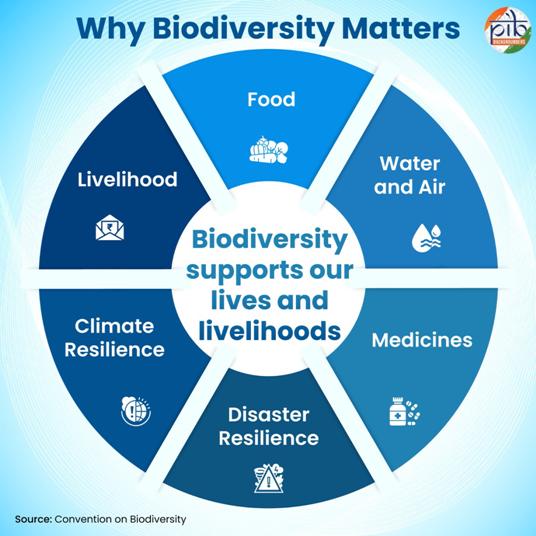
Biodiversity is central to India’s environmental and development priorities. It supports food security, livelihoods, climate resilience, and ecological balance. India’s forests, wetlands, mountains, coasts, deserts, grasslands, and marine ecosystems sustain diverse species and communities. Millions of local communities depend on these natural resources for daily life. India continues to consrerve its natural capital and biodiversity commitments through policies, institutions, and community participation aligned with global frameworks. Through these efforts, India contributes to global biodiversity goals while strengthening conservation at the national and local levels. India’s approach emphasises local stewardship, recognising that community-led action is essential for achieving broader biodiversity outcomes.
Over the past decade, India has adopted an integrated approach to biodiversity conservation that combines scientific management, habitat restoration, species recovery programmes, and community participation. Significant efforts have been made to expand protected areas, strengthen wildlife monitoring, restore degraded ecosystems, and promote sustainable use of biological resources. These initiatives have enhanced ecological resilience, supported local livelihoods, and reinforced India's position as a global leader in biodiversity conservation. By aligning conservation goals with sustainable development objectives, India is working towards securing its natural heritage for future generations while fostering inclusive and environmentally responsible growth.
Understanding Biodiversity and Its Importance
Biodiversity refers to the variety of life on earth, including plants, animals, microorganisms and the ecosystems they form. It underpins ecological balance and supports key ecosystem services such as pollination, soil formation, nutrient cycling, water purification and climate regulation. Biodiversity sustains the natural systems that make life possible and productive across regions.
Biodiversity is central to the health of both the environment and human societies. In practice, biodiversity is what keeps ecosystems functioning, resilient and capable of supporting people. Protecting biodiversity is therefore not only an environmental responsibility, but also a developmental priority for a country as ecologically diverse as India.
|
Do You Know?
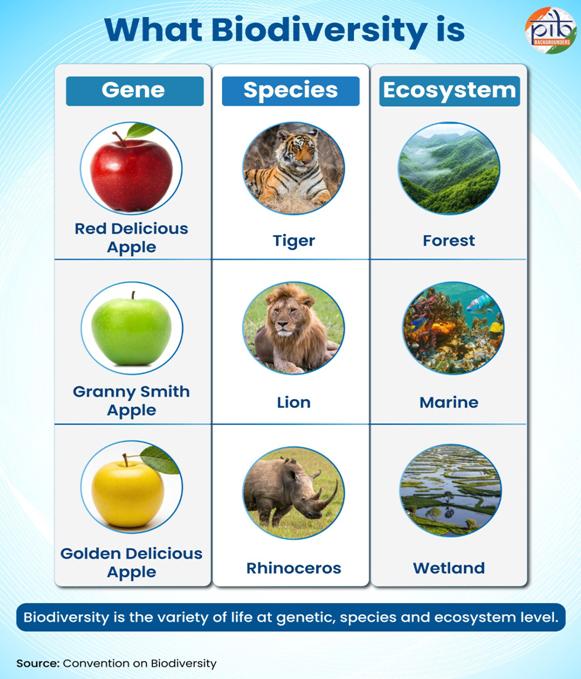
Gene is considered the basic unit of inheritance. Genes are passed from parents to offspring and contain the information needed to specify physical and biological traits. For example, Red Apple, Granny Smith Apple, and Golden Apple are different genetic varieties of apples.
Whereas, species is a group of organisms that can successfully breed to produce fertile offspring. This species definition divides up animals, plants and other forms of life into groups based on their reproduction. For example, the tiger, lion, and rhinoceros are different animal species.
An ecosystem is a geographic area where plants, animals and other organisms, as well as weather and landscape, work together to form a life. Ecosystems contain living factors, as well as non-living factors. living factors include plants, animals and other organisms. non-living factors include rocks, temperature and humidity.
|
India’s Biodiversity Framework
India’s biodiversity framework combines laws, policies, institutions, and programmes for conservation and sustainable use. It also promotes fair benefit sharing while aligning national priorities with global biodiversity commitments.
The Biological Diversity Act ,2002 (Amended in 2023)
The Biological Diversity Act, 2002 is India’s principal legal framework for conserving biological diversity, promoting sustainable use, and ensuring fair benefit sharing. It provides the statutory basis for biodiversity governance through institutions at the national, state, and local levels. The law also supports the documentation and protection of biological resources and associated traditional knowledge. It also provides for access and benefit sharing, helping ensure that the use of biological resources is linked with equitable returns to the providers of such resources.
|
Did You Know?
In practice, under India’s framework, “Traditional Knowledge” covers community‑held knowledge about biological resources and their uses (for food, medicine, agriculture, cultural and spiritual practices), passed down across generations and closely linked with local ecosystems and customary practices.
|
The Biological Diversity (Amendment) Act, 2023 further strengthened this framework by making implementation more facilitative and aligned with current needs. It supports research, innovation, and traditional knowledge based practices while improving compliance and governance efficiency. The amendment also reinforces community participation and local biodiversity documentation, which are important for effective conservation.
Together, the Act and its amendment provide a balanced legal foundation for India’s biodiversity protection efforts through-
- Three tier governance structure
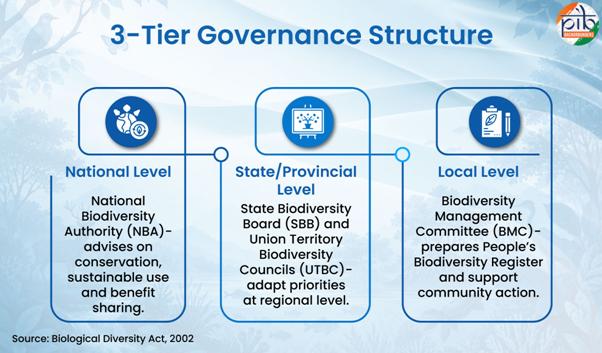
The Biological Diversity Act, 2002, Provides for 3-Tier governance Structure. At the national level, the National Biodiversity Authority(NBA) advises on conservation, sustainable use and benefit sharing. At the state and union territory level, the State Biodiversity Boards (SBBs) and Union Territory Biodiversity Councils (UTBCs) adapt these priorities to regional needs. At the local level, Biodiversity Management Committees (BMC) prepare People’s Biodiversity Registers (PBRs) and support community action. This structure helps carry global and national biodiversity goals down to villages, towns and cities.
|
Section 39 of Biological Diversity Act, 2002
The Section empowers Central Government to designate institutions as repositories for different categories of biological resources. These repositories will support the safe custody of biological materials, including voucher specimens, and strengthen. The also support documentation of newly discovered species, as well as biological resources used for research and commercial purposes.
Further, any person discovering a new taxon is required to notify the designated repository and deposit the corresponding voucher specimens. To facilitate this process, the NBA has issued guidelines outlining the criteria for institutions seeking designation as repositories.
|
- Scientific and technical support
Specialised scientific institutions strengthen this governance system. The Zoological Survey of India (ZSI) and the Botanical Survey of India (BSI) document animal and plant diversity. The Forest Survey of India (FSI) maps forest and tree cover in periodic State of Forest Reports. The National Tiger Conservation Authority (NTCA) and state forest departments support the conservation of tigers and their habitat.
Under Section 39 of the Biological Diversity Act, 2002, 20 institutions have been designated as national repositories for different categories of biological resources across the country. Two additional key institutions have recently been notified, further strengthening this national repository network for safe custody and documentation.
- Community level institutions
Local institutions reflect the role of community led action in achieving global biodiversity goals.. BMCs across the country are preparing and updating People’s Biodiversity Registers. These registers capture species, habitats and traditional knowledge at the community level. They help identify local priorities for conservation and sustainable use. National campaigns to update and digitise the registers are further strengthening this grassroots foundation. This architecture has enabled strong recent gains on protected areas, forest and tree cover, species conservation and local stewardship.
- National Biodiversity Authority Fund (NBAF)
The National Biodiversity Authority Fund is a statutory fund created under section 27 of the Biological Diversity Act. It further supports biodiversity governance by providing a mechanism for benefit sharing and conservation related use.
|
NAGOYA PROTOCOL
Adopted during COP-10 of the CBD in in Nagoya, Japan, is a legally binding supplementary agreement adopted in October 2010. It ensures the fair and equitable sharing of benefits arising from the utilization of genetic resources, as well as associated traditional knowledge held by indigenous and local communities.
MoEFCC, in collaboration with the NBA, has submitted India’s First National Report (NR1) on the implementation of the Nagoya Protocol. This report focuses on how India is applying regulations on access to genetic resources and fair and equitable sharing of benefits. The report highlights growing flows of benefits to local communities and traditional knowledge holders through formal agreements and related measures.
|
|
BIODIVERSITY FINANCE INITIATIVE
Biodiversity Finance India was launched in 2015 as a finance planning initiative to identify biodiversity funding needs and mobilise resources for conservation. The initiative is linked to the broader BIOFIN framework of UNDP and reflects India’s effort to make conservation financially sustainable.
In simple terms, BIOFIN-India focuses on identifying and mobilising finance, while the NBAF channels resources through a statutory mechanism for conservation and benefit sharing. Together, they strengthen India’s biodiversity governance through both planning and implementation.
|
- People’s Biodiversity Register (PBR)
The People’s Biodiversity Register is a local biodiversity database prepared with community participation. It records biological resources, habitats, landraces, folk varieties, cultivars, domesticated stocks, breeds, microorganisms, and associated traditional knowledge. Under the Biological Diversity Act, the Biodiversity Management Committee prepares it in consultation with local people.
PBR is an important tool for documentation, conservation, and benefit sharing. Nearly 2,72,648 such registers have been prepared across the country. This shows that the instrument has gained practical importance in India’s biodiversity governance. It also reflects the country’s emphasis on local documentation as a base for stronger conervation action.
National Biodiversity Strategy and Action Plan (NBSAP 2024-2030)
The National Biodiversity Strategy and Action Plan (NBSAP) provides India with a long term policy direction for conserving biodiversity and using it sustainably. It translates global biodiversity commitments into national priorities suited to India’s ecological and developmental context. The plan also helps guide coordinated action across ministries, institutions, and local bodies. It reflects a whole of government and whole of society approach to biodiversity protection.
The updated plan for 2024 to 2030 is aligned with the Kunming Montreal Global Biodiversity Framework (KMGBF), which gives it strong international relevance.
|
Kunming Montreal Global Biodiversity Framework (KMGBF)
Adopted during COP15 of the CBD in Montreal, Canada, co-chaired by China and Canada, is an international agreement adopted in December 2022 by 196 nations to halt and reverse biodiversity loss by 2030 and achieve a vision of "living in harmony with nature" by 2050.
Recently, MoEFCC has submitted India's Seventh National Report (NR-7) to CBD, reaffirming its commitment to the objectives of the Convention. The NR-7 presents a comprehensive, indicator-based national assessment of how India is implementing its commitments under the Convention. The report lays out the status of biodiversity, policies and targets, and major actions taken across sectors and levels of government.
|
- National Red List Roadmap (2025-2030)
National Red List Roadmap is a key step in strengthening the India’s biodiversity conservation architecture and advancing its international commitments. Led by Zoological Survey of India (ZSI) and Botanical Survey of India (BSI), with support from IUCN-India and the Centre for Species Survival, India, the roadmap will establish a nationally coordinated, science-based threatened-species assessment system. It will also help India identify conservation priorities more effectively and build a stronger evidence base for policy and action.
The roadmap is aligned with India’s broader biodiversity commitments under the KMGBF, especially the goal of improving species status assessments and guiding conservation action by 2030.
Key Achievements
India has made steady progress in biodiversity conservation, leading to visibly stronger outcomes on the ground.
Expanding forests and protected areas
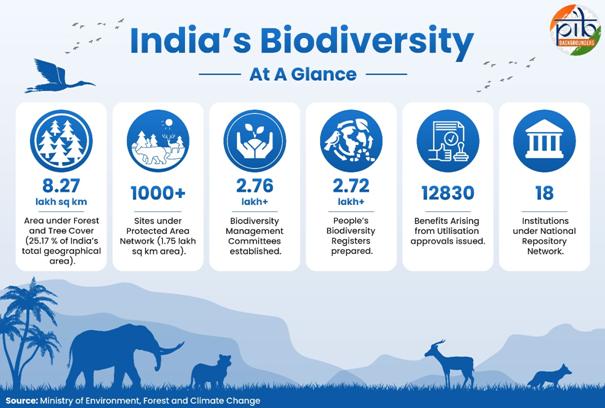
India’s total forest and tree cover stands at about 8.27 lakh square kilometres, covering 25.17 per cent of the country’s geographical area. The recorded forest area is around 7.75 lakh square kilometres, of which more than 5.20 lakh square kilometres is actual forest cover. India also has over 1134 protected areas, covering more than 1.88 lakh (1,87,592) square kilometres and supporting critical habitats and ecosystem services across the country.
Strengthening species conservation
India has achieved globally recognised success in conserving flagship species. The tiger population increased from 2,226 in 2014 to 3,682 in the latest estimates. Species databases and monitoring systems are also being strengthened through institutions such as the Wildlife Institute of India, ZSI, and BSI
Deepening community and governance outcomes
India has established a wide network of More than 2,76,653 BMCs across the country in rural and urban local bodies. These committees have prepared more than 2,72,648 People’s Biodiversity Registers across the country. A national campaign is also underway to update, verify and digitise these registers, turning them into ePBRs. This effort is strengthening documentation of local species, habitats and traditional knowledge in a systematic way. It also reflects the government’s focus on empowering communities as key partners in biodiversity stewardship.
ABS Mechanism
|
ABS e-filing Portal
Access and Benefit Sharing (ABS) e-filing Portal streamlines biodiversity governance and transparency. It was launched on 30th March 2017. However, following the Biological Diversity Rules 2014, the portal has been upgraded. This was done as part of the continuous efforts for providing upgraded services. The portal offers following benefits-
- Online Application Submission
- Transparent Processing
- Faster Approvals
- Fair Benefit Sharing
|
The Implementation of ABS is anchored in BD Act, which provides the legal basis for regulating access to biological resources and associated traditional knowledge and for ensuring fair and equitable sharing of benefits with benefit claimers including local communities. During the 2017–2026, India issued 12,830 Benefits Arising from their Utilization approvals from dedicated funds created to support benefit sharing and conservation linked activities. As of May 2026, nearly Rs.145 crore has been released to beneficiaries across the country, benefiting around 11,000 Biodiversity Management Committees.
|
International Day for Biological Diversity 2026: Snapshot
On 22 May 2026, the Union Minister for Environment, Forest and Climate Change presided over the national level observance of the International Day for Biological Diversity and an event on cheetah conservation at the Indian Institute of Forest Management (IIFM), Bhopal. Addressing the event, Union Minister reiterated India’s commitment towards implementation of the Convention on Biological Diversity and the Kunming-Montreal Global Biodiversity Framework.
The event saw the release of several biodiversity publications, digital tools and outreach materials, including:
- Customised MyStamp (personalized sheet of Postage Stamps)
- India’s Biodiversity Report 2026: Insights from the 7th National Report to CBD
- India’s Progress in Implementing ABS: Insights from India’s First National Report on the Nagoya Protocol
- ABS End-to-End Portal
- Film on Access and Benefit Sharing
- Film on Amarkantak Biodiversity Heritage Site
- Film on Conservation of Devlok Vans (Sacred Groves) of Madhya Pradesh
The 2026 observance highlighted India’s strong commitment to biodiversity conservation, ecological restoration and sustainable development. It also reinforced the country’s vision of balancing environmental protection with inclusive growth and ecological resilience.
|
From Today’s Gains to Tomorrow’s Goals
India’s biodiversity efforts are now rooted in a strong blend of laws, institutions and community‑led action, aligned with global frameworks under the CBD. India is strengthening forest and tree cover, expanding protected areas, improving species conservation and deepening local stewardship in a coordinated manner.
Looking ahead, updated strategies, dedicated financing and transparent national reporting place biodiversity at the heart of sustainable and inclusive development. The Government remains committed to further enhancing conservation outcomes by 2030 and beyond, so that healthy ecosystems, secure livelihoods and national growth reinforce each other in a positive cycle.
REFERENCES
Ministry of Environment, Forest and Climate Change
Convention on Biological Diversity
Other
Click here to see PDF
********
PIB Research
(Explainer ID: 158772)
आगंतुक पटल : 5477
Provide suggestions / comments