Rural Prosperity
Water Governance in Rural India
“Empowering Communities through Participatory Water Budgeting”
Posted On:
27 MAY 2026 11:36AM
|
Improving water governance in rural India is becoming increasingly important due to rising demand, uneven distribution, and climate variability. By counting every drop, India can build water security, climate resilience, and a sustainable future. Water budgeting enables communities to assess availability and demand, supporting informed decisions across agriculture, domestic and livestock use. Government programmes including the Atal Bhujal Yojana, the National Water Mission, and state initiatives as in Rajasthan and Maharashtra, highlight the effectiveness of participatory approaches. Technology further strengthens these efforts by supporting data-driven planning at the local level using tools like the Varuni web application. Integrating water budgeting into planning, backed by community involvement and policy support, promotes sustainable water use.
|
Water Resource Dynamics in India: Integrating Demand Management and Policy Action
Water constitutes a fundamental determinant of environmental sustainability and human well-being. The availability, distribution, and management of water resources are critical to sustaining growth across sectors. According to the study “Reassessment of Water Availability in India using Space Inputs, 2019”, conducted by the Central Water Commission, India receives an average annual precipitation of about 3,880 Billion Cubic Metres (BCM). After accounting for natural losses such as evaporation and other factors, the average annual water available in the country is estimated at 1,999.20 BCM.
The average annual water availability of a country depends largely on hydrometeorological and geological factors. However, per capita water availability depends on population size. With the continuous rise in population, per capita water availability in India is steadily declining, increasing pressure on existing water resources.
India has 17.5 percent of the global population and 11.6 percent of the world’s livestock. This creates significant demand on water resources. Agriculture accounts for 80 to 90 percent of water use in rural areas.
The growing stress on limited water resources has resulted in declining groundwater levels, seasonal water shortages, and increasing conflicts over water allocation. All these challenges highlight the need to move away from a supply-driven approach towards demand-based and planned water management systems. In this context, water budgeting has emerged as a significant tool for sustainable development in water-stressed regions where scarcity and uneven distribution threaten economic stability, food security, and climate resilience.
Counting Every Drop: Understanding Water Budgeting
Water budgeting involves a systematic assessment of water availability and demand within a defined geographical unit. These include village, watershed, block, or district, with the objective of balancing water use with renewable availability.
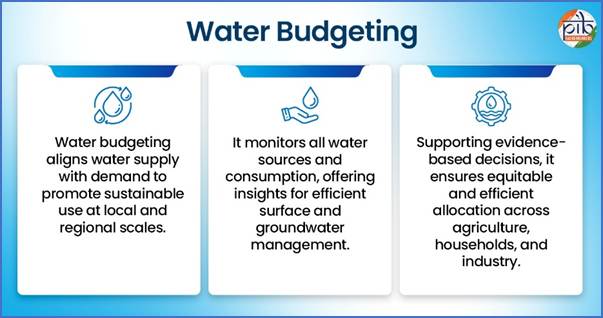
At its core, water budgeting involves the calculation of all water inputs, including rainfall, surface inflows, and groundwater recharge, against evapotranspiration, runoff, and groundwater discharge. Beyond basic accounting, a comprehensive water budget helps understand the movement and distribution of water within the natural environment. This includes the interaction between surface water and groundwater systems, seasonal variations in rainfall and recharge, and the impact of human activities such as agriculture, urbanization, and industrial use.
It can be applied at different scales from individual farms and villages to entire watersheds and river basins. This enables the preparation of location-specific water management plans based on local conditions, resource availability, and demand patterns. Such planning becomes particularly important in regions facing groundwater depletion, seasonal shortages, floods, or climate-related uncertainties.
From a governance perspective, water budgeting supports informed and evidence-based decision-making. It identifies surplus and deficit areas and enables efficient water allocation across agriculture, domestic use, livestock, and industry.
Aligning Agricultural and Livestock Water Demand through Water Budgeting
The National Commission on Integrated Water Resources Development estimates that irrigation water demand in India could reach 807 BCM by 2050 under a high-demand scenario. These projections indicate growing pressure on water resources and highlight the need for improved planning and demand management.
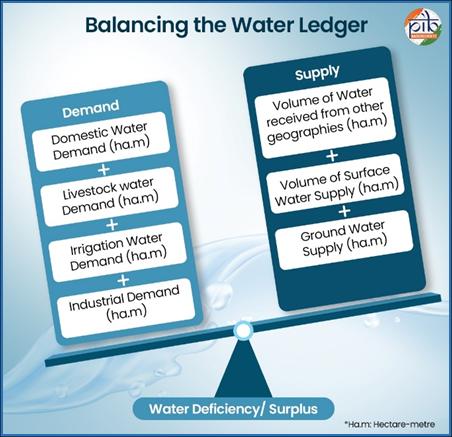
Water budgeting helps in aligning agricultural practices with available resources. It enables informed crop planning, supporting crop selection based on local water conditions and optimised irrigation and sowing to reduce stress. Evidence from participatory water budgeting initiatives supported by NABARD shows that water-aligned crop choices enhance productivity while reducing risk exposure.
The livestock census in 2019 showed 4.6% increase from 51.2 crore in 2012 to about 53.6 crore in 2019. The cow population increasedby18%from the previous census in 2012. This increase in livestock population implies a corresponding rise in water demand for drinking, fodder production, and related activities.
Water budgeting adopts a comprehensive approach by incorporating the water requirements of allied sectors such as livestock and fisheries. Estimating livestock water demand using standard norms and integrating it into overall water assessments ensures a more balanced allocation. It thereby supports diversified and sustainable rural livelihoods.
Institutionalizing Water Budgeting: National Missions and Grassroots Action
Government programmes including Atal Bhujal Yojana and National Water Mission, highlight water budgeting as a key tool for sustainable water management.
Launched in 2019, the Atal Bhujal Yojana promotes water budgeting as a key tool for decentralized water governance at Gram Panchayat (GP). The programme is implemented on a pilot basis across 229 blocks in seven groundwater-stressed states. These states and GPs were selected based on the level of groundwater depletion, institutional readiness, existing water management systems, prior experience in groundwater conservation, and willingness to participate. The final selection of GPs was made by the respective state governments to ensure effective implementation and better outcomes. During the assessments conducted in 2023-24 and 2024-25, 180 out of 229 blocks have shown measurable improvement in groundwater levels.
The scheme promotes revival and strengthening of traditional water conservation systems, including Gokatte, Bawdi, Johad, Tanka, Kalyani, and Diggi, adapted to local contexts. As of March 2026, approximately 81,700 water conservation and recharge structures have been created or restored. The scheme mandates the annual preparation and updating of water budgets, with 8,203 budgets completed across participating Gram Panchayats.
|
Sl. No.
|
State
|
Gram Panchayat (GPs) with prepared Water Budgeting
|
|
1
|
Gujarat
|
1,873
|
|
2
|
Haryana
|
1,647
|
|
3
|
Karnataka
|
1,199
|
|
4
|
Madhya Pradesh
|
670
|
|
5
|
Maharashtra
|
1,133
|
|
6
|
Rajasthan
|
1,132
|
|
7
|
Uttar Pradesh
|
549
|
|
|
Total
|
8203
|
To support this process, capacity-building initiatives have been undertaken. Over 1.25 lakh training programmes conducted across multiple levels. Demand-side interventions have been actively promoted across nearly 9 lakh hectares. This has resulted in the adoption of efficient water-use practices, such as drip and sprinkler irrigation, mulching, and crop diversification.
Institutionalizing Water Budgeting: Insights from Hiware Bazar
Hiware Bazar, a drought-prone village in Maharashtra, demonstrate how participatory water governance can transform water-scarce regions into resilient ecosystems. Facing acute water shortages since the 1970s, the village adopted a community-led watershed management. This approach combined traditional knowledge with institutional innovation.
Over time, the village implemented comprehensive measures, including rainwater harvesting, watershed development, and groundwater recharge practices. A key intervention was water budgeting at the Gram Sabha level, where annual water availability is assessed to guide agricultural planning. Based on these assessments, farmers are encouraged to adopt crop patterns aligned with available water resources. Additionally, regulations such as bans on deep borewells have been enforced to prevent over-extraction of groundwater.
This integrated, forward-looking approach has enabled Hiware Bazar to achieve water security, even during years of below-normal rainfall. The model has informed state-level policy, with Maharashtra incorporating water budgeting into its drought-proofing strategy to make 5,000 villages water-secure annually.
National Water Mission (NWM)
The National Water Mission recognises water budgeting as a foundational element of Integrated Water Resources Management (IWRM). Water budgeting under the Mission aligns with national priorities of water conservation, sustainability, and long-term water security.
Additionally, Nari Shakti se Jal Shakti under NWM emphasizes women-led institutions, including Self-Help Groups (SHGs), Water Users’ Association (WUAs), and community groups in water conservation and management. For instance, in Udham Singh Nagar district, Uttarakhand, about 1,645 women have been trained under the Jal Jeevan Mission. Additionally, 300 women-led Village Water and Sanitation Committees are operational, and 105 awareness campaigns have been conducted by women SHGs.
Water Security through Community-Led Planning in Rajasthan
Rajasthan’s highly variable rainfall and frequent droughts have led to runoff losses, declining groundwater levels, and unstable agriculture. To address this, the state launched the Mukhyamantri Jal Swavlamban Abhiyan in 2016, based on the “Four Waters Concept”. It includes conserving rainwater, groundwater, underground water, and soil moisture through watershed treatment and revival of traditional structures.
A key feature of the approach is the institutionalization of water budgeting at the Gram Sabha level. Thus, communities systematically assess water availability and allocate its use across competing needs, including drinking, irrigation, livestock, and other livelihood requirements.
Key outcomes:
- Groundwater levels increased by around 4%.
- Improved soil fertility and reduced erosion, resulting in higher crop yields.
- Water access was enhanced for 4.1 million people and 4.5 million livestock.
This case demonstrates how community-led water budgeting and conservation can strengthen water security in drought-prone regions.
Simplifying Water Budgeting with Smart Technology: Varuni Web Application
The Varuni web application employs a scientifically robust yet user-friendly methodology to generate block-level water budgets. It integrates automatically sourced data from authoritative government portals, including rainfall, land use, cropping patterns, population, and water resources. This data is subsequently processed through an in-built computational framework to produce structured water budget assessments. The Varuni web application (https://wasca.in/index)was developed under the Indo-German bilateral project “Water Security and Climate Adaptation in Rural India (WASCA)”. The project is implemented in collaboration with the Ministry of Jal Shakti and the Ministry of Rural Development, with technical support from NITI Aayog (National Institution for Transforming India).
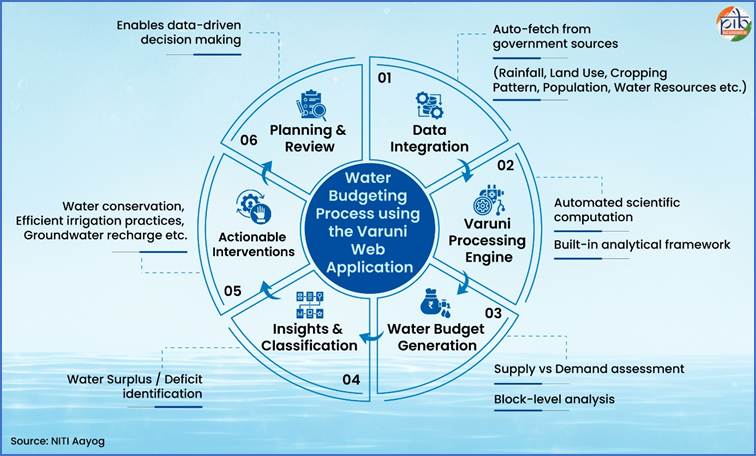
The Varuni web application uses a cycle-based approach. It systematically compares water availability (supply) with water requirements (demand) to generate a comprehensive water budget. It indicates whether a given block experiences a surplus or a deficit. It further provides contextual insights into local geography and water resource conditions.
All computations are executed through an automated framework, thereby minimizing manual intervention and reducing the likelihood of errors. This enables local authorities to accurately assess water scenarios and identify context-specific interventions. It includes water conservation, groundwater recharge, and the adoption of efficient irrigation practices.
Jalyukt Shivar Abhiyan (JSA)
The Jalyukt Shivar Abhiyan (JSA) launched in 2014, a flagship programme of the Government of Maharashtra. It was designed to provide sustainable, long-term solutions to rural water scarcity. The programme incorporates geotagging and a mobile application developed by the Maharashtra Remote Sensing Application Centre (MRSAC). It enables real-time, web-based monitoring of interventions. It adopts an integrated planning approach focused on water conservation, groundwater recharge, and village-level water budgeting.
As a result of these interventions, over 11,000 villages have been declared drought-free. Additionally,groundwater levels have increased by approximately 1.5-2 metres. Furthermore, water storage capacity has enhanced, and agricultural productivity has improved by an estimated 30-50 percent.
Strengthening Water Security through Informed Choices and Local Actions
Water, as a finite resource, underscores the need for better management, efficiency, and governance. The need to transition from fragmented approaches to integrated, data-driven water management becomes imperative. This is driven by rising pressures from population growth, agricultural demand, and climate variability. In this context, water budgeting stands out as a transformative instrument.
By aligning agricultural practices with local water availability, India is advancing evidence-based and participatory water governance. This is supported by strengthening community-led institutions and leveraging digital tools such as Varuni. Successful models, from Hiware Bazar to large-scale programmes such as the Atal Bhujal Yojana and the National Water Mission, demonstrate strong outcomes. They show that the convergence of policy, technology, and collective action can significantly enhance resilience in water-stressed regions. Institutionalizing water budgeting into planning processes across all levels will be essential for ensuring long-term water security, agricultural sustainability, and inclusive economic growth.
NITI Aayog
Ministry of Jal Shakti
Ministry of Finance
United Nations
Click here to see pdf
****
PIB Research
(Explainer ID: 158697)
आगंतुक पटल : 701
Provide suggestions / comments