Farmer's Welfare
The Superfood Sweetener
Jaggery Production and Processing in India
Posted On:
16 MAY 2026 10:40AM
India accounts for over 70% of global jaggery production, firmly establishing itself as the world leader in natural sweeteners. Nearly 20–30% of the country’s sugarcane output is diverted towards jaggery production, supporting around 2.5 million rural livelihoods. The sector has also witnessed significant export growth. Jaggery exports have increased by 106.5% in value between 2015–16 and 2024–25, indicating rising international demand. Nutritionally rich in iron, minerals, and essential micronutrients, jaggery serves as a healthier alternative to refined sugar. Complementing this growth, government initiatives such as Pradhan Mantri Kisan SAMPADA Yojana, PM Formalization of Micro Food Processing Enterprises Scheme, and One District One Product, along with GI tagging, are playing a crucial role in promoting value addition, strengthening rural enterprises, and enhancing export potential.
Jaggery Sector in India: Production, Significance, and Livelihoods
Jaggery, commonly known as gur, is a traditional, unrefined, natural sweetener. It is produced by concentrating sugarcane juice without the use of chemicals. Often called “medicinal sugar”, it is nutritionally comparable to honey. Jaggery is widely consumed across Asia, Africa, Latin America, and the Caribbean under various local names. It is valued for its natural origin, traditional processing methods, and growing consumer preference for chemical-free sweeteners.
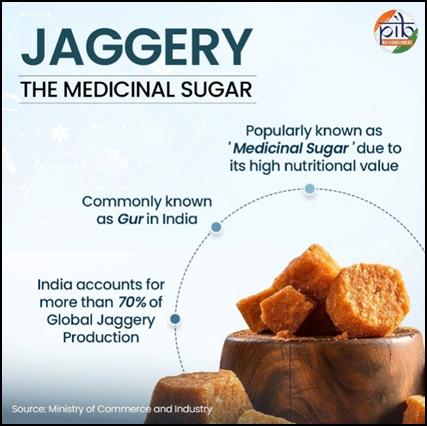
India accounts for over 70 percent of global jaggery production. This makes it the world’s largest jaggery producer. Nearly 20–30 percent of the country’s sugarcane production is used for jaggery production. It is one of the major agro-processing industries in rural India. The sector is marked by decentralized processing, low transport costs, small-scale entrepreneurship and cottage industries. It supports approximately 2.5 million livelihoods.
Sweetening Growth: India’s Expanding Jaggery Economy
India’s jaggery sector is supported by substantial sugarcane production. In 2024-25, total sugarcane output was estimated at 444.9 million tonnes (MT). Uttar Pradesh contributed 48.5 percent of total production, followed by Maharashtra (24.1 percent) and Karnataka (10.5 percent). Other producing states include Gujarat, Tamil Nadu, Bihar, Uttarakhand, Punjab, Madhya Pradesh, and Haryana.[1]
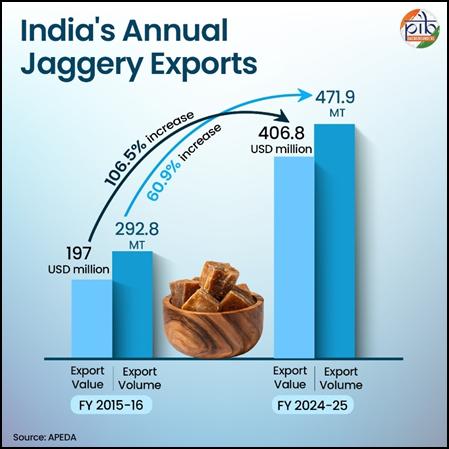
India is one of the leading exporters of jaggery and confectionery products (including traditional Indian sweets and candies). In 2015-16, exports stood at USD 197 million with a volume of 292.8 MT. By 2024-25, exports increased to USD 406.8 million with a volume of 471.9 MT. This is a rise of about 106.5% in value and 61.2% in volume over the period.[2] Major export destinations in 2024-25 included Indonesia, the USA, the UAE, Nigeria, and Nepal.[3]
If we compare year-on-year growth, exports during April-January (2025-26) reached 450.1 MT, valued at USD 384.4 million, registering an increase of about 16.5% in volume and 15.9% in value over the same period in 2024-25, when exports stood at 386.2 MT, valued at USD 331.4 million.
Domestic demand for natural sweeteners has also increased. In the sweetener segment, jaggery and honey have recorded a compound annual growth rate (CAGR) of 15–20 percent during 2021-24. Jaggery sales in domestic markets had reached approximately 5,000 metric tonnes annually by August 2024. This indicates growing consumer preference for traditional and natural sweetening products.
The Ancient Roots of India’s Jaggery Tradition
Jaggery is widely regarded as an indigenous Indian product. Its history is closely linked to the cultivation and processing of sugarcane, dating back to the Vedic period. Early references to sugarcane cultivation appear in Indian texts from around 1400–1000 BCE. Scholars have suggested that early thin varieties of sugarcane evolved in the moist regions of north-eastern India. Over time, sugarcane cultivation spread across tropical and subtropical regions, making it an important global crop. The word “sugar” is derived from the Sanskrit term sarkara, indicating deep cultural roots of sweetener production in the subcontinent. Historical accounts note that in 647 AD, a Chinese mission travelled to Magadha to learn sugarcane processing techniques. This demonstrates the early diffusion of Indian knowledge in the production of sweeteners. This long tradition of cultivation, processing, and knowledge transfer laid the foundation for India’s enduring prominence in jaggery production.
Jaggery for Nutrition and Public Health
Jaggery is increasingly recognized as a superfood, a natural, nutrient-rich alternative to refined sugar. Jaggery is produced from concentrated sugarcane juice without chemical refining. It therefore retains essential minerals and micronutrients that are typically lost during the sugar-refining process. In India, sugarcane is processed into jaggery, khandsari, and sugar through distinct production methods. Jaggery is the most naturally processed of the three, and nutritionally the richest. Jaggery is widely used in a range of traditional foods and in liquid form. Its demand is steadily increasing, driven by growing health consciousness and a consumer shift towards natural sweeteners.

Besides its traditional use, jaggery is increasingly recognized as a healthier sweetener in processed foods such as bakery and confectionery products. With the continued expansion of this sector, jaggery variants such as cane jaggery, palmyra jaggery, and raw jaggery are progressively gaining market presence. This shift reflects evolving consumer preferences for natural, minimally processed foods.
Nutritional Value of Jaggery
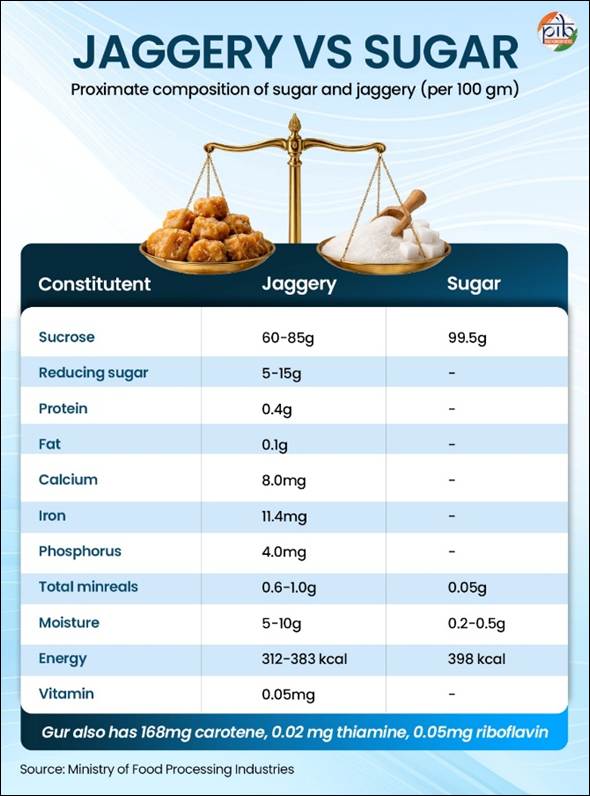
Jaggery retains most of the nutrients present in sugarcane juice, making it one of the most nutritionally rich natural sweeteners. It retains minerals like calcium, magnesium, potassium, phosphorus, sodium, iron, zinc, copper, and manganese that are lost in the intense refining for white sugar. A good-quality jaggery typically contains more than 70% sucrose, small amounts of glucose and fructose, and about 5% minerals, with low moisture content. Iron content (about 10-13 mg per 100 grams) contributes to improved haemoglobin levels, while potassium and magnesium support cardiovascular and muscle function.
Jaggery also contains trace amounts of vitamins, including folic acid and B-complex vitamins, as well as vitamins A, C, D, and E. These micronutrients make jaggery an energy-rich food that can help address deficiencies in these nutrients. Its mineral salt content is significantly higher than that of refined sugar. This makes it a suitable alternative for dietary supplementation, particularly in undernourished populations.
Integrating Jaggery into Nutrition Interventions
Jaggery has been included in Tamil Nadu’s nutrition interventions to address child malnutrition and support school participation. The state provides complementary weaning foods under its nutritious meal program and the Integrated Child Development Services (ICDS) framework. This is distributed as Take-Home Rations to eligible beneficiaries for 300 days each year. Jaggery constitutes approximately 27 percent of this complementary food mix, enhancing its energy value and micronutrient content. The supplementary food is popularly known as Sathumavu. It is procured from 25 women-run weaning food manufacturing cooperative societies and two private manufacturers in a 65:35 ratio.
These cooperatives collectively include about 1,450 members. A significant proportion of them are widows, deserted, or economically vulnerable women. Jaggery thus integrates nutrition support with livelihood generation. As per NITI Aayog, the program provides nutritious food to nearly 32.75 lakh beneficiaries across Tamil Nadu. While reducing malnutrition, the programme simultaneously promotes the use of nutrient-rich traditional ingredients such as jaggery.
Health Benefits of Jaggery
Jaggery provides sustained energy because its complex sucrose is digested slowly. It therefore releases energy gradually rather than causing rapid spikes in blood glucose. Iron gets absorbed during preparation in traditional iron vessels, making it beneficial to address anaemia. The presence of mineral salts and micronutrients supports overall health and strengthen immunity.
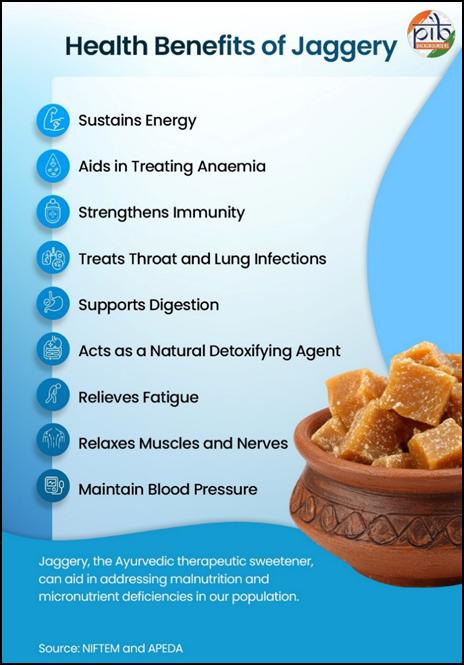
In traditional practices, like Ayurveda, jaggery has long been utilized as a therapeutic sweetener. Ayurvedic medicine considers it beneficial in treating throat and lung infections and supporting digestion. Its cleansing properties aid in detoxifying the respiratory tract and gastrointestinal system. This makes it especially beneficial for individuals exposed to dust and environmental pollutants. Its thermogenic (warming) effect is associated with relief from cough, congestion, and related respiratory discomfort.
Furthermore, jaggery is regarded as a natural detoxifying agent that supports blood purification. It is also believed to reduce fatigue, promote muscular and neural relaxation, and help maintain blood pressure. The presence of essential minerals such as calcium, phosphorus, and zinc supports bone health. Its reported anti-toxic and potential anti-carcinogenic properties contribute to overall physiological well-being.
From Cane to Livelihoods: Jaggery’s Role in Rural Development
Jaggery production in India forms part of the unorganized agro-processing sector. It plays a significant role in supporting rural livelihoods and local economies. As a leading producer and exporter, the sector sustains farmers while catering to both domestic consumption and growing export demand.
As consumer preferences evolve and global demand rises, it has become necessary to diversify along the sugarcane value chain. This is needed to enhance farm incomes and ensure environmentally and economically sustainable production systems. Value addition through Jaggery production offers substantially higher returns than selling raw sugarcane to mills. Empirical evidence indicates that integrating jaggery production with practices like crop diversification and intercropping can significantly improve net returns per unit area.
Jaggery processing contribute to rural development by fostering entrepreneurship, generating local employment, and strengthening regional economies. Jaggery processing generates year-round employment opportunities and supports migrant labour engagement. The production of high-quality jaggery enables access to premium markets, augmenting farmer incomes. Strengthening jaggery-based cottage industry thus represents a viable pathway for promoting value addition, livelihood enhancement, and inclusive agricultural growth.
Organic Jaggery Powder as a Profitable Value-Addition Enterprise
Anthonisamy, a farmer from Tirunelveli district, Tamil Nadu, has successfully demonstrated the viability of jaggery production as a value-added enterprise. He produces organic jaggery powder. His product is known for its purity and superior taste. It has gained strong demand across local markets, neighbouring states, and even export channels. By adopting organic cultivation practices and processing a local sugarcane variety, he has transformed a traditional activity into a profitable enterprise.
The value-added approach has significantly improved profitability. According to the farmer, organic jaggery powder is sold at about ₹75 per kg, compared to ₹50 per kg for conventional jaggery. Production costs, for both, are about ₹30 per kg.
Though production is seasonal, market demand for jaggery remains consistent throughout the year, ensuring steady income opportunities. Building on this success, diversified products like jaggery flavored chocolate and coconut, are further expanding market reach. Backed by central government support, the enterprise highlights how small-scale processing can enhance incomes, promote rural entrepreneurship, and strengthen agro-based livelihoods.
Unlocking the Sweet Value Chain: India’s Policy Push for Jaggery Ecosystem
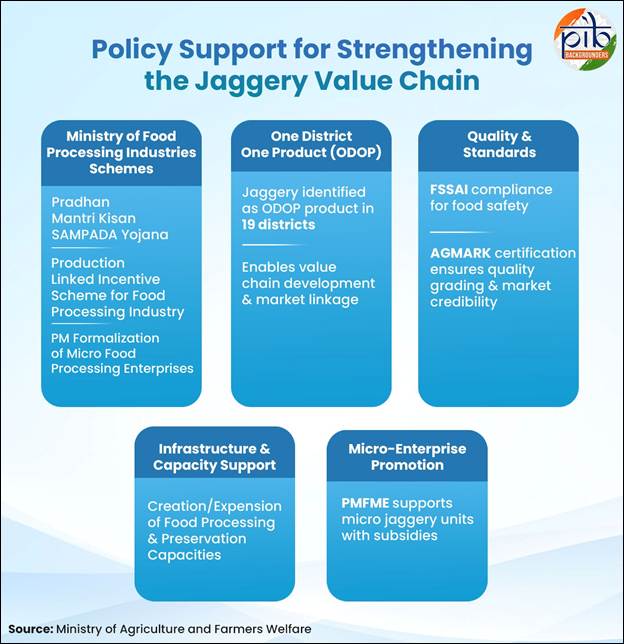
The Ministry of Food Processing Industries (MoFPI) promotes infrastructure development and enterprise growth for the food processing sector through several central sector schemes. These include
- Pradhan Mantri Kisan SAMPADA Yojana (PMKSY),
- Production Linked Incentive Scheme for Food Processing Industry (PLISFPI), and
- Pradhan Mantri Formalization of Micro Food Processing Enterprises (PMFME) Scheme.
These demand-driven initiatives are implemented nationwide. They facilitate the establishment and expansion of processing units by adopting modern technologies. Beneficiary units are required to comply with Food Safety and Standards Authority of India (FSSAI) regulations. They are also encouraged to align with international food safety standards to improve export competitiveness.
PMKSY has a component called Creation/Expansion of Food Processing & Preservation Capacities (CEFPPC). Five jaggery processing units have been approved under this as of December 31, 2025.Total grants-in-aid for this was ₹17.07 crore. The PMFME Scheme has supported3,528 jaggery based micro food processing units with subsidiestotalling₹102.31 crore. The scheme also provides branding and marketing assistance of up to 50 percent to collectives. These may include Farmer-Producer Organizations (FPOs), Self-Help Groups (SHGs), cooperatives, or special-purpose vehicles of micro-enterprises.
The One District One Product (ODOP)promotes local agro-based industries by enabling economies of scale in input procurement, shared services, and market access. Jaggery and allied products have been identified as ODOP items in 19 districts. This has facilitated value chain development and strengthened support infrastructure.
Quality assurance and standardization are supported through the Directorate of Marketing & Inspection (DMI). Agricultural commodities that meet prescribed standards are certified under the AGMARK system. These standards define quality grades and enable consumers to access reliable products. They also ensure graded raw materials for producers’ remunerative prices for farmers. Jaggery is a notified commodity covered under AGMARK certification, reinforcing quality assurance, market credibility, and export readiness.
Geographical Indication (GI) Tagged Jaggery Varieties in India
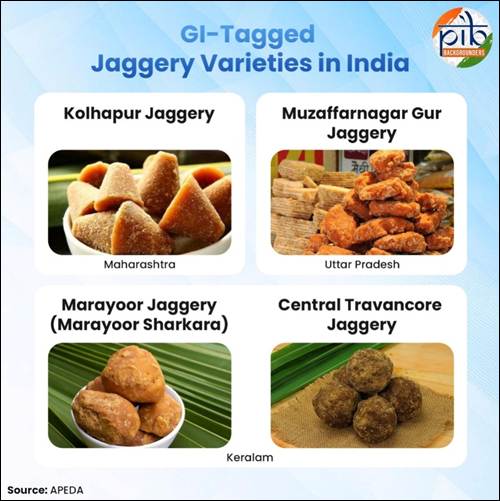
A Geographical Indication (GI) is a name or sign given to certain products that relate to a specific geographical location or origins. This could be a region, town, or country. In the jaggery sector, GI recognition strengthens regional branding. It promotes traditional processing practices, and improves market access for rural producers. India has several GI-tagged jaggery varieties, each known for distinct regional qualities and traditional processing methods. Kolhapur jaggery (Maharashtra) is valued for its golden colour and high sucrose content. Muzaffarnagar gur (Uttar Pradesh) is export-oriented and made from high-quality cane. In Keralam, Marayoor and Central Travancore jaggery are recognized for their purity, medicinal value, traditional processing and regional distinctiveness.
Towards a Resilient and Value-Driven Jaggery Sector
Jaggery production and processing form an important pillar of India’s agro-processing economy. It links agriculture, nutrition, rural livelihoods, and export potential. As the world’s largest producer, India benefits from a strong sugarcane base. Traditional processing knowledge and rising domestic and global demand for natural sweeteners further strengthen the case. The sector supports millions of livelihoods through decentralized cottage industries, offering opportunities for value addition, rural entrepreneurship, and enhanced farmer incomes.
In addition to its economic role, jaggery’s mineral content and therapeutic properties make it a healthier alternative to refined sugar. It is a useful dietary supplement for addressing micronutrient deficiencies. Government initiatives promoting food processing infrastructure, micro-enterprises, quality certification, GI tagging, and value chain development are strengthening market access and product credibility. With continued policy support, improved processing practices, and diversification into value-added products, the jaggery sector holds strong potential to drive inclusive and sustainable rural growth.
References
Ministry of Commerce and Industry
https://apeda.gov.in/JaggeryAndConfectionery
https://apeda.gov.in/Food_Agri_Products_Registered_GI
https://agriexchange.apeda.gov.in/production/India/index
https://agriexchange.apeda.gov.in/India/ExportSummary/Index
https://agriexchange.apeda.gov.in/India/ExportAnalyticalReport/Index
https://agriexchange.apeda.gov.in/India/ComparativeStatement/Index
https://www.pib.gov.in/PressReleaseIframePage.aspx?PRID=2113966®=3&lang=2
https://apeda.gov.in/sites/default/files/study_reports/Report_Indian_Organic_Market_and_Export_Promotion_Strategy.pdf
Ministry of Agriculture and Farmers Welfare
https://www.agriwelfare.gov.in/Documents/AR_Eng_2024_25.pdf
Ministry of Food Processing Industries
https://niftem-t.ac.in/pmfme/DPR-Jaggery.pdf
https://www.mofpi.gov.in/mediapr/enewsfeb4.html
https://niftem.ac.in/newsite/pmfme/wp-content/uploads/2022/08/jaggeryprocessing.pdf
https://sansad.in/getFile/loksabhaquestions/annex/187/AU116_pneN8S.pdf?source=pqals
Niti Aayog
https://www.niti.gov.in/sites/default/files/2024-07/Report-on-Promoting-Best-practices-on-Millet-26_4_23.pdf
Tamil Nadu Government
https://cuddalore.nic.in/geographical-indications/
https://agritech.tnau.ac.in/success_stories/sstories_farm_enter_2015_organic_jaggery.html
The Superfood Sweetener
******
PIB Research
(Explainer ID: 158631)
आगंतुक पटल : 248
Provide suggestions / comments