Energy & Environment
India’s Green Pathway
From Conservation to Climate Action
Posted On:
07 APR 2026 3:10PM
Introduction
In the twenty-first century, the relationship between development and the environment has moved from the margins of policy debate to the centre of national decision-making. For India, the task is especially complex, balancing rapid economic growth with biodiversity protection and climate action.
Key to India’s green pathway is the understanding that environmental protection and economic development are mutually reinforcing pillars of national progress. This vision also takes into account the current reality of climate change. As the impacts of climate change become increasingly evident across regions and sectors, the country has recognised it not as a distant risk but as a present developmental reality requiring both preparedness and proactive mitigation. Accordingly, India has adopted a calibrated approach that simultaneously strengthens biodiversity conservation, builds climate resilience and advances sustainable growth.
At the global stage, India has emerged as a credible voice for climate justice, equity and sustainable development. Its approach demonstrates that conservation and climate action are mutually reinforcing pillars of growth, and that prosperity for people and the protection of the planet can advance together.
Biodiversity Conservation and Ecosystem Restoration
India is one of the world's 17 mega-biodiverse countries. Despite occupying just 2.4% of the global land area, it accounts for nearly approximately 8% of all recorded species worldwide. The country is home to over 96,000 animal species and 47,000 plant species, including almost half of the world's aquatic plant species. This extraordinary natural heritage makes conservation not merely an environmental concern, but a national imperative.[1]
The country’s biodiversity governance framework is anchored in the Biological Diversity Act, 2002, supported by the National Biodiversity Action Plan and aligned with the Convention on Biological Diversity. India became a signatory of CBD in 1992.[2]
In 2024, at COP16 of the Convention on Biological Diversity (CBD) in Cali, Colombia, India launched its updated National Biodiversity Strategy and Action Plan (NBSAP) 2024–2030. The roadmap aims to halt and reverse biodiversity loss by 2030, with a long-term vision of living in harmony with nature by 2050. Prepared through a whole-of-government and whole-of-society approach involving 23 ministries and multiple stakeholders, the plan aligns with the Kunming-Montreal Global Biodiversity Framework and focuses on ecosystem restoration, species recovery, wetland and coastal conservation, and strengthened biodiversity governance through institutions such as the National Biodiversity Authority and Biodiversity Management Committees.[3]
Legal and Policy Framework
Core Environmental Laws
· Wildlife (Protection) Act, 1972 – Protection of wild animals, birds and plants; creation of protected areas.[4]
· Water (Prevention and Control of Pollution) Act, 1974 – Prevention and control of water pollution.[5]
· Forest (Conservation) Act, 1980 – Regulation of diversion of forest land for non-forest use.[6]
· Air (Prevention and Control of Pollution) Act, 1981 – Control and abatement of air pollution.[7]
· Environment (Protection) Act, 1986 – Umbrella legislation empowering the Central Government to protect and improve the environment.[8]
· Biological Diversity Act, 2002 – Conservation of biodiversity, sustainable use and access-benefit sharing.[9]
Together, these legislations establish a comprehensive regulatory framework ensuring ecological balance, sustainable resource management, pollution control, and long-term environmental security.
Protected Areas and Wildlife Conservation Programmes
India has implemented the following key programmes to conserve wildlife and protect endangered species.
Protected Areas: The Protected Areas network expanded from 745 in 2014 to 1,134 in 2025. Wildlife corridors have been identified to connect habitats and ensure safe animal movement.[10]
Project Tiger: Tiger Reserves increased from 46 in 2014 to 58 in 2025, covering approximately 85,000 square kilometres. The newest addition
is Madhav Tiger Reserve in Madhya Pradesh. The sixth cycle of All India Tiger Estimation has commenced,[11] building on the previous assessment that recorded 3,167 tigers in 2022.[12] India also secures habitat connectivity through 32 identified tiger corridors[13] across key landscapes, strengthening long-term conservation planning and genetic dispersal.
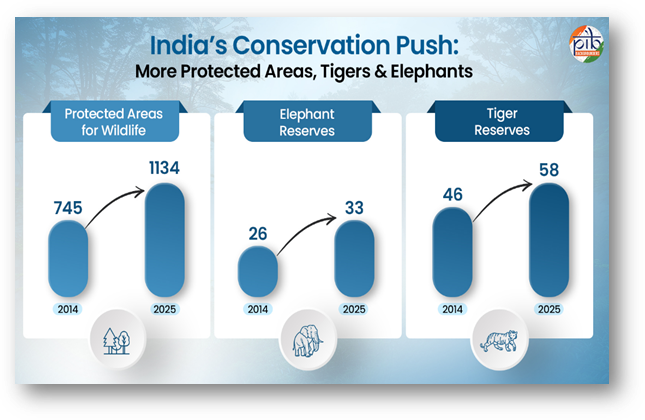
Project Elephant: Elephant Reserves increased from 26 in 2014 to 33 in 2025, bringing an additional 8,610 square kilometres under protection. There are 150 elephant corridors across 15 states.[14]
Project Cheetah: Project Cheetah entered an expansion phase in 2025. Cheetahs were introduced into Gandhisagar Wildlife Sanctuary. Planned expansion includes Noradehi and Banni Grasslands. As of December 2025, the total cheetah population reached 30, including 19 cubs born in India.[15]
Project Snow Leopard: India completed its first nationwide Snow Leopard Population Assessment between 2019 and 2023. The estimated population stands at 718 snow leopards. Ladakh recorded 477 and Uttarakhand 124. Snow Leopard Population Assessment India 2.0 (SPAI 2.0) been launched, in Wildlife Week 2025, to strengthen conservation.[16]
Project Dolphin: Under Project Dolphin, the nationwide survey from 2021 to 2023 estimated 6,327 riverine dolphins. The second range-wide estimation launched in January 2026[17], from Bijnor covers Ganga River, Indus River, Brahmaputra, Sundarbans and Odisha. It will assess Ganges River Dolphin, Indus River Dolphin and Irrawaddy Dolphin.[18]
International Big Cat Alliance: India leads the International Big Cat Alliance, launched in April 2023 to conserve 7 big cat species globally. The Framework Agreement entered into force on 23 January 2025, with membership expanding to 18 countries.[19]
Five National Level Projects for Species Conservation which includes Project Dolphin Phase 11, Project Sloth Bear, Project Gharial, as well as, four National-level Action Plans & Field Guides for Species Population Assessments and Monitoring Programmes covering River Dolphins, Tigers, Snow Leopard and Bustards were launched during the Wildlife Week 2025 (October 2-8).
These species-focused conservation initiatives are supported by a broader landscape-level strategy that strengthens forest cover, ecosystem restoration and habitat resilience. Protecting wildlife and expanding green cover are pursued together to ensure long-term ecological stability and sustainable resource management across the country.
Ecosystem Restoration
India’s diverse ecosystems face growing pressures from climate change, forest fires, habitat degradation, coastal erosion and unplanned land use. Recognising that ecological degradation can directly affect water security, livelihoods and disaster resilience, the Government of India has adopted a multi-layered strategy focused on protection, restoration and climate-proofing of critical ecosystems. This approach combines landscape-level conservation, technology-enabled monitoring and targeted habitat recovery across terrestrial, coastal and wetland ecosystems.
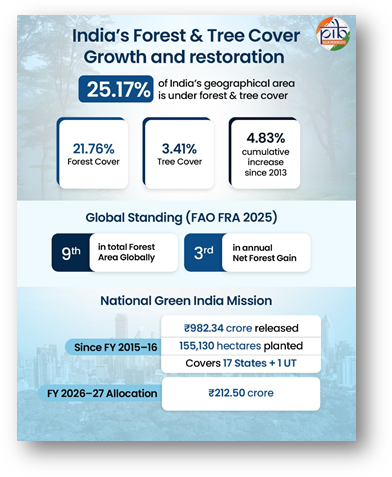
Forest and Biosphere Ecosystems
India’s terrestrial conservation efforts are anchored in a strong biosphere reserve network. The country currently has 18 notified Biosphere Reserves covering 91,425 square kilometres, of which 13 are recognised under UNESCO’s World Network of Biosphere Reserves (WNBR). The inclusion of the Cold Desert Biosphere Reserve in Himachal Pradesh in September 2025 further strengthened India’s global conservation footprint.[20]
To safeguard forest ecosystems from climate-induced risks, India has established a comprehensive forest fire prevention and control system. The Forest Survey of India operates a satellite-based real-time fire monitoring mechanism, with alerts issued through SMS and email and supported by a 24×7 national control room that tracks incidents across the country.[21][22]
Ek Ped Maa Ke Naam (Plant4Mother Campaign)[23]
Launched as a nationwide people’s participation campaign, Ek Ped Maa Ke Naam, “One Tree in Mother’s Name” encourages citizens to plant a tree as a tribute to their mothers while contributing to environmental protection.
The Ek Ped Maa Ke Naam campaign has become one of the largest people-centric environmental movements. A total of 262.4 crore saplings were planted till 31 December 2025.[24]
Wetlands and Coastal Ecosystems
Beyond forests and mangroves, India’s conservation strategy extends to wetlands and coastal regions, which play a critical role in biodiversity conservation, water security and climate adaptation.
Recognising the role of mangroves as natural buffers against cyclones, storm surges and coastal erosion, India is implementing the Mangrove Initiative for Shoreline Habitats and Tangible Incomes (MISHTI). In 2025, the initiative restored 4,536 hectares[25] of mangroves and identified 22,560 hectares (across 13 States/UTs) of degraded mangrove areas for future plantation and restoration. [26]
India has made significant progress in wetland conservation. In 2025, 11 new Ramsar Sites[27] were declared, taking the total to 98 sites as of 31 January 2026, compared to 26 in 2014, now the highest in Asia and the third largest globally by number of sites.[28] Among the recent additions are Patna Bird Sanctuary (Uttar Pradesh) and Chhari-Dhand (Gujarat). Further strengthening urban wetland governance, Udaipur and Indore became India’s first Ramsar-accredited Wetland Cities.[29][30]
Coastal ecosystem resilience is being reinforced through the National Coastal Mission, which has been extended for 2025–31 with an allocation of ₹767 crore.[31] The mission implemented as part of the National Action Plan on Climate Change aims to enhance the climate resilience of India’s coastline through integrated coastal zone management, ecosystem restoration and community-based adaptation. It focuses on conserving mangroves, coral reefs and other coastal ecosystems as natural buffers, addressing coastal erosion and sea-level rise, strengthening scientific planning and monitoring, and promoting sustainable livelihoods to ensure balanced coastal development.
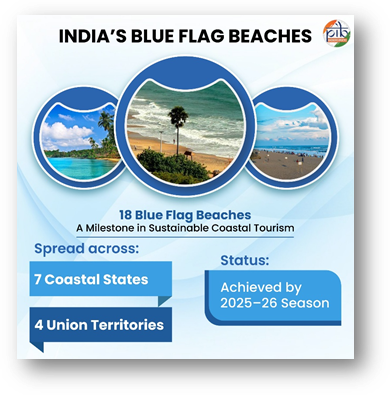
Blue Flag beaches are coastal sites certified for maintaining international standards of cleanliness, water quality, safety and sustainable management. The certification is awarded by the Foundation for Environmental Education and implemented in India by the Ministry of Environment, Forest and Climate Change (MoEFCC) under the Integrated Coastal Zone Management programme.[32]India achieved Blue Flag Certification for 18 beaches. These beaches are spread across 7 coastal states and 4 Union Territories. This certification was achieved by the 2025 -26 season.[33]
Human-Wildlife Conflict Management[34][35]
To ensure harmonious coexistence between humans and wildlife, the Ministry issued advisories to states on managing human-wildlife conflict under the Wildlife Protection Act. The advisories recommend coordinated action, identification of conflict hotspots and establishment of rapid response teams. State and District level committees review ex-gratia relief, and the Government ensures relief payment within 24 hours in cases of death and injury.
A Centre of Excellence for Human-Wildlife Conflict Management, and a Project on "Tigers Outside Tiger Reserve" were launched during the Wildlife Week 2025 (October 2-8).
These efforts demonstrate that environmental protection is not pursued in isolation but is closely linked with inclusive development and social equity. By integrating climate action, community participation and coexistence strategies within a broader development framework, India aligns environmental stewardship with the objectives of sustainable and equitable growth.
Even as India scales up biodiversity conservation and ecosystem restoration, climate change continues to pose the most profound and cross-cutting threat to ecological stability and developmental gains. Rising temperatures, increasing frequency of extreme weather events, changing rainfall patterns and sea-level rise are already exerting pressure on forests, wetlands, coasts and communities. It is recognised that conservation efforts alone, while essential, are not sufficient unless supported by deeper structural transitions in energy and towards green development pathways.
India’s focused climate action combines preparedness for climate risks with proactive mitigation through clean energy expansion, low-carbon technologies and policy reforms.
Climate & Strategic Policy Frameworks
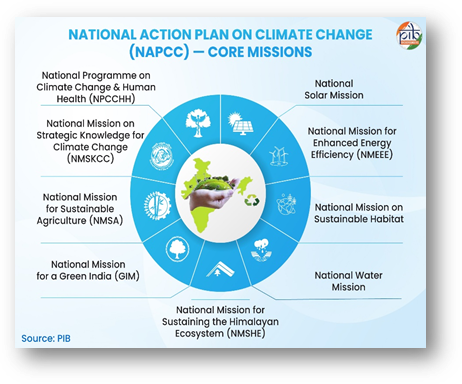
- National Action Plan on Climate Change (NAPCC) and its nine National Missions: The NAPCC provides the overarching framework for India’s climate strategy. Its missions, covering solar energy, energy efficiency, sustainable habitat, water, Himalayan ecosystems, Green India, sustainable agriculture, strategic knowledge, and later additional missions, integrate adaptation and mitigation into sectoral planning.[36]
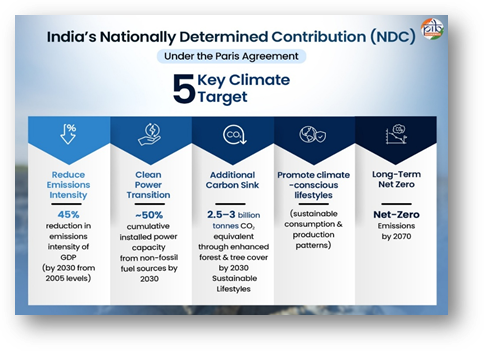
- Nationally Determined Contribution (NDC) under the Paris Agreement: In its updated NDC (2022), India committed to reducing the emissions intensity of Gross Domestic Product (GDP) by 45% from 2005 levels by 2030 and achieving about 50% cumulative electric power installed capacity from non-fossil fuel sources by 2030.[37]By June 2025, India has already reduced emissions intensity by around 36% between 2005 and 2020 and crossed 50% non-fossil installed capacity ahead of schedule.[38][39][40]
- Long-Term Low Emissions Development Strategy (LT-LEDS): Submitted to the UNFCCC in 2022, India’s LT-LEDS outlines pathways toward net-zero emissions by 2070. [41][42]
- National Green Hydrogen Mission and renewable energy expansion targets: Launched in 2023, the National Green Hydrogen Mission aims to make India a global hub for production, usage and export of green hydrogen, targeting 5 million metric tonnes[43] of annual production by 2030. This is supported by accelerated renewable energy deployment, with India targeting 500 GW of non-fossil fuel capacity by 2030.[44][45]
Together, these instruments anchor India’s pathway from conservation to climate action, aligning ecological protection with sustainable development.
Mission LiFE
Climate change poses serious risks to water security, livelihoods and economic stability. Without timely action, global estimates suggest nearly three billion people could face water shortages, and the global economy could shrink by up to 18 percent of GDP by 2050. Behavioural change at scale can make a significant difference. If one billion people adopt sustainable lifestyles, global carbon emissions could fall by approximately 20 percent.[46]
The Mission LiFE (Lifestyle for Environment), launched by the Government of India, promotes climate-conscious individual and community action. Under Mission LiFE, more than six crore people have participated in over 34 lakh events and 4.96 crore pledges have been taken as of December 2025.[47]
International Climate Commitments and Multilateral Engagement
India’s domestic progress is supported by consistent international engagement.
To operationalise international carbon market mechanisms under Article 6, India has designated the National Designated Agency for Implementation of Article 6 of the Paris Agreement as the national authority.[48]
At UNFCCC COP30 held in Belém, Brazil in November 2025, India highlighted its climate leadership and underscored the need to move from commitments to implementation. India emphasised enhanced climate finance and technology transfer for developing countries. India also welcomed Brazil’s initiative to launch the Tropical Forests Forever Facility(TFFF) and joined it as an Observer.[49]
India continues to lead global solar cooperation through the International Solar Alliance (ISA) under the vision “One World, One Sun, One Grid.” The Eighth ISA Assembly, held at Bharat Mandapam, New Delhi in October 2025, saw participation from over 550 delegates and 30 ministerial representatives, reinforcing global commitment to clean energy transition.[50]
Under the Montreal Protocol, India has demonstrated strong progress by phasing out major ozone-depleting substances ahead of mandated timelines.[51][52][53] Following ratification of the Kigali Amendment in 2021, India is advancing the phase-down of hydrofluorocarbons. By 2025, India achieved a 67.5 percent reduction in production and consumption of hydrochlorofluorocarbons (HCFC).[54]
India’s international climate commitments are reinforced by measurable domestic action. Multilateral engagement provides direction and cooperation, while implementation at home translates pledges into structural transformation. This alignment between global responsibility and national execution is most visible in India’s accelerated clean energy expansion.
Clean Energy Expansion and Structural Energy Transition
India’s clean energy expansion marks a decisive structural shift from fossil-fuel dependence to diversified, low-carbon sources. Guided by commitments under the United Nations Framework Convention on Climate Change and domestic reforms, the transition aims to enhance energy security, sustainability, and long-term economic resilience.
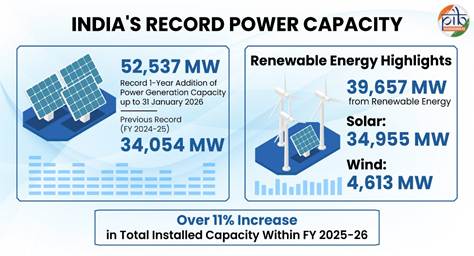
In 2025, India achieved over 50 percent cumulative installed electricity capacity from non-fossil fuel sources, five years ahead of its 2030 target.[55]
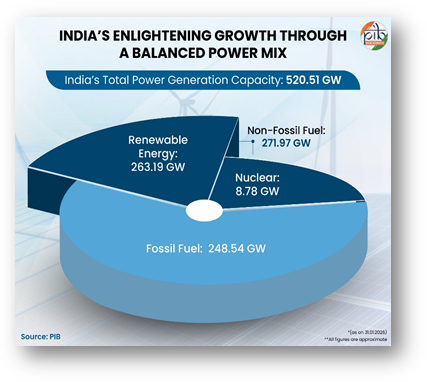
As of 31 January 2026, India’s total installed power capacity stands at 520,510.95 MW. This comprises 248,541.62 MW from fossil fuels and 271,969.33 MW from non-fossil sources. The non-fossil component includes 8,780 MW of nuclear energy and 263,189.33 MW of renewable energy.[56]
As per International Renewable Energy Agency (IRENA) Renewable Energy (RE) Statistics 2025,(with data as on December2024), globally, India stands 3rd in Solar Power installed capacity, 4th in Wind Power capacity and 4th in total Renewable Energy capacity.[57]The transition is visible across scales. On 09 October 2022, Modhera in Gujarat became India’s first 24x7 solar-powered village[58], demonstrating round-the-clock clean energy supply through integrated solar systems. The Omkareshwar Floating Solar Park in Madhya Pradesh is India's largest (as on 04th January 2025) and one of Asia’s largest floating solar parks.[59] Such projects optimise resource use and expand renewable energy capacity in innovative ways.
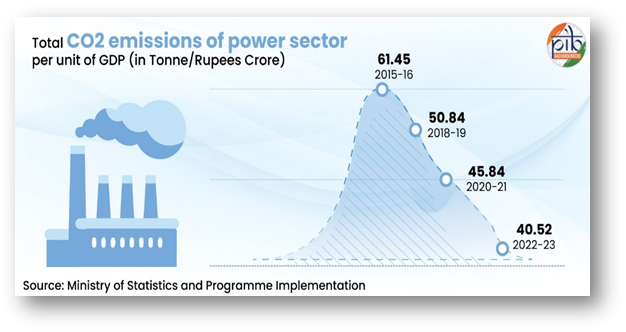
Energy efficiency improvements complement capacity expansion. The CO₂ emissions intensity of the power sector per unit of GDP declined from 61.45 tonnes per ₹ crore in 2015–16 to 40.52 tonnes per ₹ crore in 2022–23, reflecting cleaner growth pathways and technological improvements.[60]
These gains in efficiency are supported by policy instruments that reinforce long-term emission reductions across sectors. To sustain this momentum, India’s climate strategy combines regulatory frameworks with market-based mechanisms and technological innovation, strengthening accountability and accelerating the transition to a low-carbon economy.
Carbon Markets, Industrial Transition and Climate Finance Mechanisms
India’s climate strategy integrates regulation, market mechanisms and technological advancement. The operationalisation of the Carbon Credit Trading Scheme marks a major step in strengthening India’s domestic carbon market under the Indian Carbon Market framework. The scheme establishes compliance and offset mechanisms aligned with global practices and supports measurable emission reductions.
In January 2026, the Government notified Greenhouse Gas Emission Intensity targets for additional sectors. With this expansion, 490 obligated entities across major emission-intensive industries are now covered. This enhances transparency, accountability and sectoral decarbonisation.[61]
Carbon Capture, Utilisation and Storage (CCUS) has emerged as a key low-carbon technology for reducing industrial emissions by capturing and reusing or safely storing carbon dioxide. The Union Budget 2026–27 allocated ₹20,000 crore over five years to support CCUS development across emission-intensive sectors including chemicals and heavy industries.[62] This allocation promotes research, demonstration and deployment of carbon management solutions.
While carbon markets and industrial decarbonisation mechanisms address long-term emission reduction, environmental governance must also confront immediate pollution challenges. Market-based climate instruments operate alongside regulatory safeguards that control air, water and waste pollution at source. Together, they ensure that decarbonisation does not occur in isolation, but as part of a broader environmental management framework that delivers tangible public health and ecological benefits.
From Pollution Control to Sustainable Development
India’s environmental management is supported by a strong legal framework.
The Water (Prevention and Control of Pollution) Act, 1974 and the Air (Prevention and Control of Pollution) Act, 1981 address pollution control. The Commission for Air Quality Management in NCR and Adjoining Areas Act, 2021 strengthens coordination for air quality governance.[63]
Implementation is carried out in coordination with State Governments and local bodies. Enforcement is ensured by the Central Pollution Control Board and State Pollution Control Boards or Pollution Control Committees. The legal and institutional framework provides the foundation for translating environmental principles into measurable outcomes. These laws are operationalised through targeted national programmes that address priority pollution challenges in a coordinated and time-bound manner.
Clean Air Programme and Pollution Reduction
The National Clean Air Programme, launched in January 2019 by the MoEFCC, aims to improve air quality across 130 cities. [64]
Cities implement targeted clean air action plans addressing road dust, vehicular emissions, waste burning and industrial pollution. Based on comparison with 2017–18 baseline levels, 103 out of 130 cities showed improvement in PM10 concentrations in 2024–25. Sixty-four cities recorded 20% reduction and 25 cities achieved 40% reduction.[65]
Alongside targeted air quality interventions, attention has also been directed towards improving industrial by-product management to prevent secondary environmental impacts. Strengthening scientific utilisation of fly ash forms an important part of this integrated pollution control strategy.
Fly Ash Management and Utilisation
Unscientific disposal of fly ash can lead to land degradation, health concerns, and ecological risks due to respirable particulate matter and the presence of trace toxic elements.
The MoEF&CC mandates coal- and lignite-based thermal power plants to achieve 100% fly ash utilisation within prescribed timelines, promoting environmentally sound end-use applications.
In 2024–25, India generated over 340 million tonnes of fly ash, of which 332.63 million tonnes was gainfully used.
Of the total fly ash generated:
- 32% was used in construction of roads and flyovers,
- 27% in the cement industry, and
- 14% in manufacturing bricks and tiles.
Waste Recycling Expansion
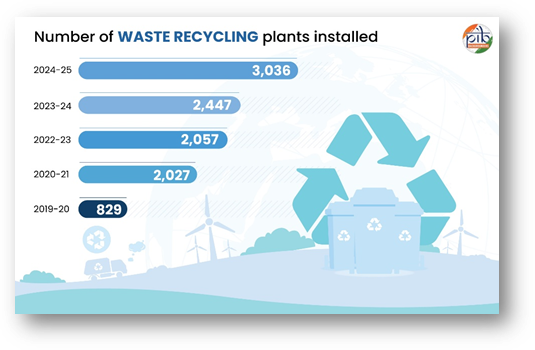
India has strengthened waste management infrastructure significantly. The number of waste recycling plants increased from 829 in 2019–20 to 3,036 in 2024–25, reflecting expanded recycling capacity and supporting Sustainable Development Goal 12.[66]
Extended Producer Responsibility (EPR)
The Ministry of Environment, Forest and Climate Change has notified EPR frameworks for plastic packaging, e-waste, tyres, and batteries. These frameworks strengthen the circular economy and promote scientific waste management.
As of December 2025, 71,401 producers and 4,447 recyclers are registered. They have facilitated recycling of 375.11 lakh tonnes of waste. EPR certificates generation of 339.51 lakh tonnes, out of which 237.85 tonnes has been transferred to producers.
[67]
Effective pollution control and waste management form the foundation of sustainable development. Clean air, safe water and scientific waste processing directly influence public health, productivity and quality of life. By strengthening regulatory enforcement and expanding recycling and resource efficiency, India links environmental protection with economic opportunity, job creation and social well-being, reinforcing that sustainability is integral to inclusive growth.
Sustainable Development and Inclusive Growth
India is a key driver of the Sustainable Development Goals (SDGs), with NITI Aayog serving as the nodal agency to coordinate progress at national and state levels.[68] NITI Aayog monitors performance across all 17 Goals, fostering competitive and cooperative federalism among States and Union Territories. According to the SDG India Index 2023–24, India’s composite score improved to 71, rising steadily from 66 in 2020–21 and 57 in 2018, reflecting sustained national progress.
India has made particularly notable progress in advancing SDG 7 (Affordable and Clean Energy). The share of renewable energy in total installed electricity capacity has reached 51.55% (as of November 2025), marking a major structural shift toward non-fossil fuel energy sources.[69] Complementing this transition, energy efficiency has improved significantly: the CO₂ emissions intensity of the power sector per unit of GDP declined from 61.45 tonnes per ₹ crore in 2015–16 to 40.52 tonnes per ₹ crore in 2022–23,[70] reflecting cleaner and more efficient economic growth. These gains reinforce India’s broader commitment to climate action and sustainable development under the SDG framework.
India’s environmental transformation reflects scale, institutional strength and sustained commitment. Record renewable energy expansion, operational carbon markets, strengthened pollution control, expanded Protected Areas, species recovery programmes, forest and mangrove restoration, wetland conservation and citizen participation together define a comprehensive environmental strategy.
India’s vision of living in harmony with nature by 2050 is supported by measurable action across sectors. By aligning domestic implementation with global cooperation, India continues to contribute to climate stability, biodiversity conservation and sustainable development for present and future generations.
References:
Ministry of Environment, Forest and Climate Change (MoEFCC)
https://moef.gov.in/convention-on-biological-diversity-cbd
https://moef.gov.in/uploads/2022/01/National-Human-Wildlife-Conflict-Mitigation-Strategy-and-Action-Plan-of-India-2.pdf
National Tiger Conservation Authority (NTCA)
http://ntca.gov.in/corridor-management/
Forest Survey of India
India Code
Press Information Bureau (PIB)
Principal Scientific Adviser
Ministry of New & Renewable Energy (MNRE)
MyGov
Ministry of Statistics and Programme Implementation
NITI Aayog
Ozone Cell – Montreal Protocol
NewsOnAir
Click here to see PDF
PIB Research
(Explainer ID: 158047)
आगंतुक पटल : 10135
Provide suggestions / comments