Social Welfare
Jan Vishwas (Amendment of Provisions) Bill, 2026
Simplifying Laws, Strengthening Trust
Posted On:
04 APR 2026 11:46AM
Key Takeaways
- The Jan Vishwas (Amendment of Provisions) Bill, 2026 proposes amendments in 79 Central Acts administered by 23 Ministries, covering 784 provisions across multiple sectors.
- It removes criminal penalties for minor procedural lapses and replaces them with civil penalties or administrative mechanisms.
- The Bill also introduces amendments aimed at improving ease of living, including reforms under the Motor Vehicles Act, 1988 and the New Delhi Municipal Council Act, 1994.
- It reduces compliance burden for MSMEs and businesses by introducing graded enforcement such as advisory notices and warnings before penalties.
|
Introduction: A Journey from Mistrust to Confidence
For many years, several laws in India treated even small procedural mistakes as criminal offences. A missed filing deadline, a wrongly filled form, or a minor paperwork error could sometimes expose citizens and businesses to criminal penalties, including the possibility of imprisonment. Many of these provisions came from older regulatory systems. Recognising the need to make laws more balanced and practical, the Government began a process of reviewing such provisions. An important step in this direction was the Jan Vishwas (Amendment of Provisions) Act, 2023, which removed criminal penalties for a number of minor offences across several Central laws.
The Jan Vishwas (Amendment of Provisions) Bill, 2026 continues this reform effort. It seeks to further reduce the criminalisation of minor violations and replace them with more proportionate civil penalties and administrative mechanisms.
Pillars of Jan Vishwas (Amendment of Provisions) Bill, 2026
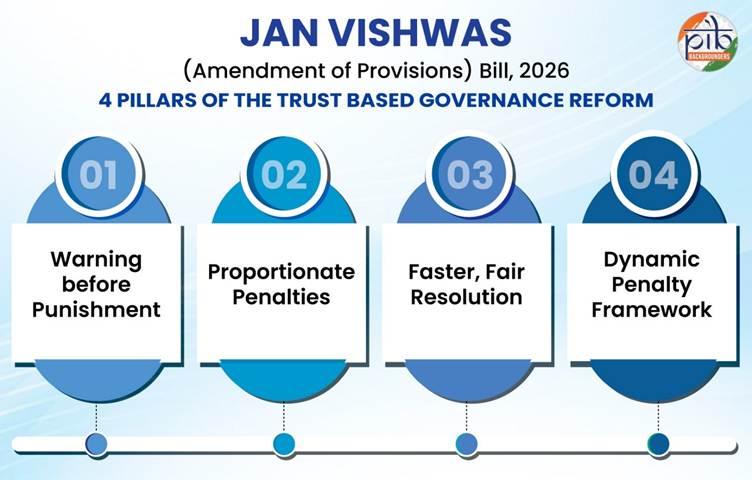
Built on four pillars, the bill aims to create a regulatory environment that encourages compliance while making everyday interactions with the law simpler.
- Warning before Punishment: First-time and minor lapses are addressed through warnings rather than immediate penalties, providing citizens and businesses a fair opportunity to comply.
- Proportionate Penalties: Penalties are calibrated to the severity of the offence, ensuring fair, balanced, and just enforcement.
- Faster and Fair Resolution: Dedicated adjudicating officers and appellate authorities enable swift and transparent resolution, while reducing the burden on courts.
- Dynamic Penalty Framework: Penalties are subject to periodic revision, ensuring that enforcement remains effective, relevant, and responsive over time.
The Jan Vishwas (Amendment of Provisions) Bill, 2026 reimagines the legal landscape by replacing rigid punishments with a more balanced and humane framework. It marks a decisive shift away from excessive criminalisation, converting hundreds of fines and imprisonment clauses into civil penalties and removing many altogether. By reducing jail terms and enabling compounding of offences, the Bill promotes compliance over punishment. It also trims the scope of offences and rationalises imprisonment provisions, ensuring that minor or procedural lapses no longer attract harsh consequences.
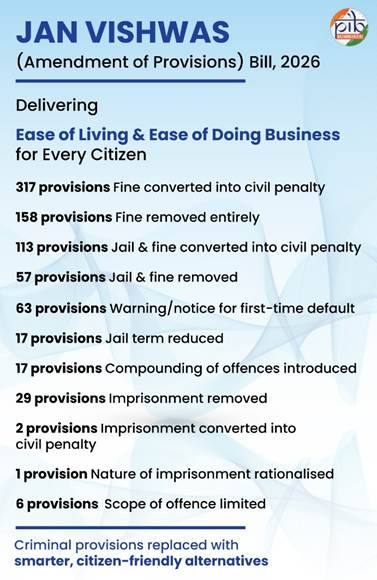
Together, these changes replace criminal sanctions for minor or procedural violations with more practical, citizen-friendly alternatives, reinforcing the objective of improving both ease of living and ease of doing business.
|
Legislative Journey: A Reform Anchored in Deliberation and Consensus
|
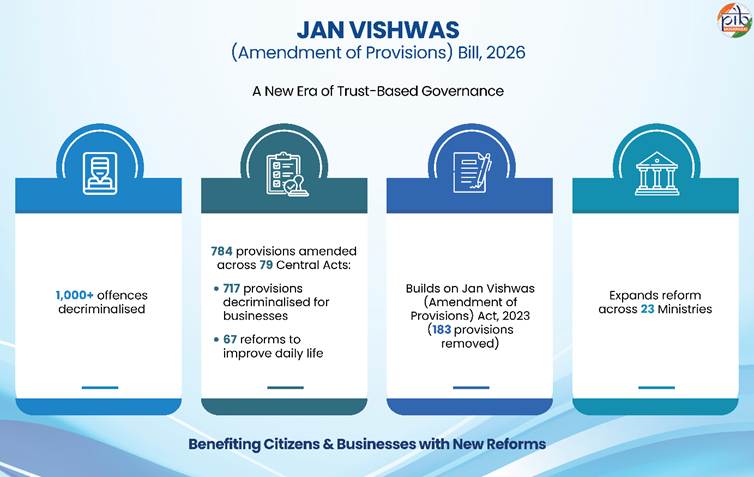
The reform initiative began with the enactment of the Jan Vishwas (Amendment of Provisions) Act, 2023, which amended 42 Central Acts and decriminalised 183 provisions by replacing imprisonment with monetary penalties and other administrative enforcement mechanisms. This marked the first consolidated legislative effort to systematically remove criminal consequences for minor and procedural violations across multiple laws.
Building upon this initiative, the Government undertook a broader review of criminal provisions across Central legislation administered by different ministries and departments. As part of this next phase of reforms, the Jan Vishwas (Amendment of Provisions) Bill, 2025 was introduced in the Lok Sabha on 18 August 2025. The Bill proposed amendments in 16 Central Acts administered by 10 Ministries, covering 355 provisions.
Following its introduction, the Bill was referred to a Select Committee of Parliament for detailed examination. The Committee held 49 sittings and submitted its report to the Lok Sabha on 13 March 2026, recommending further refinements and expansion of the proposed reforms. The committee in addition to the 288 provisions, also examined and proposed amendments in additional 62 Acts for decriminalization.
Based on the recommendations and consultations with the concerned ministries and departments, the scope of the reforms was further expanded to promote ease of doing business and ease of living. The revised legislation, presented as the Jan Vishwas (Amendment of Provisions) Bill, 2026, proposes amendments to 79 Central Acts administered by 23 Ministries, covering a total of 784 provisions, including 717 provisions proposed for decriminalisation and 67 provisions aimed at improving ease of living.
|
Citizen-Centric Reforms: Benefits for the Common Man
|
The Jan Vishwas (Amendment of Provisions) Bill, 2026 introduces several reforms that directly benefit ordinary citizens by ensuring that minor everyday lapses do not result in criminal prosecution.
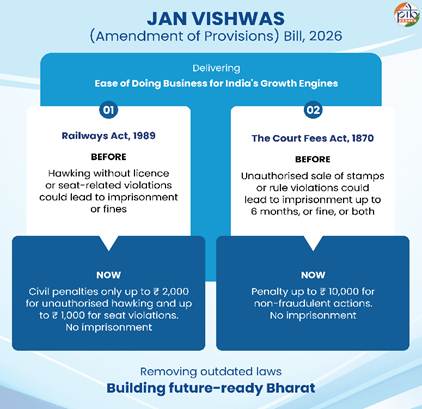
For example, under the Railways Act, 1989, refusing to vacate a berth reserved for another passenger earlier attracted a criminal fine. This has now been converted into a civil penalty of up to ₹1,000, allowing such disputes to be handled administratively rather than through criminal proceedings.
- Under the Court Fees Act, 1870, unauthorised sale of court fee stamps or non-compliance with any rules earlier attracted imprisonment of up to six months along with a fine. The reform replaces imprisonment with a monetary penalty for non-fraudulent actions.
- In the healthcare sector, the Clinical Establishments Act, 2010 earlier allowed criminal prosecution of clinics for minor deficiencies that could be rectified easily. The reform replaces this with a civil penalty of up to ₹10,000, allowing healthcare providers to correct issues without facing criminal charges.
- Under the Calcutta Metro Railway Act, 1985, a passenger caught smoking in a metro carriage or underground station earlier faced criminal prosecution. The reform converts this offence into a civil penalty of ₹2,000, ensuring that a minor lapse in a public space does not result in a criminal case.
Through such reforms, the Bill ensures that routine or minor mistakes in everyday situations do not lead to criminal proceedings, making the legal framework simpler and fairer for ordinary citizens.
|
Ease of Living Provisions under Jan Vishwas Bill
|
In addition to reducing criminal provisions across several laws, the Jan Vishwas (Amendment of Provisions) Bill, 2026 introduces a number of measures that simplify regulatory requirements and improve everyday interactions between citizens and public authorities.
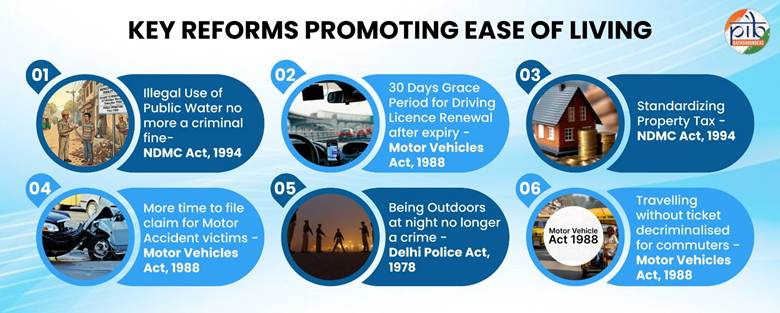
Illegal Use of Public Water Now a Civil Penalty, not a Criminal Fine (NDMC Act, 1994 - Section 295)
Earlier, removing or using water from wells or tanks in violation of a prohibition attracted a criminal fine. The reform replaces this with a fixed civil penalty of ₹1,000, ensuring accountability for misuse of public water while doing away with criminal proceedings for minor municipal violations.
Driving Licence Valid for 30 Days After Expiry - No Immediate Penalty (Motor Vehicles Act, 1988)
Previously, even a one-day lapse in a licence rendered a driver technically non-compliant. The reform introduces a 30-day grace period during which the licence remains valid, shielding ordinary drivers from abrupt penalties and providing a reasonable window for renewal.
NDMC Property Tax Shift Removes Decades-Old Confusion (NDMC Act, 1994)
Residents in the NDMC area faced an inconsistent system where 5% of properties were still taxed under the outdated rateable-value method, while 95% followed the modern unit-area method. The reform standardises taxation by adopting the transparent Unit Area Method across the board, ensuring fairness, predictability, and improved ease of living for all households.
Accident Victims Get More Time to Seek Compensation (Motor Vehicles Act, 1988 - Section 166)
Motor accident victims who are unable to meet the initial filing deadline can now approach the Claims Tribunal up to twelve months beyond the prescribed period, subject to showing sufficient cause. This reform acknowledges that families, often dealing with trauma, medical treatment, disability, or financial hardship, may not be able to act immediately, and ensures they do not forfeit their right to compensation due to delays.
Being Outdoors at Night No Longer a Crime of Suspicion (Delhi Police Act, 1978 - Section 102(c))
Earlier, merely being present in a house, building, or vehicle between sunset and sunrise without a “satisfactory explanation” could attract imprisonment of up to three months. This provision reflected a colonial-era, suspicion-based approach that treated ordinary movement as potentially criminal. The reform abolishes this offence altogether, aligning the law with modern principles. Under the Bharatiya Nyaya Sanhita and contemporary policing standards, greater emphasis is placed on liberty, intent, and evidence rather than vague notions of suspicion. As a result, citizens are no longer exposed to criminal liability simply for being present in public or private spaces at night.
Ticket Issues Become Administrative, Not Criminal (Motor Vehicles Act, 1988 - Section 178)
Earlier, travelling without a ticket or refusing to produce one could attract criminal fines of up to ₹500. The reform reclassifies these offences as civil violations, with penalties up to ₹500, decriminalising routine commuter lapses and enabling faster, more citizen-friendly enforcement.
Together, these reforms make regulatory systems simpler and more practical for citizens, while ensuring that enforcement remains effective and proportionate.
|
Ease of Doing Business Provisions under Jan Vishwas Bill
|
In addition to making an impact on the daily life of the citizens, the Jan Vishwas (Amendment of Provisions) Bill, 2026 also introduces several reforms to make compliance easier for businesses.
Replacing Criminal Penalties with Civil Penalties
The Bill replaces provisions of imprisonment with civil penalties to ensure that businesses are not exposed to criminal prosecution for minor compliance gaps.
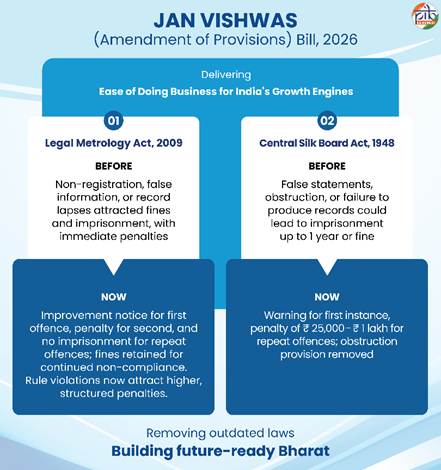
For example, under the Central Silk Board Act, 1948, furnishing incorrect information or failing to produce records earlier carried the possibility of imprisonment. The amendment introduces a warning for the first contravention and monetary penalties for repeated violations. The provision also benefits MSMEs by giving small sericulture businesses an opportunity to correct procedural lapses.
Introducing Graded Enforcement Mechanisms
In many laws, the Bill introduces a graded approach to enforcement, allowing businesses to correct mistakes before facing penalties.
Under the Tea Act, 1953, failure to furnish returns or making false returns earlier attracted fines. The amended framework provides a warning for the first contravention and penalties only for subsequent violations.
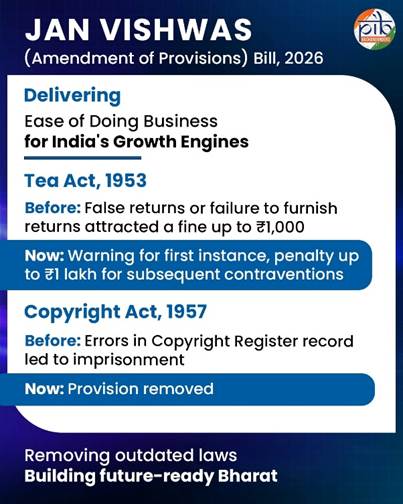
Similarly, under the Copyright Act, 1957, making a false entry in the Register of Copyrights earlier carried the possibility of imprisonment of up to one year. The reform removes this provision, ensuring that authors, artists, and creators are not exposed to criminal liability for administrative or paperwork errors.
Simplifying Compliance for Export and Trade Sectors
Reforms have also been introduced in laws governing trade and exports to reduce compliance burdens on exporters.
Under the Agricultural and Processed Food Products Export Development Authority (APEDA) Act, 1985, procedural offences such as failure to furnish returns will now follow a warning-and-penalty framework instead of immediate punitive action. This gives exporters time to correct genuine mistakes.
Removing Outdated or Redundant Provisions
Some provisions that had become outdated or imposed unnecessary compliance burdens have been removed altogether.
For instance, under the Coir Industry Act, 1953, exporting coir products without a licence under an obsolete regulatory framework earlier attracted fine. This provision has been removed, eliminating an outdated compliance requirement, further benefitting small coir MSME exporters.
Through these measures, the Bill seeks to create a regulatory environment that is more predictable, practical, and supportive of business activity, while ensuring that serious violations continue to attract appropriate penalties.
|
Benefits for MSMEs under Jan Vishwas Bill
|
The Jan Vishwas (Amendment of Provisions) Bill, 2026 introduces several reforms that reduce compliance burdens for Micro, Small and Medium Enterprises (MSMEs). The Bill provides small businesses an opportunity to correct mistakes without facing immediate punitive action.
• Under the Legal Metrology Act, 2009, failure to maintain or produce required records earlier attracted immediate penalties. The amendment introduces an improvement notice for the first lapse, allowing MSME importers to rectify compliance gaps before penalties are imposed.
• Under the Private Security Agencies Act, 2005, failure to display a licence at the business premises earlier attracted a criminal fine of up to ₹25,000. This provision has now been removed, recognising that such procedural lapses should not result in criminal liability for small security agencies.
• Under the Delivery of Books and Newspapers (Public Libraries) Act, publishers failing to deposit copies earlier faced fines. The reform introduces a warning mechanism, protecting small publishers from disproportionate penalties for procedural delays.
- Under the MMDR Act, 1957 relating to Mines and Minerals: The contravening rules made under the Act earlier carried imprisonment of up to two years or a fine. The reform replaces imprisonment with a monetary penalty of up to ₹50 lakh, ensuring that small mining and mineral-based enterprises face proportionate financial consequences instead of criminal prosecution for procedural violations.
Through these measures, the Bill supports MSMEs by simplifying compliance requirements, reducing regulatory uncertainty, and encouraging voluntary compliance while ensuring that serious violations continue to attract appropriate penalties.
|
Key Legislative Changes: Important Acts Amended
|
Covering a wide range of sectors and regulatory areas, the Jan Vishwas (Amendment of Provisions) Bill, 2026 proposes amendments across several Central laws with proportionate civil penalties, warnings, or administrative mechanisms.
- Under the Drugs and Cosmetics Act, 1940, failure to disclose the place where certain drugs (Ayurvedic, Siddha and Unani Drugs) are manufactured or stored earlier carried imprisonment of up to six months along with a fine. The amendment replaces imprisonment with a higher monetary penalty.
- Several provisions under the Delhi Municipal Corporation Act, 1957 have also been rationalised. Minor civic violations such as hawking without a licence, obstruction of municipal authorities, or certain sanitation-related offences earlier attracted criminal fines. These have been converted into civil penalties, while some outdated provisions have been removed altogether.
- Reforms have also been proposed under the Apprentices Act, 1961, where several offences related to procedural non-compliance are proposed to follow a three-stage enforcement mechanism advisory for the first contravention, warning for the second, and monetary penalties for repeated violations.
In addition, amendments have been proposed in laws such as the Agricultural and Processed Food Products Export Development Authority Act, 1985, the Road Transport Corporations Act, 1950, and the Coir Industry Act, 1953, where imprisonment or criminal fines for minor procedural lapses have been replaced with civil penalties or removed entirely.
The Jan Vishwas (Amendment of Provisions) Bill, 2026 continues the Government’s effort to modernise India’s regulatory framework. By removing criminal penalties and introducing graded enforcement mechanisms, the Bill makes laws more practical and proportionate.
These reforms reduce unnecessary compliance burdens for both citizens and businesses. At the same time, serious violations continue to attract appropriate penalties. The Bill therefore promotes a more balanced and trust-based regulatory system that supports both ease of living and ease of doing business.
References
Ministry of Commerce & Industry
https://www.pib.gov.in/PressReleaseIframePage.aspx?PRID=1945263®=3&lang=2
PIB Research
See in PDF
(Explainer ID: 158002)
आगंतुक पटल : 1330
Provide suggestions / comments