Security
Beyond Battlefield: Indian Armed Forces in Humanitarian Assistance and Disaster Relief
Posted On:
15 FEB 2026 11:22AM
Key Takeaways
- Indian Armed Forces, while safeguarding India’s sovereignty and borders, also act as first responders and enablers of national resilience through humanitarian, medical and disaster relief support.
- The 2004 Indian Ocean tsunami was a watershed moment for India’s HADR framework because the disaster’s scale and reach demanded an unprecedented, coordinated tri-services response. The Army, Navy, Air Force, and Coast Guard deployed extensive manpower, equipment, and logistics across land, sea, and air.
- 3,992 Indians were repatriated by sea over 55 days under Operation Samudra Setu during Covid-19, pandemic.
- In 2025, the Indian Army deployed 141 columns across 80+ locations in ten states, rescuing 28,293 civilians, providing medical aid to 7,318 people, and delivering relief assistance to 2,617 individuals.
- Under Operation Brahma in March 2025, a 60-bed Indian Army field hospital in Myanmar treated over 2,500 injured earthquake victims within two weeks; six aircraft, five Indian Naval ships delivered 750 MT of HADR material
- Operation Sagar Bandhu was undertaken following Cyclone Ditwah in 2025, to restore connectivity in Sri Lanka, evacuate over 2,500 people and delivered 1,058 tonnes of relief material while IAF evacuated 264 survivors including foreign nationals.
Introduction
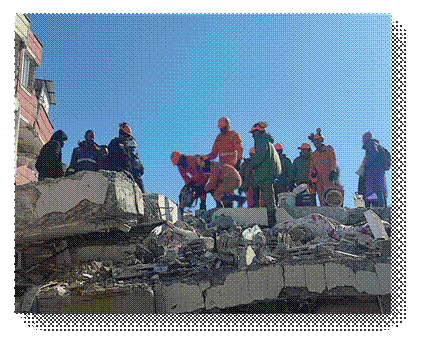
Humanitarian Assistance and Disaster Relief (HADR) operations are a vital part of India’s global engagement. As natural and man-made disasters become more frequent and severe, India draws on its extensive disaster management experience to provide timely, coordinated, and well-organized assistance internally and to affected countries. The ability to work in hostile environment, organizational skills and logistics know-hows make the armed forces most suited for HADR operations, and they are often the first responders in the event of any disaster. The objective of HADR is ensuring a “prompt, efficient, coordinated, and responsive” reaction when disasters overwhelm civilian capacities. The Government of India often deploys the Armed Forces to augment national and international relief efforts when civilian capacities are stretched.
India’s humanitarian aid and disaster relief to our partner countries is focused on providing timely assistance to save lives, alleviate suffering, maintain and protect human dignity during and post disaster.
The Indian Army undertakes the deployment of troops for rescue and relief, establishment of field hospitals, restoration of essential infrastructure, and delivery of humanitarian aid. The Indian Navy plays a critical role through evacuation of Indian nationals from abroad, transportation of relief material, and deployment of ships and helicopters for maritime and littoral assistance. The Indian Air Force provides strategic and tactical airlift by ferrying relief supplies, medical teams, and disaster response personnel to affected areas, while also undertaking evacuation and rescue missions. Complementing these efforts, the Indian Coast Guard assists during cyclones, tsunamis, earthquakes, oil platform fires, and flooding in coastal regions, ensuring rapid response and maritime safety.
Genesis, Policy & Institutional Framework
India’s Humanitarian Assistance and Disaster Relief (HADR) posture is anchored in a robust policy and institutional architecture that enables coordinated, timely, and credible responses to humanitarian crises, both overseas and within the country. While the term HADR is primarily used for international engagements, domestic disaster response is governed through a statutory framework, together reflecting a whole-of-government approach integrating diplomacy, defence, disaster management, and public health capacities.
Policy Framework
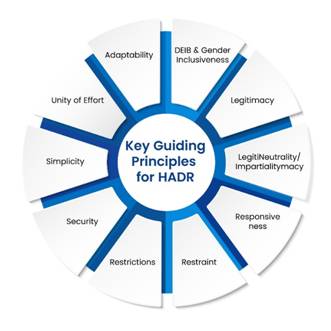
For international HADR operations, India’s approach is guided by the Agenda No. 10 (Bring about greater cohesion in international response to disasters) of Hon’ble PM’s 10-point agenda on Disaster Risk reduction. NDMA’s has also issued International HADR Guidelines (October 2024). These guidelines institutionalise overseas disaster response and are grounded in key principles, including respect for the sovereignty and territorial integrity of affected states, adherence to international humanitarian law and human rights standards, and commitments to transparency, accountability, and ethical conduct. The guidelines also implicitly align with the UNDRR Gender Action Plan (2024), reinforcing inclusivity in humanitarian action. Importantly, they formally recognise the Indian Armed Forces as pivotal enablers of rapid response, mandating their role in strategic lift, logistics, medical support, evacuation, and engineering tasks, with increasing emphasis on technology integration, such as drones and AI-enabled forecasting.
Domestically, national disaster response is governed by the Disaster Management Act, 2005, which establishes a three-tier institutional framework at the national, state, and district levels through the NDMA, SDMAs, and UDMAs/DDMAs. In India’s, the primary responsibility for disaster response rests with State Governments, while the Central Government plays a supportive and coordinating role, providing financial, logistical, and technical assistance. At the national level, overall command, control, and coordination during major disasters is overseen by the National Crisis Management Committee (NCMC) under the Cabinet Secretary, with the Ministry of Home Affairs (MHA) serving as the nodal ministry for disaster response. The National Executive Committee (NEC) coordinates inter-ministerial actions, while response at the ground level is led by District Disaster Management Authorities under the District Magistrate, operating through Incident Command Teams (ICTs). The Act also provides legal backing for civil–military coordination under the principle of Aid to Civil Authorities.
Key Institutions Involved
- Ministry of External Affairs (MEA): The nodal ministry for India’s overseas HADR engagement, responsible for diplomatic coordination, requests from affected states, and international outreach.
- Rapid Response Cell (RRC), MEA: Established in 2021, initially for COVID-19 coordination, the RRC now functions as a central coordination hub for overseas HADR, liaising with NDMA, NDRF, Armed Forces, Airports Authority of India, and other Union ministries.
- Ministry of Home Affairs (MHA): The 24x7 functional Integrated Control Room for Emergency Response (ICR-ER) of MHA, in coordination with NDRF, NDMA and MEA coordinates for HADR activities and coordinates international HADR missions from India in close cooperation with MEA and other stakeholders.
- In coordination with MHA and MEA, the NDMA manages central control room operations for HADR activities and coordinates international HADR missions from India in close cooperation with other stakeholders.
- Headquarters Integrated Defence Staff (HQ IDS) under the Ministry of Defence (MoD): Provide strategic lift, logistics, medical support, engineering capabilities, and rapid deployment assets.
- National Disaster Management Authority (NDMA): The apex policy body that frames guidelines and coordination mechanisms for disaster response, including international HADR.
- National Disaster Response Force (NDRF): Deploys specialised disaster response teams when required.
- Ministry of Health & Family Welfare (MoH&FW): Leads medical and public health support in HADR through emergency medical teams, disease surveillance, global coordination, and inclusive healthcare delivery. Coordinates, with World Health Organization and other health agencies for public health management.
Together, these institutions and guidelines ensure that India’s HADR responses are structured, swift, and strategically coherent.
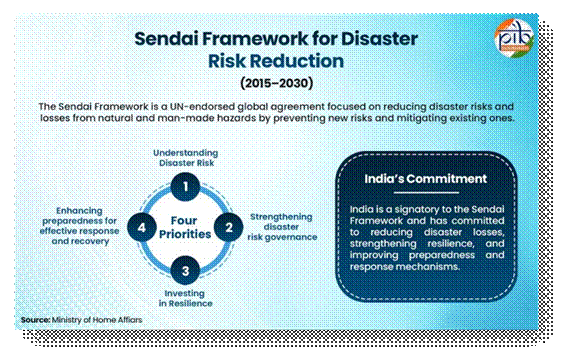
The framework mandates Armed Forces' role in rapid deployment, with emphasis on tech integration (drones, AI for forecasting). The NDMA’s HADR Guidelines formally recognize the pivotal role of the Indian Armed Forces in disaster relief operations: the Army may deploy troops and set up field hospitals; the Air Force is tasked with airlifting relief personnel, medical aid, and evacuating people; the Navy can use ships for evacuation, transport of relief goods, and its Coast Guard supports in maritime disasters like cyclones or tsunamis. This approach is aligned with India’s commitments under the Sendai Framework for Disaster Risk Reduction (2015–2030), which emphasises preparedness, resilience, effective response, and coordinated recovery.
Domestic Humanitarian Initiatives
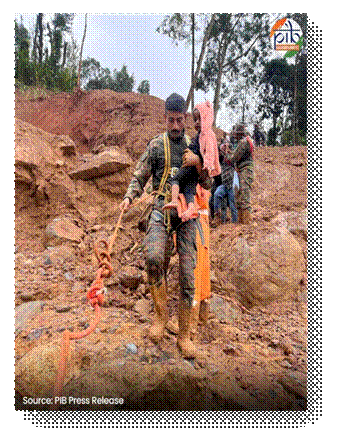
The Indian Armed Forces are routinely mobilized for national disaster response, including floods, cyclones, earthquakes, landslides and industrial or transport accidents, and operate as an integral part of the national HADR architecture alongside NDMA, NDRF, State Disaster Response Forces and civil administration. These missions demonstrate the Services’ ability to deploy air, land and sea assets rapidly for rescue, relief, medical assistance, evacuation and restoration of critical infrastructure.
Indian Ocean Tsunami (2004) The 2004 Indian Ocean tsunami was a watershed moment for India’s HADR framework. The sheer scale and wide geographic spread of the catastrophe necessitated an unprecedented, coordinated response. This involved the joint deployment of the Army, Navy, Air Force and Coast Guard, with massive mobilisation of manpower, platforms and logistics across land, sea and air domains. Under Operation Seawave, the Indian Air Force played a pivotal role, launching immediate search-and-rescue missions on 26 December 2004 with Mi-8 helicopters from Carnic airfield. Sustained daily operations in the Andaman & Nicobar Islands involved IL-76, AN-32, HS-748 aircraft and helicopters, enabling large-scale airlift of relief material, evacuation of survivors, and search-and-rescue missions. The operation also extended humanitarian assistance to Sri Lanka and Maldives, with HS-748 aircraft and Mi-8/Mi-17 helicopters operating daily, airlifting approximately 17 tonnes of relief material and evacuating personnel as required. This established a template for future tri-service HADR coordination.
The massive relief and rescue operations launched by the States and the Government of India had helped in normalizing the situation very early. About 20,900 personnel from Army, Navy, Air Force, Coast Guard and Para Military Forces were deployed. 40 Naval/Coast Guards ships, 34 aircrafts and 42 helicopters were part of the massive operations. 28,734 persons were rescued on the mainland and more than 6000 stranded people including tourists from Andaman & Nicobar Islands, were brought to the mainland. 6.36 lakh persons in all were moved to safer places and kept in 930 relief camps.
Assistance to Maldives (Operation Castor)
Three vessels were launched for Male. They were INS Mysore, INS Udaygiri and INS Aditya. INS Mysore had two helicopters and others had one each. INS Aditya was carrying water and had a water purification plant. Medical teams, medical supplies and relief equipment were also on-board. INS Mysore reached on Dec 28, 2004, INS Udaygiri on Dec 29,2004 and INS Aditya on Dec 30,2004.
Assistance to Sri Lanka (Operation Rainbow)
Sri Lanka’s request for assistance in searching for fishermen and boats missing at sea was responded to by our Navy. In addition, a Dornier aircraft landed a medical team and 600kg of medical supplies in Colombo on Dec 26, 2004. 4 vessels had been launched for Sri Lanka. INS Sharda and INS Sutlej were headed towards Galle. They reached on Dec 27, 2004. Two vessels had been launched for Trincomalee and they reached on Dec 27, 2004. These were INS Sandhayak and INS Sukanya. All vessels had helicopters and divers. Medical teams, medical supplies and relief equipment were also on-board.
Uttarakhand floods (June 2013) In the 2013 Uttarakhand disaster, multiple Service commands (Army, IAF, ITBP and NDRF) mounted large-scale rescue and evacuation operations; the IAF (Operation Rahat) and Army (Operation Surya Hope) executed thousands of sorties and rescued/evacuated large numbers of stranded people. IAF dropped 730MT of essential commodities at different places. C-130 J “Super Hercules”, MI- 26, MLH, ALH, Cheetah and Mi-17V5 were used during the rescue operations in the Uttarakhand disaster 2013.
Jammu & Kashmir floods (September 2014) The Indian Air Force launched Operation Megh Rahat to support large-scale rescue and relief operations during the 2014 Jammu & Kashmir floods. Around 70 IAF aircraft were deployed in coordination with the Indian Army, NDRF, and civil agencies, rescuing over 96,000 people and airlifting more than 3,500 tonnes of relief material to affected areas. Relief effort included medical aid, shelter and food provided to approximately 2,18,000 civilians. An Indian Navy diving team comprising 10 divers led by an officer along with two Gemini craft, diving and rescue equipment were deployed for relief operations
Kerala floods (August 2018) Defence forces and NDRF/National assets were heavily engaged -40 helicopters, 31 aircraft, 182 rescue teams, 18 medical teams of Defence forces, 58 NDRF teams and over 500 boats were used; more than 60,000 people were rescued or shifted to relief camps. IAF and Navy air/sea assets conducted extensive air-lifts and airdrops of relief material.
Cyclone Fani (May 2019) The Indian Navy pre-positioned ships and teams (medical teams, divers, relief material) to undertake HADR and evacuation operations along the Odisha coast. The central response included deployment of multiple NDRF teams, Army engineering columns, aircraft/helicopters and naval ships. During Cyclone ‘Fani’, Government had 19 columns of Army, 09 Engineering Task Force (ETF), 27 aircraft/helicopters and 16 Ships of Armed Forces for relief and rescue operations.
Cyclone Amphan (May 2020) Ahead of and after landfallin eastern India, specifically in West Bengal and Odisha, the IAF maintained a high state of preparedness and supported relief operations, while central/state agencies coordinated evacuation and relief. A total of 56 Heavy and Medium Lift assets comprising of 25 fixed-wing aircraft and 31 helicopters were earmarked by the IAF.
Glacial Lake Outburst, South Lhonak (October 2023) A Glacial Lake Outburst in South Lhonak, located in Sikkim's far northwestern region,produced a ~50-60 ft surge in the Teesta. Operation HIMRAHAT was launched to rescue stranded civilians in snowbound areas of Lachung and forward areas of East Sikkim. 1,247 tourists were evacuated to safe locations.
NHIDCL Tunnel Rescue Operation (November 2023) Following the collapse of the under-construction Silkyara–Dandalgaon, tunnel (Uttarakhand) on 12 Nov 2023, trapping 41 workers, the Indian Army promptly deployed engineer columns and tunnelling experts to assist in rescue efforts. The operation concluded successfully on 29 Nov 2023 with all workers safely rescued.
Cyclone Michaung, Chennai (Dec 2023) Following heavy rains and flooding of River Adyar and Manapakkam Canal on 4 Dec 2023, the Indian Army rescued 230 civilians, concluding operations on 7 Dec. In a subsequent flood relief effort on 18 Dec 2023, two Army columns rescued 1,083 civilians from inundated areas of Chennai.
Nationwide Flood and Landslide Relief Operations (2024) The Indian Army deployed 83 columns, including the Eco Task Force (ETF), across fourteen states to support disaster relief operations. During these missions, 29,972 civilians were rescued, medical assistance was provided to around 3,000 people, and relief material was distributed to over 13,000 civilians. Major relief efforts were conducted in Manipur (May 2024), Wayanad, Kerala (July 2024), Uttarakhand (July 2024), and Gujarat (August 2024).
Nationwide Flood and Landslide Relief Operations (2025) During 2025, the Indian Army deployed 141 columns, including Engineer Task Forces, across more than 80 locations spanning ten states. These operations resulted in the rescue of 28,293 civilians, provision of medical assistance to 7,318 individuals, and distribution of relief material to 2,617 people.
Major relief operations were conducted in Assam (Coal Miners Rescue, January 2025), Telangana (Tunnel Rescue Operation, February 2025), and Uttarakhand (Avalanche Rescue Operation in Chamoli District, February 2025, and Dharali Cloudburst Rescue Operation, August 2025). Additional flood relief operations were undertaken in Manipur and Tripura (June 2025), Jammu & Kashmir and Punjab (August 2025), and Maharashtra (September 2025).
Major International HADR Operations/Evacuation / Relief Operations
India has established itself as a dependable first responder in the Indian Ocean Region and beyond, extending timely humanitarian assistance, evacuation, and relief operations during crises across the globe. The coordinated efforts of the Indian Army, Navy, and Air Force under the Government’s vision of “VasudhaivaKutumbakam” and SAGAR (Security and Growth for All in the Region) reflect India’s enduring commitment to global peace and compassion. The flagging-off of INS Sunayna as IOS SAGAR in April 2025, from Karwar (Karnataka) with 44 naval personnel from Comoros, Kenya, Madagascar, Maldives, Mauritius, Mozambique, Seychelles, Sri Lanka and Tanzania, highlights India’s commitment to collective maritime security, capacity-building and cooperation, strengthening SAGAR’s vision of shared growth and stability in the Indian Ocean Region. Together, these initiatives reflect India’s evolving HADR and maritime outreach doctrine, where swift disaster response on land, complements proactive naval diplomacy and collective security efforts.
Operation Maitri (Nepal, 2015) Operation Maitri was India’s rapid response to the April 2015 Nepal earthquake; it involved coordinated deployment of IAF aircraft, Army engineer’s task force, NDRF teams and MEA diplomacy. Within four hours of the Nepal earthquake, the IAF launched relief operations and rescued 11,200 people. It deployed C-130J, C-17, and IL-76 aircraft to airlift 295 NDRF personnel, 46.5 tonnes of relief material, and five sniffer dogs. The fleet included C-130J Super Hercules, C-17 Globemaster III, IL-76 Gajraj, An-32, and eight Mi-17 series medium-lift helicopters (including Mi-17 V5). Moreover, India announced a major reconstruction assistance package for Nepal, pledging US $1 billion, including a substantial grant component, as part of its post-earthquake relief and long-term development support. This was in addition to an existing US $1 billion bilateral assistance programme, taking India’s total commitment to US $2 billion over five years.
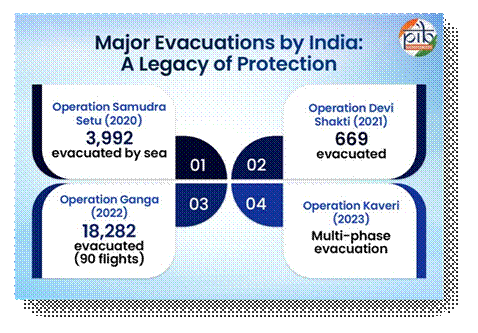
Operation Devi Shakti (Afghanistan, 2021) The operation saw India evacuate 669 people from Afghanistan in 2021, including 448 Indian nationals, 206 Afghans from minority communities, and 15 foreign nationals, using a mix of Indian Air Force and Air India flights. A special flight on 10 December brought back 10 Indians, 94 Afghans, and 2 Swaroops of Guru Granth Sahib along with ancient Hindu manuscripts. The Government also ensured the safe return of five holy saroops of Sri Guru Granth Sahib and dispatched medical relief supplies for the Indira Gandhi Children’s Hospital, Kabul, handed over to WHO officials.
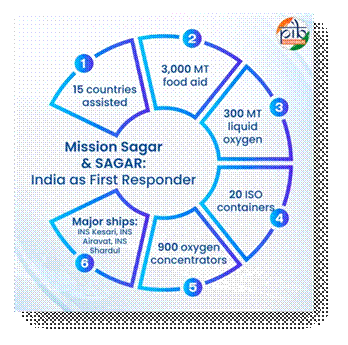
Mission Sagar (Indian Ocean Region, 2020–2022; and follow-ons) Naval HADR under SAGAR: Launched in May 2020 under the Prime Minister’s vision of SAGAR (Security and Growth for All in the Region), Mission Sagar has seen successive Indian Navy deployments delivering humanitarian aid to foreign countries across the Indian Ocean. During Covid-19, ships such as INS Kesari, INS Airavat, and others provided over 3,000 MT of food aid, 300 MT of liquid medical oxygen, 900 oxygen concentrators, and 20 ISO containers to 15 nations, including the Maldives, Mauritius, Seychelles, Madagascar, Comoros, Sudan, and Mozambique. These missions, executed in close coordination with the Ministries of Defence and External Affairs, reaffirm India’s role as the first responder in the region.
Operation Samudra Setu (2020) Launched on 5 May 2020, Operation Samudra Setu, meaning “Sea Bridge”, was the Indian Navy’s large-scale sea evacuation mission during COVID-19. Over approximately 55 days, the operation brought home 3,992 Indian citizens by sea using ships like INS Jalashwa, INS Airavat, INS Shardul and INS Magar, traversing over 23,000 km.
Operation Ganga (Ukraine, 2022) In February-March 2022, India launched a major evacuation effort during the Ukraine conflict, rescuing 18,282 citizens through 90 flights-76 commercial and 14 IAF. The Government of India fully funded the mission, ensuring that students and their families incurred no evacuation costs.
Operation Dost (Türkiye and Syria, 2023) A7.8-magnitude earthquake struck areas of Syria and southeast Türkiye on 6 February 2023. The scale of the disaster demanded urgent global action. India was among the first countries to respond. It rapidly extended humanitarian assistance to the affected regions. Drawing on its extensive experience in humanitarian assistance and disaster relief, India swiftly mobilized resources to support Türkiye during this critical period. As part of India’s humanitarian response to the Turkey earthquake, Operation Dost was launched in 2023. An Indian Army Field Hospital with 99 medical specialists and paramedics was established at Iskenderun, Hatay Province, providing over 1,000 medical consultations, performing 4 major and 58 minor surgeries, and conducting extensive diagnostic and emergency care for affected civilians. In addition, personnel and equipment have been sent to set up a 30-bed self-sustained field hospital of the Indian Army. India has been able to send more than 250 personnel, specialized equipment and other relief material amounting to more than 135 tons to Türkiye on 5 C-17 IAF aircrafts. As regards Syria, more than 6 tons of emergency relief assistance has been delivered through a C130J IAF aircraft to Damascus.
Operation Kaveri (Sudan, April 2023) Launched on 19 April 2023, Operation Kaveri was a coordinated evacuation mission by the Indian Armed Forces using Indian Air Force and Indian Navy assets. A total of 2,171 Meals Ready to Eat (MREs) were provided by the Indian Army for Indian nationals. Evacuation operations were carried out from Port Sudan to Jeddah, and subsequently from Jeddah to India, ensuring the safe return of all evacuees.
Operation Brahma (Myanmar, 2025) Under Operation Brahma, India’s humanitarian support to earthquake-hit Myanmar continued through mid-April 2025, strengthening relief, medical care, and infrastructure assistance. India has been the first responder since the disaster on 28 March, providing approximately 750 tonnes of humanitarian aid, including essential medicines, foodgrain, tents, blankets, rapidly deployable surgical and medical shelters, water sanitation and drinking water, and prefabricated office structures. A200-bed field hospital treated over 2,500 patients, while an 80-member NDRF Heavy Urban Search and Rescue team and a 127-member Indian Army field hospital team were deployed to support ongoing efforts. From the maritime front, Indian Naval Ships Satpura and Savitri, operating under the Eastern Naval Command, sailed for Yangon on 29 March 2025 carrying 40 tonnes of HADR material, which was handed over to the Chief Minister of Yangon on 31 March 2025. Indian Naval Ships Karmuk and LCU 52, deployed from the Andaman and Nicobar Command, sailed for Yangon on 30 March 2025 carrying 30 tonnes of relief material, including HADR pallets containing essential clothing, drinking water, food, medicines, and emergency stores. These consignments were handed over at Yangon Port on 1 April 2025. Additionally, Indian Naval Ship Gharial departed from Visakhapatnam Port on 1 April 2025 for Yangon and delivered 442 MT of food aid, comprising 405 metric tons of rice, 30 metric tons of cooking oil, 5 metric tons of biscuits, and 2 metric tons of instant noodles, intended to meet the immediate food requirements of the affected population in Myanmar.
Complementing the sea effort, an IAF C-130J transported around 16 tonnes of relief material, including tents, generators, drinking water, food supplies, and essential medicines. On 15 April, the IAF despatched 20 pre-fabricated office modules to Naypyidaw, demonstrating India’s sustained commitment to Myanmar’s recovery.
Operation Sagar Bandhu (2025) Under Operation Sagar Bandhu, launched on 28 November 2025, India continues to provide comprehensive HADR support to Sri Lanka following Cyclone Ditwah. As of 9 December 2025, India has delivered about 1,058 tonnes of relief material, including dry rations, tents, tarpaulins, hygiene kits, clothing, water purification kits, and around 4.5 tonnes of medicines and surgical equipment, besides 60 tonnes of specialised equipment. Indian Navy ships INS Vikrant, INS Udaygiri, INS Sukanya, INS Gharial and LCUs L51, L54 and L57 transported over1,000 tonnes of relief from Tamil Nadu to Colombo and Trincomalee. IAF Mi-17 helicopters evacuated 264 survivors and airlifted 50 tonnes of supplies, while over 2,500 stranded Indians were evacuated, including 400 by IAF aircraft. A para field hospital at Mahiyanganaya has treated over 2,200 patients, and 248 tonnes of Bailey Bridge equipment with Army engineers are restoring critical connectivity. A 120-foot dual carriageway Bailey Bridge, weighing 110 tonnes, was opened on December 23, 2025, in Kilinochchi District of Sri Lanka’s Northern Province, one of the areas worst affected by Cyclone Ditwah. The bridge was airlifted from India and installed under Operation Sagar Bandhu, restoring critical connectivity and supporting relief and recovery efforts.
India’s response to disasters domestically and internationally, exemplifies its institutionalized HADR framework, where rapid tri-services deployment and MoD-led coordination enable an integrated land–sea–air response. Such operational experience directly informs recent multi-agency preparedness initiatives, strengthening interoperability, information-sharing and whole-of-government crisis management for future regional emergencies.
Recent Developments and Preparedness
Focusing on multi-agency engagement, the efforts strengthen communication, interoperability and faster crisis response at national and regional levels. Promoting a synergistic approach among the Civil Administration, Armed Forces and key disaster-management stakeholders, these initiatives enable the exchange of domain knowledge, experience and best practices. Together, they enhance preparedness, swift mobilisation and effective joint all-domain operations during large-scale emergencies and reinforce the need for collaborative HADR management.
Exercise Samanvay(2022) The Indian Air Force conducted the annual Joint HADR ExerciseSamanvay 2022 at Air Force Station Agra from 28–30 November 2022, with participation from national stakeholders like NDMA, NDRF, DRDO, BRO, IMD and civil administration, along with representatives from ASEAN countries. The drill included a seminar on disaster management, a multi-agency capability demonstration, and a tabletop exercise to test institutional preparedness.
Exercise Chakravat(2023) “Chakravat 2023,” Annual Joint HADR Exercise, was conducted by the Indian Navy in Goa from 9–11 October 2023, bringing together key national agencies such as the Armed Forces, NDMA and NDRF. The drill also saw participation from eight friendly foreign nations, Comoros, Madagascar, Maldives, Mauritius, Mozambique, Seychelles, Sri Lanka and Tanzania, strengthening regional cooperation. The exercise focused on coordinated disaster response, interoperability and joint preparedness for large-scale emergencies.
Exercise Sanyukt Vimochan2024 The Indian Army conducted the multilateral annual joint HADR exercise ‘Sanyukt Vimochan 2024’ at Ahmedabad and Porbandar on 18–19 November 2024, demonstrating India’s disaster response readiness. The exercise featured coordinated logistics, rapid response, rescue operations, casualty evacuation, and rehabilitation with agencies including the Indian Armed Forces, NDMA, NDRF, and state forces, highlighting collaborative disaster management capabilities.
Exercise Tiger Triumph (2025) The fourth edition of the Tri-Service HADR exercise Tiger Triumph 2025, between India and the United States was held from 1–11 April, 2025. The Indian side was represented by Indian Naval Ships Jalashwa, Gharial, Mumbai and Shakti with integral helicopters and landing crafts embarked, Long Range Maritime Patrol Aircraft P8I, Army Troops from 91 Inf Brigade and 12 Mech Infantry Battalion, Air Force C-130 Aircraft and MI-17 Helicopters, along with the Rapid Action Medical Team (RAMT) working in close coordination with US Navy, Marine Corps, Army and Air Force units. The exercise significantly enhanced joint interoperability, command-and-control procedures and disaster-relief readiness between India and the United States.
India’s commitment to HADR is firmly anchored in its strategic vision of promoting regional stability and strengthening global cooperation. These missions highlight the Armed Forces' commitment to "Nation First," transforming adversity into opportunities for resilience. The humanitarian assistance underlines India’s commitment to its ‘Neighbourhood First’ policy and the timeless Indian ethos of ‘VasudhaivaKutumbakam’ – the world is one family. The Indian Army continues to stand shoulder to shoulder with friendly nations in times of crisis, reflecting India’s resolve to be a first responder in the region.
References:
Ministry of Defence (MoD)
Press Information Bureau
Ministry of External Affairs https://www.mea.gov.in/press-releases.htm?dtl/39421/Operation_Brahma__Support_to_Myanmar_continues_April_16_2025
· https://www.mea.gov.in/distinguished-lectures-detail.htm?492&utm
· https://www.hcicolombo.gov.in/section/press-releases/2under-operation-sagar-bandhu-1000-tonnes-of-relief-material-fromtamil-nadu-arrives-in-sri-lanka
· https://www.mea.gov.in/rajya-sabha.htm?dtl%2F39214%2FQUESTION+NO2324+RELIEF+AND+MEDICAL+ASSISTANCE+TO+OTHER+NATIONS
High Commission of India, Colombo, Sri Lanka
National Disaster Management Authority/National Disaster Response Force/National Institute of Disaster Management
· https://ndma.gov.in/Governance/Guidelines
Indian Army
All India Radio
Commerce Ministry
Department Of Atomic Energy
English PDF
***
PIB Research
(Explainer ID: 157371)
आगंतुक पटल : 1846
Provide suggestions / comments