Economy
Union Budget 2026–27: Strengthening India’s Textile Value Chain
Posted On:
04 FEB 2026 9:58AM
Key Takeaways
· The Union Budget 2026-27 places Textiles at the centre of growth strategy with focus on employment, exports, rural livelihoods and sustainable manufacturing.
· Push for scale and modern manufacturing through mega textile parks and support for MMF and technical textiles.
· MSMEs and artisans supported through liquidity measures, cluster modernisation and skilling initiatives.
· Policy direction emphasises scale, sustainability and competitiveness to strengthen India’s position in global textile value chains.
|
Textiles Take Centre Stage in Union Budget 2026-27
The Union Budget 2026–27 lays emphasis on scaling up manufacturing in strategic, frontier sectors including Textiles.
|
India’s textile sector is one of the nation’s oldest and most diverse industries, deeply rooted in centuries-old traditions. The Union Budget 2026–27 places the textile sector at the heart of India’s growth, underlining its strategic importance to the economy. By prioritising this labour-intensive industry, the Budget acknowledges textiles as a key driver of job creation, export growth, rural livelihoods and sustainable manufacturing.
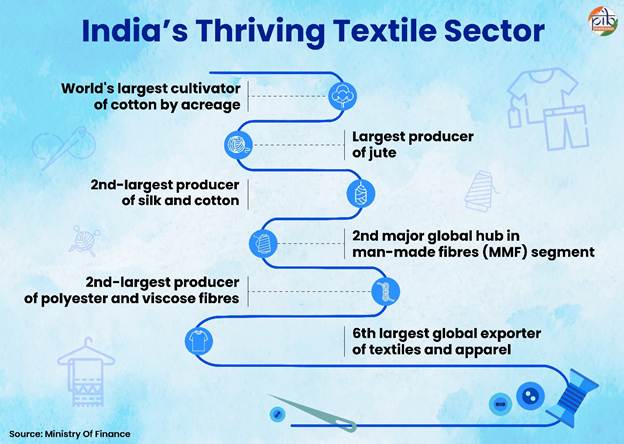
Notably, the Indian textile sector possesses significant intrinsic strengths- the country is the world's largest cultivator of cotton by acreage, the largest producer of jute, the second-largest producer of silk and cotton, second major global hub in the man-made fibres (MMF) segment and the second-largest producer of polyester and viscose fibres.
Weaving Growth: How Budget 2026–27 Boosts India’s Textile Sector
In the Union Budget 2026-27, a comprehensive and integrated policy framework has been declared to bolster the entire textile value chain- from fibre to fashion, from village industries to global markets.
Integrated Programme for the Textile Sector
With the objective of boosting competitiveness, fostering self-reliance and creating jobs, the Government has proposed an Integrated Programme for the textile sector, structured around five sub-components:
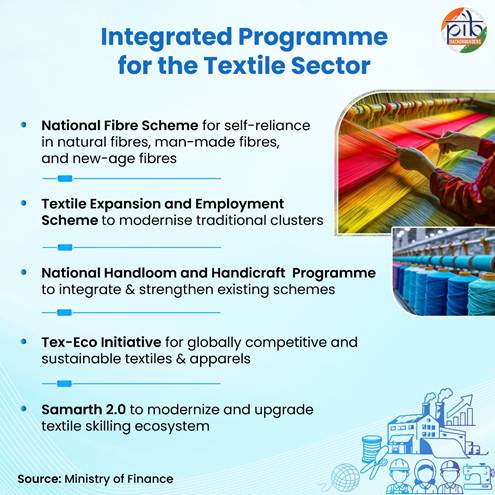
- National Fibre Scheme: This scheme aims to build self-reliance across the fibre spectrum by supporting natural fibres such as silk, wool, and jute, alongside man-made fibres (MMF) and new-age fibres. By strengthening domestic fibre availability and encouraging innovation in advanced textile materials, the scheme seeks to reduce import dependence, promote diversification beyond cotton, and enhance India’s capability in high-performance and specialised textiles.
- Textile Expansion and Employment Scheme: Focused on modernisation of traditional textile clusters, this component provides capital support for machinery, technology upgradation, and the establishment of common testing and certification centres. The scheme is expected to enhance productivity, improve quality compliance and enable large-scale employment generation.
- National Handloom and Handicraft Programme: Existing schemes for handloom and handicrafts will be integrated and strengthened under a unified national programme. The objective is to provide targeted and effective support to weavers and artisans, improve incomes, ensure market linkages, and preserve India’s rich textile heritage. Additionally, the Government is providing financial assistance for the promotion of natural and vegetable dyes and for the establishment of dye houses, through two components viz. the Mega Cluster Development Programme and Need-based Special Infrastructural Projects.
- Tex-Eco Initiative: The Tex-Eco Initiative promotes globally competitive and environmentally sustainable textiles and apparel (T&A) manufacturing. It aligns domestic production with international sustainability standards, and supports access to emerging green markets.
- Samarth 2.0: An upgraded skilling programme, Samarth 2.0 aims to modernise the textile skill ecosystem through deeper collaboration with industry and academic institutions. It seeks to ensure the availability of industry-ready skilled manpower across the value chain.
Mega Textile Parks and Technical Textiles
The Government has announced the setting up of Mega Textile Parks in challenge mode, with a focus on providing integrated infrastructure, enabling scale efficiencies, and promoting value addition across the textile value chain. These parks are also expected to support the growth of technical textiles, a high-potential segment with applications in industrial, medical, defence, and infrastructure sectors.
Mahatma Gandhi Gram Swaraj Initiative
The Mahatma Gandhi Gram Swaraj Initiative focuses on strengthening khadi, handloom, and handicrafts. The initiative emphasises global market linkage, branding, streamlined training, skilling, quality improvement, and process modernisation. It aims to benefit weavers, village industries, and rural youth, while supporting One District One Product (ODOP) initiative.
Export Promotion Measures for Textiles and Allied Sectors
To support exports of textiles and allied sectors, the Budget has announced the extension of the export obligation period from six months to twelve months for exporters of textile garments, leather garments, leather or synthetic footwear, and other leather products manufactured using duty-free imported inputs. This measure is intended to provide greater operational flexibility, ease of compliance, and improved working capital management for exporters.
What is TReDS?
TReDS is an electronic platform that enables financing and discounting of trade receivables of MSMEs via multiple financiers. The receivables can be due from corporates, other buyers, including Government Departments, PSUs.
|
Liquidity Support for Textile MSMEs through TReDS
To strengthen liquidity access for textile MSMEs, the Government has announced measures to enhance the effectiveness of the Trade Receivables Discounting System (TReDS), through which over ₹7 lakh crore has already been facilitated.
Key measures include:
- Mandatory use of TReDS by CPSEs for procurement from MSMEs
- Credit guarantee support through the Credit Guarantee Fund Trust for Micro and Small Enterprises (CGTMSE) for invoice discounting on TReDS
- Linking the Government e-Marketplace (GeM) with TReDS to enable faster and lower-cost financing of government procurement receivables
- Introduction of TReDS receivables as asset-backed securities to support secondary market participation and improve liquidity
SME Growth Fund and Champion SMEs
A dedicated ₹10,000 crore SME Growth Fund has been introduced to support the creation of future “Champion SMEs.” The fund is poised to incentivise enterprises based on select criteria.
Textile Sector Driving Growth, Exports and Employment in India
With an estimated size of USD 179 billion, the Indian T&A industry contributes ~2% to the country’s GDP, accounts for ~11% of manufacturing gross value added (GVA), and 8.63% to exports, underscoring its critical role in India’s economic architecture.
Exports Maintain Growth Momentum
On the export front, India is the 6th largest global exporter of T&A, with a share of ~4% in world exports in this segment.
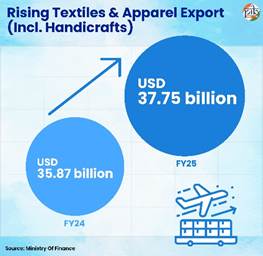
India’s export of T&A (including Handicrafts) increased to USD 37.75 billion in FY25, up from USD 35.87 billion in FY24, despite subdued global trade environment, reflecting the sector’s adaptability, diversified market presence, and strength across value-added and labour-intensive segments.
- In December 2025, export growth was broad-based across key segments, led by Handicrafts (7.2%), Ready-Made Garments (2.89%), and MMF yarn, fabrics and made-ups (3.99%).
- These trends reinforce India’s competitive advantage across value-added manufacturing, traditional crafts and employment-intensive segments, amid fluctuating global demand.
-
DID YOU KNOW?
During January–November 2025, India’s textile sector recorded export growth across 118 countries and export destinations!
|
2025 was a year of significant market diversification across both emerging and traditional markets including the UAE, Egypt, Poland, Sudan, Japan, Nigeria, Argentina, Cameroon and Uganda. Growth remained steady in key European markets such as Spain, France, the Netherlands, Germany and the UK.
The textile sector is the second-largest employment generator in India, after agriculture. As per the Economic Survey 2026-27, textiles industry has a 9% share in employment across 8 major industry groups. The 2025 estimates show that the sector provides direct employment to 45 million+ people, including women and rural communities.
Growth Drivers of India’s Textile Sector
Over the years, India has developed the capacity to cater to a broad spectrum of demand- from affordable mass-market apparel to niche, high-value segments- across both domestic and international markets. To sustain this competitiveness and further attract investment, the Government has been actively supporting the sector through a range of targeted initiatives-
PM MITRA Scheme’s significant progress in 2025
- The Government approved setting up of 7 PM Mega Integrated Textile Region and Apparel (PM MITRA) Parks in Greenfield/Brownfield sites with an outlay of ₹4445 crore for a period of 7 years up to 2027-28.
- Investment MoUs with expected investment potential of ₹27,434 crore+ have been signed.
- Infrastructure works worth ₹2590.99 crore have been started by all 7 State Governments.
- The scheme is expected to generate employment of 3 lakhs (1 lakh direct and 2 lakh in-direct) with an estimated investment of ₹10,000 crore per park.
- The Production Linked Scheme (PLI) for Textiles, operational up to FY 2029-30 aims to promote production of MMF Apparel & Fabrics and products of Technical Textiles.
- It aims to help the industry achieve size and scale, become competitive, create employment opportunities and support creation of a viable enterprise and competitive industry.
- The cotton sector supports ~6 million farmers and 40–50 million people across value chains.
- To enhance transparency, the Kapas Kisan mobile app was launched, enabling farmer self-registration and slot booking.
- The 'Kasturi Cotton Bharat' Programme was launched, to enhance the global market acceptance of Indian cotton.
- Additionally, the Quality Control Order (QCO) 2023 for cotton bales has been deferred till August 2026.
Initiative to Promote Sustainability and Circularity
- A tripartite MoU was signed between Textiles Committee, GeM and Standing Conference of Public Enterprises (SCOPE), Circle Back campaign, National Handloom Development Programme, National Textile Sustainability Council to promote and mainstream the public procurement of upcycled products.
- The implementation of the new Labour Codes carries significant implications for the textile industry.
- By establishing a unified framework covering wages, employment conditions, workplace safety, social security and dispute resolution, the Codes streamline compliance while reinforcing worker welfare.
Goods & Service Tax 2.0 (GST)
- 2025’s Next-Gen GST rationalisation in textiles resulted in lower prices for consumers, relief for manufacturers and boosted exports and employment.
The sustained export momentum, broadening market footprint, and robust performance of value-added segments reaffirm India’s position as a reliable and resilient global sourcing hub for T&A. With continued emphasis on diversification, competitiveness, and MSME participation, the sector is well-placed to scale up exports and deepen its integration with global value chains in the period ahead.
Textile Sector Outlook
The recent policy push is towards scale and modernisation - integrated textile parks, support for MMF and technical textiles, investment incentives, and easing of raw-material constraints are all aimed at boosting competitiveness and value addition.
At the same time, the Ministry of Textiles has set an ambitious direction for exports, with current textile exports around ₹3 lakh crore and a Vision 2030 objective of expanding this to about ₹9 lakh crore through stronger domestic manufacturing and wider global outreach.
Trade developments add another layer to the outlook. A transformational trade deal for India’s T&A sector, the India-EU FTA offers zero duty access in textiles and clothing, covering all tariff lines and reduces tariffs by up to 12%. It lowers duties of up to 10.5% in Indian wooden, bamboo, and handcrafted furniture. The Commerce Minister Piyush Goyal recently said the India–EU FTA could significantly expand India’s textile and garment exports to the European market by improving duty conditions, particularly benefiting labour-intensive segments.
The Union Budget 2026-27 direction further emphasizes employment generation, inclusive growth, sustainability, and coordinated implementation led by the Ministry of Textiles in partnership with States, industry, MSMEs, artisans, and skilling institutions, reinforcing India’s position as a competitive, reliable, and forward-looking global textile and apparel hub.
Conclusion
India’s textile sector stands at a pivotal moment, supported by strong production fundamentals, rising exports and sustained policy backing.
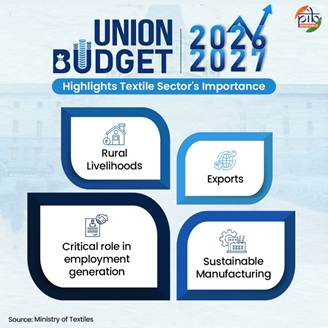
The Union Budget 2026–27 reinforces this trajectory by strengthening the entire value chain, from fibre and manufacturing to skills, sustainability and market access.
Together with expanding trade partnerships and a clear push towards scale, technology and value addition, these measures position the sector to deepen its global integration while continuing to generate employment and support livelihoods across the country.
References
Ministry of Finance
https://www.indiabudget.gov.in/economicsurvey/doc/echapter.pdf
https://www.indiabudget.gov.in/doc/budget_speech.pdf
Ministry of Textiles
https://www.pib.gov.in/PressReleasePage.aspx?PRID=2221486®=3&lang=2
https://www.pib.gov.in/PressReleasePage.aspx?PRID=2208051®=6&lang=1
https://www.pib.gov.in/PressReleaseIframePage.aspx?PRID=2215380®=3&lang=2
https://www.pib.gov.in/PressReleasePage.aspx?PRID=2219250®=3&lang=1
https://www.pib.gov.in/PressReleasePage.aspx?PRID=2204546®=3&lang=2
https://www.pib.gov.in/PressReleasePage.aspx?PRID=2222481®=3&lang=2
Ministry of Commerce & Industry
https://www.pib.gov.in/PressReleasePage.aspx?PRID=2117470®=3&lang=2
Reserve Bank of India
https://www.rbi.org.in/commonman/English/scripts/FAQs.aspx?Id=3138
India Brand Equity Foundation
https://www.ibef.org/industry/textiles
Click here to see in PDF
PIB Research
(Explainer ID: 157185)
आगंतुक पटल : 232
Provide suggestions / comments