Farmer's Welfare
Balanced Use of Fertilizers: A Key Enabler of Sustainable Farming
Aligning Productivity, Soil Health, and Environmental Responsibility
Posted On:
31 JAN 2026 10:25AM
Key Takeaways
- Balanced fertilization entails applying all essential macronutrients and micronutrients in appropriate proportions, quantities, timing, and methods, based on crop requirements, soil fertility status, and prevailing climatic conditions.
- The Government of India is proactively promoting the balanced use of fertilizers through multiple initiatives, including the Soil Health Card Scheme, Nutrient-Based Subsidy, neem-coated urea, customised and fortified fertilizers, and nano fertilizers.
- Regenerative agriculture strengthens balanced fertilization by improving soil health and enhancing nutrient use efficiency, while reducing losses and sustaining long-term productivity.
- Soil test–based recommendations, customised fertilizers, and integrated nutrient management approaches enable more precise and efficient fertilizer use.
|
Introduction: The Rationale for Balanced Fertilization
The Green Revolution marked a decisive turning point in India’s agricultural history. The introduction of fertilizer-responsive high-yielding varieties (HYVs) of rice and wheat during the mid-1960s, supported by expanded irrigation and the use of chemical fertilizers, transformed the country from a “hand-to-mouth” situation into a self-sufficient and, eventually, a food-exporting nation. This rapid enhancement in foodgrain production not only ensured national food security but also significantly reduced hunger and improved rural livelihoods, positioning India as a model for other developing countries.
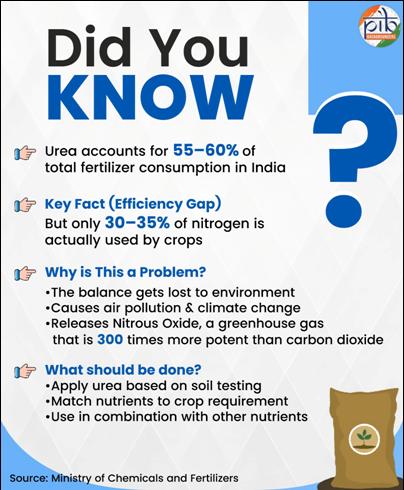
However, the intensification that underpinned these productivity gains gradually revealed its limitations. Continuous cultivation, coupled with a disproportionate reliance on nitrogenous fertilizers and a decline in the use of organic manures, led to nutrient imbalances and a steady deterioration of soil health. Excessive and imbalanced fertilizer use accelerated the depletion of secondary and micronutrients, degraded soil structure, and increased nutrient losses through runoff and leaching.
Declining soil fertility is adversely affecting crop growth and yield:
- by disturbing plant metabolic processes,
- increasing susceptibility to pests and diseases, and
- reducing produce quality.
Imbalanced fertilization has far-reaching consequences beyond soil degradation. These processes further contribute to environmental contamination and pose potential health risks. These adverse effects also extend to the livestock sector, as crops cultivated on nutrient-depleted soils often lack essential minerals required in feed and fodder, resulting in compromised animal health and diminished productivity. Consequently, nutrient imbalance constitutes a significant constraint to the long-term sustainability and efficiency of integrated crop-livestock production systems. Therefore, maintaining soil fertility and adopting scientifically sound practices are fundamental to the sustainability of agricultural production. Soil fertility, determined by its chemical, physical, and biological properties, constitutes the basis for efficient nutrient use, economic viability, and environmental protection.
In response to the emerging challenges of Imbalanced fertilization, the Indian Council of Agricultural Research (ICAR) initiated the All India Coordinated Research Project on Long-Term Fertilizer Experiments (AICRP-LTFE). Implemented across a wide range of agro-ecological regions and cropping systems, the study was designed to evaluate the long-term effects of sustained fertilizer application on soil health, crop productivity, and system sustainability. The study has provided robust empirical evidence on nutrient mining, soil degradation, and the need for rational fertilizer management, thereby informing policy formulation and promoting rational nutrient management practices to sustain high-input agriculture while safeguarding environmental health. In this context, the Government of India has been actively promoting balanced fertilization as a core strategy to restore and sustain soil health, thereby supporting sustainable agricultural productivity.
What are Fertilizers?
Fertilizer is any material of natural or synthetic origin added to the soil to supply one or more plant nutrients.
Fertilizers are broadly classified into inorganic and organic fertilizers:
Inorganic fertilizers are manufactured chemical compounds that contain specific nutrients in concentrated forms, enabling precise and immediate nutrient supply to crops.
Organic fertilizers are derived from natural sources such as compost, animal manures, crop residues, seaweed, and bone meal. They supply nutrients gradually in a balanced form while improving soil structure, organic matter, and biological activity, and also include animal by-products like blood meal, feather meal, and horn or hoof meal.
|
Balanced Fertilization: A Key to Sustainable Agriculture
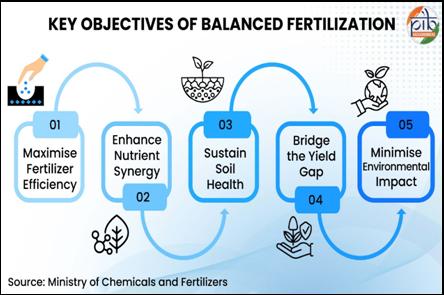
Balanced nutrient management enhances fertilizer use efficiency by maximizing nutrient uptake and minimizing losses, while fostering synergistic interactions among nutrients that support improved plant growth, crop performance, and productivity. It sustains soil fertility over the long term, including soil organic matter and biological health, helps bridge the yield gap between potential and realized crop yields through adequate nutrition, and reduces environmental impacts such as nutrient runoff, leaching, and greenhouse gas emissions arising from imbalanced fertilizer use.
The scientific basis of balanced fertilization can be traced to Justus von Liebig’s Law of the Minimum, which states that crop growth is constrained by the nutrient that is most limiting, regardless of the abundance of other nutrients. This principle underscores the futility of excessive application of a single nutrient when other essential nutrients remain deficient.
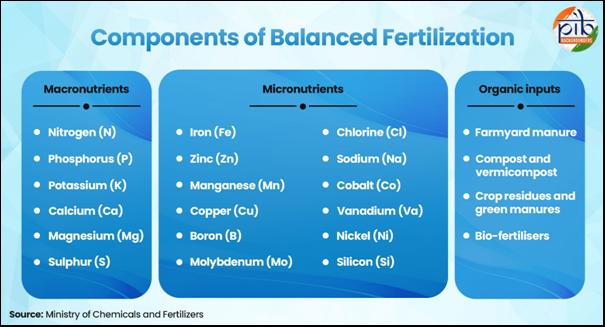
Balanced fertilization, therefore, refers to the application of all essential plant nutrients-macronutrients and micronutrients- in appropriate proportions, quantities, timing, and methods, based on crop requirements, soil fertility status, and prevailing climatic conditions. It goes beyond the conventional practice of applying only nitrogen (N), phosphorus (P), and potassium (K) and integrates a holistic nutrient management approach.
Benefits of Balanced Fertilization
Balanced fertilization constitutes a fundamental pillar of sustainable agriculture, delivering wide-ranging agronomic, economic, and environmental advantages:
Higher Crop Productivity: Balanced nutrient supply enables crops to reach their full potential, resulting in significantly higher yields.
Optimal Performance of High-Yielding Varieties: Balanced nutrition is critical for maximising the productivity gains of improved crop varieties.
Improved Nutrient Use Efficiency: Adequate micronutrient availability enhances macronutrient use efficiency, reducing waste.
Better Crop Quality and Stress Resistance: Well-nourished plants exhibit improved disease resistance and stress tolerance, resulting in higher-quality harvests for human consumption and animal feed.
Improved Soil Health and Sustainability: Balanced fertilization enhances soil fertility, microbial activity, soil structure, and water retention capacity
Reduced Environmental Risks: Matching nutrient application with crop demand minimises runoff, leaching, and water pollution.
Cost-Effective Input Use: Balanced nutrient management helps farmers use inputs most efficiently, reducing unnecessary fertilizer costs while improving returns through higher yields and better quality, making it a cost-effective approach in the long run.
Process of Balanced Fertilization: From Soil to Solution
Achieving balanced fertilization requires a multi-pronged strategy that integrates science, policy, technology, and farmer participation. The following measures are crucial for ensuring sustainable nutrient management in Indian agriculture:
- Integrated Nutrient Management (INM) is a core strategy for achieving balanced fertilization and is grounded in the Smart Nutrient Use principle, a practical, science-based framework. It enables the efficient, economical, and sustainable application of nutrients by judiciously integrating organic inputs, mineral fertilizers, and biological sources. INM recognises that neither chemical fertilizers nor organic inputs alone are sufficient to meet the complete nutritional requirements of crops. Accordingly, it promotes a holistic approach that combines:
- Chemical fertilizers- for providing essential macronutrients (NPK).
- Organic Matter-Including compost, farmyard manure, cow dung, and green manures like Dhaincha, to enhance soil structure, water retention, and microbial activity.
- Crop Rotation & Residue Management- Enhance system diversity, disrupt pest and disease cycles, and improve nutrient use efficiency.
- Customised Fertilizers through Technology: Customised fertilizers are formulated to meet the nutrient needs of a specific crop and soil. These fertilizers contain both macro and micronutrients in scientifically determined proportions.
For example, micronutrients like zinc, boron, and sulphur can be blended with urea or DAP based on local soil deficiencies. This targeted application helps reduce nutrient losses, improve fertilizer efficiency, and lead to better crop response.
- Soil Test-Based Fertilizer Recommendations: Soil testing is a fundamental and essential step in balanced fertilization. Based on test results, soils are classified as low, medium, or high in nutrient content. Fertilizer doses are increased for nutrient-deficient soils and reduced where nutrient levels are already sufficient. The Soil Health Card Scheme supports this approach by providing farmers with field-specific soil data, enabling them to apply fertilizers more accurately and avoid excessive use.
- Soil Test Crop Response (STCR) Approach: The STCR approach links fertilizer application directly with crop yield targets. It takes into account soil nutrient status, crop type, and local climatic conditions to calculate the exact nutrient requirements to achieve a desired yield. This method prevents over- and under-application of fertilizers, improves nutrient-use efficiency, and supports sustainable crop production.
- Diagnosis and Recommendation Integrated System (DRIS): This approach analyses plant tissue to evaluate nutrient ratios such as nitrogen to phosphorus (N/P) or nitrogen to potassium (N/K), rather than focusing solely on absolute nutrient values
When imbalances are detected, corrective measures-usually through top dressing-are recommended. This approach is beneficial for long-duration crops and has also shown positive results in wheat and soybeans.
- Site-Specific Nutrient Management (SSNM): It focuses on applying fertilizers according to a crop’s actual needs and soil variability within a field. Instead of using a uniform fertilizer dose, it ensures nutrients are applied only where and when they are required. It involves:
- Assessing field variability to understand differences in soil fertility within the same field
- Using existing nutrient sources such as soil reserves, crop residues, and organic manure
- Applying fertilizers only to fill nutrient gaps, avoiding excess use
The approach follows three steps:
-
- Set a realistic yield target based on local conditions
- Estimate the indigenous nutrient supply from soil and organic sources
- Apply fertilizers to meet the remaining deficit.
Regenerative Agriculture: A Complimentary Approach to Balanced Fertilization
Regenerative agriculture is a holistic farming approach centred on restoring soil health and enhancing biodiversity. Its core practices include reducing soil disturbance, promoting crop rotation, cultivating cover crops, and integrating agroforestry systems.
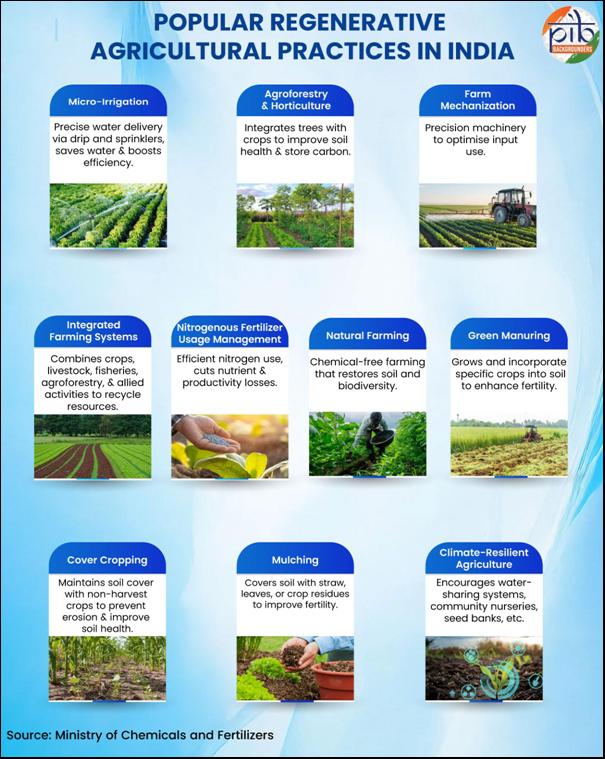
By improving soil structure and increasing organic matter content, regenerative practices enhance the soil’s capacity to retain nutrients and moisture, thereby improving nutrient uptake by crops. This leads to reduced nutrient losses, lower need for repeated fertilizer applications, and more efficient nutrient use, supporting balanced fertilization. In the Indian context, widely adopted regenerative practices include micro-irrigation, precision mechanization, natural farming, cover cropping, mulching, and a climate-resilient agricultural system.
Government Initiatives Driving Balanced Fertilization
Recognising the importance of balanced fertilization for improving soil health, sustaining crop productivity, and minimising environmental degradation, the Government of India has undertaken a range of proactive initiatives to promote its adoption across the agricultural sector.
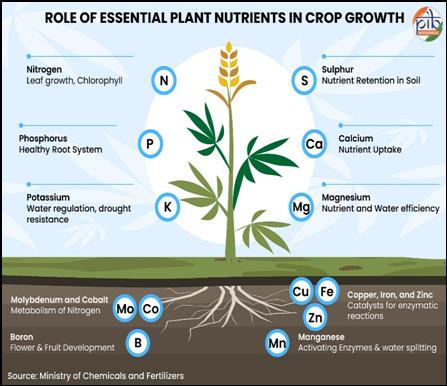
Launched in 2015, the Soil Health Card (SHC) Scheme provides farmers with a scientifically generated, plot-wise diagnostic report for each landholding, based on scientific soil testing. The card assesses soil health across twelve key parameters, including Macronutrients: nitrogen, phosphorus, potassium, and sulphur; Micronutrients: zinc, Iron, Copper, Manganese, and Boron; and critical soil properties such as soil reaction (pH), Electrical Conductivity (EC), and Organic Carbon. (OC).
Issued every two years, the soil health card provides farmers with a comprehensive understanding of the nutrient status and physicochemical conditions of their soils. It also offers crop-specific recommendations on the appropriate use of chemical fertilizers, bio-fertilizers, organic inputs, and soil treatments to support informed decision-making and long-term soil health management. By July 2025, the scheme had provided more than 93,000 farmer training programmes, approximately 6.8 lakh field demonstrations, and thousands of awareness campaigns. As of mid-November 2025, over 25.55 crore soil health cards have been distributed across the country, reflecting the scale and outreach of the scheme in promoting balanced nutrient management.
Nutrient-Based Subsidy (NBS) Scheme
The Nutrient-Based Subsidy (NBS) Scheme promotes balanced use of essential nutrients such as nitrogen, phosphorus, potassium, and sulphur, helping farmers avoid over-reliance on a single fertilizer and maintain soil health while improving crop productivity. Under the scheme, the Government provides a fixed subsidy on phosphatic and potassic (P&K) fertilizers, including DAP, with subsidy rates linked to each fertilizer's nutrient content and revised periodically. The approved NBS rates for Rabi 2025-26 are effective from October 1, 2025, to March 31, 2026. Between 2022–23 and 2024-25, more than ₹2.04 lakh crore in subsidies were allocated for both indigenous and imported phosphatic and potassic (P&K) fertilizers.
The Government mandated a 100 percent neem coating on all domestically produced urea, permitting fertilizer manufacturers to levy a maximum retail price (MRP) up to 5 percent higher, to offset the associated costs. This requirement was implemented from September 2015 for indigenously manufactured urea and from December 2015 for imported urea, resulting in the complete transition of the national urea supply to neem-coated formulations.
Neem-coated urea is conventional urea treated with neem oil, which acts as a nitrification inhibitor and slows the release of nitrogen in the soil, thereby synchronizing nutrient availability with crop demand. This improves nitrogen use efficiency, reduces nutrient losses, and reduces fertilizer overuse. It enables farmers to reduce urea consumption. Consequently, the adoption of neem-coated urea contributes to improved soil health and greater efficiency in agricultural production systems.
Paramparagat Krishi Vikas Yojana
Launched in 2015, the Paramparagat Krishi Vikas Yojana (PKVY) promotes organic farming by providing financial assistance of ₹31,500 per hectare over a three-year period. The scheme supports balanced nutrient management by integrating traditional agricultural practices with sustainable soil fertility approaches, including the use of compost, biofertilizers, and organic matter. As of 31st October 2025, a total area of 16.90 lakh ha has been covered under PKVY since its inception.
PM-PRANAM (PM Programme for Restoration, Awareness, Nourishment and Amelioration of Mother Earth)
The PM-PRANAM Scheme (Prime Minister Programme for Restoration, Awareness, Nourishment and Amelioration of Mother Earth) focuses on reducing the use of chemical fertilizers and promoting balanced nutrient application. The scheme encourages the adoption of eco-friendly alternatives such as organic manure, bio-fertilizers, and compost. The scheme includes a provision to incentivise States and UTs to reduce chemical fertilizer (urea, DAP, NPK, and MOP) consumption during a given financial year compared to the average consumption of the preceding three years, with incentives equivalent to 50 percent of the fertilizer subsidy savings achieved. During FY 2023–24, 14 States recorded a reduction of 15.14 lakh metric tonnes in chemical fertilizer consumption relative to the average of the previous 3 financial years.
Promotion of Nano Fertilizers
Nano Fertilizers are plant nutrients packaged in tiny particles called nanomaterials, allowing nutrients to be released slowly and absorbed by crops more efficiently, with minimal waste. To promote their adoption, the Department of Fertilizers has undertaken key initiatives:
- Awareness campaigns through workshops, webinars, field demonstrations, street plays, and regional films
- Availability of nano urea and nano Diammonium Phosphate (DAP) at Pradhan Mantri Kisan Samridhi Kendras (PMKSKs) nationwide
- Integration of nano urea into monthly fertilizer supply planning to ensure availability.
- Nationwide promotion of balanced fertilizer use, including nano variants
- Organization of a “Maha Abhiyan” to promote the adoption of nano Diammonium Phosphate (DAP) across all 15 agro-climatic zones, supported by field demonstrations and structured farmer interactions
- Promotion of drone-based spraying and battery-operated sprayers to enable efficient and cost-effective application, supported by trained village-level entrepreneurs
- Encouragement to fertilizer companies to expand and scale up the production of nano-fertilizer
Development of Customised and Fortified Fertilizers
The government has been promoting the adoption of fortified, soil-, crop-, and area-specific fertilizers tailored to nutrient needs. Under the Nutrient-Based Subsidy (NBS) policy, subsidised phosphatic and potassic (P&K) fertilizer variants fortified or coated with micronutrients such as boron and zinc are eligible for subsidy support. In addition, these fortified or coated fertilizers receive an additional subsidy per metric tonne (MT) to incentivise their use alongside primary nutrients and encourage balanced nutrient application.
Enforcement Initiatives to Safeguard Fertilizer Supply and Farmer Interests
The Department of Fertilizers (DoF), in close coordination with the Department of Agriculture and Farmers’ Welfare (DA&FW), Government of India, undertook a comprehensive enforcement drive during the Kharif and the ongoing Rabi season 2025–26 (April–Mid Jan,26) to safeguard farmer interests and ensure the integrity of the national fertilizer supply chain.
In collaboration with State Governments and district-level authorities, extensive enforcement actions, including inspections, raids, and legal proceedings, were carried out to curb the diversion and misuse of fertilizers. As part of the drive, 14,692 show-cause notices were issued, 6,373 licenses were suspended or cancelled, and 766 first information reports (FIRs) were registered. These proactive and stringent measures ensure the timely availability of fertilizers, strengthen market discipline, and preserve the integrity of fertilizer distribution systems nationwide.
Conclusion
Balanced fertilization has become central to India’s strategy for sustaining agricultural productivity while addressing emerging challenges of soil degradation, nutrient imbalance, and environmental stress. Recognising the risks arising from skewed fertilizer use, the Government has undertaken proactive, coordinated measures to correct nutrient imbalances and improve fertilizer-use efficiency through science-based, farmer-centric interventions.
Initiatives such as soil test–based recommendations under the Soil Health Card Scheme, the Nutrient-Based Subsidy, promotion of Integrated Nutrient Management, encouragement of customised and fortified fertilizers, and the adoption of innovative inputs such as nano fertilizers reflect an intensive policy effort to address nutrient imbalances and improve fertilizer-use efficiency. Collectively, these interventions underscore the Government’s commitment to restoring soil health, optimising input use, and strengthening the long-term resilience and productivity of the agricultural sector.
References
Lok Sabha
Ministry of Agriculture and Farmers Welfare
PIB Press Releases
PIB Backgrounders
Economic Survey 2025-2026
Click here to see pdf
***
PIB Research
(Explainer ID: 157129)
आगंतुक पटल : 218
Provide suggestions / comments