Farmer's Welfare
International Year of Cooperatives 2025
"A Year of Cooperative Empowerment and Expansion"
Posted On:
18 JAN 2026 10:08AM
|
Key Takeaways
- More than 8.5 lakh cooperatives registered; 6.6 lakh functional, serving 32 crore members across 30 sectors with 10 crore women linked to cooperatives through SHGs
- 79,630 Primary Agricultural Credit Societies (PACS) approved for computerisation; 59,261 PACS actively using ERP software; hardware delivered to 65,151 PACS; online audits completed in 42,730 PACS; 32,119 PACS enabled as e-PACS.
- 32,009 new multipurpose PACS, dairy, and fisheries cooperatives registered nationwide
- National Co-operative Exports Limited (NCEL) exports: 13.77 LMT worth Rs.5,556 crore to 28 countries, dividend of 20% distributed to member cooperatives.
- National Cooperative Organics Limited (NCOL) membership: 10,035 cooperatives; 28 organic products
- Bharatiya Beej Sahakari Samiti Limited (BBSSL) membership: 31,605 cooperatives
- National Cooperative Development Corporation (NCDC) disbursed Rs.95,183 crore in FY 2024-25; Rs.95,000 crore disbursed so far in FY 2025-26.
- World’s largest decentralised grain storage plan operational: godowns completed in 112 PACS creating 68,702 MT storage capacity
|
Introduction
The cooperative movement in India draws philosophical grounding from the ancient concept of “Vasudhaiva Kutumbakam", which views “the world as one family,” and embodies principles of mutual respect, shared responsibility, and universal solidarity. This enduring ethos of collective well-being continues to shape the evolution of cooperative institutions in India, which prioritize community-centric development. India’s commitment to promoting and strengthening the cooperative model, guided by the vision of “Sahkar Se Samridhhi,” remains a key aspect of its development strategy. The government continues to focus on strengthening and expanding the cooperative movement by deepening its outreach to the grassroots and by creating an enabling policy, legal, and institutional framework.
The International Cooperative Alliance (ICA) defines cooperatives as member-owned and member-governed enterprises, guided by shared economic, social, and cultural objectives in their decision-making.
The global significance of cooperatives was formally recognised by the United Nations, which declared 2025 as the “International Year of Cooperatives” (IYC), announced on 19th June 2024, under the theme “Cooperatives Build a Better World”. The theme highlighted the contribution of cooperatives in addressing contemporary global challenges and advancing the UN Sustainable Development Goals (SDGs) by 2030. Through IYC 2025, the United Nations sought to mobilise action at national, regional, and global levels, encouraging governments, institutions, and individuals to strengthen cooperative enterprises in pursuit of a more sustainable and equitable future.
Overview of Cooperative Movement in India
During the pre-Independence period, cooperatives gained legal recognition with the enactment of the Cooperative Credit Societies Act, 1904. Following Independence, cooperatives emerged as a key instrument of decentralized development and participatory governance. The establishment of institutions such as the National Cooperative Development Corporation (NCDC) (1963) and the National Bank for Agriculture and Rural Development (NABARD) (1982) further strengthened rural credit systems and cooperative growth, while the creation of a dedicated Ministry of Cooperation on 6th July 2021, marked a significant milestone by providing focused national attention to the sector.
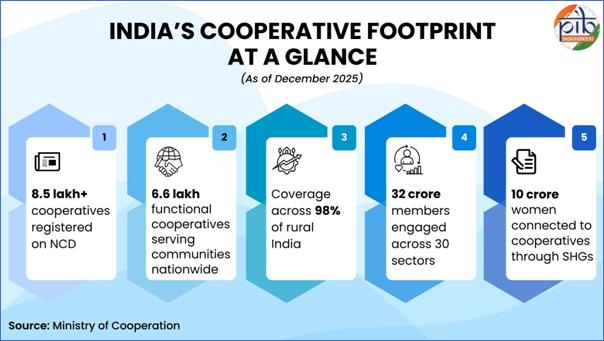
Cooperatives in India operate across a wide range of sectors, including agriculture, credit, banking, housing, and women’s welfare, and collectively account for more than one-fourth of the world's cooperatives. As of December 2025, the National Cooperative Database (NCD) records over 8.5 lakh cooperatives, of which approximately 6.6 lakh are operational, covering nearly 98 percent of rural India and serving around 32 crore members across 30 sectors. These institutions connect milk producers, artisans, fishers, traders, and workers to markets, while connections with women-led SHGs have integrated nearly 10 crore women into the cooperative framework. From nationally recognized entities such as Amul to major institutions like NABARD, KRIBHCO, and IFFCO, alongside thousands of local societies and cooperatives, these entities constitute a foundational pillar of India’s economic architecture.
Holistic Initiatives and Achievements in the Year
The Ministry of Cooperation has undertaken a range of initiatives to address the evolving needs of cooperative societies and their members. Guided by the vision of “Sahkar Se Samriddhi”, these efforts aim to strengthen the cooperative movement nationwide and enable cooperatives to realize their full economic and social potential.
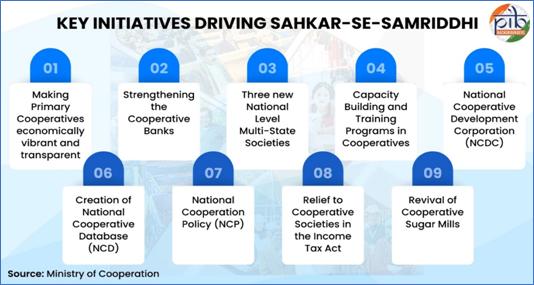
Making Primary Cooperatives Economically Vibrant and Transparent
Enhancing Inclusivity and Governance in PACS
In consultation with States, UTs, and major cooperative institutions, the Government has issued Model Bye-laws to enable Primary Agricultural Credit Societies (PACS) to undertake more than 25 business activities while strengthening governance, transparency, and accountability. These bye-laws also widen membership by ensuring the participation of women and SC/ST communities. So far, 32 States/UTs have adopted or aligned their bye-laws with these provisions.
|
Primary Agricultural Credit Societies (PACS) are village-level institutions that provide short-term credit and financial services to rural borrowers, and facilitate the collection of repayments.
|
Modernizing Cooperative Credit through Digital Platforms
The Government of India has approved a Rs.2,925.39 crore project to computerise functional Primary Agricultural Credit Societies (PACS) and integrate them onto a common Enterprise Resource Planning (ERP)-based national software platform. Implemented for the period 2022-23 to 2026-27, following approval on June 29, 2022, the initiative digitally links PACS with NABARD through State Cooperative Banks and district central cooperative banks.
Under the scheme, each PACS will be provided with essential hardware support, including a computer, webcam, VPN, printer, and biometric device. This infrastructure will facilitate the effective completion of subsequent implementation steps. The ePACS system comprehensively captures financial and operational transactions, generating financial statements in accordance with the Common Accounting System (CAS)-MIS standards.
As on date:
- 59,261 PACS are actively using ERP software, compared to 47,155 PACS as on 2 January 2025.
- Hardware delivered to 65,151 PACS, covering about 82% of the expanded target of 79,630 PACS (as against 57,578 PACS covered as of January 2025).
- Online audits completed in 42,730 PACS
- 32,119 PACS enabled as e-PACS
- 34.94 crore transactions processed through 22 ERP modules
- Software available in 14 languages
Establishment and Scaling of Multipurpose Cooperatives at the Grassroots
The Government of India has approved the plan to establish new multipurpose PACS, dairy, and fisheries cooperatives with the objective of achieving comprehensive coverage of all panchayats and villages across the country over the next five years. Top of Form
According to the National Cooperative Database 32,009 new PACS, dairy, and fishery cooperatives have been registered. At present, PACS operates in 2,55,881 Gram Panchayats (GPs), dairy cooperatives cover 87,159 GPs, and fisheries cooperatives are present in 29,964 Gram Panchayats nationwide. Bottom of Form
Integration of PACS with Central Government Schemes
Primary Agricultural Credit Societies (PACS) have been integrated with multiple central government schemes, significantly expanding their role as village-local service delivery hubs. So far, 38,190 PACS have been upgraded into Pradhan Mantri Kisan Samriddhi Kendras (PMKSKs) to supply agricultural inputs, while 51,836 PACS function as Common Service Centres (CSCs) delivering more than 300 e-services. So far, 4,192 PACS/ cooperative societies from 34 States/ UTs have applied online for PM Bhartiya Jan Aushadhi Kendra, out of which 4,177 PACS have been given initial approval by PMBI and 866 have received drug licences from State Drug Controllers, and 812 PACS have been assigned store codes to operate as Pradhan Mantri Bhartiya Janaushadhi Kendras (PMBJKs), thereby improving access to affordable medicines. PACS are also eligible to establish retail petrol and diesel outlets under the Combined Category 2 (CC2) framework, with 117 opting for bulk-to-retail conversion and 59 commissioned by Oil Marketing Companies. Till now 394 PACS/ LAMPS from 28 States/ UTs have applied online for retail petrol/ diesel dealership, out of which 10 PACS have been commissioned. Furthermore, PACS can apply for LPG distributorships to diversify their revenue streams, and 962 PACS have been identified as Paani Samitis to undertake the operations and maintenance of rural piped water supply schemes, thereby strengthening their role as multipurpose service centres at the grassroots level.
Formation of new Farmer Producer Organizations (FPOs) by PACS
Under the FPO scheme, 1100 additional FPOs have been allotted to the National Cooperative Development Corporation (NCDC) in cooperative sector. Now, PACS will be able to do other economic activities related to agriculture as FPOs. Till now a total of 1863 FPOs have been formed in the cooperative sector by NCDC, out of which 1117 FPOs have been formed through strengthening of PACS. Under the scheme, an amount of Rs.206 crore has been disbursed to FPOs/CBBOs till date.
Formation of Fish Farmer Producer Organization (FFPO)
To provide market linkage and processing facilities to the fishermen, NCDC has registered 70 FFPOs in the initial phase. Department of Fisheries, Government of India has further allocated the conversion of 1000 existing fisheries cooperative societies into FFPOs to NCDC, with an approved outlay of Rs.225.50 crore. NCDC has so far facilitated the formation of 1,070 FFPOs, and the strengthening of 2,348 FFPOs is currently under progress. Under the scheme, an amount of Rs.98 crore has been disbursed to FFPOs/CBBOs.
Strengthening Financial Inclusion through Cooperative Bank Mitras
Dairy and Fisheries cooperative societies can be made as Bank Mitras of District Central Cooperative Banks (DCCBs) and State Cooperative Banks (StCBs) to expand their business and promote financial inclusion. With support from the National Bank for Agriculture and Rural Development (NABARD), Micro-ATMs are also being provided to these Bank Mitra Co-operative Societies to strengthen digital financial inclusion and enable transparent, traceable, “door-step financial services”. A total of 12219 Bank Mitra have been appointed in Gujarat with the issuance of 12624 Micro-ATM, covering all 14330 Gram Panchayats in the state of Gujarat. The scheme added another revenue stream for Dairy cooperative societies and PACS, besides generating employment for over 15,000. Based on learnings of the scheme, national wide rollout is planned as per the SOP of the ministry.
Rupay Kisan Credit Card to Members of Cooperative Societies
A Pilot project has been started in Panchmahal and Banaskantha districts of Gujarat to expand the reach and capacity of Rural Co-operative Banks and to provide necessary liquidity to the members of Rural Co-operative Societies. Under this project, Bank Accounts of all the members of the cooperative societies are being opened in the concerned District Central Cooperative Banks and with the support of NABARD, Rupay-Kisan Credit Cards (KCCs) are being distributed to the account holders. More than 22 lakh kisan credit cards have been issued thro,ugh which more than 10,000 crores of loans have been disbursed creating entrepreneurship and employment.
World’s Largest Decentralised Grain Storage Plan
The Government approved the world’s largest grain storage plan in the Cooperative Sector on 31st May 2023 and has launched it as a pilot project to address deficits in food grain storage capacity at the grassroots level. The plan focuses on developing agricultural infrastructure at the Primary Agricultural Credit Society (PACS) level, including storage godowns, custom hiring centres, processing units and Fair Price Shops, through convergence with existing Government of India schemes such as the Agriculture Infrastructure Fund (AIF), Agricultural Marketing Infrastructure Scheme (AMI), Sub Mission on Agricultural Mechanisation (SMAM) and Pradhan Mantri Formalisation of Micro Food Processing Enterprises (PMFME).
As on 30 December 2025:
• Godowns completed in 112 PACS (Pilot Phase I - 11, Rajasthan - 82, Maharashtra - 15, Gujarat - 4)
• Storage capacity created: 68,702 MT
• Scheme expanded beyond PACS to all cooperative societies
White Revolution 2.0
The Ministry of Cooperation has launched White Revolution 2.0 to strengthen and expand dairy cooperatives, boost milk procurement, and create better livelihood opportunities for women and rural producers. The initiative aims to increase milk procurement by 50 per cent in five years by integrating currently uncovered areas into the cooperative network. A Standard Operating Procedure (SOP) was launched on 19th September 2024, followed by the inauguration of 6,600 new Dairy Cooperative Societies (DCS) on 25th December 2024. So far, 20,070 DCSs have been registered across 31 States and Union Territories.
Atmanirbharta Abhiyan
The Ministry of Cooperation has launched a programme to promote the production of tur, masur, urad, and maize by linking farmers with cooperative networks and ensuring assured procurement at the Minimum Support Price (MSP), while permitting open market sales when prices exceed MSP. To facilitate implementation, the National Cooperative Consumer Federation (NCCF) and National Agricultural Cooperative Marketing Federation of India (NAFED) have developed digital registration platforms, e-samyukti and e-samridhi, for farmer enrolment through cooperatives. To promote domestic production of pulses and maize, 56,673 PACS/FPOs and 54.74 lakh farmers have registered on e-Samyukti and e-Samridhi portals. Procurement achieved includes 9.08 LMT of pulses and 45,105 MT of maize.
Strengthening the Cooperative Banks
Beyond PACS, digital reforms now cover the wider cooperative ecosystem to create an integrated and transparent structure. “Sahakar Sarathi”, a shared service entity approved by the Reserve Bank of India, supports Rural Cooperative Banks (RCBs) with more than 13 digital, financial and audit services. It has an authorised capital of Rs.1,000 crore, with 33.33 per cent shareholding each by NABARD, NCDC and RCBs. Cooperative banks are also being onboarded to the RBI Integrated Ombudsman Scheme to improve grievance redressal. To encourage stronger institutional performance, a Cooperative Ranking Framework was launched on 24th January 2025, using digital indicators such as audit quality, operational efficiency and financial strength to promote transparency and competitiveness across cooperatives.
Three New National-Level Multi-State Societies
Strengthening the Cooperative Seed Ecosystem: Establishment of BBSSL
Bharatiya Beej Sahakari Samiti Limited (BBSSL) has been established by the Government as a as a new apex multi-state cooperative seed society under the Multi-State Cooperative Societies (MSCS) Act, 2002. The institution is mandated to coordinate the production, testing, certification, procurement, processing, storage, branding, labelling, and packaging of foundation and certified seeds through Primary Agricultural Credit Societies (PACS). BBSSL has introduced seeds under the brand “Bharat Beej”, and to date, 31,605 PACS and cooperative societies have enrolled as members.
Apex Framework for Organic Farming and Market Integration: NCOL
National Cooperative Organics Limited (NCOL) has been established as the apex multi-state cooperative to promote and scale organic farming in India. With a membership of 10,035 PACS and cooperative societies, NCOL provides comprehensive end-to-end support encompassing aggregation, certification, testing, processing, branding, and export facilitation. NCOL markets certified organic produce under the “Bharat Organics” brand, offering 28 products that undergo batch-wise testing for more than 245 pesticides. In addition, NCOL has entered into partnerships with several States to support procurement, certification processes, and cluster-based initiatives.
National Apex Cooperative for Export Promotion: NCEL
National Co-operative Exports Limited (NCEL) has been established as a national-level, multi-state cooperative to promote and facilitate exports from India’s cooperative sector. Approved by the Union Government and registered under the Multi-State Co-operative Societies Act, 2002, on 25 January 2023, NCEL functions as an apex umbrella organization, representing cooperatives across sectors in international markets and strengthening their global trade engagement. So far, 13,890 PACS/ cooperative societies have become members of NCEL. In Q3 of FY 2025–26, NCEL exported 13.77 LMT of agri commodities worth Rs.5,556.24 crore. A 20% dividend was distributed to members.
Capacity Building and Training Programs in Cooperatives
Establishment of Cooperative University
Tribhuvan Sahkari University: The Ministry of Cooperation has set up Tribhuvan Sahkari University (TSU) as India’s first national university for the cooperative sector by converting IRMA, with the Act taking effect on 6th April 2025. TSU began functioning immediately and launched three postgraduate programmes in 2025-26. The University will build skilled manpower and support the goals of the National Cooperation Policy 2025 through education, research and sector-wide affiliations.
Training Programmes
Capacity-building programmes for members, secretaries, and board members of newly registered PACS are conducted through the National Council for Cooperative Training (NCCT) and NABARD. In 2024-25, NCCT conducted 4,389 training programmes and trained 3.15 lakh participants. CSC-focused training covered 30,210 PACS. Awareness programmes, walkathons and youth initiatives were organised nationwide.
National Cooperative Development Corporation (NCDC)
The National Cooperative Development Corporation (NCDC), established in 1963 under the Ministry of Cooperation, serves as a key institution for providing financial and technical support to cooperatives across both farm and non-farm sectors. It helps strengthen the production, storage, and processing of agricultural produce, promoting income-generating activities such as dairy, fisheries, handloom, and women-led cooperatives. Through these efforts, NCDC enhances the economic role of cooperatives and supports livelihoods at the grassroots level.
NCDC operates dedicated schemes such as Nandini Sahakar, Swayam Shakti Sahakar, Ayushman Sahakar, and Yuva Sahakar, which provide concessional finance, interest subvention, and start-up support to women-led, youth-led, SC/ST, and innovative cooperatives.
NCDC disbursed Rs.95,183 crore in FY 2024-25 and Rs.95,000 crore in FY 2025-26 (till date). The Government has also permitted NCDC to issue Rs.2,000 crore in government-guaranteed bonds.
Sahakar Taxi Cooperative Limited (India’s first cooperative-led Mobility platform)
Sahakar Taxi Cooperative Limited is India’s first cooperative-led mobility initiative, created to offer fair earnings for drivers and affordable services for passengers. The cooperative is promoted by Amul, NAFED, NABARD, IFFCO, KRIBHCO, NDDB & NCEL with an authorized Share Capital- Rs.300 crore. Over 1,50,000 drivers and 2,00,000 customers have already registered on app in trial run in NCR and Gujarat. Over 5000 daily rides have been done in triala run before propothe sed official launch in January. The scheme is expected to have nation-wide presence by 2029.
Inclusion of Cooperative Societies as 'Buyer' on the GeM Portal
The registration of Cooperative Societies as buyers has been approved on the Government e-Marketplace (GeM) in 2022. Cooperative Societies can procure goods and services from about 67 lakh verified sellers and service providers on the GeM platform. So far, 721 Cooperative Societies have been onboarded as buyers, with efforts also underway to encourage their registration as sellers. To date, these societies have completed 3,285 transactions amounting to Rs.396.77 crore.
Creation of National Cooperative Database (NCD)
A comprehensive National Cooperative Database (NCD) was launched on 8th March 2024 by the Ministry of Cooperation with support from States and Union Territories. It provides single-point access to data on over 8.5 lakh cooperative societies with approximately 32 crore members across 30 sectors, and is regularly updated by State and Union Territory nodal officers. The database is accessible at: https://cooperatives.gov.in/en
National Cooperation Policy (NCP)
The National Cooperation Policy (NCP) 2025 was launched by the Ministry of Cooperation on 24th July, 2025. The policy outlines a long-term strategic framework to revitalise and modernise India’s cooperative movement. Anchored in the vision of Viksit Bharat 2047 and the principle of Sahkar-se-Samriddhi, the policy builds on India’s rich cooperative legacy to strengthen cooperatives, enhance inclusivity, and prepare them for future challenges. It articulates a mission to achieve 16 objectives over the next decade, structured around six strategic mission pillars.
Relief to Cooperative Societies in the Income Tax Act
Recent tax reforms have eased the financial burden on cooperatives while improving their operational capacity to better serve members. The surcharge applicable for cooperatives with taxable income between Rs.1 crore and Rs.10 crore has been reduced from 12 percent to 7 percent, while the Minimum Alternate Tax has been lowered from 18.5 percent to 15 percent. Additionally, new manufacturing cooperatives established on or before 31st March 2024 are eligible for a concessional corporate tax rate of 15 percent. For PACS, Primary Cooperative Agriculture and Rural Development Banks (RRBs), the permissible limits on cash deposits, payments, loans, and repayments per member have been enhanced from Rs. 20,000 to Rs. 2 lakh, thereby providing greater operational flexibility and facilitating improved service delivery.
Revival of Cooperative Sugar Mills
The Government has provided major fiscal support to cooperative sugar mills by exempting payments up to the Fair and Remunerative Price (FRP) or State Advised Price (SAP) from taxation since April 2016, and allowing past payments as expenditure, delivering tax relief of over Rs.46,000 crore. A Rs.10,000 crore loan scheme through NCDC is supporting ethanol, cogeneration and working capital needs, with Rs.1,000 crore released to NCDC and Rs.10,005 crore disbursed to 56 mills. Cooperative mills now receive the same treatment as private firms in ethanol procurement, and existing ethanol plants are being converted into multi-feed units to use maize. The GST on molasses has been reduced from 28% to 5%, and revival efforts are underway at Kodinar, Talala and Valsad to strengthen operations and farmer incomes.
Conclusion
India’s commitment to strengthening cooperatives as a driver of inclusive and equitable growth is reflected in the comprehensive set of reforms undertaken in alignment with the objectives of the International Year of Cooperatives 2025. Guided by the vision of Sahkar se Samriddhi, a series of reforms have enhanced the transparency, functionality, and multipurpose role of Primary Agricultural Credit Societies (PACS), expanded the cooperative network to the panchayat level, augmented storage and processing infrastructure, and provided targeted support to women and marginalized communities.
Digitalisation, new multi-state cooperatives, capacity-building institutions, and supportive financial and policy measures have further improved governance, efficiency, and market integration. Collectively, these efforts demonstrate the evolving role of India’s cooperative movement in fostering resilient livelihoods, strengthening rural economies, and promoting participatory and sustainable development.
References
Ministry of Cooperation
https://www.cooperation.gov.in/
https://cooperatives.gov.in/Final_National_Cooperative_Database_023.pdf
https://www.cooperation.gov.in/sites/default/files/inline-files/Compilation-of-Suggestions-received-so-far.pdf
https://ncel.coop/
https://ncol.coop/
https://bbssl.coop/
https://www.ncdc.in/index.jsp?page=genesis-functions=hi
https://www.cooperation.gov.in/sites/default/files/2025-03/IYC%20Annual%20Action%20Plan-English.pdf
https://2025.coop/iyc/
https://cooperatives.gov.in/en/home/faq
https://www.cooperation.gov.in/sites/default/files/2025-07/NCP%28Eng%29_23Jul2025_v5_Final.pdf
https://cooperatives.gov.in/en
https://www.cooperation.gov.in/en/about-primary-agriculture-cooperative-credit-societies-pacs
https://www.cooperation.gov.in/hi/node/1436#:~:text=In%20order%20to%20make%20PACS,NABARD%20through%20DCCBs%20and%20StCBs.
https://www.cooperation.gov.in/sites/default/files/2025-11/Initiatives%20%28Booklet%29%20%20-%2020.11.2025%28updated%29.pdf
https://www.cooperation.gov.in/sites/default/files/2025-07/NCP%28Eng%29_23Jul2025_v5_Final.pdf
Ministry of Agriculture and Farmers Welfare
https://www.nafed-india.com/
Ministry of Fisheries, Animal Husbandry and Dairying
https://www.nddb.coop/
https://nfdb.gov.in/
Ministry of Consumer Affairs, Food and Public Distribution
https://nccf-india.com/
Ministry of Finance
https://www.nabard.org/EngDefault.aspx
PIB Press Releases
https://www.pib.gov.in/PressReleseDetail.aspx?PRID=2201738®=6&lang=1
https://www.pib.gov.in/PressReleasePage.aspx?PRID=2201628®=3&lang=2
https://www.pib.gov.in/PressReleasePage.aspx?PRID=2201659®=3&lang=1
https://www.pib.gov.in/PressReleasePage.aspx?PRID=2201632®=3&lang=1
https://www.pib.gov.in/PressReleasePage.aspx?PRID=2201663®=3&lang=1
https://www.pib.gov.in/PressReleasePage.aspx?PRID=2201754®=3&lang=1
https://www.pib.gov.in/PressReleasePage.aspx?PRID=2153182®=3&lang=2
https://www.pib.gov.in/PressReleasePage.aspx?PRID=2201752®=3&lang=1
https://www.pib.gov.in/PressReleasePage.aspx?PRID=2204693®=3&lang=1
https://www.pib.gov.in/PressReleasePage.aspx?PRID=2199602®=3&lang=1
https://static.pib.gov.in/WriteReadData/specificdocs/documents/2025/sep/doc2025926647401.pdf
https://www.pib.gov.in/PressReleasePage.aspx?PRID=2205137®=3&lang=1
https://www.pib.gov.in/PressReleasePage.aspx?PRID=2201637®=3&lang=2
https://www.pib.gov.in/PressReleasePage.aspx?PRID=2186643
https://www.pib.gov.in/PressReleasePage.aspx?PRID=2201749®=3&lang=2
https://www.pib.gov.in/PressReleasePage.aspx?PRID=2199832
https://www.pib.gov.in/PressReleasePage.aspx?PRID=2205068®=3&lang=2
https://www.pib.gov.in/PressReleseDetail.aspx?PRID=2201738®=6&lang=1
Kindly see here in PDF
***
PIB Research
(Explainer ID: 156980)
आगंतुक पटल : 4073
Provide suggestions / comments