Economy
A Decade of Startup India
Scaling Innovation, Shaping India’s Growth Story
Posted On:
15 JAN 2026 2:16PM
Key Takeaways
With over 2 lakh DPIIT-recognised startups as of December 2025, India stands firmly as one of the world’s largest startup ecosystems.
A decade of Startup India has built a full-lifecycle support system spanning ideation, funding, mentorship, and scale-up.
Around 50% of DPIIT-recognised startups originate from Tier-II and Tier-III cities, signalling the democratisation of entrepreneurship.
AIM 2.0 centred on piloting new initiatives to address ecosystem gaps and scaling proven models in collaboration with Governments, industry, academia, and communities
Rural and grassroots programmes such as SVEP, ASPIRE, and PMEGP are enabling micro-enterprises, women-led ventures, and local jobs.
|
Startups: Pivotal Role in Economic Transformation
National Startup Day on 16 January 2026 marks a landmark decade of the Startup India Initiative. What began in 2016 as a policy push to energise entrepreneurship has evolved into one of the world’s largest and most diverse startup ecosystems. Anchored by “Startup India” this movement has had a transformative impact on India’s entrepreneurial and innovation ecosystem. It is firmly aligned with India’s march toward achievement of Viksit Bharat 2047, combining economic modernization with inclusive regional uplift. reflecting its.
Startups have emerged as a vital pillar of India’s economic transformation, driving innovation, job creation, and inclusive development. Over the past decade, India has rapidly evolved into one of the world’s largest startup ecosystems, with more than 2 lakh startups as of December 2025 . Major hubs like Bengaluru, Hyderabad, Mumbai, and Delhi-NCR have been at the forefront of this transformation. At the same time, smaller cities are also steadily contributing to the momentum with around 50% of the startups emerging from Tier II/ III cities. , reflecting the democratisation of entrepreneurship.
|
Startups: An Inspiration for Economic Growth
- Drive technological innovation and productivity
- Create large-scale employment opportunities
- Enhance financial inclusion and digital access
- Promote regional and grassroots entrepreneurship
|
Startups are increasingly bridging India’s rural- urban divide by deploying solutions across agri-tech, telemedicine, microfinance, tourism, and ed-tech, directly addressing developmental gaps and supporting rural livelihoods. Within this landscape, women-led startups are emerging as a key driver of inclusive and regionally balanced growth, with more than 45% of recognised startups having at least one-woman Director/Partner as of December 2025. This reflects the emergence of innovation not only as an economic engine but also as a driver of social equity and balanced regional development.
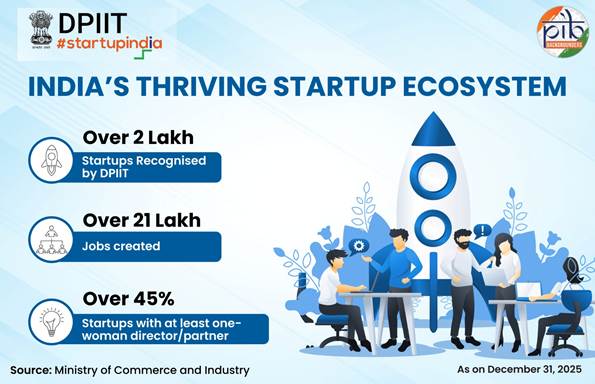
Startup India Initiative: A Decade of Building India’s Innovation Backbone
The Startup India Initiative, led by the Department for Promotion of Industry and Internal Trade (DPIIT) under the Ministry of Commerce and Industry, has emerged as the cornerstone of India’s innovation and entrepreneurial ecosystem. Over the past decade, the initiative has evolved from a policy-focused framework into a comprehensive, multi-dimensional platform supporting startups at every stage from ideation to scaling operations. This progress is reflected in India’s high-value startup ecosystem, which has expanded from just four privately held companies valued above $1 billion in 2014 to over 120 such firms today, with a combined valuation exceeding $350 billion underscoring both the scale and growing global relevance of India’s startup landscape.
Startups are leveraging India’s young demographic dividend, generating employment across technology, services, and manufacturing sectors, while also creating indirect job opportunities through gig work and supply chains. Beyond employment, startups are increasingly collaborating with large corporates and multinational companies, facilitating technology transfer, scalability, and global market integration.
In traditional sectors, innovation is driving economy-wide impact: agri-tech platforms like Hesa are improving farmers’ market access by bridging the rural-urban divide, while clean mobility startups such as Zypp are delivering scalable EV-based last-mile solutions. These innovations are producing multiplier effects across finance, supply chains, sustainability, and digital infrastructure, underscoring the broader ecosystem benefits of a thriving startup sector.
To accelerate innovation-led entrepreneurship, DPIIT, through the Startup India initiative, has rolled out the following flagship schemes and digital platforms to support funding, mentorship, and the scaling of startups nationwide.
- Fund of Funds for Startups (FFS)
The Fund of Funds for Startups (FFS) is a flagship initiative of the DPIIT under the Startup India Action Plan and is managed by the Small Industries Development Bank of India (SIDBI). With a corpus of ₹10,000 crore, the scheme supports SEBI-registered Alternative Investment Funds (AIFs), which in turn invest in startups, with the objective of expanding access to domestic risk capital and strengthening the entrepreneurial ecosystem.
The corpus of Rs. 10,000 crore has been committed to over 140 AIFs, which have collectively invested ₹25,500+ crore in 1,370+ startups.
- Credit Guarantee Scheme for Startups
The Credit Guarantee Scheme for Startups is implemented for enabling collateral free loans to startups through eligible financial institutions. CGSS is operationalized by the National Credit
Guarantee Trustee Company (NCGTC) Limited. Under CGSS, 330+ loans worth over ₹800 crore have been guaranteed for startup borrowers.
- Startup India Seed Fund Scheme (SISFS)
With a corpus of ₹945 crore, the Startup India Seed Fund Scheme (SISFS) provides financial assistance to startups for activities such as proof of concept, prototyping, product trials, market entry, and commercialisation. The scheme is overseen by an Expert Advisory Committee (EAC), which is responsible for its implementation, execution, and monitoring.
The corpus of ₹945 crore have been approved to 215+ incubators to support early-stage startups under the scheme.
The Startup India Online Hub is a one-of-a-kind digital platform for all stakeholders of the entrepreneurial ecosystem in India to discover, connect and engage with each other.The Startup Hub operationalizes this by connecting investors, mentors, and incubators with India’s aspiring entrepreneur. It brings together funds, academic institutions, corporates, and government bodies.
- States’ Startup Ranking Framework (SRF)
The States’ Startup Ranking Framework (SRF) assesses states and Union Territories based on their startup-friendly policies and implementation, fostering competitive federalism to strengthen India’s entrepreneurial ecosystem. Under the framework, states and UTs are classified into categories such as Best Performers, Top Performers, Leaders, Aspiring Leaders, and Emerging Startup Ecosystems, encouraging healthy competition and continuous improvement in startup governance.
- National Mentorship Portal (MAARG)
The Mentorship, Advisory, Assistance, Resilience, and Growth (MAARG) program has been developed to provide startups across the country with easy access to mentorship. By connecting entrepreneurs with experienced mentors, the portal aims to support startup growth, offer strategic guidance, and strengthen the overall entrepreneurial ecosystem nationwide.
- Startup India Investor Connect Portal
Developed in collaboration with SIDBI, the Startup India Investor Connect Portal is a digital platform that connects startups with venture capital funds and investors, with a particular focus on early-stage ventures. The platform enables entrepreneurs to reach multiple investors through a single application and pitch their ideas efficiently.
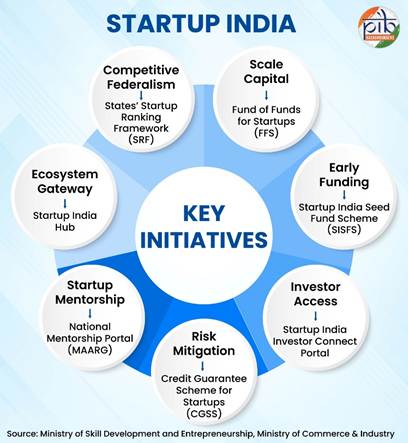
Schemes Strengthening India’s Startup Ecosystem
In addition to Startup India, a range of sector-specific and ministry-led initiatives have reinforced India’s startup ecosystem by addressing technology development, rural entrepreneurship, academic innovation, and regional inclusion. These schemes ensure that startup support is broad-based, decentralised, and aligned with national development priorities.
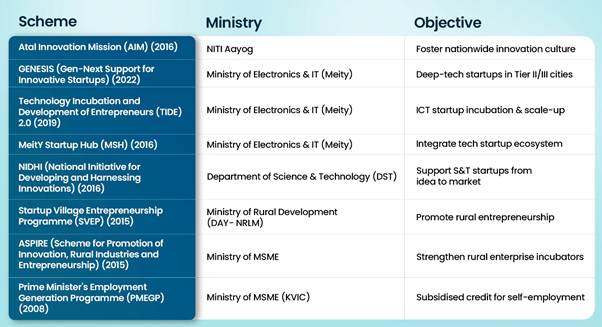
Atal Innovation Mission (AIM)
Launched in 2016 by NITI Aayog, the Atal Innovation Mission (AIM) is the Government’s flagship initiative that aims to foster a nationwide culture of innovation and entrepreneurship across schools, universities, research institutions, startups, and industry. With an outlay of ₹2,750 croreup to March 2028, AIM provides an integrated framework to design innovation programmes, enable partnerships, and strengthen India’s startup ecosystem.
|
AIM 1.0: Flagship Programs
While closely working with various central and state ministries, incubators, and global partners, the flagship programmes under AIM promote the Indian startup ecosystem.
Atal Tinkering Labs (ATLs)
- The Atal Tinkering Lab (ATL) programme is focussed to reshape India’s education landscape by moving students away from rote learning towards creativity, problem-solving, and innovation.
- With more than 10,000 ATLs spread across 733 districts, AIM is enabling millions of students to explore 21st-century skills such as AI, robotics, IoT, 3D printing, and beyond. While engaging over 1.1 crore students, it has enabled 16 lakh+ innovation projects.
Community Innovator Fellowship (CIF)
- Implemented in partnership with UNDP India, the programme equips aspiring community innovators with the knowledge, mentorship, and infrastructure support needed to drive grassroots entrepreneurship and social impact.
- In one-year intensive fellowship, each fellow is placed at an Atal Community Innovation Centre, where they gain SDG awareness, entrepreneurial and life skills, and hands-on experience in developing and refining their own innovation ideas.
Youth Co:Lab program
- Youth Co:Lab aims at empowering and investing in young people across Asia-Pacific to drive the SDGs through leadership, social innovation, and entrepreneurship.
- The programme highlighted theme-based national dialogues, through panels, workshops, and webinars, while also supporting youth-led ventures via long-term incubation and representation at regional summits.
- The Youth Co:Lab National Innovation Challenge 2024–25, in partnership with AssisTech Foundation, focused on enabling young entrepreneurs, including innovators with disabilities, to develop solutions that enhanced access and well-being for Persons with Disabilities across assistive technology, inclusive ed-tech and skilling, and care service models.
|
While AIM 1.0 focused on establishing innovation infrastructure and nurturing India’s emerging ecosystem, AIM 2.0 (2024) is centred on piloting new initiatives that address ecosystem gaps and scaling proven models in collaboration with Governments, industry, academia, and communities. It is also strengthening the early-stage innovation pipeline by scaling the Atal Tinkering Labs (ATLs) ecosystem, which nurtures problem-solving and entrepreneurial mindsets among school students.
|
Programs under AIM 2.0
- The Language Inclusive Program of Innovation (LIPI)focuses on reducing barriers for innovators, entrepreneurs, and investors who do not speak English through India’s 22 scheduled languages by establishing 30 Vernacular Innovation Centres
- The Frontier Program seeks to design tailored innovation and entrepreneurship models for Jammu & Kashmir, Ladakh, the North Eastern states, and Aspirational Districts and Blocks through Atal Tinkering Labs.
- The Human Capital Development Program aims to build a pipeline of professionals, managers, teachers, and trainers, equipped to develop, operate and maintain India’s innovation and entrepreneurship ecosystem.
- The Deeptech Reactor serves as a research sandbox to explore effective pathways for commercializing deep tech innovations, particularly those requiring long gestation periods and significant investment.
- The International Innovation Collaborations program takes India’s innovation and entrepreneurship ecosystem international.
- Other programs that target at improving the quality of output (jobs, products, and services) include the Industrial Accelerator program to increase industry involvement in scaling-up advanced startups and; The Atal Sectoral Innovation Launchpads (ASIL) program to build iDEX-like platforms in central ministries for integrating and procuring from startups in key industry sectors.
|
GENESIS (Gen-Next Support for Innovative Startups)
The GENESIS initiative, a National Deep-tech Startup Platform by Ministry of Electronics and Information Technology (MeitY), was launched in July 2022, with an aim to scale up about 1600 technology startups through implementing agencies in Tier-II and Tier-III cities across India, providing significant funding and support for deep-tech innovation.
With a budgetary outlay of ₹490 crore spread over five years, the scheme is positioned to accelerate and strengthen India’s rapidly expanding technology startup ecosystem through collaborative engagement among various stakeholders- startups, government institutions, academia, and corporates.
MeitY Startup Hub (MSH)
Established in 2016, the MeitY Startup Hub (MSH) under the Ministry of Electronics and Information Technology (MeitY) promotes technology-led innovation and strengthen India’s startup ecosystem. The Hub drives technology-led economic growth and innovation and acts as a central platform connecting incubation centres, Centres of Excellence on Emerging Technologies, and other platforms supported by the MeitY.
As of December 2025, the MeitY Startup Hub (MSH) supports a thriving ecosystem comprising of over 6,148+ startups, more than 517 incubators and over 329 labs across the country
Technology Incubation and Development of Entrepreneurs (TIDE) 2.0 Scheme
Anchored within the Ministry of Electronics and Information Technology (MeitY), the TIDE 2.0 Scheme was introduced in 2019 to catalyse technology-driven entrepreneurship by strengthening incubators that support Information and Communication Technology (ICT) startups using emerging technologies such as IoT, AI, blockchain and robotics. The supported thematic include Healthcare, Education, Agriculture, Financial Inclusion (including digital payments), Infrastructure and Transportation and Environment and Clean Tech. It further seeks to offer holistic support across seven thematic areas aligned with national priorities.Support is channelled through 51 incubators situated in top academic institutions and national research organisations across the country.
NIDHI (National Initiative for Developing and Harnessing Innovations)
The National Initiative for Developing and Harnessing Innovations (NIDHI), launched in 2016 by the Department of Science and Technology (DST), Ministry of Science and Technology, acts as an umbrella programme for nurturing ideas and innovations (knowledge-based and technology-driven) into successful startups. The programme focuses on building an innovation-driven entrepreneurial ecosystem with the objective of socio-economic development through wealth and job creation.
It has contributed to the economy by generating 1,30,000+ jobs, supported 12,000+ startups, backed 175+ Technology Business Incubator (TBI) and generated 1100+ IP (Intellectual Property).
|
Components
NIDHI-PRAYAS (Promotion and Acceleration of Young and Aspiring technology entrepreneurs), Supports from Idea to Prototype by providing a maximum funding support to an innovator/ Startup of ₹10 lakhs.
NIDHI-EIR (Entrepreneur in Residence), Support system to reduce risk for budding entrepreneurs, and encourage graduate students and provides financial support of up to ₹30,000/- monthly.
NIDHI-TBI (Technology Business Incubator), To tap innovations and technologies for venture creation by utilising expertise and infrastructure available with the host institution.
NIDHI-iTBI (Inclusive- Technology Business Incubator), A new variant of the NIDHI-TBI where it focuses on promoting entrepreneurship and supporting i-TBIs largely in Tier-2 and Tier-3 cities, with a focus on inclusiveness in terms of geographies, gender, persons with special abilities, etc.
NIDHI-Accelerator (Startup Acceleration Programme), Fast tracking a start-up through focused intervention.
NIDHI-SSS (Seed Support System), Provide early-stage investment through a maximum financial support of ₹1000 lakh (made available to an incubator) and ₹100 lakh per start-up as Seed Support
NIDHI-COE(Centres of Excellence), provide globally competitive facilities to help startups go global.
|
Startup Village Entrepreneurship Program (SVEP)
Implemented in May 2015 as a sub-scheme under the Deendayal Antyodaya Yojana–National Rural Livelihood Mission (DAY-NRLM), the SVEP aims to promote rural entrepreneurship by enabling households to set up and scale local enterprises.
- It aims to reduce poverty through self-employment and skilled wage employment resulting in sustainable and diversified livelihood options for the poor.
- SVEP bridges gaps in capital access and technical support for rural enterprises.
- Through these targeted interventions, the programme has supported 3.74 lakh enterprises as of 30 June 2025, strengthening local economies and enhancing income-generating opportunities at the grassroots level.
ASPIRE (A Scheme for Promotion of Innovation, Rural Industries and Entrepreneurship)
Launched by the Ministry of MSME in 2015, the scheme aims to promote innovation and entrepreneurship in rural and underserved areas. It focuses on setting up Livelihood Business Incubators (LBIs) for micro-enterprise creation, skilling and re-skilling opportunities, and workforce supply to industrial clusters.
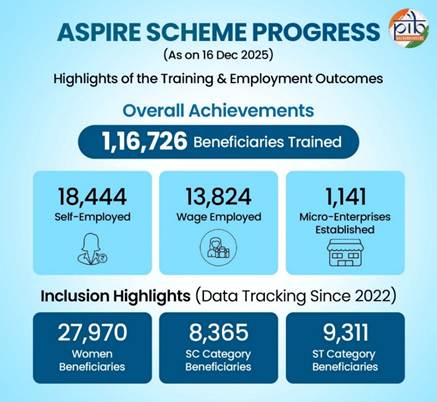
|
Financial Incentives
- For procurement of plant and machinery:
- A maximum of ₹ 1 crore to Government agencies
- ₹ 75 lakh to Private agencies
- For Operational Expenditures on manpower cost, running incubation and skill development programmers, etc.
- Maximum of ₹1 crore to Government and Private agencies as operational expenditure support towards manpower cost, running incubation and skill development programmers, etc.
|
Prime Minister’s Employment Generation Programme (PMEGP)
Conceived as India’s flagship intervention to promote self-employment and grassroots enterprise creation, the Prime Minister’s Employment Generation Programme (PMEGP) was brought into effect in 2008 by integrating the earlier Prime Minister’s Rojgar Yojana (PMRY) and Rural Employment Generation Programme (REGP) into a single, streamlined framework. The scheme is implemented through the Khadi and Village Industries Commission (KVIC) under the Ministry of MSME, ensuring wide outreach and effective last-mile delivery.
- As a Central Sector Scheme, it extends Margin Money (MM) support to General Category beneficiaries, covering 25% of the project cost in rural locations and 15% in urban areas.
- Special Category beneficiaries, comprising SC, ST, OBC, Minority, Women, Ex-servicemen, Persons with Disabilities, Transgender applicants, and individuals from the Northeastern Region, Hill and Border areas, and Aspirational Districts, are eligible for an enhanced Margin Money subsidy of 35% in rural areas and 25% in urban areas.
- The scheme also supports projects up to ₹50 lakh in the manufacturing sector and ₹20 lakh in the service sector.
Looking Ahead: A Future Built on Innovation & Execution
As India marks a decade of the Startup India Initiative, the country’s startup ecosystem stands at an inflection point- moving decisively from rapid expansion to sustainable scale and deeper integration with the real economy.
A decade on, India’s startup ecosystem represents not merely scale, but structural transformation built on demographic advantage, digital public infrastructure, and a sustained reform agenda. Startups are now embedded across priority sectors, driving innovation, employment generation, and global market integration. As India advances towards a $7.3 trillion economy by 2030 and the broader vision of Viksit Bharat 2047, startups are poised to remain central to the country’s development trajectory serving both as catalysts of growth and as enduring symbols of India’s future-ready, innovation-led economic model.
References
Ministry of Commerce & Industry
https://www.pib.gov.in/PressReleasePage.aspx?PRID=2098452®=3&lang=2
https://www.pib.gov.in/PressReleasePage.aspx?PRID=2038380®=3&lang=2
https://www.pib.gov.in/PressReleasePage.aspx?PRID=2201280®=3&lang=1
https://www.startupindia.gov.in/content/sih/en/startup-scheme.html
AU4149_fl3i6c.pdf
https://www.pib.gov.in/Pressreleaseshare.aspx?PRID=1895966®=3&lang=2
https://investorconnect.startupindia.gov.in/
https://www.startupindia.gov.in/srf/
AU1507_iPkDqy.pdf
AU4149_fl3i6c.pdf
https://www.indiabudget.gov.in/economicsurvey/doc/echapter.pdf
https://aim.gov.in/pdf/ATL-Guidebook.pdf
Ministry Of Electronics & Information Technology
https://sansad.in/getFile/loksabhaquestions/annex/184/AU2240_79NBJo.pdf?source=pqals
https://msh.meity.gov.in/schemes/tide
https://msh.meity.gov.in/
Ministry of Science & Technology
https://nidhi.dst.gov.in/nidhieir/
https://nidhi.dst.gov.in/schemes-programmes/nidhiprayas/
https://nidhi.dst.gov.in/
https://www.pib.gov.in/PressReleasePage.aspx?PRID=2170134®=3&lang=2
NIDHI- Seed Support System (NIDHI-SSS) | India Science, Technology & Innovation - ISTI Portal
Ministry of Rural Development
https://www.pib.gov.in/PressReleasePage.aspx?PRID=2081567®=3&lang=2
https://www.pib.gov.in/PressReleaseIframePage.aspx?PRID=2146872®=3&lang=2
Ministry of Micro, Small & Medium Enterprises
https://www.pib.gov.in/PressReleasePage.aspx?PRID=2204536®=3&lang=1
https://aspire.msme.gov.in/ASPIRE/AFHome.aspx
https://www.nimsme.gov.in/about-scheme/a-scheme-for-promotion-of-innovation-rural-industries-and-entrepreneurship-aspire-
Ministry of Home Affairs
https://www.pib.gov.in/PressReleasePage.aspx?PRID=2170168®=3&lang=2#:~:text=Similarly%2C%20the%20number%20of%20unicorn,harnessed%20to%20create%20unicorn%20startups
https://www.pib.gov.in/PressReleasePage.aspx?PRID=2176932®=3&lang=2
Ministry of Skill Development & Entrepreneurship
https://www.pib.gov.in/PressReleasePage.aspx?PRID=2038380®=3&lang=2
Press Information Bureau
https://www.pib.gov.in/PressNoteDetails.aspx?NoteId=155121&ModuleId=3®=3&lang=2
https://www.pib.gov.in/FactsheetDetails.aspx?Id=149260®=3&lang=2
https://www.pib.gov.in/PressNoteDetails.aspx?NoteId=154840&ModuleId=3®=3&lang=2
https://static.pib.gov.in/WriteReadData/specificdocs/documents/2025/jun/doc2025619572801.pdf
NITI Aayog
https://aim.gov.in/atl.php
https://www.pib.gov.in/PressReleasePage.aspx?PRID=2077102®=3&lang=2
IBEF
https://www.ibef.org/blogs/the-role-of-startups-in-india-s-economic-growth
https://www.ibef.org/economy/foreign-direct-investment
https://www.ibef.org/blogs/the-role-of-startups-in-india-s-economic-growth
SIDBI
https://www.sidbivcf.in/en/funds/ffs
Click here for pdf file.
***
PIB Research
(Explainer ID: 156949)
आगंतुक पटल : 339
Provide suggestions / comments