Energy & Environment
India’s Green Maritime Odyssey
Agenda for a Sustainable Ocean Economy
Posted On:
15 DEC 2025 11:30AM
Key Takeaways
- Indian ports are going green, adding renewable capacity, LNG bunkering, green cover expansion to reduce emissions and improve environmental performance.
- New Mangalore Port has achieved 100% solar power integration, serving as a benchmark for renewable adoption
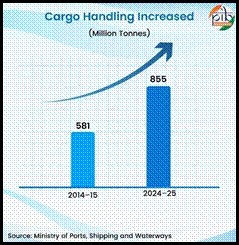
- India’s major ports handled 855 million tonnes of cargo in FY 2024-25 - up from 581 million tonnesin FY 2014– 15, reflecting a decadal growth of 47.16 %.
|
Introduction
As a critical constituent of the infrastructure sector, ports account for nearly 95 % of external trade by volume. During FY2024-25, India’s major ports handled 855 million tonnes of cargo - up from 581 million tonnesin FY 2014– 15, reflecting a decadal growth of 47.16 %. India’s ports are expanding rapidly to support economic growth in line with vision of Atmanirbhar Bharat, yet this surge intensifies environmental pressures. Ports are among the major sources of air and water pollution, and greenhouse gases (GHGs), putting stress on the rich biodiversity and marine life found in the mangroves, lagoons, coral reefs, and beaches along the coast.
Hence, if India is to achieve its vision of Atmanirbharta, while also meeting its overall Intended Nationally Determined Contributions ((INDCs)under climate change negotiations, the maritime sector needs to work towards a plan for achieving sustainability. Additionally, global maritime organizations have also set targets for the shipping industry. For example, the International Maritime Organization (IMO) is aligned with 9 UN Sustainable Development Goals for safe, efficient, and sustainable ports, and has set a target of 40% CO2 reduction from shipping sector by 2030.
Policy Framework
The idea of Green Maritime in India grew from the need to be aligned with such national and global priorities and commitments, HSE (Health, Safety, and Environment) standards, and the growing focus to make port operations safer, cleaner, and more sustainable.
To embed “green” in its approach, the obsolete Indian Ports Act, 1908 has been repealed and replaced by the Indian Ports Act, 2025, a modern statute institutionalizing cleaner, greener, and sustainable maritime operations.
The strategy and plan for achieving these goals lie in the Maritime India Vision (MIV) 2030, launched by the Ministry of Ports, Shipping and Waterways in 2021. It lists
The Indian Ports Act, 2025, which replaces the colonial and outdated Ports Act 1908, mandates adherence to global green norms, strengthening environmental safeguards in maritime operations. It introduces robust pollution control and disaster readiness measures to promote sustainable, eco- friendly port practices and reduce the sector's environmental footprint. It also aligns withThe International Convention for the Prevention of Pollution from Ships (MARPOL)and Ballast Water Management.
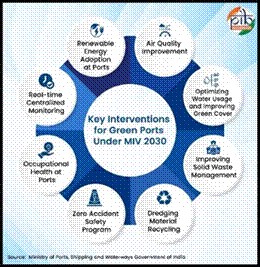
150 initiatives for for building a sustainable maritime ecosystem and serves as the blueprint for coordinated and accelerated growth of India’s maritime sector over the next decade.It places a lot of focus on building a Safe, Sustainable and Green Maritime Sector and has identified key interventions like increasing usage of renewable energy, reducing air emissions, optimizing water usage, improving solid waste management, zero accident safety program, and centralized monitoring system to achieve this.
Additionally, long term vision and strategy for green ports is also anchored in Maritime Amrit Kaal Vision 2047, which is a long-term roadmap for India’s maritime resurgence, with investments of nearly ₹80 lakh crore earmarked for ports, coastal shipping, inland waterways, shipbuilding, and green shipping initiatives. Outlining more than 300 actionable initiatives, it projects India’s rise as one of the world’s top maritime and shipbuilding powers by the centenary of independence, anchored in sustainability.
Harit Sagar: Green Port Guidelines
The Harit Sagar Green Ports Guidelines of 2023 align with the targets set under the Maritime India Vision (MIV) 2030, and with India’s COP26 commitments to reduce emission intensity by 45% by 2030 and achieve net-zero by 2070. They serve as a comprehensive framework to help Indian ports develop safe, efficient, green, and sustainable operations.
Salient features include:
- Ports must reduce carbon emissions per ton of cargo by 30% by 2030 and 70% by 2047.
- Ports must increase the share of renewable energy to over 60% by 2030 and over 90% by 2047.As of 2025, New Mangalore Port has achieved 100% solar power integration, serving as a benchmark for renewable adoption.
- Ports must electrify more than 50% of port equipment and vehicles by 2030, rising to over 90% by 2047.
- Ports must expand green cover by over 20% by 2030 and over 33% by 2047 to improve environmental quality.
- Ports must ensure shore-to-ship power supply is available to all vessels in phases, reaching EXIM vessels by 2025.
- Ports must achieve 100% wastewater reuse and reduce freshwater consumption by over 20% by 2030 through better resource management.
Status of Implementation
The Maritime India Vision 2030 and Harit Sagar Guidelines outline eight key interventions to transform Indian ports into fully green and sustainable hubs under MIV 2030.
1. Renewable Energy Adoption at Ports
Ports expand renewable energy by assessing land, rooftops, and calm water surfaces for solar installations, using both rooftop systems and floating PV assets that are rapidly gaining commercial acceptance. Wind energy adoption is increased by identifying feasible areas for onshore wind farms and setting up windmills through PPP models, and leveraging offshore wind potential at the southern tip of the Indian peninsula, offshore areas near the Port of Okha, and the vast salt fields of Kutch. Ports also launch a tidal energy pilot in Gujarat’s Gulf of Cambay or Kutch, which together offer 8,000–12,000 MW of potential.
Under the Harit Sagar Green Port Guidelines, share of renewable energy at Ports should exceed 60 percent by the Year 2030 and 90 percent by year 2047. The table below shares the status of renewable capacity at some ports.
|
Port Name
|
Renewable Capacity (MW)
|
|
1. Deendayal Port (Kandla)
|
~20 MW (solar + wind) (2025)
|
|
2. Visakhapatnam Port
|
10 MW (solar) (2023)
|
|
Port Name
|
Renewable Capacity (MW)
|
|
3. New Mangalore Port
|
5.2 MW (solar) (2023)
|
|
4. V.O. Chidambaranar Port (Tuticorin)
|
9 MW (solar+ wind+ rooftop solar system +1 MW ground based solar facility under construction) (2025)
|
|
5. Cochin Port
|
100kWp and 150kWp grid-connected solar plants, Installation of a 1.5MWp grid-connected floating solar plant, 9 solar prosumers (2024)
|
|
6. Chennai Port
|
It is proposed to install 2MWp rooftop Solar Power Generating PV units (2025)
|
|
7. Paradip port authority
|
Paradip Port Authority contributes ₹18,600 Cr with a 10 MW Solar Power Plant (2025)
|
|
8. Mormugao Port Authority
|
MPA is already a green port as we are producing 3 MW power through our in-house solar power plant which is taking care 100 percent of our consumption
|
|
9. Mumbai Port
|
Roof top solar power generation capacity - 1500KVA (2024-25)
|
|
10. Jawaharlal Nehru Port Authority
|
A combined rooftop and ground-mounted installed solar capacity of 4.10 MW (2023)
|
|
11. Haldia Port
|
2MW (AC) Solar PV Grid Power Plant (2025)
|
|
12. Kamarajar Port
|
Installed Renewable Energy Capacity: 320 KW S
|
Did You Know
Mormugao Port is India’s first port to introduce Green Ship Incentives through the Environmental Ship Index, aligning with global efforts to reduce air emissions in shipping. The port's incentive program, ‘Harit Shrey,’ launched in October 2023, offers discounts on port charges based on ESI scores, rewarding ships with higher environmental performance. This recognition is especially noteworthy as the Mormugao Port was one of three ports in Asia alongside Japan and Oman to offer such incentives.
|
2. Air Quality Improvement

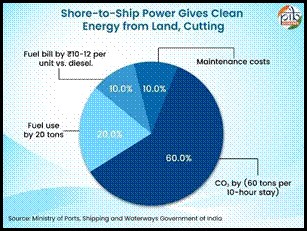
Ports worldwide are cutting emissions by using renewable energy in operations, and reducing operating costs. India too aims to electrify over 50% of its material-handling equipment by 2030-starting with ship-to-shore cranes, followed by reach stackers, straddle carriers, and forklifts. LNG bunkering is also expanding, offering ships and port vehicles a cleaner, cheaper fuel with up to 80% lower emissions than diesel. To manage dust and air pollution Indian ports are shifting to clean fuels, shore power, electric equipment, LNG, and green cover to reduce overall emissions within the port ecosystem. A key part of this shift is the introduction of shore-to-ship power supply. Mumbai Port is working on installations to provide shore-to-ship power supply, i.e., 200 kW, 415-volt, 50 Hz at five locations and has planned installations for the future as well, an initiative taken in order to reduce greenhouse gases emissions (GHG).Deendayal Port Authority (DPA) Kandla has further advanced this drive by deploying four electric wheel loaders, aligning with the Harit Sagar Green Port Guidelines.
Paradip Port has strengthened its environmental management through extensive dust-suppression systems, wheel- washing units, mechanical sweepers, and fixed sprinklers. It operates a Tier-1 oil-spill response facility, and has shifted to LED lighting. The port has also carried out large-scale green initiatives, planting 11.5 lakh plants in and around the Paradip area by 2023–24 through OFDC. Additionally, a plantation programme of 1 lakh seedlings in the Paradip locality was executed through OFDC Ltd. with an investment of about ₹8.42 crore.
3. Optimizing Water usage and Improving Green Cover
Port operations such as dredging, cargo handling, and ship waste discharge degrade water quality, and consume large amounts of freshwater for firefighting, dust suppression, landscaping, ballasting, and ship supply. To improve this, ports are required to build sewage and wastewater treatment plants, manage oily waste through recycling, and strengthen oil-spill response using satellite monitoring. Water conservation can be boosted with atomizers and mist canons, which cut water use by up to 1/20th. Ports must also expand green cover-currently only 3% to 36% against the required 33%-using available land, mangroves, and mudflats, supported by CSR participation.
4. Improving Solid Waste Management
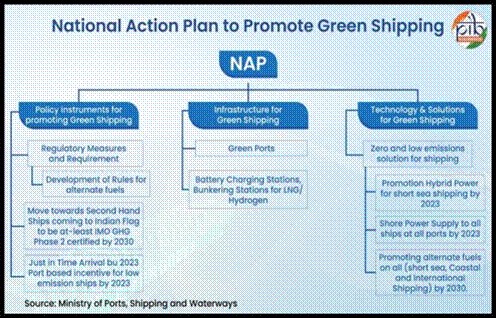
Ports generate significant solid waste from construction debris to domestic refuse requiring efficient systems for collection, segregation, transport, and processing. While major ports produce 20-30 tonnes of waste daily, recycling rates vary widely due to weak segregation and poorly located transfer stations. To improve this, ports must strengthen solid and plastic waste management in line with the National Action Plan for Green Shipping and the Swachh Bharat Mission. Major Ports have already taken important steps toward better cleanliness. They are cleaning the wharf, repairing and cleaning storage sheds, fixing port roads, repainting road signs, improving and maintaining toilet complexes, and placing dustbins across the port areas. These activities show clear progress in keeping port premises cleaner while preparing the ground for stronger waste-management systems.
5. Dredging material Recycling
Dredging, essential for developing and maintaining ports, generates large volumes of material often dumped at sea, causing environmental harm. Ports are shifting to sustainable methods by recycling and reusing dredged material for land reclamation, construction, beach nourishment, shoreline protection, and habitat creation. This requires analysing material properties, minimizing sediment suspension, and protecting biodiversity. A phased approach is proposed-first piloting the recycling of at least 30% of dredged material, then expanding reuse for construction, soil enhancement. Other port needs through PPP-based mechanisms, as seen in ports like Mundra, Jaigarh, Visakhapatnam, and Paradip.
6. Zero Accident Safety Program
A Zero Accident Safety Program is essential for Indian ports to strengthen safety culture, enhance worker protection, and improve productivity. To achieve zero accidents, ports must focus on five key areas: risk assessment, equipment- related safety, hazardous material management, safety culture and training, and process re-engineering. Strengthened safety training, redesigned material-handling processes, and robust disaster management planning are critical to reducing hazards and ensuring safe, efficient port operations.
V.O. Chidambaranar Port Authority demonstrates how this safety goals can be put into practice. The port ensures that only safe, suitable, and well-maintained equipment is used during operations. Workers and stakeholders follow proper safety practices and use Personal Protective Equipment (PPE) while handling cargo. The port regularly conducts safety mock drills, awareness programs, and inspections of operational areas. It maintains proper lighting at night and trains workers on the importance of high safety standards. Because of these continuous and dedicated efforts, VOC Port has successfully operated as a “Zero Fatal Accident Zone” in 2019, 2020, and 2021, showing its strong commitment to achieving a zero-accident environment.
7. Occupational Health at Ports
Ports expose workers to multiple physical, chemical, biological, ergonomic, and psychosocial hazards, making strong occupational health measures essential. Ports must identify and assess these risks, implement preventive systems, and ensure workers are fit and protected through proper training, medical support, and emergency readiness. Strengthening occupational health services includes trained medical officers, 24/7 emergency care, and essential rescue equipment, supported by a Medical Monitoring Program that conducts pre-employment screening, periodic checks, and confidential health documentation. India’s seafarer workforce has grown to 3.08 lakh as of December 2024, a 263% increase since FY 2014-15, with women's participation rising 10-fold, supported by enhanced health protocols.
A notable achievement in this regard is Mumbai Port Trust’s 200-bed hospital serving 45,000 employees and its ongoing PPP project to develop a 600-bed super-specialty hospital on 10 acres at a cost of INR 639 crore, significantly upgrading occupational health infrastructure for port workers.
8. Real-time Centralized Monitoring
Global ports comply with international HSE standards and emission-reduction initiatives, but India’s maritime sector still lacks a unified and well-documented approach. To close this gap, ports need a centralized real-time monitoring system that tracks key HSE indicators using uniform targets and global reporting frameworks. This system will digitally capture and monitor safety, health, and environmental data across all ports, provide transparency through a national dashboard, and help identify trends and improve emissions control, safety performance, and overall collaboration.
Did you know
India set up the National Centre of Excellence in Green Ports & Shipping (NCoEGPS) in partnership between the MoPSW and TERI in November 2023. This Centre is backed by major ports -Cochin Shipyard, Deendayal Port, Paradip Port, and V.O. Chidambaranar Port. Its main job is to research policies, regulation, and new technologies to make ports and shipping greener, pushing for carbon neutrality and a circular economy. And it helps decision-makers at national and state level by giving them the tools to implement green measures like electrifying port operations, using renewable energy, biofuels, and building green infrastructure.
|
The MIV 2030 is implemented through the Harit Sagar Green Port Guidelines (2023), which mandate renewable energy, zero-liquid discharge, and emission reduction targets across all major ports to achieve net-zero goals.
Initiatives like Sagarmala Programme, Harit Sagar, Harit Nauka, and Green Tug Transition Programme (GTTP)etc provides practical roadmap for decarbonising shipping through green finance, regulations, technology, and collaboration, balancing sustainability with economic growth.
Major Government -Led Green Initiatives
Below are key green initiatives of government for sustainable maritime growth and cleaner energy.
- Sagarmala Programme: It isa flagship program to make India a global maritime leader is a key part of Maritime India Vision 2030 and Maritime Amrit Kaal Vision 2047. It aims to lower logistics costs, speed up trade, and create jobs through smarter, greener transport networks. Under this program, 840 projects worth ₹5.8 lakh crore will be completed by 2035. So far, 272 projects worth ₹1.41 lakh crore are finished, and 217 projects worth ₹1.65 lakh crore are underway
|
Did You Know
The Central Government approved the project proposal for the “Development of an all-weather greenfield Major Port at Vadhavan” in Maharashtra, in June 2024. Vadhavan Port is being developed by Vadhavan Port Project Limited (VPPL), a joint venture between Jawaharlal Nehru Port Authority (JNPA) and Maharashtra Maritime Board (MMB). The total estimated project cost is INR 76,220 Cr., comprising investment of INR 38,976 Cr. for core infrastructure development (including INR 17,709 Cr. for reclamation and dredging activities through PPP mode) and INR 37,244 Cr. for the development of terminal and other commercial infrastructure through PPP mode.
|
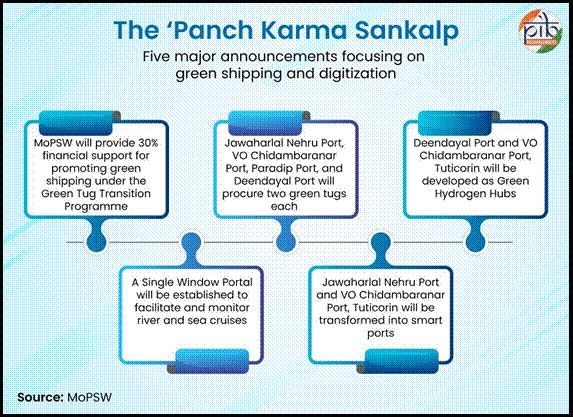
- Green Tug Transition Programme (GTTP): The Green Tug Transition Program (GTTP) as a key initiative under the ‘Panch Karma Sankalp’. This landmark initiative is set to drive the transition from conventional fuel-based harbour tugs, a marine vessel that helps other vessels by pushing or pulling them, with direct contact or a tow line, to greener, more sustainable alternatives, marking a major step in India's commitment to environmental sustainability and the advancement of its maritime sector. This program not only aligns with country’s environmental goals but also strengthens India’s commitment to ‘Make in India,’ promoting domestic innovation and manufacturing in the maritime industry.‘Make in India’ initiative was launched globally in
September 2014 as a part of India’s renewed focus on Manufacturing. The objective of the Initiative is to promote India as the most preferred global manufacturing destination and to make India an integral part of the global supply chain.
Green Hybrid Tugs are vessels which are powered by Green Hybrid Propulsion systems, and subsequently adopting non-fossil fuel solutions like (Methanol, Ammonia, Hydrogen).
|
- Harit Nauka (Green Vessel) Initiative: The Harit Nauka guidelines for inland vessels was launched to promote adoption of greener technologies in inland waterway vessels.The initiative aims eventually for a complete shift to “Green Vessels” by 2047.
The Government envisions complete transition to Green Vessels by 2047 with the objectives of:
-
- Developing and operationalizing new age vessels with standardized designs/ infrastructure that are green and safe.
- Creating an enabling ecosystem for the operation of such Green Vessels
- Promoting safe, convenient and green inland waterway-based passenger transport
- Developing indigenous capacity and promoting “Make in India” policy in shipbuilding
- Enabling financial assistance for development of Green Vessels and related ecosystem
- The National Green Hydrogen Mission: It was launched by the Government of India in 2023 to cut carbon emissions and make India a global leader in green hydrogen. By 2030, the goal is to produce 5 million tonnes of green hydrogen every year, bringing in ₹8 lakh crore investments, creating 6 lakh jobs, and saving ₹1 lakh crore in fossil fuel imports. The mission focuses on production, pilot projects, electrolyser manufacturing, skill training, infrastructure, and research, with plans to replace fossil fuels in steel, transport, and fertilizer sectors. To push this forward three major ports namely Kandla, Paradip and Tuticorin ports have been identified by MoPSW to be developed as Green Hydrogen hubs.
In line with India’s National Green Hydrogen Mission, Shipping Corporation of India is working to retrofit at least two ships to run on green hydrogen or other green hydrogen-derived fuels by 2027. In this regard, 2 vessels from its fleet have been identified to be retrofitted to run on green methanol.
|
The government has also been inking strategic MoUs to accelerate sustainable maritime development. These agreements strengthen India’s broader green port agenda which is supported by concrete investments, advanced technologies, and strong partnerships.
Sustainable MoUs Fuel India’s Maritime Growth
On 19 September 2025, at Bhavnagar, a landmark MoU Exchange Ceremony under the banner “Samudra Se Samriddhi-Transforming India’s Maritime Sector” marked a defining moment in India’s maritime ambitions.27 separate MoUs had been signed, embodying a holistic and forward-looking maritime agenda. Among these, a clear emphasis on sustainability emerged. With commitments exceeding ₹66,000 crore, the projects encompass high- capacity ports, green mobility, tourism, energy, shipping security, shipbuilding ecosystems, and robust financial capital frameworks.
- MoU signed between the Inland Waterways Authority of India (IWAI) and the Bihar Government for a ₹908 crore Water Metro Project in Patna. It involves energy-efficient electric ferries and modern terminals.
- Mazagaon Dock Shipbuilders Limited entered into a parallel MoU with Guidance Tamil Nadu to set up another large greenfield yard in Thoothukudi.
- Shipbuilding clusters in Andhra Pradesh, Odisha, Gujarat, Maharashtra, and Tamil Nadu are explicitly designed as green innovation hubs, promoting carbon-neutral shipbuilding and eco-friendly marine engineering. Shipyards are increasingly embracing green, efficient, and sustainable technologies.
- To reinforce combined capacities in the east, Garden Reach Shipbuilders & Engineers signed agreements with IPRCL, SCI, SMPK, and Modest Shipyard for new ventures in greenfield facilities, tug development, and ship repair, particularly in Gujarat and West Bengal.
- The Sagarmala Finance Corporation Limited signed agreements with financial institutions such as Neo Fund, NaBFID, IIFCL, and Climate Fund Managers, paving the way for sustainable investments into the maritime sector. These MoUs will help mobilise equity, co-investment, and innovative debt instruments for green shipbuilding, fleet modernisation, and maritime logistics projects.
In tandem with these domestic efforts, India is also strengthening its international maritime collaborations through global green pacts, including on oil spills in high seas.
|
India’s International Green Maritime Pacts
|
|
|
Country
|
Green Initiatives Signed
|
|
|
|
Denmark
|
India and Denmark agreed on a joint work plan for green and digital maritime initiatives under their MoU via a Steering Group with DG Shipping and the Danish Maritime Authority, set up a Centre of Excellence in Green Shipping, and will cooperate in green fuel development, green maritime
technology, ship recycling, and energy efficient innovation.
|
|
|
|
Norway
|
India and Norway Joint Working Group decided to cooperate on green shipping, ship recycling, maritime training, maritime security related issues.
|
|
|
|
Russia
|
India and Russia will strengthen cooperation on the Northern Sea Route to promote more efficient, lower-emission Arctic shipping.
|
|
|
|
Malta
|
The Joint Committee formed under the MoU signed between India and Malta discussed the possible collaboration in the field of green shipping, cruise shipping, ports infrastructure, initiatives under IMO, sharing information and best practices in shipping registry.
|
|
|
|
Singapore
|
India signed an MoU with Singapore on Green and Digital Shipping Corridor. The collaboration is expected to accelerate the adoption of low-emission technologies, strengthen digital tools, and transform maritime operations.
|
|
|
|
Netherlands
|
India and the Netherlands signed an MoU on Maritime Cooperation and the Green Digital Sea Corridor to drive sustainable port growth.
|
|
Conclusion
India stands poised at the threshold of a transformative maritime era - one that harnesses its vast coastline, growing industrial capacity and strategic position to not only advance trade and connectivity but also cement a legacy of sustainability and resilience. Through visionary programmes, legislative reforms and green-shipping initiatives, the country is rewiring its maritime ecosystem for the future: cleaner ports, low-emission fleets, smart infrastructure and inclusive opportunity. As India charts its course toward 2047, it is doing so not just as a rising maritime power, but as a responsible steward of the seas, a globally competitive economy and a partner committed to the well-being of the planet.
References:
https://www.pib.gov.in/PressReleasePage.aspx?PRID=2182946
https://www.pib.gov.in/PressReleasePage.aspx?PRID=2105136
https://www.pib.gov.in/PressReleasePage.aspx?PRID=2105085
https://www.pib.gov.in/PressReleasePage.aspx?PRID=2182563
https://www.pib.gov.in/PressReleasePage.aspx?PRID=2045946
https://www.pib.gov.in/PressReleasePage.aspx?PRID=2074644
https://www.pib.gov.in/PressReleasePage.aspx?PRID=2155480
https://www.pib.gov.in/PressReleasePage.aspx?PRID=2109521
https://www.pib.gov.in/PressNoteDetails.aspx?id=155063&NoteId=155063&ModuleId=3
https://www.pib.gov.in/PressReleseDetail.aspx?PRID=2155845
https://www.pib.gov.in/PressReleseDetailm.aspx?PRID=2167305
https://www.pib.gov.in/PressReleasePage.aspx?PRID=2157621
https://www.pib.gov.in/PressReleasePage.aspx?PRID=2172488
https://www.pib.gov.in/PressReleasePage.aspx?PRID=2183140
https://mopsw.nic.in/sagarvidyakosh/index.php?title=Jawaharlal_Nehru_Port_Authority
Mumbai Port Authority
https://mumbaiport.gov.in/WriteReadData/RTF1984/1703606288.pdf
Ministry of External Affairs
https://www.mea.gov.in/Images/attach/Make_in_India_Initiative.pdf
Click here to see pdf
****
RK
(Explainer ID: 156496)
आगंतुक पटल : 2516
Provide suggestions / comments