Infrastructure
National Energy Conservation Day: Saving Energy, Securing Future
Posted On:
14 DEC 2025 12:43PM
Key Takeaways
|
- PM Surya Ghar mission has added 7 GW of clean energy and connected nearly 24 lakh households with solar energy by December 2025.
- The transition from Perform, Achieve and Trade (PAT) to Carbon Credit Trading Scheme (CCTS) marks a major shift, putting carbon-intensity reduction and tradable credits at the heart of industrial energy policy.
- Digital platforms are modernising energy-efficiency governance by strengthening monitoring, compliance, and transparency.
- India’s clean energy capacity now crosses the 50% non-fossil milestone, reflecting the growing success of renewable expansion, efficiency schemes, and grid stability improvements.
|
Introduction
Energy is more than just electricity or fuel; it is the force that enables modern life. It lights our homes, powers our industries, drives transportation, supports digital services, and keeps hospitals, schools, and businesses running.
Energy underpins economic growth, social development, and technological advancement. As India’s economy expands, the demand for reliable and affordable energy continues to rise. Addressing this demand requires not only expanding supply but also ensuring efficient and responsible energy use.
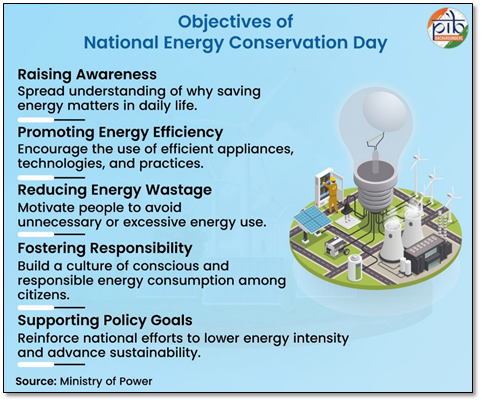
Energy efficiency involves achieving the same output with less energy consumption, while conservation focuses on avoiding waste. Together, they form a central pillar of India’s energy strategy. Recognising their importance, India observes National Energy Conservation Day on 14 December each year to promote awareness and acknowledge contributions towards efficient energy use.
|
National Energy Conservation Day
National Energy Conservation Day, or Rashtriya Urja Sanrakshan Diwas, observed annually since 1991, was established to promote awareness of reducing energy use and encouraging efficient practices across various sectors. Following the enactment of the Energy Conservation Act, 2001, the Bureau of Energy Efficiency (BEE) began leading nationwide efforts, including outreach programmes, school competitions, and the national awards. Today, the day serves as an important reminder that energy efficiency is central to ensuring affordability, reducing emissions, strengthening grid reliability, and supporting India’s broader clean-energy transition in a rapidly growing economy.
|
India’s Current Energy Landscape
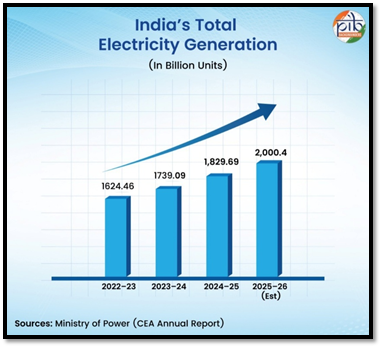
India is among the world’s top three energy consumers, and electricity demand continues to grow every year. The total electricity generation increased from 1,739.09 Billion Units (BU) in 2023–24 to 1,829.69 BU in 2024–25, a growth of 5.21%. For 2025–26, the generation target has been set at 2,000.4 BU.
At the same time, the power system has become more reliable. In June 2025, the energy-shortage levels were reported to be as low as 0.1 %. India's meta peak demand of 241 GW with zero shortage highlights improved system resilience and better demand-supply management.
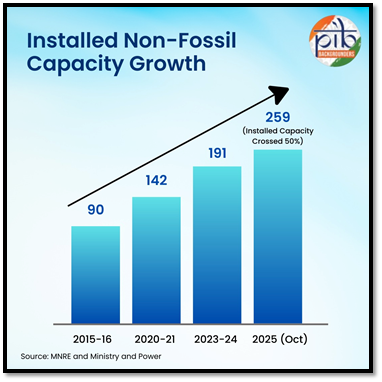
India’s energy mix is rapidly shifting toward cleaner sources. As of 31 October 2025, the country’s total installed generation capacity stands at 505 GW, of which non-fossil sources account for over 259 GW. This means that more than 50% of installed electricity capacity now comes from non-fossil sources such as solar, wind, hydro, and nuclear power. This evolving landscape shows that India is not only expanding access to energy but also moving toward a cleaner and more sustainable energy future.
Major Energy Conservation Initiatives
To reduce energy wastage and promote the efficient use of resources, the Ministry of Power and the Bureau of Energy Efficiency (BEE) have launched several national programs across industries, encouraging the adoption of efficient technologies, improved design, and smarter energy management.
Flagship government programs shaping progress are:
Industrial Energy Efficiency: Industry accounts for a major share of India’s total energy consumption, making efficiency improvements central to reducing costs and emissions.
- The Carbon Credit Trading Scheme (CCTS) is India’s new market-based framework for industrial decarbonisation. Under CCTS, emission-intensive sectors are assigned Greenhouse Gas Emission Intensity (GEI) targets, and industries that outperform these targets earn Carbon Credit Certificates that can be traded.
In December 2025, the government transitioned several major energy-intensive sectors, including aluminium, cement, petrochemicals, refineries, pulp & paper, textiles, and chlor-alkali, from the earlier PAT mechanism to the CCTS Compliance Mechanism.
The Perform, Achieve and Trade (PAT) scheme served as India’s foundational programme for industrial energy efficiency. PAT assigned energy-reduction targets to designated consumers, and industries that exceeded these targets earned Energy Saving Certificates (ESCerts) for trading. PAT laid the groundwork for large-scale efficiency improvements, which CCTS now deepens by directly linking performance to carbon-emission outcomes.
Household Energy Efficiency: A major pillar of India’s energy-conservation strategy is improving efficiency at the household and small-business level.
- The Standards & Labelling (S&L) Programme, covering 28 appliance categories (17 mandatory), provides consumers with clear information through star labels and encourages manufacturers to adopt higher-efficiency technologies. Recent additions, such as grid-connected solar inverters, reflect the programme’s continued expansion.
- UJALA LED programme: Launched in January 2015, the Unnat Jyoti by Affordable LEDs for All (UJALA) scheme aims to provide energy-efficient LED bulbs to domestic consumers at affordable prices. The initiative not only reduces electricity bills but also saves energy and has helped create a large, competitive market for energy-efficient appliances.
|
The UJALA LED programme has expanded nationwide with 36.87 crore LED bulbs distributed, resulting in 47,883 million kWh of energy savings annually, ₹19,153 crore in cost savings, 9,586 MW of avoided peak demand, and a yearly reduction of 3.88 million tonnes of CO₂ emissions.
|
- Pradhan Mantri Surya Ghar Muft Bijli Yojana (2024): Launched in February 2024 with an outlay of ₹75,021 crore, aims to equip one crore households with rooftop solar systems and provide up to 300 units of free electricity each month. As of December 2025, over 23.9 lakh homes have installed rooftop solar.
- RDSS: The Revamped Distribution Sector Scheme (RDSS), launched in 2021, is a flagship programme to strengthen the operational and financial performance of electricity distribution companies (DISCOMs). As of December 2025, India has installed 4.76 crore smart electricity meters under central and DISCOM-driven programmes.
Buildings: India has developed building-energy codes to promote efficient construction and reduce electricity use in new buildings.
- The Energy Conservation Building Code (ECBC), first introduced in 2007, sets minimum energy-efficiency standards for commercial buildings. It was later strengthened through the Energy Conservation and Sustainable Building Code (ECSBC), which expands requirements to cover sustainability, materials, and overall environmental performance.
- Eco Niwas Samhita (ENS)was introduced in 2018 for homes; it focuses on reducing energy use in residential buildings through better design, ventilation, and insulation. Together, these codes improve comfort, lower energy bills, and support India’s long-term energy-efficiency goals.
Digital and Institutional Frameworks: Strengthening institutions and data systems is essential for scaling energy efficiency across sectors.
- Digital tools such as the Urja Dakshata Information Tool (UDIT) offer nationwide insights into energy consumption patterns, programme performance, and sector-wise savings.
- National Mission on Enhanced Energy Efficiency (NMEEE) provides the overarching policy architecture through initiatives like PAT, Market Transformation for Energy Efficiency (MTEE), Energy Efficiency Financing Platform (EEFP), and Framework for Energy Efficient Economic Development (FEEED).
- Behavioural initiatives under LiFE (Lifestyle for Environment) further strengthen public participation by promoting mindful, responsible consumption.
Public Participation: Public participation is promoted nationwide through awards and painting competitions.
The National Energy Conservation Awards (NECA), held every year since 1991 on 14 December, is among India’s leading recognitions for energy efficiency, celebrating industries, organisations, and individuals for exemplary energy-saving achievements. Since 2021, the National Energy Efficiency Innovation Awards (NEEIA) have also been organised to highlight cutting-edge innovations in energy efficiency.
A nationwide National Painting Competition on Energy Conservation is also organised on 14 December, serving as one of the country’s largest student outreach initiatives. Conducted at the school, state, and national levels, it encourages children to creatively depict energy-saving themes and fosters early awareness of sustainable practices.
India’s Global Leadership & International Partnerships
Do You Know?
UJALA’s LED-bulb distribution model is being exported beyond India. The state of Melaka in Malaysia adopted a UJALA-type scheme under an agreement with Energy Efficiency Services Limited (EESL). Earlier, the government had launched UJALA-UK to promote efficient lighting.
|
In 2024, India formally joined the International Energy Efficiency Hub, a global platform where governments, international organisations, and private stakeholders collaborate to promote energy-efficient technologies and practices. This step signals India’s commitment to aligning its domestic efficiency efforts with global best practices and to sharing its experiences internationally.
Under the United Nations Framework Convention on Climate Change (UNFCCC), every country is required to chart an energy-transition pathway suited to its national priorities. India has defined a pathway that balances rapid economic growth with long-term climate responsibility. The country has committed to achieving net-zero emissions by 2070, and its 2030 Nationally Determined Contributions (NDCs) include reducing the emissions intensity of GDP by 45%, ensuring that 50% of installed power capacity comes from non-fossil sources, creating an additional carbon sink of 2.5–3 billion tonnes of CO₂ equivalent, promoting sustainable lifestyles through the LiFE movement, and enhancing resilience in climate-vulnerable sectors.
These engagements position India as a leading voice for the Global South, advocating for affordable clean energy, equitable climate finance, and access to technology under the principles of the UNFCCC. During its G20 Presidency, India advanced global cooperation on clean fuels and energy transitions, including the launch of the Global Biofuels Alliance (GBA).
Till date, the GBA has been expanded to 25 countries and 12 international organisations, reflecting global confidence in India’s leadership on sustainable fuels. The alliance brings together major biofuel producers, consumers, and multilateral bodies to accelerate the adoption of affordable, low-carbon fuels worldwide.
India also co-founded the International Solar Alliance (ISA), which works to expand affordable solar power across developing countries. ISA has become a key platform for mobilising investment, strengthening cooperation, and accelerating solar deployment in the Global South.
ISA 2025 Key Highlights
- India hosted the 8th ISA Assembly in New Delhi, bringing together 125+ Member and Signatory countries, 550 delegates, and 30+ ministers, reinforcing ISA’s growing global influence.
- ISA launched several new global solar initiatives, including:
- SUNRISE, a programme for solar recycling and circularity;
- OSOWOG (One Sun One World One Grid) to advance cross-border solar grid integration;
- SIDS Solar Procurement Platform, developed with the World Bank for Small Island Developing States;
- Global Capability Centre (GCC) to strengthen innovation, training, and capacity-building.
- ISA advanced its “Towards 1000” strategy, which aims to mobilise USD 1 trillion in solar investments by 2030 and support deployment of 1,000 GW of solar capacity across member countries.
|
Beyond ISA, India engages through international platforms such as the Coalition for Disaster Resilient Infrastructure (CDRI), Mission Innovation, and partnerships with the International Renewable Energy Agency (IRENA) to support global clean-energy innovation.
|
According to the IRENA Renewable Energy Statistics 2025, India ranks:
- 3rd in solar energy
- 4th in wind energy, and
- 4th globally in total installed renewable energy capacity
|
The Road Ahead: Role in NDCs, Net Zero, and Viksit Bharat
Energy conservation remains one of the important goals, and BEE continues to play a central role in the journey. Initiatives such as Standards & Labelling, PAT/CCTS, building energy codes, NECA/NEEIA, energy audits, state partnerships, and large-scale public campaigns, BEE is working to ensure that efficiency becomes a natural part of everyday decision-making. Its awareness programmes, ranging from school painting competitions to mass outreach campaigns and National Awards, help young people, households, and businesses understand that every unit of energy saved contributes to national progress.
As the nation observes National Energy Conservation Day, the road ahead is clear: conserving energy is not only a technical necessity but a civic responsibility. The Government, BEE, industry, and citizens must work together to build an informed, efficiency-driven culture that supports India’s vision of a clean, secure, and sustainable energy future. Energy conservation will remain integral to India’s growth strategy as the country advances towards its 2030 climate commitments and its long-term vision of Viksit Bharat.
PIB Research
References
Ministry of Power: https://powermin.gov.in/sites/default/files/uploads/power_sector_at_glance_Sep_2025.pdf
https://cdnbbsr.s3waas.gov.in/s3f80ff32e08a25270b5f252ce39522f72/uploads/2023/04/2023041368-1.pdf
https://www.pib.gov.in/PressReleasePage.aspx?PRID=2090639®=3&lang=2
https://powermin.gov.in/en/content/energy-efficiency
https://www.pib.gov.in/PressReleasePage.aspx?PRID=2200456®=3&lang=1
https://www.pib.gov.in/PressReleseDetail.aspx?PRID=2135450®=3&lang=1
https://powermin.gov.in/sites/default/files/uploads/MOP_Annual_Report_Eng_2024_25.pdf
https://www.pib.gov.in/PressReleasePage.aspx?PRID=2179463®=3&lang=2
https://www.pib.gov.in/PressReleasePage.aspx?PRID=2061656®=3&lang=2
https://www.pib.gov.in/PressReleasePage.aspx/pib.gov.in/Pressreleaseshare.aspx?PRID=2089243®=3&lang=2
https://www.pib.gov.in/PressReleseDetail.aspx?PRID=1513648®=3&lang=2
https://www.pib.gov.in/PressReleasePage.aspx?PRID=1489805®=3&lang=2
https://www.pib.gov.in/newsite/PrintRelease.aspx?relid=170569®=3&lang=2
Bureau of Energy Efficiency:
https://beeindia.gov.in/sites/default/files/press_releases/Brief%20Note%20on%20PAT%20Scheme.pdf
https://udit.beeindia.gov.in/standards-labeling/
https://udit.beeindia.gov.in/about-udit/#:~:text=Home%20/%20About%20UDIT,Informing%20policy%20and%20NDC%20goals
PIB Archives:
https://www.pib.gov.in/PressNoteDetails.aspx?id=156347&NoteId=156347&ModuleId=3®=3&lang=1
https://www.pib.gov.in/FactsheetDetails.aspx?Id=149086®=3&lang=2
https://www.pib.gov.in/FactsheetDetails.aspx?Id=149088®=3&lang=2
Ministry of Environment, Forest and Climate Change
https://www.pib.gov.in/PressReleasePage.aspx?PRID=1885731®=3&lang=2
Cabinet:
https://www.pib.gov.in/PressReleaseIframePage.aspx?PRID=1847812®=3&lang=2
https://www.pib.gov.in/PressReleaseIframePage.aspx?PRID=1837898®=3&lang=2
Ministry of Petroleum & Natural Gas
https://www.pib.gov.in/PressReleasePage.aspx?PRID=2036867®=3&lang=2
https://mopng.gov.in/en/page/68
Ministry of New and Renewable Energy
https://www.pib.gov.in/PressReleasePage.aspx?PRID=2071486®=3&lang=2
https://cdnbbsr.s3waas.gov.in/s3716e1b8c6cd17b771da77391355749f3/uploads/2025/11/202511061627678782.pdf
https://www.pib.gov.in/Pressreleaseshare.aspx?PRID=1606776®=3&lang=2#:~:text=Cumulative%20renewable%20energy%20capacity%20of,was%20given%20by%20Shri%20R.K
https://cdnbbsr.s3waas.gov.in/s3716e1b8c6cd17b771da77391355749f3/uploads/2024/10/20241029512325464.pdf
https://www.pib.gov.in/PressReleasePage.aspx?PRID=2183434®=3&lang=2
https://sansad.in/getFile/annex/269/AU1111_Djrfhp.pdf?source=pqars
https://www.pib.gov.in/PressReleseDetail.aspx?PRID=2200441®=3&lang=2
Ministry of Homes Affairs
https://ndmindia.mha.gov.in/ndmi/leadership-initiatives
Ministry of Science and Technology
https://mi-india.in/
International Renewable and Energy Efficiency:
https://www.irena.org/News/pressreleases/2022/Jan/India-and-IRENA-Strengthen-Ties-as-Country-Plans-Major-Renewables-and-Hydrogen-Push
https://www.pib.gov.in/PressReleasePage.aspx?PRID=2036867®=3&lang=2
Ibef:
https://www.ibef.org/industry/power-sector-india
National Energy Conservation Day: Saving Energy, Securing Future
*******
PIB Research
(Explainer ID: 156480)
आगंतुक पटल : 6266
Provide suggestions / comments