Economy
Lok Adalats: Justice That Speaks for the People
Accessible, Compassionate and Timely Resolution for Every Citizen
Posted On:
13 DEC 2025 1:46PM
Key Takeaways
- Lok Adalats is a friendly and informal forum where disputes are resolved by consensus, not contest.
- From National to Taluk-level authorities, they ensure timely and locally accessible dispute resolution across India.
- National and E-Lok Adalats settle millions of cases annually, offering fast, cost-effective resolutions and reducing court backlogs.
- Permanent Lok Adalats handle essential service disputes using conciliation and adjudication, ensuring citizens receive timely, fair outcomes.
|
|
Introduction: Where Justice Meets People, Hope Finds Its Voice
|
On a quiet Saturday morning in a small district town, the usually silent court complex hums with a different kind of energy. Outside, you see farmers with land disputes, shopkeepers resolving payment issues, families settling long-pending claims, and bank officials sifting through files, all gathered with a shared hope that today, years of waiting may finally end. There is no tense courtroom drama, no intimidating legal jargon. Instead, there is conversation, negotiation, and an unusual sense of relief that justice might actually be simple.
This is the spirit of the Lok Adalat, India’s people-centric forum where disputes are settled not by contest, but by consensus. Lok Adalats have become one of India’s most trusted alternative dispute resolution mechanisms. Whether held in court premises, community halls, or virtually through E-Lok Adalats, they bring justice closer to citizens, saving time, reducing costs, and cutting the burden on courts. Unlike formal courts, Lok Adalats are informal, friendly platforms where parties sit together and work out on solutions they can both accept. There are no court fees, no complex procedures, and no winners or losers. The effort is not to decide who is right, but to help people find a practical, fair, and quick resolution so they can move on with their lives.
|
Statutory Foundation: The Legal Services Authorities Act, 1987
|
By embedding Lok Adalats within the Legal Services Authorities Act, 1987, India ensures a legally robust & deeply humane model of justice.
|
Lok Adalats did not emerge in isolation, they evolved from a broader national commitment to ensure that every person, regardless of income or background, can access justice with dignity. This commitment took a concrete legal form through the Legal Services Authorities Act, 1987. This is a landmark legislation that transformed free legal aid and alternative dispute resolution from scattered initiatives into a structured, nationwide system.
- The Act lays down the structure, powers, and functions of
Lok Adalats, ensuring that settlements reached through conciliation carry the same legal force as a court decree.
- The statutory backing enhances credibility and also reinforces confidence among citizens and institutions to resolve disputes amicably outside traditional courtrooms.
- No court fee is payable when a matter is filed in a Lok Adalat.
Key Legal Provisions of Legal Services Authorities Act, 1987
|
Establishment of Lok Adalats at various levels (State, District, Taluk, High Court, Supreme Court) ensures a nationwide, institutional structure for accessible dispute resolution.
|
|
Referral of cases, pending in court or pre-litigation matters, to Lok Adalats to ensure early resolution option without lengthy litigation.
|
|
Lok Adalats function on a conciliation model, with a co-operative and non-adversarial approach.
|
|
Already paid court fees is refunded when the case is settled, encouraging settlement and relief for litigants.
|
|
Award of Lok Adalat is final & binding, deemed as a civil court decree and no appeal is permitted for quick finality and enforceability.
|
|
Establishment & jurisdiction of Permanent Lok Adalats for public utility services leads to faster resolutions.
|
|
Institutional Architecture: National to Taluk-Level Structure
|
The 4- tiered institutional design ensures that Lok Adalats are not just symbolic events in major cities but a functioning, accessible mechanism across urban centres, small towns, and rural belts.
|
The strength of the Lok Adalat system lies in its 4-tiered structure that reaches citizens across every level of governance, from the Supreme Court down to Taluk courts. This institutional framework ensures that no individual is too far from a forum for quick, affordable and conciliatory justice. The structure operates through a coordinated chain of Legal Services Authorities, enabling nationwide uniformity while responding to local needs.
The 4-Tiered Organisational Structure
|
Level & Leadership
|
Key Functions
|
|
National Legal Services Authority (NALSA) under Chief Justice of India
|
Policy direction, regulations, National Lok Adalat calendar, monitoring and coordination.
|
|
State Legal Services Authority (SLSA) under Chief Justice of HC & Executive Chairman
|
Implement NALSA policy, organise Lok Adalats (including High Court matters), legal aid delivery, preventive legal services.
|
|
District Legal Services Authority (DLSA) under District & Sessions Judge
|
Coordinate with Taluk Legal Services Committee (TLSCs), organise district-level Lok Adalats, manage legal aid and local implementation.
|
|
District Legal Services Authority (DLSA) under Seniormost Judicial Officer
|
Conduct Lok Adalats in taluka/mandal, grassroots legal aid, first-point citizen access.
|
Through this architecture, the promise of easy, timely, people-centric justice becomes a practical reality for millions.
|
National Lok Adalats (NLAs): A Mission-Mode Delivery Mechanism
|
DID YOU KNOW?
Every year, NALSA releases a National Lok Adalat calendar. It announces dates in advance for simultaneous sittings across all courts.
These pre-set dates give courts, lawyers, litigants, and government departments the breathing space to identify cases, prepare files, and encourage settlements ahead of time.
|
While Lok Adalats operate throughout the year in different jurisdictions, National Lok Adalats extend this framework by conducting simultaneous, nationwide sittings on a single day at all levels of the judiciary and aims at clearing a large volume of cases in a time bound manner. The general procedure of National Lok Adalat ensures that involved parties are given a reasonable opportunity of being heard before referral. Cases (both pre-litigation and pending) are referred to Lok Adalats either by a court or by the Legal Services Authority (be it SLSA or DLSA). A court may refer a pending case when both parties consent, one party applies and the court sees scope for settlement, or the court itself finds the matter fit. Pre-litigation disputes can also be sent on an application by any party.
Even during COVID-19, this calendar-driven system allowed for rapid adaptation, giving rise to E-Lok Adalats, which enabled remote participation and brought justice directly into people’s homes.
The scale of mobilisation is unmatched in the global justice ecosystem. Thousands of benches operate on the same day, supported by judicial officers, conciliators, para-legal volunteers and staff, transforming ordinary court complexes into bustling centres of resolution and compromise.
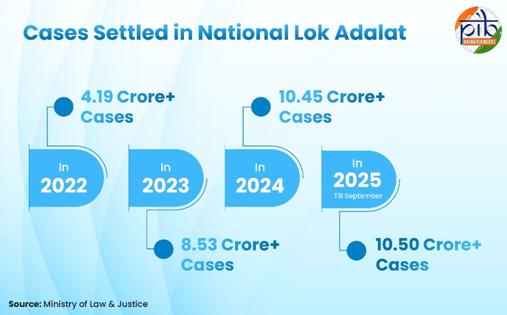
The outcomes of these mission-mode efforts have been extraordinary. These are not just statistics, they reflect households gaining closure, small traders resolving disputes, accident victims receiving compensation, and countless litigants stepping out of long-pending cases that had drained time, resources and emotional energy.
National Lok Adalats show what is possible when the justice system adopts a campaign mindset: speed with sensitivity, scale with fairness, and efficiency rooted in compassion.
National Lok Adalat: The Framework
- Cases are referred as per the procedure prescribed under the Legal Services Authorities Act, 1987.
- Necessary directions are issued to conduct pre-Lok Adalat or pre-conciliation sittings before the scheduled date of National Lok Adalat, ensuring scope of an amicable settlement.
- Pending cases disposed of during Lok Adalat are updated on the National Judicial Data Grid (NJDG), promoting use of technology or digital platforms.
- Extensive awareness campaigns are organised to enhance participation of parties.
|
|
Permanent Lok Adalats (PLAs): Ensuring Quick Relief in Public Utility Services
|
Public Utility Services (e.g., transport, electricity, water, postal, telecom)
Jurisdiction: Upto ₹ 1 Crore
Panel Composition: Chairperson + 2 Members (with relevant expertise)
|
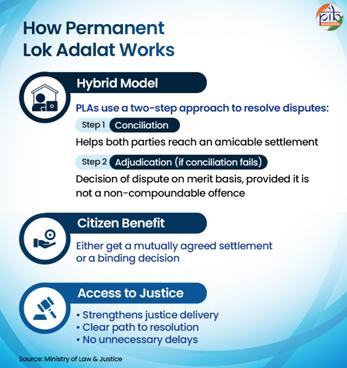
As a specialised forum dedicated to pre litigation conciliation and settlement, Permanent Lok Adalats (PLAs) have emerged as an important mechanism for resolving everyday service-related disputes. PLAs (Sections 22B-22E) under the Legal Services Authorities Act, 1987, resolve disputes connected to public utility services areas such as transport, telecommunications, electricity, water supply and postal services.
Unlike regular Lok Adalats, these bodies exist as permanent forums with authority not only to conciliate but also to decide disputes when settlement fails, ensuring certainty and closure. The Award of the Permanent Lok Adalat is final and binding on all the parties.
|
Performance Snapshot: Millions of Lives, Countless Resolutions
|

Lok Adalats across India have continued to deliver speedy, cost-effective, and accessible justice in recent years. National, State, and Permanent Lok Adalats, along with the digital E‑Lok Adalats, have collectively resolved disputes ranging from pre-litigation cases to pending court matters. Their combined efforts have significantly reduced the burden on traditional courts while ensuring citizens receive timely settlements and binding decisions. This overall strive has improved public trust in alternative dispute resolution, and substantial savings of time and resources for both litigants and the justice system, as showcased by high number of resolved cases.
|
Conclusion: Resolving Disputes, Rebuilding Trust, Renewing Lives
|
As the day winds down in court complexes across the country after a busy day of Lok Adalat, a quiet sense of satisfaction lingers in the air. Lok Adalats and Permanent Lok Adalats, now complemented by E‑Lok Adalats, show that justice need not be distant or intimidating. It can be accessible, empathetic, and empowering. Every settlement is a story of understanding, every resolved case a moment of trust restored between citizens and the system. In this quiet, persistent way, the Lok Adalat system reminds us that justice is not just about laws and courts, it is about people, dignity, and the simple, profound right to move forward in life with fairness and hope.
References
Ministry Of Law & Justice:
https://nalsa.gov.in/lok-adalats/
https://cdnbbsr.s3waas.gov.in/s32e45f93088c7db59767efef516b306aa/uploads/2025/09/202509171342021284.pdf
https://cdnbbsr.s3waas.gov.in/s38261bae60fcef985b46667cf365e690b/uploads/2025/12/20251208634523449.pdf
https://www.pib.gov.in/PressReleasePage.aspx?PRID=2100326®=3&lang=2
https://doj.gov.in/access-to-justice-for-the-marginalized/
https://nalsa.gov.in/faqs/#1743592297157-684e9890-2d0b
https://nalsa.gov.in/faqs/#1743592298196-ba4b10d1-37f2
https://nalsa.gov.in/national-lok-adalat/
https://nalsa.gov.in/permanent-lok-adalat/
https://nalsa.gov.in/the-legal-services-authorities-act-1987/
https://nalsa.gov.in/lokadalats/#:~:text=Lok%20Adalat%20is%20one%20of,Legal%20Services%20Authorities%20Act%2C%201987
https://www.pib.gov.in/PressReleasePage.aspx?PRID=1848734®=3&lang=2
https://cdnbbsr.s3waas.gov.in/s39f329089b8d9644b96ba05d545355d67/uploads/2025/06/202506042007507813.pdf
Lok Sabha:
https://sansad.in/getFile/loksabhaquestions/annex/184/AU4710_TmG1Ss.pdf?source=pqals
Press Information Bureau:
https://www.pib.gov.in/PressReleasePage.aspx?PRID=2187718®=3&lang=2
Others:
https://cdnbbsr.s3waas.gov.in/s38261bae60fcef985b46667cf365e690b/uploads/2025/12/20251208634523449.pdf
https://www.indiacode.nic.in/bitstream/123456789/10960/1/the_legal_service_authorities_act%2C_1987.pdf
Click here to see PDF
****
PIB Research
(Backgrounder ID: 156468)
आगंतुक पटल : 212
Provide suggestions / comments