Farmer's Welfare
PM Vishwakarma Haat 2026
Vishwakarma ka Abhiyaan, Viksit Bharat ka Nirmaan
Posted On:
24 JAN 2026 10:25AM
On a crisp winter morning in Delhi, as the gates of Dilli Haat, INA open and the early visitors begin to arrive, Mr. Punchok Paldan is already at work, greeting passers-by with a warm smile. A skilled woodcarver from Leh, Ladakh, he sets out his handcrafted wooden creations with practised ease, welcoming strangers as though they are familiar faces. This marks his second year at the PM Vishwakarma Haat. Having recorded sales of nearly ₹2 lakh during his participation last year, he returns this time with greater confidence, carrying not only his craft but also a sense of connection and belonging fostered through the platform.
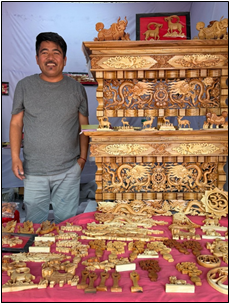
Around him, the Haat gradually stirs to life, the rhythmic tap of chisels on wood blends with the soft rustle of handwoven textiles. The earthy aroma of terracotta wares drifts from carefully arranged displays. PM Vishwakarma Haat 2026 is more than an exhibition; it is a vibrant, living marketplace where India’s traditional crafts continue to evolve, connect, and reach new audiences.
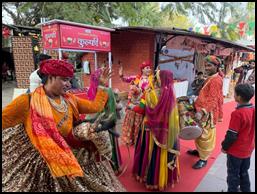
Organised by the Ministry of Micro, Small and Medium Enterprises (MSME) at Dilli Haat, INA, from 18 to 31 January 2026, the Haat brings together over 117 artisans from across various states and union territories. Open daily from 10:30 AM to 10:00 PM, it offers visitors a rich, pan-India canvas of craftsmanship that reflects the ethos of “Vishwakarma Ka Abhiyaan, Viksit Bharat Ka Nirman.” Alongside handcrafted products, the Haat features live craft demonstrations, including pottery, bangle-making, and doll-making, as well as cultural performances, making it an immersive experience that extends beyond a conventional marketplace.
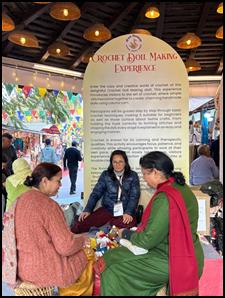
The PM Vishwakarma scheme, launched in September 2023, has emerged as a comprehensive initiative to empower traditional artisans and craftspersons from villages by integrating them into formal market systems. The scheme provides end-to-end support, including a PM Vishwakarma Identity Card and Certificate, skill training with a daily stipend of ₹500, a free toolkit worth ₹15,000, access to collateral-free credit, and incentives for adopting digital transactions. In addition to financial and skill development support, the scheme places strong emphasis on market linkage through platforms such as PM Vishwakarma Haat, enabling artisans to showcase, brand, and market their products to a broader national and international audience. The essence of the initiative is aptly reflected in the phrase “Virasat se Vikas”. As of 22 January 2026, the scheme has received 2.72 crore applications for selection and has registered approximately 30,000 artisans.
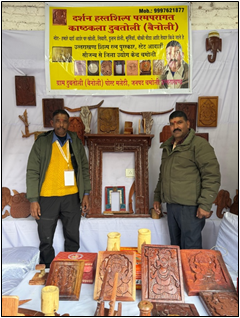
In one corner of the Haat, two artisans from Uttarakhand stand close by, their journeys distinct in craft yet united by tradition. Mr. Darshan Lal from Chamoli district has devoted over three decades to wood carving, carrying forward a lineage of artisans associated with the construction of the Badrinath temple. A recipient of a district-level award and later the Silver Ratna award for artisans, he formally registered his enterprise as an MSME in 2008–09. Reflecting on his experience, he says that “We knew how to make things,” but opportunities for expansion and market access were limited. Under the PM Vishwakarma scheme, he received skill training, a toolkit, and access to affordable credit. More significantly, a platform that enabled his craft to engage with the market on equitable terms. PM Vishwakarma Haat 2026 marks his first exhibition participation in Delhi. Drawing from his experience, he now encourages fellow artisans to enrol in the scheme, viewing it not as a procedural requirement but as a pathway to growth.
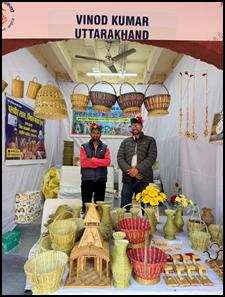
Nearby, Mr. Vinod Kumar from Uttarkashi district displays an array of crafts made from bamboo, dwarf bamboo, and pine. While pine craft represents his ancestral occupation, he gradually diversified into bamboo, reflecting a balance between tradition and adaptability. He began his enterprise in 2008 and formally registered it as an MSME in 2022. Today, Vinod directly employs trainers to train artisans across 13 districts of Uttarakhand. Sales at exhibitions such as this typically range between ₹40,000 and ₹50,000; however, the broader impact extends beyond immediate revenue. His enterprise functions as a catalyst, where individual success fosters skill development and livelihood opportunities for many others. With support from the PM Vishwakarma scheme, including training and tools, his work demonstrates how entrepreneurial growth can lead to broader community empowerment.
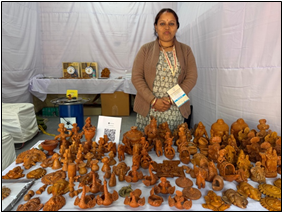
For Ms. Jyotsna Paul from Dhubri, Assam, terracotta represents both inherited tradition and creative innovation. After joining her family enterprise, she registered it as an MSME in 2020. Since then, government-supported platforms have enabled her to reach markets well beyond her hometown, including fairs in Assam, Varanasi, Noida, and now Delhi. Invitations through State NRLM missions, the Ministry of Textiles, the Ministry of MSME, and export promotion councils, with travel, accommodations, and meals covered, substantially reducing risk and encouraging broader engagement. Sales at such exhibitions typically range between ₹20,000 and ₹30,000, and at PM Vishwakarma Haat 2026 alone, she has already recorded sales of ₹15,000–₹20,000. More than immediate returns, the Haat offers her continuity, a platform to return, refine her craft, and steadily expand her market presence.
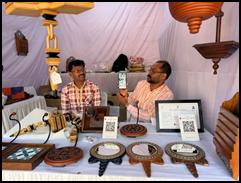
From Kerala, Mr. Sudheesh V D showcases intricately carved wooden artefacts, complemented by a strong digital presence. Alongside his physical stall, he actively manages an Instagram page, effectively linking traditional craftsmanship with online outreach. Registered as an MSME in 2024, he accessed a collateral-free loan of up to ₹3 lakh at a concessional interest rate of 5 percent, significantly lower than conventional bank lending rates. He received a free toolkit valued at ₹15,000. At exhibitions such as these, his sales seldom fall below ₹20,000. For artisans like him, the marketplace is no longer limited by geography, as digital platforms, online payments, and repeat customers extend the reach of their craft well beyond the physical market.
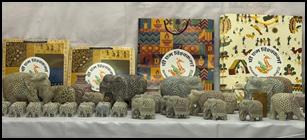
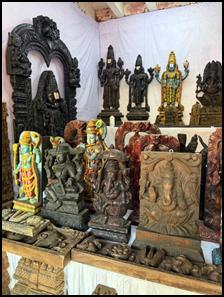
Dilli Haat’s consistently high footfall makes it a strategically advantageous venue for an exhibition of this nature. The diversity of products on display is vast, ranging from Kashmiri kurtis to intricately carved stone statues standing over 6.5 feet tall. Ministry-branded shopping bags, available in multiple sizes, help reduce packaging costs for artisans while simultaneously serving as mobile promotional tools for the Haat.
Each stall is also equipped with a placard issued by the Ministry of MSME, providing visitors with transparent and credible information about the artisan, including name, place of residence, contact details, nature of enterprise, monthly production capacity, and willingness to undertake bulk or customised orders. This seemingly modest feature effectively converts a temporary stall into a professional micro-enterprise interface, reinforcing trust and facilitating repeat transactions and sustained market linkages.
Equally notable is the level of awareness among artisans. They articulate a clear understanding of government schemes and associated benefits, including access to affordable credit under the PM Vishwakarma and related initiatives, concessional interest rates compared to conventional bank loans, and the integrated nature of support encompassing training, tools, and finance. The widespread adoption of UPI as the preferred mode of transaction further reflects increasing digital literacy and the expanding reach of formal banking services in rural areas.
These fairs succeed because artisans choose to return. Participation is not viewed as a one-time opportunity but as part of a credible and functioning ecosystem that artisans recognise and trust. Here, governance is made visible not through procedures or paperwork, but through tangible outcomes that directly support livelihoods. Collectively, these outcomes support the Government’s broader development vision of Sabka “Saath, Sabka Vikas, Sabka Vishwas” by building trust at the grassroots, strengthening livelihoods under Aatmanirbhar Bharat, and steadily advancing the goal of Viksit Bharat@2047 through inclusive, market-linked growth. As evening sets in and the lights begin to dim, visitors continue to linger. Conversations extend across counters, and hands move thoughtfully over fabric, wood, clay, and stone, assessing weight, texture, and trust. PM Vishwakarma Haat 2026 does not promise an instant transformation. Instead, it offers something more durable: access, visibility, and dignity. In this Haat, history and culture are not preserved behind glass; they are alive, shaped by skilled hands, strengthened by policy support, and shared openly with those willing to pause, observe, and engage.
References
Ministry of Micro, Small and Medium Enterprises
https://pmvishwakarma.gov.in/
https://www.pib.gov.in/PressReleasePage.aspx?PRID=2215839®=3&lang=2
PM Vishwakarma Haat 2026
*****
PIB Research
(Features ID: 157068)
आगंतुक पटल : 2079
Provide suggestions / comments