Others
A Gallery of Eternal Courage: Inauguration of Param Vir Dirgha at Rashtrapati Bhavan
Posted On:
21 DEC 2025 9:50AM
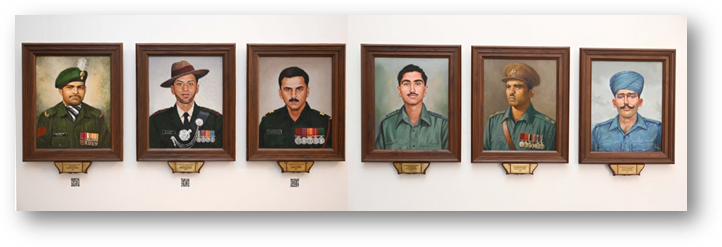
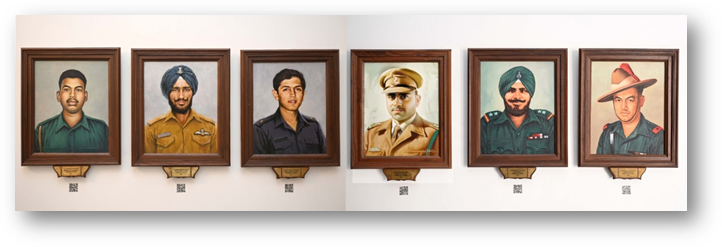
The majestic halls of Rashtrapati Bhavan have recently gone through a profound transformation. On the occasion of Vijay Diwas on 16th of December, the President Smt Droupadi Murmu inaugurated the Param Vir Dirgha at Rashtrapati Bhavan. With this, the portraits of British ADCs earlier displayed in Rashtrapati Bhawan corridors gave way to the portraits of the 21 recipients of Param Vir Chakra, India’s highest wartime gallantry award. What was once a symbol of colonial authority has now become a symbol of national pride, the unconquerable spirit of our national heroes who showed dauntless courage in defending our nation.
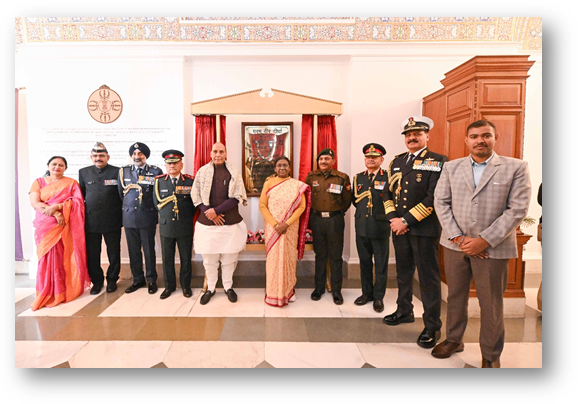
The inauguration, attended by Defence Minister Shri Rajnath Singh, Chief of Defence Staff General Anil Chauhan, Chief of the Army Staff General Upendra Dwivedi, Chief of the Air Staff Air Chief Marshal A. P. Singh, Chief of the Naval Staff Admiral Dinesh K. Tripathi, and other dignitaries, honoured not only the living legends but also the next of kin of those who made the supreme sacrifice.
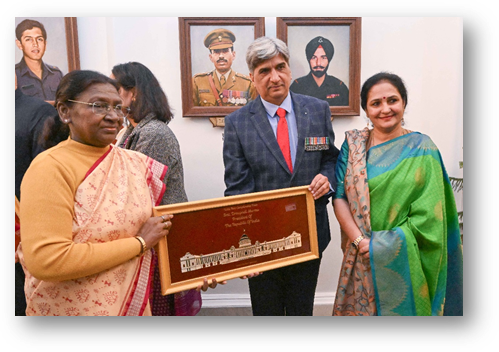
During the colonial era, Rashtrapati Bhavan, then the Viceroy’s House, projected imperial authority through its architecture and interiors. Portraits of British military aides once lined the corridors, reflecting a hierarchy rooted in foreign rule. With independence, these spaces were gradually redefined, aligned with the values, struggles, and aspirations of a sovereign nation.
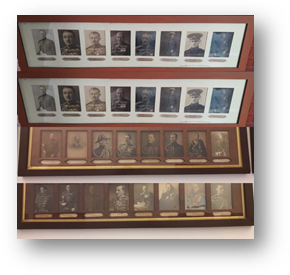
The Param Vir Dirgha represents the culmination of that journey. By replacing colonial imagery with the stories of India’s bravest soldiers, honour now rests with those whose courage and sacrifice defended the nation.
The Param Vir Chakra: India’s Highest Honour
Instituted on 26 January 1950 by the Government of India, the Param Vir Chakra recognises acts of the highest gallantry in the presence of the enemy. Often awarded posthumously, it symbolises courage that transcends duty, acts where personal survival is eclipsed by the call of the nation.
The medal is circular and cast in bronze. In the centre, on a raised circle, is the state emblem, surrounded by four replicas of Indra's Vajra. On the reverse is the inscription "Param Vir Chakra" in Hindi and English. The "Param Vir Chakra “represents the "Wheel of the Ultimate Brave", reflecting righteous courage.
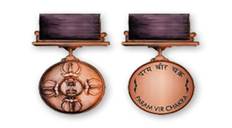
Of the 21 recipients of this highest gallantry award, 14 were awarded posthumously, underscoring the ultimate price paid for the nation’s freedom and security.
The Param Vir Dirgha honours all 21 Param Vir Chakra awardees and showcases India’s major military engagements, including the 1947–48 Jammu and Kashmir operations, the 1962 conflict with China, the 1965 and 1971 wars against Pakistan (with the Bangladesh Liberation War), and the 1999 Kargil conflict. Each name etched into the Dirgha represents a life defined by extraordinary resolve, soldiers who stood their ground against overwhelming odds, pilots who flew into peril with unwavering focus, and officers who led from the front, even unto death.
Major Somnath Sharma, the first recipient of the Param Vir Chakra, displayed exceptional leadership during the defence of Badgam in Kashmir in November 1947. Facing a vastly superior enemy force, he repeatedly braved open ground under intense enemy fire to direct his men. In full view of the enemy, he marked targets with cloth strips to direct Indian aircraft, undeterred by the grave risk to his own life. Even after sustaining casualties and with his arm in a plaster cast, he continued to distribute ammunition and encourage his troops. His action delayed the enemy for six crucial hours, safeguarding the motherland. Through exceptional courage, steadfast determination and supreme sacrifice, Major Somnath Sharma upheld the highest traditions of the Indian Army.
On 6 February 1948, at No. 2 Piquet on Taindhar, Naik Jadunath Singh commanded a small post that faced repeated enemy assaults. Though vastly outnumbered and wounded, he repelled successive attacks through exceptional leadership and firepower. When all his men became casualties, he fought on alone, launching a final charge before being killed in action, preventing the enemy from overrunning the piquet and safeguarding the defence of Nowshera.
Under a United Nations mission in the Congo, on 5 December 1961 at Elizabethville, Katanga, Captain Gurbachan Singh Salaria led a small force of Gorkhas to block enemy reinforcements threatening a strategic roundabout. Outnumbered and under heavy fire, he mounted a determined close quarter assault, neutralising enemy positions and armoured cars. Though mortally wounded, his action ensured mission success and prevented the encirclement of UN forces, exemplifying exceptional leadership and courage.
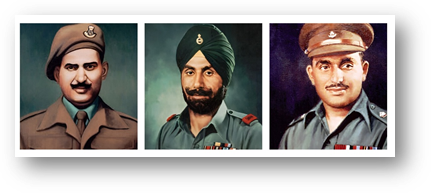
On 10 September 1965, Company Quarter Master Havildar Abdul Hamid countered a major Pakistani tank assault in the Khem Karan sector. Braving intense shelling, he manoeuvred his recoilless gun to destroy multiple enemy tanks at close range. Even after being targeted by heavy fire, he continued fighting until mortally wounded, inspiring his unit to repel the armoured attack through exceptional courage and selflessness.
During the 1971 war, Lance Naik Albert Ekka demonstrated exceptional bravery in the Battle of Gangasagar on the eastern front. Despite being grievously wounded, he charged and silenced multiple enemy machine gun positions, enabling his battalion to secure a vital objective that facilitated further advances towards Bangladesh. His actions proved decisive in overcoming a heavily fortified enemy defence.
On 16 December 1971, during the Battle of Shakargarh, Second Lieutenant Arun Khetarpal led his troop against a Pakistani armoured attack at Jarpal. Displaying exceptional courage, he destroyed multiple enemy tanks under intense fire. Even after his tank was hit and he was severely wounded, he refused to withdraw and continued to engage enemy armour even after his tank was hit and he was severely wounded, ensuring the defence of a vital sector. His sacrifice ensured that the enemy’s desperate attempt to breach the sector was thwarted.
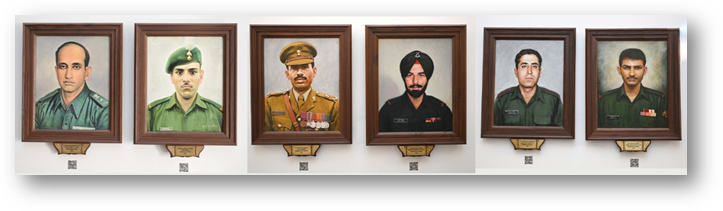
Flying Officer Nirmal Jit Singh Sekhon, a Gnat pilot stationed at Srinagar, defended the valley during the 1971 war despite unfamiliar terrain and high-altitude conditions. On 14 December 1971, as six Pakistani Sabre jets attacked the airfield, he took off against overwhelming odds and engaged the enemy in a low-level dogfight. Outnumbered and under intense fire, his aircraft was shot down. His action disrupted the attack and protected Srinagar airfield, setting a lasting benchmark of courage and gallantry in the Indian Air Force.
During Operation Meghdoot in June 1987, Naib Subedar Bana Singh volunteered for the daring mission to capture an enemy post on the Siachen Glacier at 21,000 feet. Navigating a treacherous route between steep ice walls, he led his men into close combat under extreme conditions, ultimately securing the position through extraordinary courage and leadership.
On 25 November 1987, Major Ramaswamy Parameswaran was returning from a search operation in Sri Lanka when his unit was ambushed at night by militants. Displaying exceptional presence of mind, he manoeuvred his troops to outflank the attackers and led a counterassault. Shot in the chest during close combat, he fought on, continued issuing orders, and inspired his men until his last breath, repelling the ambush and making the supreme sacrifice.
The Kargil conflict of 1999 saw acts of gallantry under extreme terrain and fire. On 7 July 1999, in an operation at Point 4875, Captain Vikram Batra’s company was tasked with clearing a narrow, treacherous ridge flanked by steep drops and fortified enemy defenses. Engaging the enemy at point-blank range, he fought relentlessly, killing five enemy soldiers in hand-to-hand combat. Despite sustaining grievous injuries, he continued leading from the front, and ultimately, he succumbed to his injuries. Inspired by his extraordinary courage and leadership, his troops launched a ferocious counterattack, annihilating the enemy and capturing Point 4875.
During the assault on Tiger Hill, Grenadier Yogendra Singh Yadav volunteered to lead the climbing team up a steep and snow-covered rocky approach at an altitude of nearly 16,500 feet. Despite sustaining multiple gunshot wounds, he continued his advance, neutralised enemy positions in close combat, and enabled the successful capture of one of the conflict’s most critical objectives.
Together, these accounts reflect not only battlefield success but a deeper ethos of duty, leadership, and self-sacrifice. The Param Vir Dirgha brings these narratives together in one space, allowing visitors to engage with the lived history of courage that has shaped the Republic and continues to inspire future generations.
Designed as a contemplative gallery, the Param Vir Dirgha is not intended to overwhelm, but to endure. Its layout encourages visitors to pause, to absorb the gravity of each citation and the human story behind the honour. Archival photographs, official citations, and carefully curated displays bring these narratives to life without spectacle, allowing dignity to remain the central theme.
Light, space, and silence are integral to the experience. The Dirgha does not shout its message; it allows courage to speak for itself. In doing so, it transforms a corridor into a chronicle, one that bridges generations and invites reflection on the cost of freedom.
Vijay Diwas: A Fitting Dedication
The inauguration on Vijay Diwas lends deeper resonance to the Dirgha. Observed annually on 16 December, Vijay Diwas commemorates India’s decisive victory in the 1971 war against Pakistan, which led to the liberation of Bangladesh. By opening the Param Vir Dirgha on this occasion, the nation draws a clear line between victory and valour, historic triumphs and the individuals whose courage made them possible.
The Dirgha is not only a memorial; it is a message. For young visitors, it introduces ideals that textbooks cannot convey, selflessness, discipline, and service before self. For serving personnel and veterans, it reaffirms that the nation remembers, honours, and learns from its protectors.
More broadly, the gallery reflects India’s evolving relationship with its past. It acknowledges history without being bound by it, foregrounding stories that inspire confidence in the Republic’s moral and institutional foundation.
This spirit of remembrance extends beyond Rashtrapati Bhavan. A few years ago, Prime Minister Narendra Modi announced the renaming of islands in the Andaman and Nicobar archipelago after 21 Param Vir Chakra awardees, signalling the nation’s commitment to honouring its heroes across the physical and cultural landscape.
Together, the Param Vir Dirgha and these commemorative initiatives articulate a shared national vision, one that connects India’s present and future with the courage and sacrifice that have shaped its journey.
As Rashtrapati Bhavan continues to evolve as a people’s space, open, accessible, and reflective of India’s diversity, the Param Vir Dirgha stands as an enduring presence. It ensures that the highest expressions of courage are woven into the everyday fabric of national life.
In reclaiming this corridor, India has done more than replace portraits on a wall. It has rewritten the narrative of honour, placing its bravest sons at the heart of the Republic’s most iconic institution. The Param Vir Dirgha stands as a reminder that freedom is not inherited; it is earned, defended, and remembered.
In the words silently conveyed through these portraits, courage has indeed rewritten the corridor, etching an eternal chapter in India’s saga of heroism
https://gallantryawards.gov.in/awards (Full list of awardees available here)
National War Memorial
Welfare and Rehabilitation Board
Gallantry Awards
NCERT
Press Information Bureau
A Gallery of Eternal Courage: Inauguration of Param Vir Dirgha at Rashtrapati Bhavan
*****
PIB Research
(Features ID: 156609)
आगंतुक पटल : 946
Provide suggestions / comments