Economy
Financial Inclusion in India: Banking Every Citizen, Empowering Every Household
प्रविष्टि तिथि:
12 AUG 2026 16:23 PM
Introduction
Financial inclusion is central to India's vision of equitable development. Over the past decade, India has expanded access to banking, digital payments, credit, insurance, pensions and investment opportunities. Digital Public Infrastructure and citizen-centric reforms have driven this transformation. India has moved beyond universal bank account ownership towards active participation in the formal financial system. This transformation has empowered millions of households, entrepreneurs and businesses.
Key Indicators of Financial Inclusion in India
Several indicators highlight the significant progress made in expanding financial access, infrastructure and participation across India.
RBI's Financial Inclusion (FI) Index
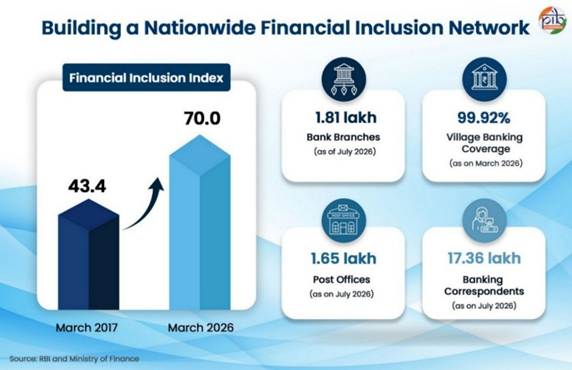
The RBI's FI Index measures the extent of financial inclusion across access, usage and quality of financial services. It serves as a comprehensive indicator of progress in expanding formal financial services nationwide. The FI Index increased from 43.4 in March 2017 to 70.0 in March 2026, reflecting broad-based improvements across all three dimensions.
The Global Findex Database is the world's leading source of data on financial inclusion. It measures how adults access and use financial services across economies. The Global Findex 2025 highlights India's remarkable progress in financial inclusion. Account ownership has reached 89% since 2011, reflecting significant gains in access to formal financial services and active account usage over the past decade.
Bank branches remain the foundation of India's formal banking system. They provide savings, credit and other financial services across the country. India has over 1.81 lakh bank branches (17 July 2026).
Banking access is delivered through branches, Business Correspondents and India Post Payments Bank (IPPB) outlets. As of 6 March 2026, 99.92% villages in the country are covered with banking outlets within a 5 km radius.
IPPB strengthens last-mile banking through over 1.65 lakh post offices (17 July, 2026). It serves more than 11 crore customers across 5.57 lakh villages and towns.
Business Correspondents extend doorstep banking services to unbanked and under-banked areas. India has over 17.36 lakh BC supporting doorstep banking services nationwide (17 July 2026).
Pillars of Financial Inclusion
India's financial inclusion ecosystem rests on interconnected policy and institutional pillars. They promote universal access and meaningful participation in the formal financial system.
Universal Banking
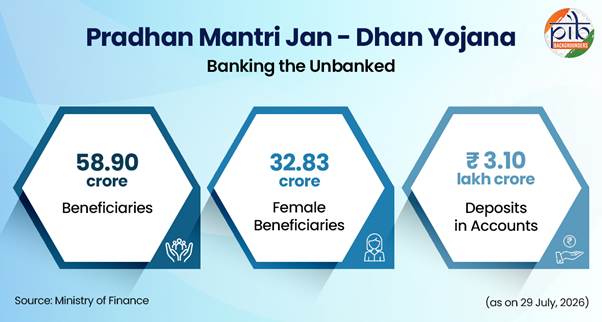
Pradhan Mantri Jan - Dhan Yojana (PMJDY)
- PMJDY (2014) provides every unbanked adult with a basic savings bank account where minimum balance needs to be maintained.
- It offers access to savings, remittances, credit, insurance, pension and Direct Benefit Transfer (DBT).
- PMJDY account holders are provided a RuPay Debit Card and accident insurance cover. The insurance cover is ₹2 lakh for accounts opened after 28 August 2018 and ₹1 lakh for accounts opened before that date. Eligible account holders can also avail an overdraft facility up to ₹10,000.
- It facilitates enrolment under Pradhan Mantri Jeevan Jyoti Bima Yojana (PMJJBY), Pradhan Mantri Suraksha Bima Yojana (PMSBY), Atal Pension Yojana (APY), and access to MUDRA loans.
- The JAM Trinity Integrates Jan Dhan accounts, Aadhaar and mobile connectivity to strengthen financial inclusion.
- It enables Direct Benefit Transfer (DBT) for transparent and efficient delivery of government benefits. DBT reduces leakages, eliminates fake beneficiaries and minimises intermediaries in welfare delivery.
- The JAM Trinity strengthens formal banking access and promotes trust in digital financial services.
|
Total Direct Benefit Transfer
|
No. of Schemes
|
No. of Ministries Involved
|
|
(as on 10 August, 2026)
|
|
₹ 52,89,019 Cr
|
320
|
56
|
Social Security for All
Pradhan Mantri Jeevan Jyoti Bima Yojana (PMJJBY)
- PMJJBY (2015) is an annual renewable life insurance scheme which offers a ₹2 lakh life cover for individuals aged 18–50 years.
- The scheme is available at an annual premium of ₹436, which is auto-debited from the subscriber's bank account.
- It provides financial security to families in the event of the insured person's death.
- The scheme provides immediate cover for accidental death and a 30-day waiting period for non-accidental death.
|
Gross Enrolments
|
No. of Claim Received
|
No. of Claims Disbursed
|
|
(as on 30 June 2026)
|
|
27.78 Cr
|
11,31,505
|
10,97,751
|
Pradhan Mantri Suraksha Bima Yojana (PMSBY)
- PMSBY (2015) is also an annual renewable accident insurance scheme for savings bank account holders aged 18–70 years.
- It provides ₹2 lakh cover for accidental death or full disability, and ₹1 lakh for partial disability.
- The insurance is available at an annual premium of ₹20 which is auto-debited from the linked bank account.
|
Gross Enrolments
|
No. of Claim Received
|
No. of Claims Disbursed
|
|
(as on 30 June 2026)
|
|
58.66 Cr
|
2,56,526
|
1,89,057
|
Atal Pension Yojana (APY)
- APY (2015) is a contributory pension scheme for workers in the unorganised sector, launched in 2015.
- It provides a guaranteed monthly pension ranging from ₹1,000 to ₹5,000 after attaining 60 years of age.
- The contributions are based on the subscriber's age at enrolment and the chosen pension amount.
- Enrolment under the scheme is facilitated through banks and post offices, expanding pension coverage among low-income workers.
|
Total Subscribers
|
Male Subscribers
|
Female Subscribers
|
Transgender Subscribers
|
|
(as on 30 June 2026)
|
|
9.29 crore
|
4.72 crore (50.8%)
|
4.56 crore (49.16%)
|
26,599 (0.028%)
|
Inclusive Credit
- PM Mudra Yojana (2015) provides collateral-free loans up to ₹20 lakh to non-corporate, non-farm micro and small enterprises across manufacturing, trading, services, and allied agricultural activities.
- Mudra loans are extended for a wide range of activities that promote income generation and employment creation.
- It offers four loan categories based on enterprise growth: Shishu, Kishor, Tarun and Tarun Plus.
|
No. of Loans Sanctioned
|
Amount Sanctioned
|
|
(as on 27 March, 2026)
|
|
57.79 crore
|
₹40.07 lakh crore
|
- PM SVANidhi is a first-of-its-kind micro-credit initiative focused on street vendors with government-backed credit guarantee support.
- It provides collateral-free loans in three progressive tranches of ₹15,000, ₹25,000 and ₹50,000.
- The scheme offers interest subsidy and credit guarantee support to eligible street vendors.
|
Total Beneficiaries
|
Loans Disbursed
|
Total Loan Value
|
|
(as on May 2026)
|
|
More than 75.5 lakh
|
Over 1.12 crore
|
More than ₹17,800 crore
|
- KCC provides timely and adequate credit to farmers through the banking system.
- It offers an ATM-enabled debit card, one-time documentation and flexible withdrawals.
- KCC provides credit for crop cultivation, post-harvest needs, marketing, farm maintenance, household expenses and allied activities.
|
Total number of KCC/ISS applications (as on 10 August 2026)
|
|
Commercial Bank
|
Rural Bank
|
Cooperative Bank
|
|
763.6 lakh
|
368.6 Lakh
|
1242.0 Lakh
|
- Jan Samarth is a unified digital platform for credit-linked government schemes.
- It connects beneficiaries directly with lenders, simplifying access to government-sponsored credit.
- The platform has 16 registered credit schemes, 8 loan categories and more than 300 lenders.
|
No. of Applications
|
Amount of Applications
|
|
(as on 1 June 2026)
|
|
54.10 lakh
|
₹ 3,00,951 crore
|
Digital Financial Inclusion
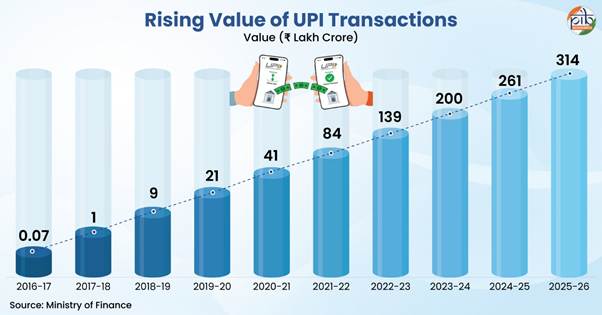
- UPI has emerged as the backbone of India's digital payments ecosystem, driving financial inclusion and digital transactions.
- The transaction volume increased nearly 12,000-fold and transaction value increased nearly 4,000-fold between FY 2016–17 and FY 2025–26.
- The IMF has recognised UPI as the world's largest real-time payment system by transaction volume, highlighting India's digital public infrastructure leadership.
|
Volume of Transactions
|
Value of Transactions
|
No. of Banks live on UPI
|
|
(as on July 2026)
|
|
2,365.8 crore
|
29,87,880.49 crore
|
741
|
Financial Literacy
National Centre for Financial Education (NCFE)
- The centre promotes financial education and awareness across all sections of society under the National Strategy for Financial Education.
- It conducts seminars, workshops, training programmes and awareness campaigns to strengthen financial literacy.
- It also develops targeted financial education materials covering financial markets and digital financial services
|
Workshops Conducted
|
Beneficiaries
|
Male
|
Female
|
|
(as on 10 August, 2026)
|
|
31,082
|
10,68,571
|
373,999 (35%)
|
694,572 (65%)
|
Financial Education Programme for Adults (FEPA)
- FEPA was launched in September 2019 by NCFE to promote financial awareness among adults.
- The programme covers farmers, women’s groups, ASHA and Anganwadi workers, SHGs, employees and skill development trainees.
- It focuses on Special Focused Districts (SFDs), aligned with the National Strategy for Financial Education.
|
Workshops Conducted
|
Beneficiaries Covered
|
|
(as on 10 August, 2026)
|
|
19,266
|
6,48,512
|
Nationwide Financial Inclusion Saturation Campaign
- The four-month campaign was launched on 1 July, 2025 to extend financial inclusion across 2.70 lakh Gram Panchayats and ULBs.
- More than 2.67 lakh camps were organised across villages and towns during the campaign.
- 5.19 crore KYC re-verifications, 1.20 crore nomination updates were completed and 92,066 claims were settled under PMJJBY/ PMSBY
|
PMJDY accounts Opened
|
PMJJBY Enrolments
|
PMSBY Enrolments
|
APY Enrolments
|
|
(as on 31st October 2025)
|
|
1.11 crore
|
1.40 crore
|
2.86 crore
|
44.43 lakh
|
From Access to Empowerment
India's financial inclusion journey has evolved from expanding account ownership to enabling meaningful financial participation. A strong network of banks, digital infrastructure and government schemes has widened access to formal financial services. PMJDY, JAM trinity, social security and inclusive credit have strengthened financial resilience across diverse sections of society. Digital payments and financial literacy are further enabling citizens to participate confidently in the formal financial system. Together, these initiatives are building a more accessible, resilient and inclusive financial ecosystem that supports inclusive growth.
References
Ministry of Finance
https://www.pib.gov.in/PressReleasePage.aspx?PRID=2293812®=48&lang=1&noshow=1
https://www.pib.gov.in/PressReleasePage.aspx?PRID=2246857®=48&lang=2
https://www.pib.gov.in/PressReleasePage.aspx?PRID=2293812®=48&lang=1&noshow=1
https://pmjdy.gov.in/scheme
https://pmjdy.gov.in/account
https://dbtbharat.gov.in/
https://dfs.dashboard.nic.in/DashboardF.aspx
https://www.jansamarth.in/home
https://www.pib.gov.in/PressReleasePage.aspx?PRID=2188526®=48&lang=2
https://www.pib.gov.in/PressReleasePage.aspx?PRID=2257087®=3&lang=1
NPCI
https://www.npci.org.in/product/upi/product-statistics
Ministry of Communications
https://www.pib.gov.in/PressReleasePage.aspx?PRID=2138023®=48&lang=2
Ministry of Road Transport & Highways
https://www.pib.gov.in/PressReleasePage.aspx?PRID=2086611®=48&lang=2
Ministry of Agriculture and Farmers Welfare
https://fasalrin.gov.in/
Ministry of Electronics and Information Technology
https://socialwelfare.vikaspedia.in/viewcontent/social-welfare/financial-inclusion/financial-literacy/national-centre-for-financial-education-ncfe?lgn=en
World Bank
https://www.worldbank.org/en/publication/globalfindex
PIB Backgrounders
https://www.pib.gov.in/PressNoteDetails.aspx?ModuleId=3&NoteId=154980&lang=1®=3
https://www.pib.gov.in/FactsheetDetails.aspx?Id=149258®=48&lang=2
https://www.pib.gov.in/PressNoteDetails.aspx?NoteId=158149&ModuleId=2®=20&lang=8
https://www.pib.gov.in/PressNoteDetails.aspx?id=158322&NoteId=158322&ModuleId=3®=3&lang=1
https://www.pib.gov.in/PressReleasePage.aspx?PRID=2266920®=3&lang=1
https://www.pib.gov.in/PressReleasePage.aspx?PRID=2285236®=3&lang=1
https://www.pib.gov.in/PressNoteDetails.aspx?NoteId=158466&ModuleId=3®=3&lang=2
https://www.pib.gov.in/PressNoteDetails.aspx?NoteId=158056&ModuleId=3®=3&lang=2
https://www.pib.gov.in/PressReleasePage.aspx?PRID=2269253®=3&lang=1
Others
https://newsonair.gov.in/countrys-improvised-financial-inclusion-index-shows-continued-progress-in-financial-services-rbi/
Financial Literacy App by NCFE
https://ncfe.org.in/
Financial Inclusion in India: Banking Every Citizen, Empowering Every Household
*****
PIB Research
(तथ्य सामग्री आईडी: 150832)
आगंतुक पटल : 1272
Provide suggestions / comments