Posted On:
02 NOV 2026 4:37PM by PIB Delhi
Astronomers have divulged the mystery behind the changing X-ray behaviour of NGC 4490 ULX-8, one of the brightest X-Ray emitters located in a nearby galaxy, by tracking X-Ray observations over a 24-year period. This can help in understanding the compact objects that power the ULXs and also track the growth of these objects in such extreme environments.
Ultraluminous X-ray sources (ULXs) are among the brightest X-ray emitters in nearby galaxies, apart from the emission from supermassive black holes in their centres. ULXs are thought to host either neutron stars or black holes that draw in matter from a companion star. As this material falls inward, it heats up and emits intense X-rays. ULXs appear to shine more brightly than expected from the maximum luminosity predicted by a simple balance between gravity pulling matter inward and radiation pushing it outward. This limit, known as the Eddington limit, is often used as a benchmark for how bright an accreting object can be.
Determining the nature of the compact object powering a ULX is crucial for understanding the physics of super-Eddington accretion, powerful outflows of gas, and the growth of compact objects in such extreme environments.
A research team from Indian Institute of Astrophysics ((IIA), the Raman Research Institute, both autonomous institutes of the Department of Science and Technology (DST) along with other institutions discovered long-term spectral changes that point to evolving accretion conditions around the compact object.
The results provide strong evidence that ULX-8 is powered by a black hole accreting matter at rates exceeding the classical Eddington limit. The work demonstrates the value of long-term multi-mission monitoring in uncovering the nature of some of the Universe's brightest X-ray sources.
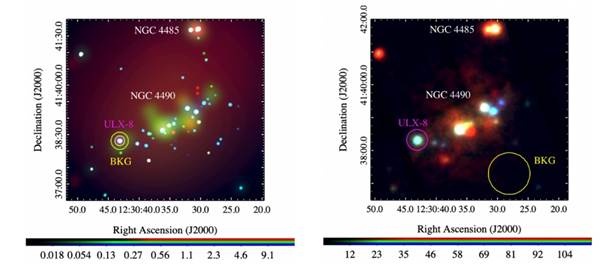
Fig: False-colour X-ray images of NGC 4490/85. Left: Image created from Chandra observations. Right: Image created from EPIC-pn and MOS1/2 observations with XMM-Newton.
“We analysed archival and recent observations of ULX-8 in the interacting galaxy pair NGC 4490/4485, obtained with Chandra, XMM-Newton, and Swift space-based X-ray telescopes between 2000 and 2024, enabling one of the longest X-ray studies of this source to date”, explained Aru Beri, a faculty member at IIA and a co-author of the study.
The study revealed that ULX-8 remained an exceptionally luminous X-ray source throughout the 24-year observing period, while its brightness varied substantially over time. Despite these changes, the source showed no evidence for the dramatic transitions between different accretion states that are commonly observed in many black hole X-ray binaries.
Instead, the X-ray emission retained characteristics consistent with a persistently active ultraluminous accretion flow. The results suggest that ULX-8 is most likely powered by a stellar-mass black hole accreting matter at or near the Eddington limit, providing an important laboratory for studying how compact objects can sustain extreme rates of mass accretion and generate enormous amounts of energy.
Future observatories such as European Space Agency's (ESA) NewAthena mission and India's proposed next-generation timing and spectroscopy mission XSat will provide improved sensitivity and monitoring capabilities for studying ULXs. Continued long-term observations will help reveal how these extreme systems evolve and offer deeper insights into the physics of super-Eddington accretion and the nature of some of the brightest X-ray sources in the nearby Universe.
The study which was authored by Tarang Vashisht (a student at IISER Mohali), Aru Beri (Indian Institute of Astrophysics), and researchers from IUCAA and Raman Research Institute, was published in the Monthly Notices of the Royal Astronomical Journal.
Publication link: https://academic.oup.com/mnras/article/549/3/stag976/8691580?login=false
***
NKR/FT/AA