PIB Backgrounder
‘Whole-of-Industry’ approach to drive India’s Electronics and Semiconductor ambitions
Posted On:
23 SEP 2026 11:42AM by PIB Delhi
India’s electronics and semiconductor sector is entering an exciting new chapter. With major investments flowing in, manufacturing capacities expanding, and global companies increasing their presence, the ecosystem is growing at an unprecedented pace. As the industry scales up, leaders are increasingly advocating for a stronger, more coordinated approach among industry bodies to transform individual strengths into a collective national capability.
A key message emerging from industry leaders is that the next stage of growth cannot be driven by any single segment alone. Semiconductors, electronics manufacturing, components, materials, design, packaging and end-use applications are becoming increasingly interdependent. Success, therefore, will depend not only on technological capabilities and infrastructure but also on the industry’s ability to work together.
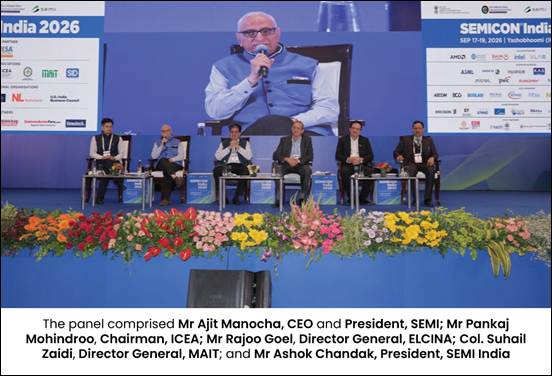
This spirit of collaboration was at the heart of the panel discussion, “Industry Associations Advancing India’s National Agenda,” held during SEMICON India 2026. Moderated by Shri Amitesh Kumar Sinha, CEO, India Semiconductor Mission (ISM) the session brought together senior representatives from leading industry associations to discuss how deeper collaboration can help accelerate India's semiconductor and electronics ambitions.
The discussion reflected a growing consensus that the industry must move towards a more coordinated, “whole-of-industry” approach. Participants noted that while individual associations represent different segments of the ecosystem, they are ultimately working towards a common objective: building a globally competitive electronics and semiconductor sector in India.
A recurring theme during the discussion was the increasing convergence across technology sectors. Chips today derive value not in isolation but through their integration into devices, products and systems. Advances in fabrication rely on supporting materials and equipment, while manufacturing depends on packaging, testing and broader electronics capabilities. This interconnected nature of the industry calls for stronger linkages and more structured collaboration across the value chain.
Another area of discussion was the need to sustain engagement beyond individual conferences and events. Industry leaders explored the idea of creating a more permanent community mechanism that can facilitate continuous dialogue, encourage coordination among associations and help drive collective action on matters of national importance.
The proposal is not about replacing the specialised role of existing associations. Instead, it seeks to build on their strengths by providing a common platform where they can collaborate on issues that cut across sectors and value chains. As India's ambitions evolve from establishing manufacturing facilities to building a comprehensive semiconductor ecosystem, such institutional collaboration is increasingly being seen as a strategic necessity.
The discussion reinforced the broader “Silicon to Systems” vision, where design, manufacturing, packaging, electronics and technology solutions work in tandem to create a stronger and more resilient ecosystem. As India advances its semiconductor ambitions, industry leaders indicate that collaboration may prove to be just as important as capital investments and infrastructure development in shaping the next phase of growth.
Supporting this momentum, SEMICON India 2026 brought together more than 600 exhibitors, including nearly 300 international companies, showcasing the growing global interest in India's semiconductor and electronics ecosystem. The event also witnessed 56 MoUs, strategic initiatives and industry announcements across manufacturing, design, packaging, AI, R&D, logistics and skilling.
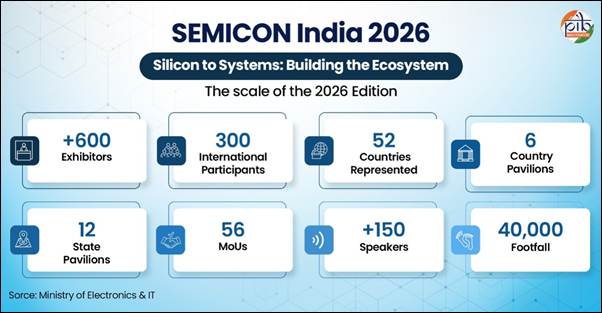
Government support continues to play a significant role in this transformation. Through initiatives such as the Production Linked Incentive (PLI) schemes and the India Semiconductor Mission, efforts are underway to strengthen domestic capabilities and build a robust manufacturing ecosystem. The Government has approved 12 semiconductor projects under the Semicon India programme, with five commercial semiconductor units already operational as of September 2026
Together, these developments underline a broader reality: India's semiconductor story is no longer just about building factories. It is increasingly about building connections across industries, institutions and technologies, with collaboration emerging as the foundation of the country's next phase of electronics and semiconductor growth.
Click to see pdf
***
PIB Research
(Release ID: 2313743)
Visitor Counter : 330