Ministry of Fisheries, Animal Husbandry & Dairying
Union Minister, Shri Rajiv Ranjan Singh and Shri Suvendu Adhikari, Hon'ble Chief Minister, West Bengal Co-Chaired Review meeting on implementation of Schemes and Programmes for development of fisheries and aquaculture in West Bengal
Focus on charting Roadmap for Sustainable Growth of the Fisheries Sector by Enhancing Production, Strengthening Market Linkages and Fisheries Value Chain Development
Posted On:
21 SEP 2026 6:01PM by PIB Delhi
The Department of Fisheries, Government of India organized a Review Meeting on Development of Fisheries and Aquaculture in West Bengal on 21st September 2026 in Kolkata, West Bengal co-chaired by Shri Rajiv Ranjan Singh, Hon’ble Union Minister for Fisheries, Animal Husbandry & Dairying and Panchayati Raj and Shri Suvendu Adhikari, Hon'ble Chief Minister, West Bengal. After more than a decade, a high-level fisheries review meeting was organized to chart a roadmap for realizing the untapped fisheries potential of West Bengal.
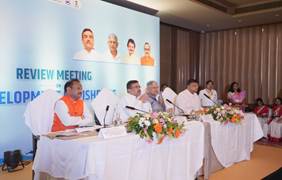
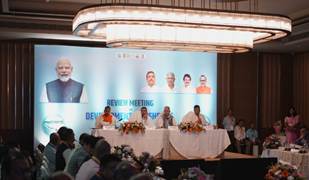
The review meeting was held in the gracious presence of Shri Rajesh Mahata, Hon'ble Minister of State (Independent Charge) Department of Fisheries & Department of Animal Resources Development, Government of West Bengal, Shri Manoj Kumar Agarwal, Hon’ble Chief Secretary, Government of West Bengal. The meeting also witnessed participation from officials from Department of Fisheries, GoI, West Bengal state fisheries department, National Fisheries Development Board (NFDB), ICAR institutes, National Bureau of Fish Genetic Resources (NBFGR), CIFE, National Bank of Agriculture and Rural Development (NABARD), National Cooperative Development Corporation (NCDC), Indian Coast Guard, Coastal Aquaculture Authority (CAA), Export Inspection Council (EIC) and Marine Products Export Development Authority (MPEDA).
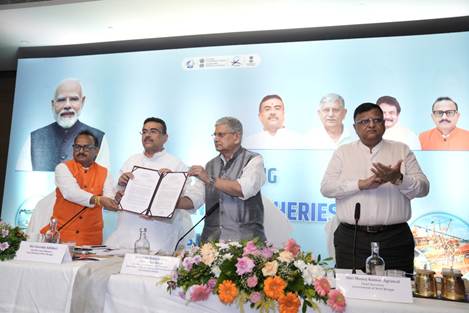
Shri Rajiv Ranjan Singh, Hon’ble Union Minister for Fisheries, Animal Husbandry & Dairying and Panchayati Raj handed over the administrative approval for development of 6 Reservoirs at a cost of Rs. 832.50 lakh with central share of Rs. 499.50 lakh to Shri Suvendu Adhikari, Hon'ble Chief Minister, West Bengal.
The Union Minister highlighted West Bengal's vast untapped fisheries potential and stated that, despite being the second-largest fish-producing State, it has significant scope to increase productivity, aquaculture, exports and value addition. He noted that the State currently exports fisheries products worth about ₹5,000 crore but has the potential to increase this to ₹15,000–20,000 crore through expansion of aquaculture, He noted that Sundarbans has immense potential for aquaculture-led export growth particularly through high-value species such as black tiger shrimp, mud crab, hilsa and ornamental fish, and development of export-oriented infrastructure. Referring to the national growth of the sector, he stated that India's fish production has increased from 95.7 lakh tonnes in 2014 to 197.75 lakh tonnes, while fisheries exports have more than doubled to ₹73,890 crore. He emphasized the need to strengthen seed quality, feed, disease management, cold chain infrastructure, fishing harbours, fish landing centres and deep-sea fishing capabilities under the upcoming PMMSY 2.0 and assured the Government of India's full support in enhancing production, productivity and exports from West Bengal.
Shri Suvendu Adhikari, Chief Minister, West Bengal underscored the State's commitment to working closely with the Government of India to unlock the immense potential of the fisheries sector, particularly in North 24 Parganas, South 24 Parganas and the Sundarbans region. He highlighted the importance of flagship initiatives such as PMMSY, the National Fisheries Digital Platform (NFDP) and PM-MKSSY in strengthening fisheries development and improving the welfare of fishers. Stressing the need for enhanced safety and security of fishermen operating in deep-sea waters, he called for greater focus on communication systems, wireless connectivity, control room infrastructure and emergency response mechanisms. He also emphasized the importance of improving fishing harbours, cold-chain infrastructure, supply chains and coastal village development under initiatives such as Sagarmala, while assuring full cooperation between the State and Central Governments for effective implementation of fisheries schemes and maximizing benefits for the nearly 50 lakh people dependent on the sector.
Shri Rajesh Mahata, Hon'ble Minister of State (Independent Charge) Department of Fisheries & Department of Animal Resources Development, Government of West Bengal, highlighted that the State recorded a fish production of 25.43 lakh metric tonnes in 2025-26, making it the second-largest fish-producing State in the country, while also retaining its position as the leading fish seed producer. He emphasized the need to improve productivity, quality and efficiency through better seed, feed, farm management and disease control, while strengthening traceability and regulatory compliance to support exports. He noted that under PMMSY, fisheries interventions worth ₹102.23 crore of Central share and ₹66.48 crore of State share have been mobilized in the State. Stressing the importance of registration on the National Fisheries Digital Platform, cold-chain infrastructure, value addition, market linkages and fisher safety, he called for greater adoption of science and technology and reaffirmed the State Government's commitment to working closely with the Government of India and research institutions for sustainable growth of the fisheries sector.
Shri Manoj Kumar Agarwal, Hon’ble Chief Secretary, Government of West Bengal highlighted the immense untapped potential of the fisheries sector in West Bengal, observing that only a fraction of the State's potential has been harnessed so far. He emphasized the need for closer coordination between the Central and State Governments, accelerated implementation of fisheries schemes, and greater participation of fish farmers through initiatives such as the National Fisheries Digital Platform. Stressing the importance of timely execution of projects, preparation of a robust pipeline of proposals, adoption of best practices, and focused capacity building, he called for sustained institutional collaboration to maximize investments and deliver tangible outcomes for the growth of the fisheries sector and the livelihoods dependent on it.
Shri Shubhanjan Das, Secretary, Department of Fisheries, Government of West Bengal, highlighted that the fisheries sector supports the livelihoods of nearly 32 lakh people in the State. He informed that implementation of long-pending PMMSY projects, including the upgradation of fishing harbours at Fraserganj, Kakdwip, Shankarpur and Petuaghat, has been expedited and sought continued support under PMMSY Phase-II. He also outlined initiatives to expand fisher registration through the National Fisheries Digital Platform, develop reservoir fisheries in Bankura and Purulia, promote modern technologies such as biofloc, cage culture and soft-shell crab farming, and strengthen mariculture, export facilitation, aquaculture regulation and maritime safety.
Dr. Surabhi Rai, Joint Secretary (Marine), Department of Fisheries, Ministry of Fisheries, Animal Husbandry and Dairying, presented an overview of the Department’s schemes and programmes and reviewed their implementation in West Bengal. She highlighted the State’s potential in ornamental fisheries and high-value species, while emphasizing traceability, deep-sea fishing through vessel modernization, promotion of crab culture in the Sundarbans, strengthening post-harvest infrastructure, formation of FFPOs and cooperatives, and greater focus on training, certified seed, quarantine facilities and targeted outreach of fisheries schemes.
Representatives from leading fisheries institutions highlighted a range of interventions to accelerate fisheries development in West Bengal. The Coastal Aquaculture Authority assured support for expediting farm registrations and strengthening export compliance, while ICAR-CIFA emphasized improving seed quality through broodstock management and hatchery certification, promoting indigenous ornamental fish species, and expanding culture of commercially important species to reduce imports. ICAR-CIBA highlighted the vast potential of brackish water aquaculture through diversification into mud crab, seabass, black tiger shrimp and cage culture, while ICAR-CMFRI stressed sustainable marine fisheries management, conservation of fish stocks, and promotion of mariculture, seaweed cultivation and marine ornamental fisheries. ICAR-CIFRI proposed structured training programmes for fish farmers, the Central Institute of Coldwater Fisheries Research highlighted opportunities for rainbow trout farming in Darjeeling and Kalimpong, and ICAR-NBFGR emphasized genetic resource conservation, broodstock improvement, biosecurity and disease surveillance. The institutions collectively assured scientific, technical and capacity-building support to enhance productivity, sustainability and fisheries-based livelihoods in the State.
The review meeting underscored the importance of sustained cooperation between the Government of India, the Government of West Bengal and allied institutions for accelerating the growth of the fisheries and aquaculture sector in the State. The deliberations provided a clear framework for focused action on productivity enhancement, infrastructure development, technology adoption, capacity building and improved service delivery, with a view to strengthening livelihoods and realizing the full potential of the sector in West Bengal.
************
JP
(Release ID: 2313120)
Visitor Counter : 212